Psych 101- 12 Elicited Behavior
 Call Kai
 Learn
 Practice Test
 Spaced Repetition
 Match
 Flashcards
 Knowt Play
1/14

There's no tags or description
Looks like no tags are added yet.
15 Terms
Learning
a process by which experiences change our behavior
Features of learning:
changes are relatively enduring
changes are in potential for behavior
changes are not due to maturation, motivation, or fatigue
Unconditioned Behavior
behaviors that do not require the learning of an association
reflexes
fixed action patterns
habituation
sensitization
Conditioned Behaviors
Behaviors that require learning an association between two or more events
Classical (pavlovian) conditioning
Operant (instrumental) conditioning
Elicited Behavior
Behavior that is elicited (caused) by a stimulus or event
Emitted Behavior
Behavior that is selected, shaped, and maintained by a stimulus or event
Reflexes
A behavioral response functionally linked to a stimulus, the simplest form of elicited behavior. Sensory motor to motor neuron
Fixed Action Patterns
A sequence of elicited behaviors in which each response produces the stimulus that elicits the next response
species-specific
invariable; all or none
Habituation
a decrease in strength of a response when a stimulus is presented repeatedly, begins when the stimulus is benign.
stimulus specific
adaptive function
dishabituation
Sensitization
an increase in strength of a response when a stimulus is presented repeatedly, occurs when a stimulus is noxious
Generalized: often enhances response to a variety of stimuli
Emotionally charged: often occurs with pain, fear, or trauma
Ivan Pavlov
Dogs and digestion experiment, classical conditioning
Classical Conditioning
unconditioned stimulus
unconditioned response
conditioned stimulus
conditioned response
Acquired and losing a conditioned response
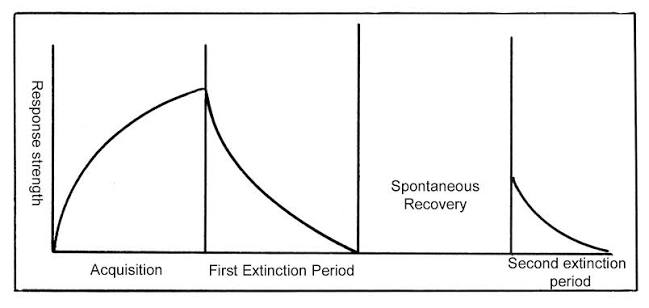
Stimulus Generalization
If stimulus is similar to original stimulus will cause generalization of conditioned response
Stimulus Discrimination
If the stimulus is entirely different, it will be discriminated against/not reactive
John Watson- Behaviorism
Believed psychology should be focused on observable behaviors
classical conditioning with complex behavior