Exchange & Transport of Gases
 Call Kai
 Learn
 Practice Test
 Spaced Repetition
 Match
 Flashcards
 Knowt Play
1/33

There's no tags or description
Looks like no tags are added yet.
34 Terms

What is the difference between pulmonary and alveolar ventilation?
Pulmonary: Exchange of gases between the atmosphere & the lungs (breathing)
Alveolar: Exchange of gases within the alveoli

The flow of blood in adjacent pulmonary capillaries (to alveoli to exchange gases) is known as
perfusion
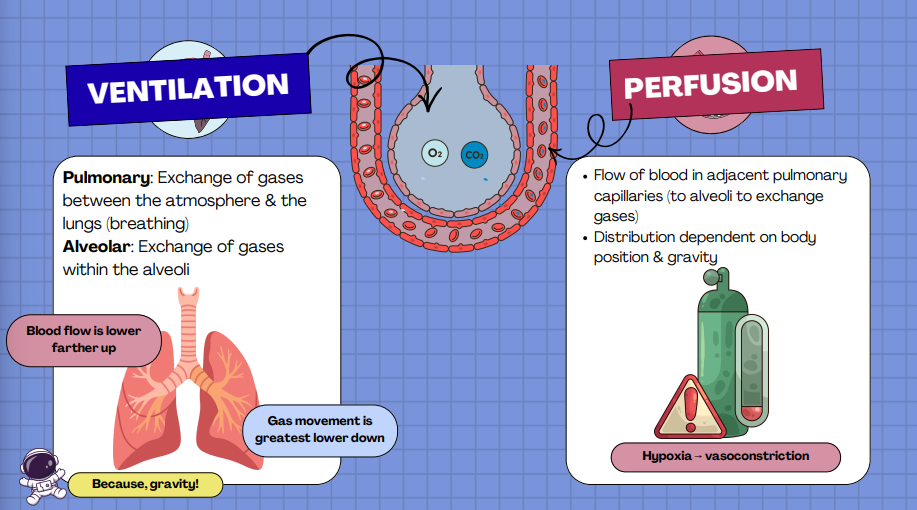
Why is blood flow lower farther up the lungs?
Gravity

Why is gas movement the greatest lower down in the lungs?
Gravity, air rises, blood settles due to gravity.
What ratio is the relationship between ventilation and perfusion?
V/Q Ratio
What is a normal V/Q Ratio?
0.8 ratio, 4L/5L and perfusion > ventilation
A patient presents with 0.5 V/Q. Is this high or low V/Q?
Low, less than 0.8
A patient presents with 1.4 V/Q. Is this high or low V/Q?
High V/Q, more than 0.8

Explain a low V/Q.
A low V/Q = low fraction = low number = numerator decreases = ventilation is inadequate = shunting

Explain a high V/Q.
A high V/Q = high number = lower denominator = lower perfusion = inadequate perfusion = deadspace
T/F: The bottom of the lungs receive more blood than the top.
T
A low V/Q ratio can result from what respiratory diseases?
Atelectasis, asthma, pulmonary edema, and especially PNA!!!
Pneumonia = fluid in lungs = poor ventilation
A high V/Q ratio can result from what respiratory diseases?
PE, HF, CV disease
How can you remember that high V/Q (deadspace) leads to pulmonary embolism?
DeadSPEACE
What is the most common cause of hypoxemia?
Abnormal V/Q
The movement of gases across the alveolar-capillary membrane is known as
diffusion

What is the affinity of Hgb to O2 affected by?
CO2 in the blood
pH
Temp
2,3-DPG (by-product of glycolysis in RBCs)
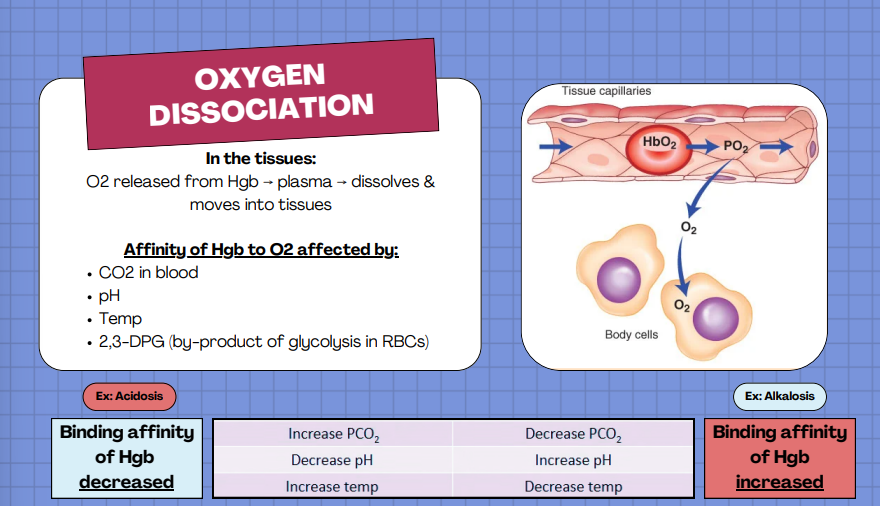
Explain the path of O2 dissociation.
O2 released from Hgb —> plasma —> dissolves & moves into tissues

In what acid-base state is the binding affinity of Hgb decreased?
Acidosis because in those states, we are in a hypermetabolic state where we need more O2. Therefore, Hgb has less O2 affinity because it holds onto O2 more loosely in case we need more O2 to be dissociated in tissue.

In what acid-base state is the binding affinity of Hgb increased?
Alkalosis because cells are not as active, so Hgb will hold onto the O2 when the tissues don’t need it.

Where is the respiratory center located?
In the brain stem.

The regulation of breathing occurs in the
brainstem

T/F: Breathing cannot be both automatic and voluntary.
F, breathing can absolutely do both, and voluntary = integrating breathing with voluntary acts like speaking and singing.

Which receptors in the brainstem monitor blood O2, CO2, and pH to adjust ventiation for metabolic needs?
Chemoreceptors

Chemoreceptors in the brainstem monitor what?
blood O2, CO2, and pH to adjust ventiation for metabolic needs

Which receptors in the brainstem monitor breathing patterns & lung function?
Lung receptors
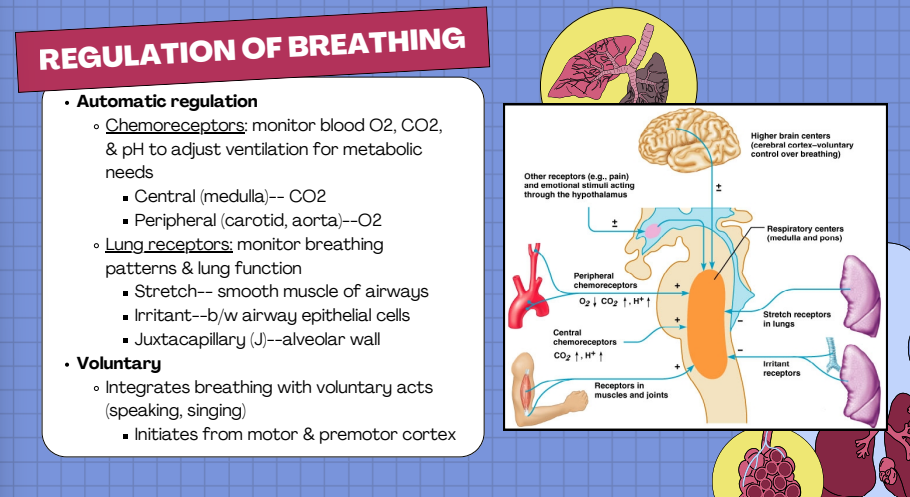
Lung receptors in the brainstem monitor what?
monitor breathing patterns & lung function

There are two types of chemoreceptors, central and peripheral. What is the difference?
Central (medulla): CO2 monitoring
Peripheral (carotid, aorta): O2 monitoring
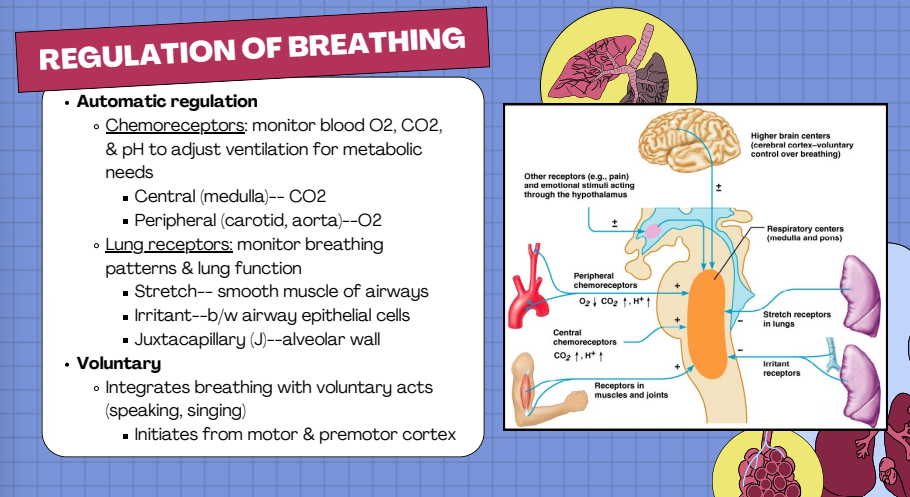
There are 3 types of lung receptors, stretch, irritant, and juxtacapillary. WHat is the difference in what they control?
Stretch — smooth muscle of airways
Irritant — between airway epithelial cells
Juxtacapillary — alveolar wall
T/F: The cough reflex is not protective.
F, the cough reflex is a protective neural reflex to prevent accumulation of secretions, entry of hazardous substances.
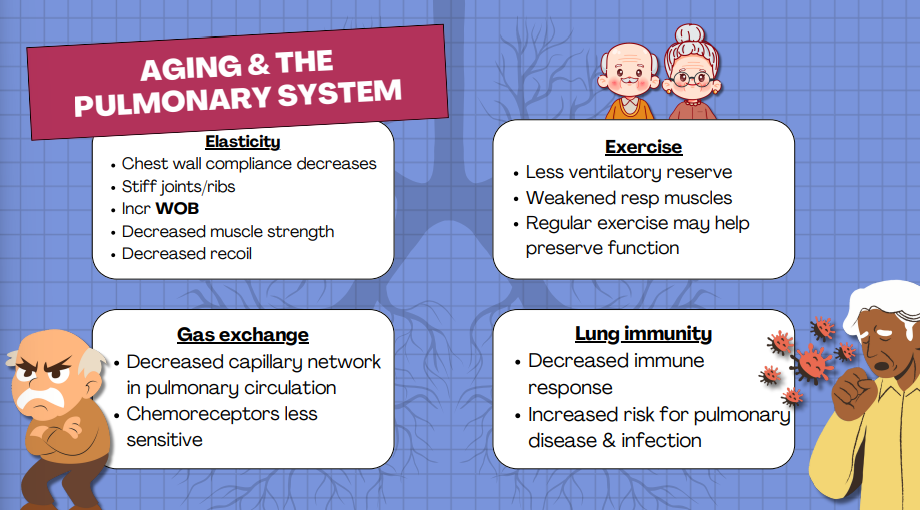
What demographic is at risk for increased work of breathing, less elasticity, reduced gas exchange, decreased immune response, and weakened respiratory muscles?
Older Adults
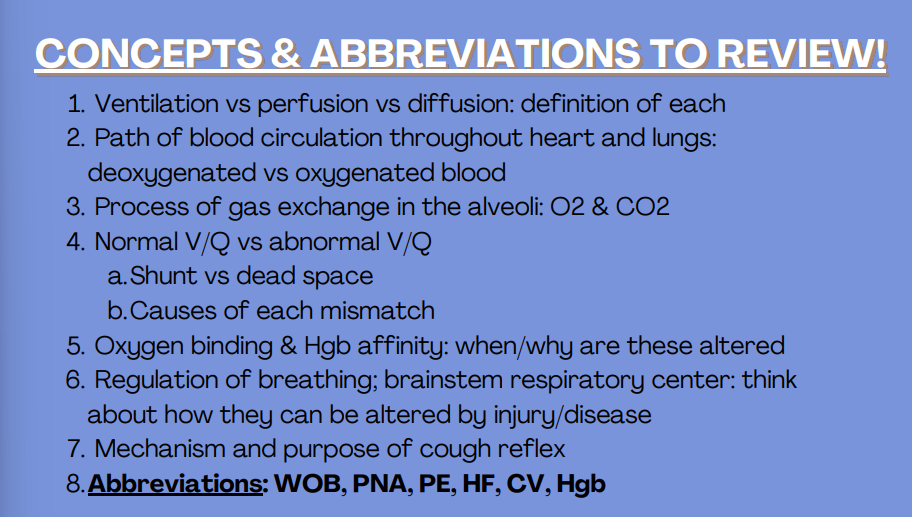
concepts to review
okay
What nerve controls the diaphragm?
Phrenic nerve
T/F: The brain is highly sensitive to changes in CO2.
T