APBIO U1 — FRQs
 Call Kai
 Learn
 Practice Test
 Spaced Repetition
 Match
 Flashcards
 Knowt Play
1/38

There's no tags or description
Looks like no tags are added yet.
Name | Mastery | Learn | Test | Matching | Spaced | Call with Kai | Chat |
|---|
No analytics yet
Send a link to your students to track their progress
39 Terms
Describe the role of water in the hydrolysis of ATP.
Water is added during the process to cleave or split a phosphate group from the ATP molecule. This reaction breaks the covalent bond, releasing the energy stored within the bond
Explain the orientation of amino acids in a folded protein resuspended in water, specifically regarding polar vs. nonpolar R groups.
Polar R groups are hydrophilic and orient toward the surface of the protein to form hydrogen bonds with the surrounding water molecules. Nonpolar R groups are hydrophobic and are pushed into the interior (middle) of the protein to minimize contact with water
Describe the chemical process by which double-strand breaks occur along the DNA backbone.
The breaks occur through enzymatic hydrolysis. During this process, a water molecule is added to break the covalent bonds (specifically phosphodiester linkages) that connect the sugars and phosphates within the backbone.
Identify the atoms and types of bonds found in a glucose molecule.
A glucose molecule is composed of carbon, hydrogen, and oxygen atoms (C, H, and O). These atoms are held together by covalent bonds.
You are performing an experiment involving the hydrolysis of an amylose starch polymer consisting of 300 glucose monomers. Determine how many water molecules are required for complete hydrolysis.
To completely hydrolyze a polymer of 300 monomers, 299 water molecules are required. One water molecule is needed to break the bond between each pair of adjacent monomers.
Explain the molecular cause of Sickle Cell Disease in terms of protein structure and R-group interactions.
A mutation replaces glutamic acid (hydrophilic) with valine (nonpolar/hydrophobic). When blood is deoxygenated, these mutated hemoglobin proteins form hydrophobic bonds with one another to hide the nonpolar valine from water, resulting in the formation of fibers that deform the red blood cells
Explain how hydrogen bonding contributes to the high specific heat of water and why this is vital for life.
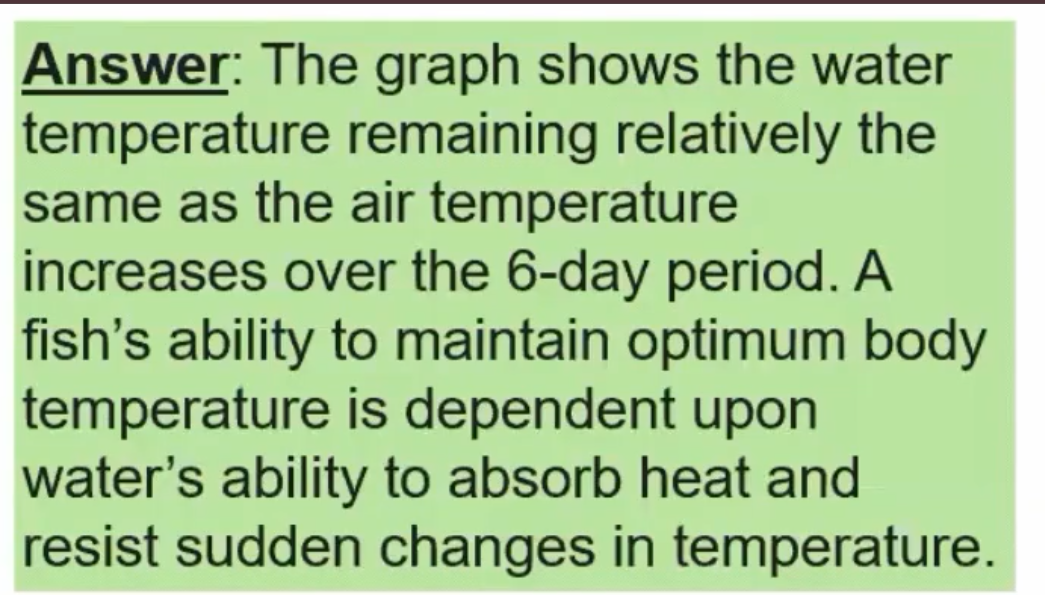
Water resists temperature changes because a large amount of energy is required to first break the hydrogen bonds between molecules before the water molecules can move faster (increasing temperature). This property helps organisms maintain homeostasis by stabilizing body temperatures.
Compare the structural differences between DNA and RNA nucleotides.
DNA contains a deoxyribose sugar and the nitrogenous base thymine, whereas RNA contains a ribose sugar and the nitrogenous base uracil. Both share a phosphate group and the bases adenine, cytosine, and guanine.
Describe the four levels of protein structure, including the bonds responsible for each.
Primary: Sequence of amino acids held by peptide bonds
Secondary: Alpha-helices and beta-sheets formed by hydrogen bonds between the polypeptide backbone
Tertiary: Final 3D shape formed by R-group interactions (H-bonds, hydrophobic interactions, ionic bonds, or disulfide bridges)
Quaternary: Interactions between multiple polypeptide chains
Explain how cohesion, adhesion, and surface tension result from hydrogen bonding.
Cohesion occurs when water molecules form H-bonds with other water molecules. Adhesion occurs when water forms H-bonds with other polar surfaces. Surface tension is the collective force of H-bonds at the surface of water that resists external pressure. These properties combined allow for transpiration in plants

1.1 Video Question

1.1 — Question #1
A.) The carbohydrates have the same properties because they have the same number of carbon, hydrogen, and oxygen atoms.
B.) The carbohydrates have the same properties because they each have a single carbon-oxygen double bond.
C.) The carbohydrates have different properties because they have different arrangements of carbon, hydrogen, and oxygen atoms.
D.) The carbohydrates have different properties because they have different numbers of carbon-carbon bonds.
C.)
Correct. Compounds that have the same chemical formula but different structural formulas usually have different properties.
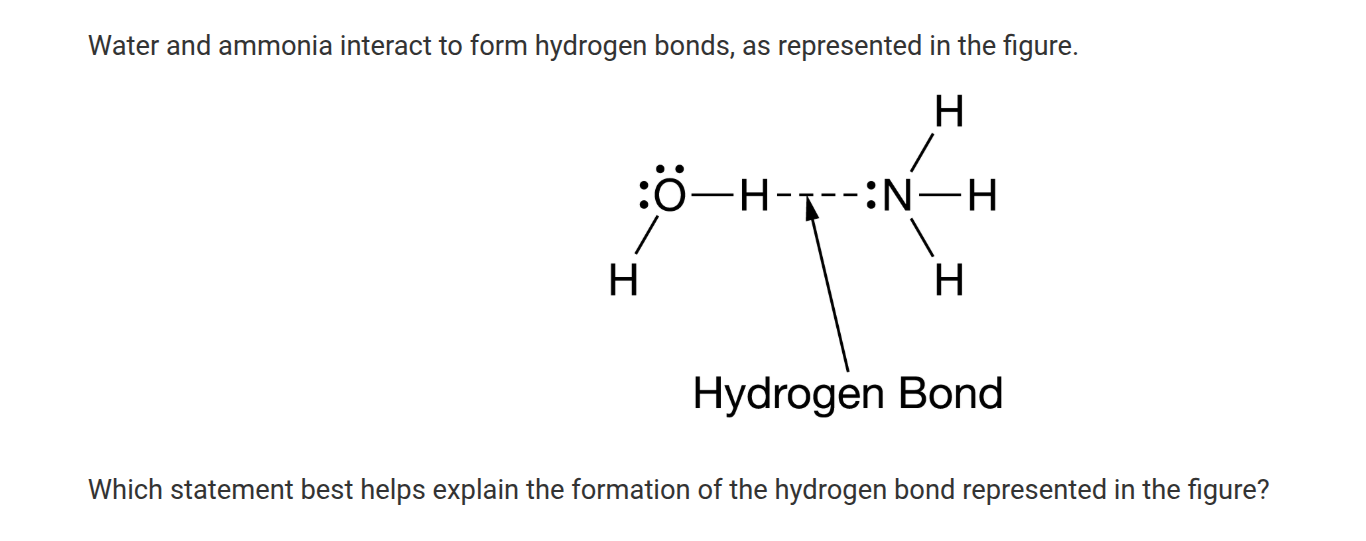
1.1 — Question #2
A.) The oxygen has a partial positive charge, and the nitrogen has a partial negative charge.
B.) The nitrogen has a partial negative charge, and the hydrogen attached to the oxygen has a partial positive charge.
C.) The nitrogen has a partial negative charge, and the hydrogen attached to the oxygen has a partial positive charge.
D.) The nitrogen has a partial negative charge, and the hydrogen attached to the oxygen has a partial positive charge.
B.)
Correct. The greater electronegativity of oxygen and nitrogen compared with hydrogen makes for unequal sharing of electrons, which results in partial negative charges associated with the oxygen and nitrogen atoms and partial positive charges associated with the hydrogen atoms in both molecules. The attraction between opposite charges results in the formation of the hydrogen bond represented in the figure.

1.1 — Question 3
A.) Covalent bonds between water molecules and the air above provide cohesion, which causes tiny bubbles to form under the feet of the insect.
B.) Ionic bonds between molecules at the surface of the water provide an electric charge, which attracts the feet of the insect, keeping it on the surface.
C.) Polar covalent bonds between molecules at the surface of the water provide adhesion, which supports the weight of the insect.
D.) Hydrogen bonds between molecules at the surface of the water provide surface tension, which allows the water surface to deform but not break under the insect.
D.)
Correct. Hydrogen bonds form between water molecules due to the partial charges produced as a result of the polarity of the water molecule. The strength of the attraction between the water molecules allows organisms to walk across the surface without breaking the hydrogen bonds.
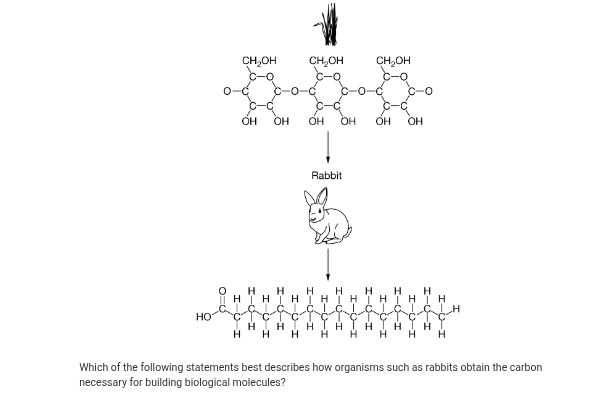
1.2 — Question #1
A.) Rabbits eat plants and use energy absorbed from the plants to make carbon atoms from electrons, protons, and neutrons in the air.
B.) Rabbits eat plants and break down plant molecules to obtain carbon and other atoms that they rearrange into new carbon-containing molecules.
C.) Rabbits eat plants and use water absorbed from the plants to hydrolyze CO2, which the rabbits breathe in from the air and use as a carbon source.
D.) Rabbits eat plants and make carbon-containing molecules by using carbon atoms that the plants absorbed from the soil and stored in the cells of their leaves.
Answer B
Correct. Rabbits break down the plant molecules to obtain the individual atoms or small molecules that can be built into larger, complex biological molecules.

1.2 — Question #2
A.) The carbon dioxide molecules released by the fish are converted by the bacteria to oxygen atoms, which are used by the plants to make water molecules.
B.) The oxygen molecules released by the fish are converted by the bacteria to ammonia molecules, which are used by the plants to make lipids and fatty acids.
C.) The nitrites released by the fish are converted by the bacteria to carbon dioxide molecules, which are used by the plants to make carbohydrates.
D.) The ammonia molecules released by the fish are converted by the bacteria to nitrates, which are used by the plants to make proteins and nucleic acids.
Answer D
Correct. As shown in the figure, the ammonia molecules released by the fish are converted by the bacteria to nitrites and nitrates. The plants absorb the nitrates, which are nitrogen-containing nutrients that the plants use to make the amino acids and nucleotides needed for building proteins and nucleic acids.

1.2 — Question #3
Correct. Sawdust will not provide sufficient amounts of nitrogen and phosphorus, resulting in the seedlings having a reduced ability to produce both of the monomers shown (amino acids and nucleotides).

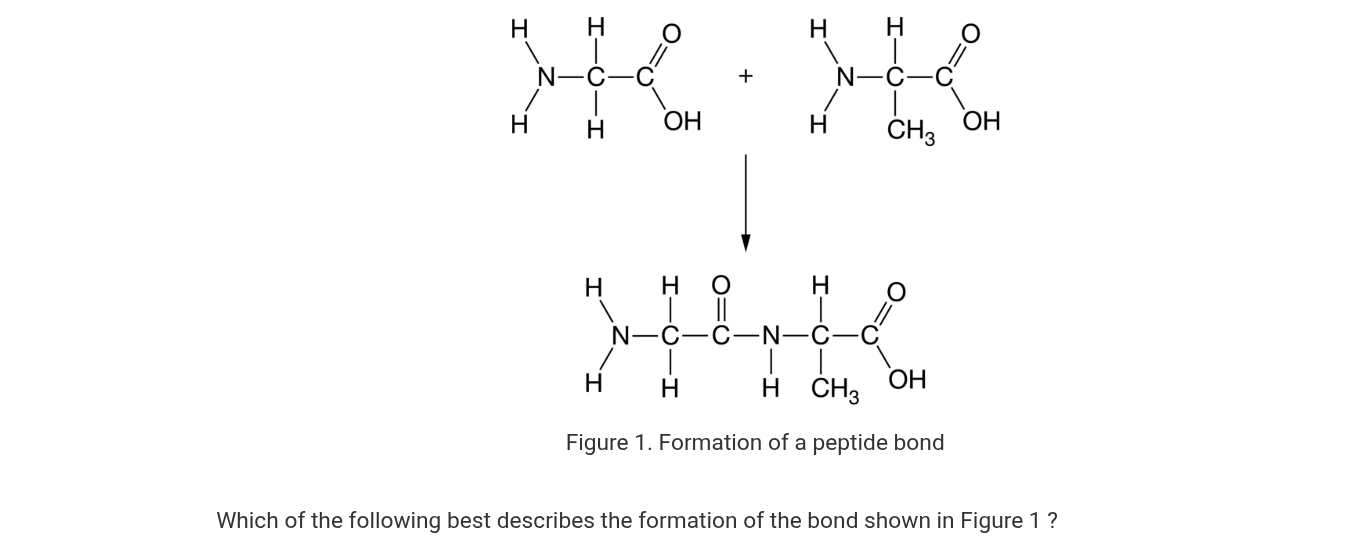
1.3 — Question #1
1.3 — Question #2

1.3 — Question #3
1.4 — Question #1
1.4 — Question #2
1.4 — Question #3
1.4 Argumentation


1.4 FRQ
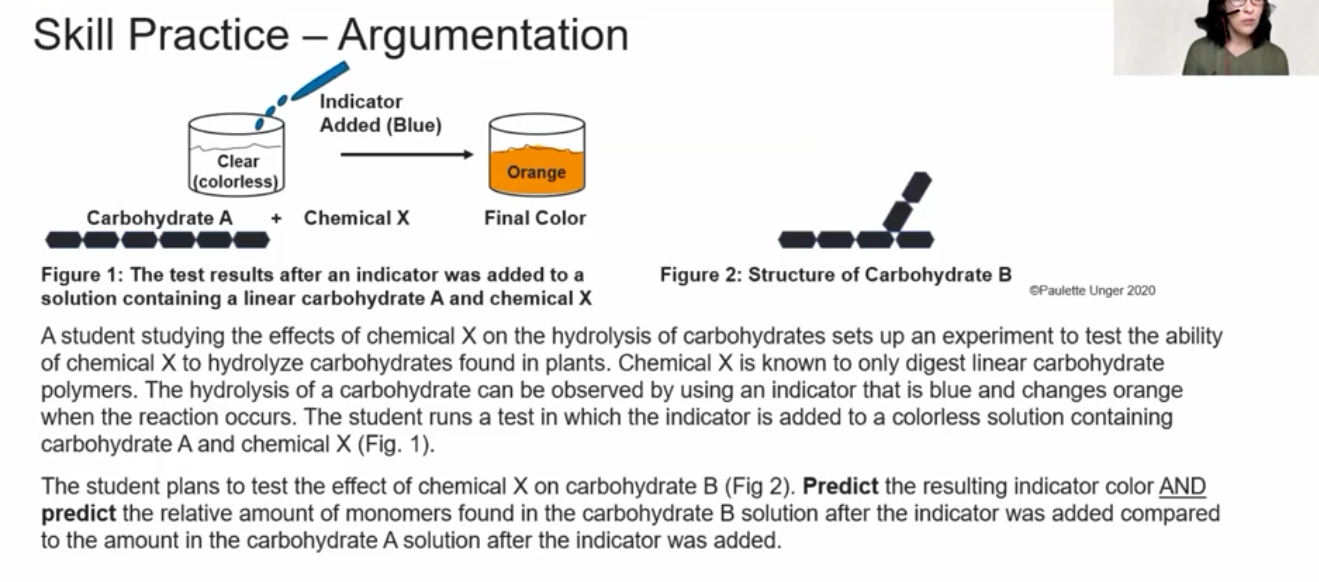
A glucose molecule contains covalent bonds, specifically carbon-carbon (C-C), carbon-hydrogen (C-H), and carbon-oxygen (C-O) bonds.
The C-O and O-H bonds are polar covalent
while C-C and C-H bonds are nonpolar Covalent.
In its cyclic form, glucose also contains an ether linkage (C-O-C)


1.5 — Question #1
1.5 — Question #2

1.5 — Question #3

1.6 — Skills Practice
It is DNA because of the nucleotides present

1.6 — Skills Practice #2
Segment 1 will destabilize faster than segment 2 (A-T has less hydrogen bonds than C-G which destabilizes)

1.6 — Question #1

1.6 — Question #2

1.6 — Question #3

1.7 — Skills Practice
Replacing a polar amino acid with a nonpolar one in the receptor protein’s binding site will decrease the compatibility between the receptor and signal molecule, likely leading to reduced or abolished binding. Consequently, the function of the receptor protein will be impaired or lost because it can no longer effectively bind and respond to its signal molecule.

1.7 — FRQ
The hemoglobin’s ability to bind and release oxygen would be impaired due to the disruption of cooperative binding.

1.7 — Question #1

1.7 — Question #2

1.7 — Question #3
