Lesson 82 - Therapeutic principles of common Intestinal disorders
 Call Kai
 Learn
 Practice Test
 Spaced Repetition
 Match
 Flashcards
 Knowt Play
1/65

There's no tags or description
Looks like no tags are added yet.
66 Terms
Protein-losing enteropathy (PLE):
excessive loss of plasma proteins through the GI tract; causes include mucosal inflammation and lymphatic disease
Maldigestion & Malabsorption: general therapeutic principles
Enzyme replacement
Highly digestible diets
Vitamin supplementation
Targeted therapy based on cause
Antibiotics: not a default solution
Chronic Enteropathies (~IBD/IBS): Dietary therapy (first-line in most cases)
Hydrolyzed protein diet
Novel protein elimination diet
Highly digestible diet
Chronic enteropathies: Immunosuppressive therapy
Used when diet alone is insufficient
Common drugs:
Prednisolone (first-line)
Budesonide (selected cases)
Cyclosporine or chlorambucil (refractory cases or cats)
Chronic enteropathies in dogs are often classified according to treatment response rather than a clearly identified cause

Corticosteroids: Anti-inflammatory effects
inhibition of phospholipase A2 → reduced prostaglandins and leukotrienes
decreased cytokine production (IL-1, IL-2, TNF-α)
reduced leukocyte migration and vascular permeability
Corticosteroids: Immunosuppressive effects
suppression of T-cell activation
reduced lymphocyte proliferation
decreased antibody production
apoptosis of some immune cells
In IRE, corticosteroids lead to:
decreased mucosal inflammation
restoration of epithelial barrier
improvement of nutrient absorption
Probiotics: MOA
Microbial competition, Microbiome support
Production of antimicrobial substances
Improvement of intestinal barrier
Immune modulation
Probiotics: Indications
acute canine diarrhea
antibiotic-associated diarrhea
stress-induced diarrhea
some chronic enteropathies
PLE: therapeutic principles
Dietary management: Low-fat diets (especially with lymphangiectasia)
Hydrolyzed or highly digestible diets
Immunosuppressive therapy: For inflammatory or immune-mediated enteropathies
Antithrombotic considerations: Increased risk of thromboembolism in severe PLE
Consider antithrombotic therapy in high-risk patients
Common Causes of short bowel syndrome
Surgical Resection: Removal of part of the small intestine to treat conditions like Crohn's disease, volvulus, necrotizing enterocolitis, trauma, or cancer.
Congenital Defects: An abnormally short, missing, or improperly formed small intestine (intestinal atresia or gastroschisis).
Symptoms of short bowel syndrome
Chronic or severe diarrhea
Greasy, foul-smelling stools (steatorrhea)
Unintended weight loss and malnutrition
Dehydration and low fluid levels
Extreme fatigue, weakness, or lethargy
Cramping, bloating, and gas
SBS: 1. Nutritional management
Highly digestible diet
Low-residue diet
Frequent small meals
Moderate fat (species-dependent)
Supplemental vitamins (especially B12)
SBS: 2. Fluid and electrolyte support
Oral or parenteral fluids
Correction of imbalances
SBS: 3. Control of diarrhea
Antidiarrheals
Fiber
Intestinal dysbiosis and ammonia production: key mechanisms
Microbial Shift: Dysbiosis increases populations of ammonia-producing bacteria(Enterobacteriaceae, Klebsiella, Proteus, Veillonellaceae,Streptococcaceae).
Enzymatic Activity: These bacteria express urease and proteolytic enzymes that convert urea and unabsorbed proteins into ammonia (NH₃) and carbon dioxide.
Colonic pH Changes: Higher ammonia levels elevate colonic pH, which encourages the growth of more pathogenic, acid-sensitive bacteria.
Intestinal dysbiosis and ammonia production: Gut Mucosal Damage
Neurotoxicity (Gut-Liver-Brain Axis): High circulating ammonia crosses the blood-
brain barrier, leading to neuroinflammation, astrocyte swelling, and clinical
manifestations like hepatic encephalopathy (confusion, motor deficits, fatigue).
Excess ammonia is toxic to the intestinal lining, disrupting tight junctions and contributing to "leaky gut" and local mucosal inflammation.
Intestinal dysbiosis and ammonia production: Liver Strain and Hyperammonemia
Gut-derived ammonia travels via the portal vein to the liver, where a healthy liver converts it to urea via the urea cycle.
When liver function is impaired (such as in cirrhosis or fatty liver disease), or portosystemic shunting occurs, systemic blood ammonia levels rise (hyperammonemia).
Intestinal dysbiosis and ammonia production: Neurotoxicity (Gut-Liver-Brain Axis)
High circulating ammonia crosses the blood-brain barrier, leading to neuroinflammation, astrocyte swelling, and clinical manifestations like hepatic encephalopathy (confusion, motor deficits, fatigue).
Intestinal dysbiosis & ammonia production: therapeutic principle
1. Reduce intestinal ammonia production
Feed highly digestible, controlled-protein diets
Use high-quality protein (dairy, egg)
Avoid sudden high-protein meals
Small, frequent feedings
Intestinal dysbiosis & ammonia production: therapeutic principle
2. Modify intestinal microbiota
Lactulose (first-line therapy):
Acidifies colonic contents
Converts NH₃ → NH₄⁺ (non- absorbable)
Promotes ammonia excretion in feces
Antibiotics (if needed): Metronidazole, Amoxicillin
Intestinal dysbiosis & ammonia production: therapeutic principles 3-6
3. Correct precipitating factors(Common triggers: Gastrointestinal bleeding, Constipation, High-protein meals, dehydration, etc)
4. Support hepatic detoxification: IV fluids, correct electrolyte and acid–base disturbances, use hepatoprotective agents
5. Manage neurologic signs: Minimize stress and stimulation… Avoid sedatives metabolized by the liver if possible
6. Treat the underlying cause: Portosystemic shunt… surgery
Chronic hepatopathy: Disease-specific management
Therapeutic principles of bloat(tympany)
Stomach tube - decompression of the GIT
Antifoaming therapy
Correction of diet or underlying disease
Supportive care
Bloat: Antifoaming agents/Oral surfactants
Vegetable oils
Mineral oil
Poloxalene
Simethicone
Bloat: Trocar and Cannula / Surgical Intervention:
Emergency puncturing of the rumen using a trocar or performing a rumenotomy to relieve extreme, life-threatening pressure
Laxatives and constipation medicines

1) Enhancing Excitation (For Underactive Gut/Hypomotility)
Gut moves too slowly, as seen in Gastroparesis or Chronic Constipation; treatments aim to kickstart contractions by boosting excitatory neurotransmitters.
Underactive gut: Acetylcholine (ACh) Amplification and serotonin(5-HT)
ACh is the primary neurotransmitter responsible for muscle contraction in the gut
Serotonin plays a massive role in initiating the peristaltic reflex
Underactive gut: Prokinetics like Pyridostigmine(acetylcholinesterase inhibitor)
prevent the breakdown of ACh, keeping muscles contracting
Underactive gut: Prucalopride or Metoclopramide
5-HT4 receptor agonists stimulate excitatory motor neurons to release more ACh, speeding up transit
Underactive gut: Motilin Receptor Agonists
Motilin is a hormone that triggers the Migrating Motor Complex (the gut's "housekeeping" wave)
underactive gut: Erythromycin
low dose mimics motilin to stimulate strong gastric contractions
Reducing inhibition for underactive gut: Dopamine Antagonists
Dopamine naturally inhibits GI motility by suppressing ACh release.
Domperidone or Metoclopramide block dopamine (D2) receptors → inhibiting the inhibitor, they allow excitatory pathways to take over and increase motility.
3. Enhancing Inhibition / Reducing Excitation (For Overactive Gut / Hypermotility)
When the gut is hyperactive or spasms, as seen in Irritable Bowel Syndrome with Diarrhea (IBS-D) or Esophageal Spasms, the goal reverses
Enhancing Inhibition/Reducing Excitation for Overactive Gut: smooth muscle relaxants
Smooth Muscle Relaxants: Block the calcium channels required for muscle contraction(Dicyclomine, Hyoscyamine, or peppermint oil)
Enhancing inhibition/reducing excitation for overactive gut: opioid receptor agonists
Stimulate mu-opioid receptors in the gut (like Loperamide or Eluxadoline) to reduce the release of excitatory neurotransmitters, effectively slowing down transit and reducing cramping
Neurotransmitters and ENS

Hypomotility (↓ motility)
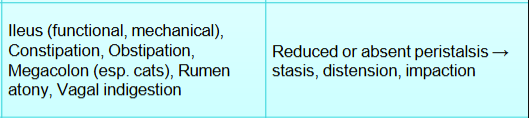
Hypermotility

Disorders of coordination

Secondary/systemic causes

Types of ileus
Paralytic (functional) ileus – loss of peristalsis due to neural, metabolic, or inflammatory causes
Mechanical ileus – physical blockage of the lumen (foreign body, neoplasia, volvulus, intussusception, hernia)
Prokinetic drugs are
agents that enhance gastrointestinal motility by stimulating excitatory pathways or blocking inhibitory ones
Prokinetic drugs: Parasympathomimetics (e.g., neostigmine, bethanechol)
act as acetylcholine agonists or cholinesterase inhibitors → increase cholinergic stimulation of smooth muscle
Prokinetic drugs: Dopamine antagonists (e.g., metoclopramide, domperidone)
block dopamine’s inhibitory effect → enhance acetylcholine release → improve motility in stomach and proximal small intestine
Prokinetic drugs: Serotonin agonists (e.g., cisapride)
stimulate serotonin receptors in enteric neurons → strong pro-motility effect throughout GI tract
Macrolide Antibiotics(erythromycin most common)
Act as motilin receptor agonists
Administered at low, sub-antimicrobial doses (under MIC)
Stimulate migrating motor complex → improve gastric emptying and intestinal motility
Risk of dysbiosis/antibiotic-associated colitis (Clostridium overgrowth)
Mainly used in small animals for gastric hypomotility, less so in horses
Adjunctive/Local Agents: support motility through regional or indirect mechanisms
Examples and actions:
Lidocaine (IV, horses): reduces sympathetic tone, anti-inflammatory, analgesic → improves post-op ileus
Opioid antagonists (naloxone, methylnaltrexone): counter opioid-induced ileus
Magnesium sulfate/osmotic agents: draw fluid into gut lumen, aiding motility
Therapeutic targets: key receptors
Cholinergic System (↑ Motility): Muscarinic receptors (M2/3)
Adrenergic System (↓ Motility): Adrenergic α2 and β2 receptors
Opioid Receptors (↓ Motility): μ receptors
Serotonin Receptors (~↑ Motility): 5-HT 3/4 receptors
Dopamine Receptors (↓ Motility): D2 receptors
Motilin Receptors (↑ Motility)
Bethanechol: Muscarinic agonist (M3) Effects
Increases the motility of the ileocaecocolonic region in cattle
Increases gastric and cecal emptying
post-operative ileus in horses, gastro-oesophageal reflux in foals
Bethanechol: common adverse effects
Diarrhea
Salivation
Bradycardia
Hypotension
Abdominal cramps
Erythromycin(Motilin-receptor agonist) Effects
Stimulates the pyloric antrum and smooth muscles of the proximal small intestines
postoperative ileus, cecal impactions
Erythromycin adverse effects
Mild abdominal discomfort
diarrhea
Passage of soft feces
Antibiotic-associated colitis
Neostigmine & Ranitidine(AChE inhibitors) Effects
Caecum and colon impactions refractory to other medication
Not first line drugs
Ranitidine is primarily used as histaminic antagonist(increases gastric pH)
Metoclopramide(5-HT-4 receptor agonist, 5-HT-3 antagonist, dopamine antagonist)
Effects
Increases gastric emptying - pigs and sheep
increases esophagus sphincter tone
stimulates duodenum motility: horses
increased rumen motility and functional pyloric stenosis – ruminants
Antiemetic (central effect)
Metoclopramide adverse effects
Restlessness/agitation, Sedation, excitement and collapse
Cross BBB
Domperidone: Dopamine antagonist Effects
Similar to metoclopramide, but does not cross the blood-brain barrier
Domperidone adverse effects
Limited, possible GI upset in dogs and some endocrine effects: increase in prolactin and aldosterone concentrations
Cisapride(Serotonin 5-HT4 agonist) Effects
Increases stomach motility and emptying - dogs, cats
Increases motility of small intestines and colon - horses, dogs, cats, pigs
Cisapride adverse effects
Abdominal discomfort
interference with myocardial potassium influx - cardiac arrhythmias
Spasmolytics: N-butylscopolammonium(Acetylcholine antagonist (M3) Effects
Relaxes smooth muscles in the GI-tract, GI spasms, facilitate rectal palpation in horses
Short duration of action 20-30 minutes, quaternary ammonium compound - no CNS action
Reduced contractility: Loperamide
μ-opioid receptor agonist
Stops diarrhoea
Loperamide adverse effects
Contraindicated in acute infectious diarrhea
No CNS effects because it cannot cross BBB - CNS effects can be observed in dogs with an MDR1 mutation
Species specific reminders: dogs and cats
Dogs: consider parvovirus, foreign bodies, acute haemorrhagic diarrhoea, and chronic enteropathy.
Cats: constipation/megacolon, lymphoma, anorexia-related hepatic lipidosis and species-specific drug safety.
Straining must be distinguished from urinary obstruction in cats.
Avoid sodium phosphate enemas in cats; some dogs with ABCB1/MDR1 variants risk loperamide neurotoxicity
Species specific reminders: Horses and food animals
Equine colic can represent surgical disease; reassess pain and perfusion promptly.
Ruminant neonatal diarrhoea: fluids, electrolytes, glucose, nutrition, passive immunity and hygiene.
Piglet diarrhoea needs herd-level assessment, biosecurity and age-specific differentials.
Food-producing animals: follow approved use, withdrawal periods and local regulations