Strategies in Organic and Biological Chemistry
 Call Kai
 Learn
 Practice Test
 Spaced Repetition
 Match
 Flashcards
 Knowt Play
1/59

There's no tags or description
Looks like no tags are added yet.
60 Terms
What is the routine for designing a synthesis?
Analysis
Recognise functional groups in target molecule
Disconnect with known reliable reactions in mind
Repeat as necessary to find avaliable starting materials
Synthesis
Write out plan adding reagents and conditions
Modify plan according to unexpected failures or successes in lab

How is this molecule synthesised?
Friedel-Crafts acylation

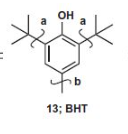
How is this molecule synthesised? (2 ways)
Friedel-Crafts alkylation

What is a nucleobase?
Molecule that contains N heterocycle with a purine or pyrimidine structure, which is a component of nucleotides in nucleic acids.

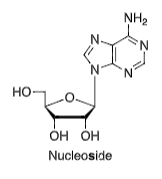
What is a nucleoside?
A nucleoside is formed when a nucleobase is attached to a sugar molecule, specifically ribose or deoxyribose, without any phosphate groups.
What is a nucleotide?
A nucleotide is a building block of nucleic acids, consisting of a nucleobase, a sugar (ribose or deoxyribose), and one or more phosphate groups.

What is a polymer of nucleotides called?
Oligonucleotides, nucleic acids, RNA & DNA
What are the structure and properties of nucleobases?
Derivates of pyrimidine or purine
Nitrogen-containing heteroaromatic molecules
Planar or almost planar structures
Absorb UV light around 250-270 nm
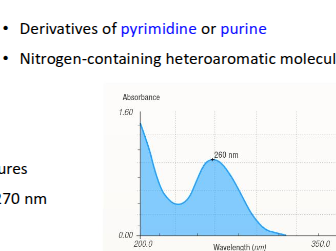

Why is the UV absorption range for nucleobases 250—270 nm?
Due to π → π* electronic transitions
Excited states of common nucleobases decay rapdily via radtionless transitions
Effcective photoprotection of genetic material
No fluorescence of nucleic acids

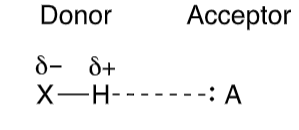
What is a H-bond donor and H-bond acceptor?
H-bond donor: Hydrogen attached to highly electronegative atom
H-bond donor: Strongly electronegative atom O,N,F
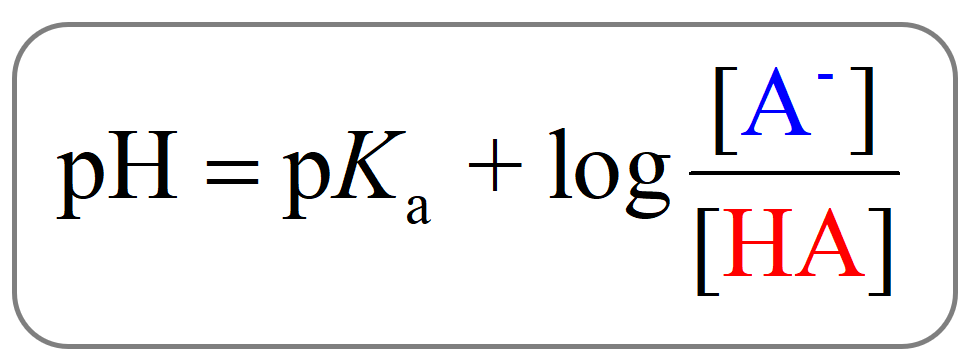
How do you work out acid dissociation constant and pKa?

What is the Hasselbalch equation?
Why are purine and pyrimidine bases good H-bond donors (d) and acceptors (a)?
N atoms are able to donate lone pairs
Neutral molecules at pH 7


What are prototropic tautomers?
Structural isomers that differ in location of protons

What is keto-enol tautomerism?
Tautomerism that is common in ketones

What is lactam-lactim tautomerism?
Occurs in some heterocycles
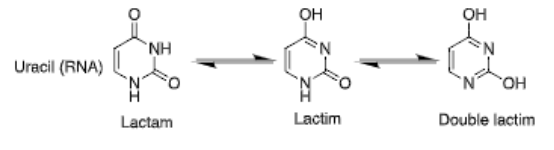
With these isomers, which tautomers is the most predominant in neutral pH?
Lactam tautomer
Show the Fischer projection of ribofuranose (aldehyde and beta-furanose)

Show the Haworth projection of ribofuranose (aldehyde and beta-furanose)

What is the RNA name of ribofuranose?
Beta-D-ribofuranose
What is the DNA name for ribofuranose?
beta-d’-deoxy-D-ribofuranose

In nucleotides, how is the pentose ring attached to the nucleobase?
N-glycosidic bond
Bond formed to anomeric carbon of sugar in beta configuration
Bond formed to N1 in pyrimidines
Bond formed to N9 in purines

Is N-glycosidic bond stable towards hydrolysis?
Yes especially in pyrimidines

How is N-glycosidic bond cleaved and catalysed
Catalysed by acid

Is there relatively free rotation around N-glycosidic bond in free nucleotides?
Yes
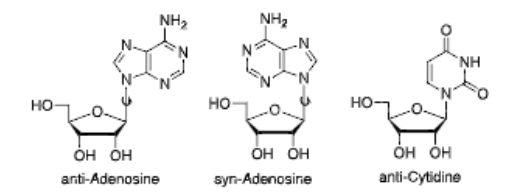
What conformation are the free nucleotides if there is an angle rotation of near 0 degrees?
Syn conformation

What conformation are the free nucleotides if there is an angle rotation of near 180 degrees?
Anti conformation (in B-DNA)

What charge are the phosphate groups attached to 5’ at neutral pH?
Negatively charged → Prevents tangling of electron-electron repulsion (soluble)
Nucleic acids built using 5’-triphosphates ATP,GTP,TTP,CTP

What charge are the phosphate groups attached to 5’ at neutral pH?
Negatively charged
Nucleic acids contain one phosphate moiety per nucleotide

What is the symbol name and nucleoside name for this nucleotide?
Symbols: A, dA, dAMP
Nucleoside: Deoxyadenosine

What is the symbol name and nucleoside name for this nucleotide?
Symbols: G, dG, dGMP
Nucleoside: Deoxyguanosine

What is the symbol name and nucleoside name for this nucleotide?
Symbols: T, dT, dTMP
Nucleoside: Deoxythymidine

What is the symbol name and nucleoside name for this nucleotide?
Symbols: C, dC, dCMP
Nucleoside: Deoxycytidine

What is the symbol name and nucleoside name for this nucleotide?
Symbols: A, AMP
Nucleoside: Adenosine

What is the symbol name and nucleoside name for this nucleotide?
Symbols: G, GMP
Nucleoside: Guanosine

What is the symbol name and nucleoside name for this nucleotide?
Symbols: U, UMP
Nucleoside: Uridine

What is the symbol name and nucleoside name for this nucleotide?
Symbols: C, CMP
Nucleoside: Cytidine

What are the differences between DNA and RNA?
Difference in monosaccharide
Difference in nucleobase

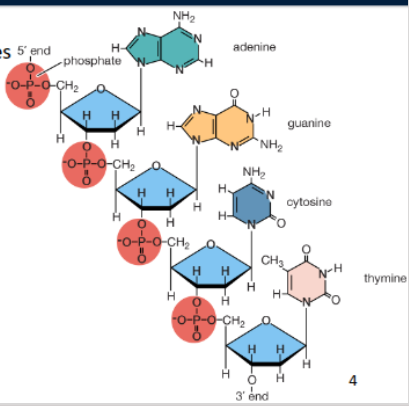
How are covalent bonds formed in this nucleic acid?
Covalent bonds formed via phosphodiester linkages → Phosphate groups more stable when its part of polymer chain
Negatively charged backbone → Makes polymers more soluble

Is this nucleic acid structure linear?
YES
→ No branching or cross links

What is the directionality for this nucleic acid structure?
5’ end is different from 3’ end
Read sequence from 5’ to 3’
What is the DNA backbone like?
Fairly stable
What is the RNA like?

Chemically unstable
→ In water, RNA lasts for few years
→ In cells, mRNA is degraded in few hours
Why is RNA instable? (Show dimer of 2 nucleobases)
Basically RNA is unstable of OH- group → Deprotonation and O- interacts with phosphate backbone
Hydrolysis also catalysed by enzymes (RNase)
RNase abundant throughout nature


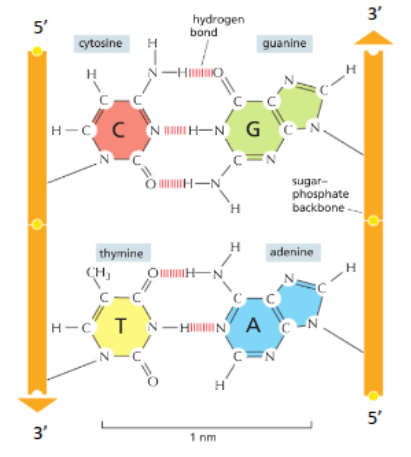
What is Watson-Crick-Franklin base pairs?
When two bases can hydrogen bond to form base pair (not covalent bond)

How big are the possibilities of base pairs being found in monomers?
Large number

How big are the possibilities of base pairs being found in polynucleotides?


Only a few possibilites exist
Do Watson-Crick-Franklin (WCF) base pairs predominate more in double-stranded DNA or RNA?
Predominates in double-stranded DNA
→ Purine pairs with pyrimidine

What are the Watson-Crick-Franklin base pairings in this image?
A=T (2 Hydrogen bonds are formed)
C=G (3 Hydrogen bonds are formed)
→ The two strands are complimentary


What is the process of DNA/RNA denaturation?
Covalent bonds remain intact → Genetic code remains intact (Hydrogen bonding breaks instead)
Hydrogen bonds are broken → Two strands separate
Base stacking is lost → UV absorbance increases and becomes more free in solution and Bases are more flexible
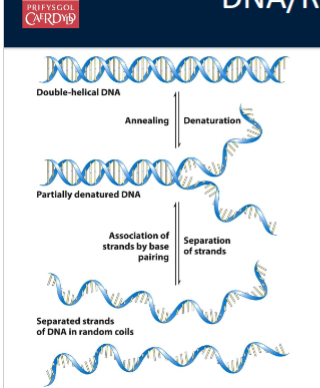

How is denaturation of DNA/RNA induced?
High change in pH


How is denaturation in DNA/RNA reversible?
Annealing


What are the several factors that affect the midpoint of transition (Tm = Melt temperature) → Called melt transition
Tm increases with:
Higher GC content
Higher concentration
Longer oligomer length
pH values nearer to neutral
Higher salt concentration
RNA duplex is 20 degrees more stable than DNA


What is required to replicate DNA?
Template
→ Each new duplex comprimises a template and daughter strand

What is a template?
original double-stranded DNA molecule, where each separated single strand acts as a template to guide the synthesis of a new complementary strand
What are the three steps to biosynthesis of biopolymers?
Initiation
Elongation
Termination
What is the initation step for the biosynthesis of biopolymers?
Double helix opened with aid of initiatior proteins and unwound with helicases
Replication bubble required so bubble can grow at both ends

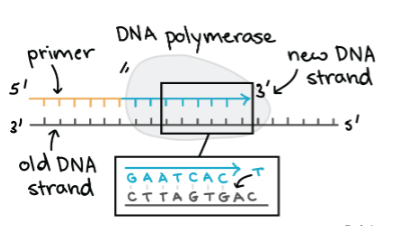
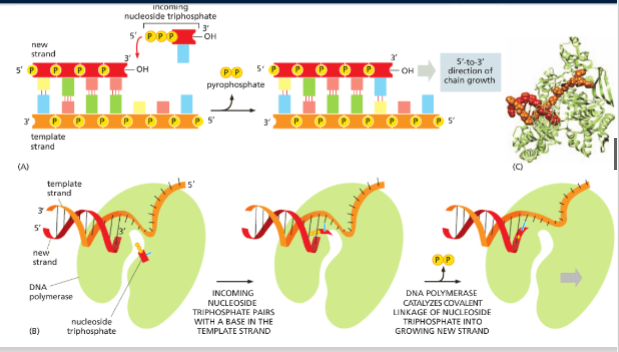
What is the elongation step for the biosynthesis of biopolymers?
Incoming nucleoside triphosphate (binds of anhydride groups) pairs with base in template strand
DNA polymerase catalyzes covalent linkage of nucleoside triphosphate into growing new strand
What is a primer?
Short oligonucleotide sequence created by primase enzyme
What is DNA polymerase?
Enzyme that can build complementary DNA strand starting from an existing primer