Ch 5 Review ANAT 1026
 Call Kai
 Learn
Learn Practice Test
 Spaced Repetition
 Match
Match Flashcards
 Knowt Play
1/58

There's no tags or description
Looks like no tags are added yet.
Name | Mastery | Learn | Test | Matching | Spaced | Call with Kai | Chat |
|---|
No analytics yet
Send a link to your students to track their progress
59 Terms
What week of development does tooth buds/germs begin to grow in the alveolar process of the fetus?
Sixth week
What are tooth buds?
Small clumps of cells that will eventually form tissues of the tooth
On the sixth week of development, what is starting to develop?
Dental Lamina, Enamel, and (Primary) Dentin
Secondary dentin is produced throughout life by _____?
Odontoblasts
In tooth development, what part of the tooth is last to calcify?
Apex
What are the areas called where tooth buds start to develop?
Crypts
Where do developmental lobes form?
Crypts
What is the fusing of developmental lobes called?
Coalescence
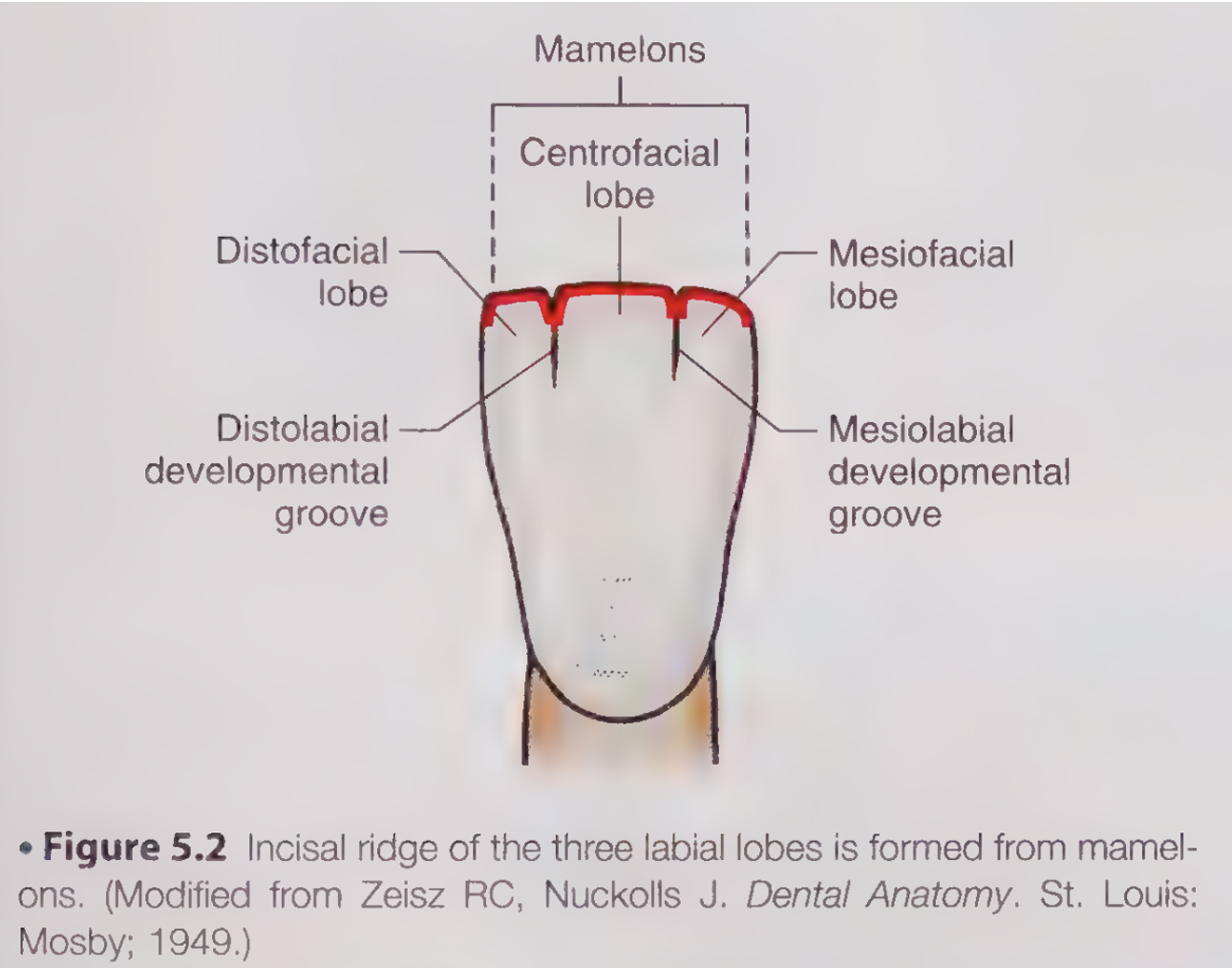
What are mamelons?
Small, rounded ridges on incisal edges of newly erupted anteriors, which are naturally grinded away

Label this figure of the maxillary right second premolar
1 — distobuccal lobe
2 — centrobuccal lobe
3 — mesiobuccal lobe
4 — lingual lobe
What tooth am i describing: 3 lingual lobes that form a high buccal busp, with 1 lingual lobe
Maxillary premolars
What tooth am i describing: 3 lingual lobes that form a buccal busp, with 1 smaller lingual lobe
Mandibular first premolars
How can you tell the difference between mandibular first and second premolars?
mandibular second premolars have larger lingual cusps compared to mand first premolars
How can you tell the difference between maxillary and mandibular premolars
The size of the lingual cusp, it’s larger on the maxillary premolar
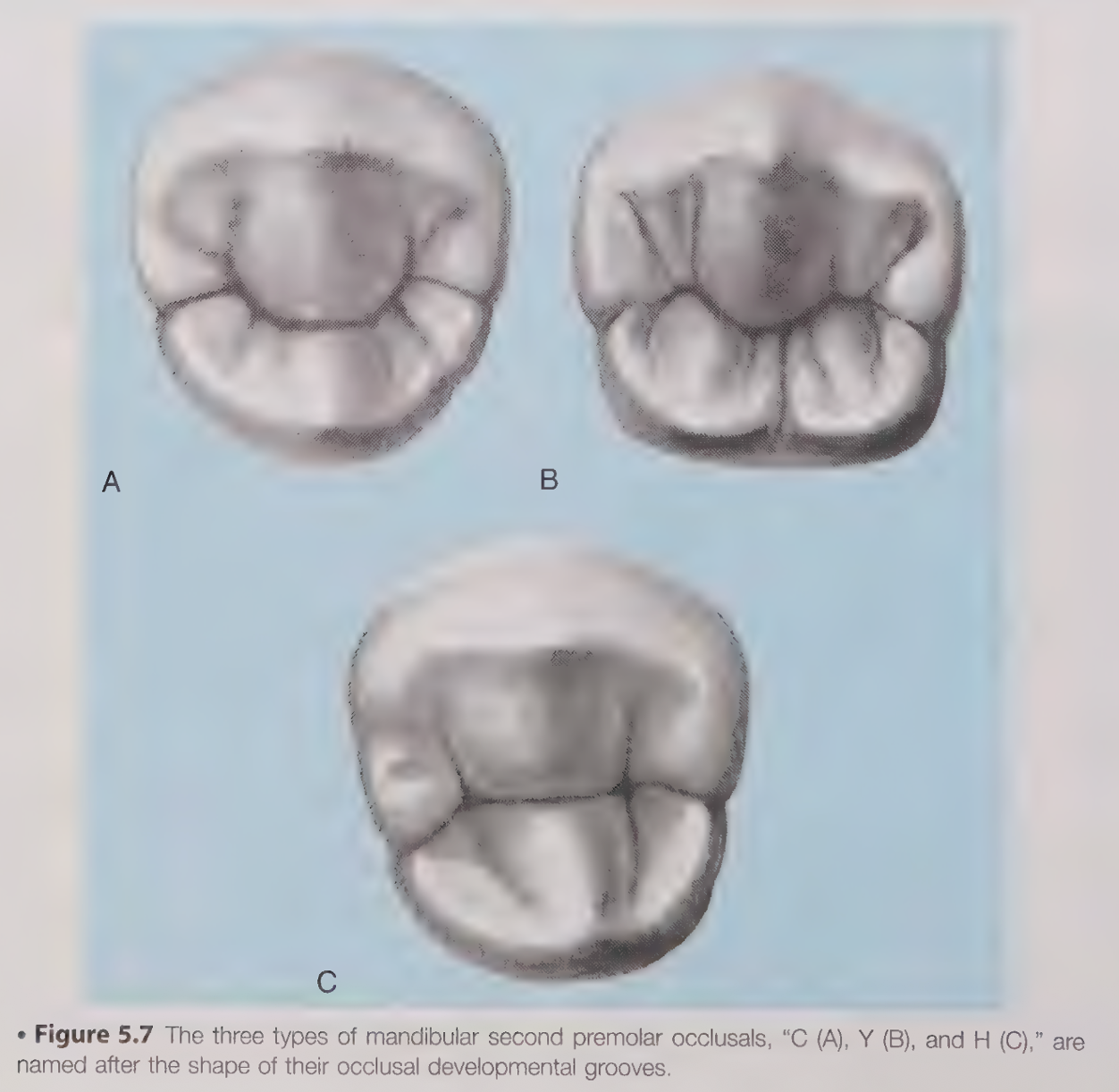
Mandibular second molars have different types of patterns on their occlusal surface. What are they?
C shaped, Y shaped, H shaped
Name the lobes of a maxillary first molar
2 buccal lobes — mesiobuccal, distobuccal lobes
3 lingual lobes — mesolingual, distolingual, rudimentary lobe (Lobe of Carabelli)
Regarding size, which is larger — first or second molars?
first molars
What are the 3 general rules of eruption?
1 — mandibular teeth are first to erupt
2 — each tooth erupts in pairs
3 — permanent teeth erupt slightly earlier in girls than in boys
Name the order of eruption of primary dentition
@ 6-8m — lower centrals
@ 10m — upper centrals and laterals follow
@ 12m — lower laterals
@16 — lower first molars and upper first molars
@16-20m — canines
@24m — second molars
Name the order of eruption of permanent dentition
Lower first molars
Upper first molars (MIXED DENTITION 6’s grow in @ 6 years!)
Lower centrals
All laterals
Lower canines
Lower first premolars
Upper first premolars
Lower second premolars
Upper second premolars
Upper canines
Lower second molars
Upper second molars
At what age do you typically see the 8’s erupting?
17 years, although they could be missing through buds never being formed. Pretty sure I have this
Explain “mesial drift”
phenomenon regarding the tendency of molars having an erupting force or migrating and tipping towards the midline.
Where are the following for the interproximal space? Apex, Sides of the Triangle, Base
Apex — Contact area
Sides — Proximal Surface
Base — Alveolar Bone
What is the purpose of embrasures?
To allow food to be moved away from contact areas, reduces occlusal traumas,
What is a cervical embrasure?
Below the contact area, results from bone and gingival recession which results in black triangles in between teeth
What are the purpose of buccal/facial and lingual contours?
Helps direct food for proper gum stimulation, and self cleaning to tongue and cheek areas
Where is the lingual contour of posterior teeth?
Near or at middle third tooth
Where is the lingual contour of anterior teeth?
At the cervical third of the tooth
Where is the buccal contour of anterior teeth?
At the cervical third of the tooth
Where is the buccal contour of posterior teeth?
At the cervical third of the tooth
List the stages of tooth development
1 — Initiation/Bud Stage
2 — Cap Stage
3 — Bell Stage
4 — Advanced Bell Stage
5 — Eruption
When does Initiation/Bud Stage start? What happens?
Initiation/Bud Stage starts at the sixth week of development
Tooth buds will form (aka tooth germs), and initial budding from the dental lamina is seen

What is the dental lamina?
a band of epithelial tissue that serves as the very first structural blueprint for tooth development
What is the vestibular lamina? What happens?
Thickening of the oral epithleium buccal to the dental lamina. Clefting of the vestibular lamina forms grooves that become the mucobuccal fold

What happens during the Cap Stage?
Cells differentiate producing key structures
Enamel Organ
Outer Enamel Epithelium (OEE)
Inner Enamel Epithelium (IEE)
Stellatte Reticulum
Dental Papilla
Dental Follicle/Sac

When does the Bell Stage occur? What happens in the Bell Stage?
The Bell Stage occurs at the 11/12th week of fetal life
This is when lobes are formed, Histodifferentiation — histo meaning tissue, enamel being one them
The stratum Intermedium layer become obvious
What happens in the Advanced Bell Stage, or “Crown Stage”?
This is when the crown, and shape of the crown is formed
Dental Papilla becomes odontoblasts (makes dentin)
—> this makes sense dental papilla = pulp, and recall pulp makes odontoblasts to make dentin
IEE become ameloblasts (makes enamel)
What cells make Dentin? Enamel?
Odontoblasts; Ameloblasts
What forms first, dentin or enamel?
Dentin
What is the Successional Lamina?
An extension of the dental lamina that forms lingually, where permanent teeth are formed.
(Think if you “succeed”, you have made it onto making adult teeth)

What happens during the Eruption Stage?
Eruption Stage is root formation and elongation, teeth entering mouth, and formation of the PDL as per the Dental Follicle/Sac
What does the dental follicle/sac signal?
Signals for creation of supporting structures; periodontium, cementum, alveolar bone
What is this dental anomaly: Hyperdontia
Extra teeth, too many buds in Stage 1 (Initiation/Bud Stage)
What is this dental anomaly: Hypodontia
Lack of or missing teeth — something didnt develop between stages 1 (Bud Stage) and 2 (Cap Stage)
What is this dental anomaly: Gemination
Twinning of a tooth — tried to split into 2 but still fused together (looks like 2 teeth)
What is this dental anomaly: Anadontia
Someone born with no teeth (no buds)
What are the two ways mesial drift affect deciduous dentition?
1 — Natural spaces in between the primary teeth are closed
2 — if a primary tooth is prematurely lost, the first molar will push up against the teeth and may keep premolars from erupting
What is tooth exfoliation? How does it happen?
It’s the process of losing baby teeth. Where the roots of primary teeth are resorbed, causing tooth to lose anchorage, becoming loose, and exfoliating.
The pressure brought from permanent tooth onto the root of the primary tooth triggers the body to activate osteoclasts which resorb the primary roots
Whats the difference between osteoclasts and osteoblasts?
Osteoclasts break down bone
Osteoblasts build up bone
In Advanced Bell stage, state how enamel and dentin is derived
IEE (Inner Enamel epithelium) —> Ameloblasts —> Enamel
Dental Papilla —> Odontoblasts —> Dentin
Name four dental anomalies we learned in class today
Hyperdontia, Hypodontia, Gemination, Anadontia
At the bud stage, inital budding is seen where?
Dental Lamina
At what stage does vestibular lamina form?
in stage 1 (in between initiation and bud)
Whats a good way to remember order of eruption of baby teeth?

What is the term for tooth development?
Odontogenesis
Can ameloblasts/enamel regenerate?
No, that’s why cavities need to be filled
During the bud stage (around the 7th week of fetal life), how many areas of initial budding from the dental lamina are characteristically observed in each dental arch?
10 areas
What is the exception to Eruption Rule #1 (mandibular teeth precede maxillary teeth in eruption) for both deciduous and permanent teeth?
Deciduous — Upper laterals and canines before lower laterals and canines
Permanent — Upper first premolar before lower first premolar
What teeth are named after age?
2 year old molars — baby 5’s erupt (primary second molars)
6 year old molars — 6’s erupt
12 year old molars — 7’s erupt