CLAS241 - Fourth Century (400-300 BCE)
 Call Kai
 Learn
Learn Practice Test
 Spaced Repetition
 Match
Match Flashcards
 Knowt Play
1/19

There's no tags or description
Looks like no tags are added yet.
Name | Mastery | Learn | Test | Matching | Spaced | Call with Kai | Chat |
|---|
No analytics yet
Send a link to your students to track their progress
20 Terms
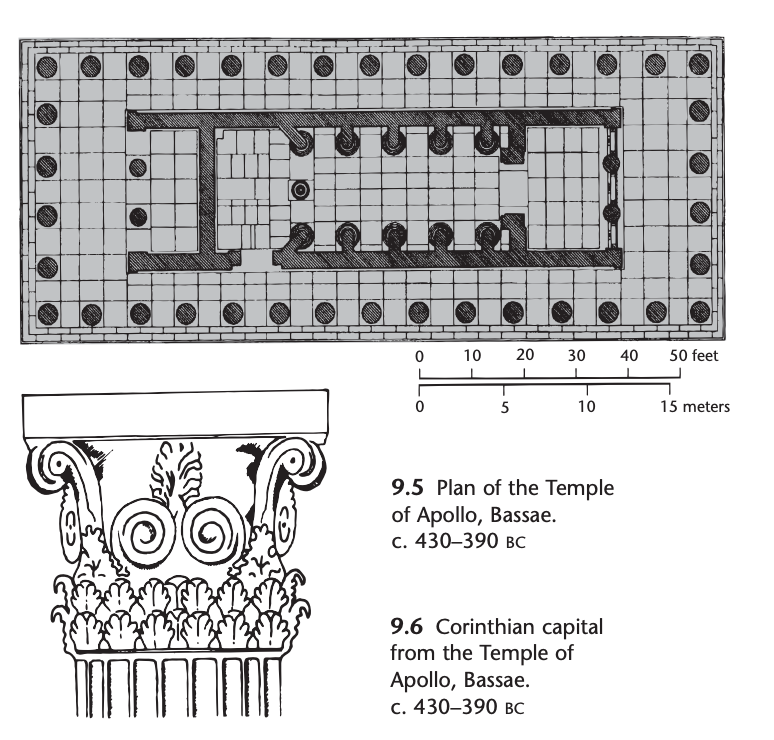
Plan of the Temple of Apollo at Bassae (Iktinos). Fourth Century. 400 - 300 BCE.
First example of a Corinthian Column in Greece
Only one found in INTERIOR
Exterior is a typical Doric temple, and it also had interior Ionic columns
Ionic columns were “engaged columns” = attached to each other and to side walls
Temple designed by architect Iktinos
Significant because he was the first one to incorporate all three orders
Plan is odd but likely due to having confined building area and preserving the architecture of an earlier temple at the same site:
Odd proportions (too long)
15 columns instead of 13 - unlike classical ratio
Unusual North-South orientation
Doesn’t open properly in the East - Most Greek temples faced East-West with an East entrance
Temple plan consisted of:
6 columns by fifteen; Porches front and back have 2 columns in antis, front porch deeper than back
Arrangement behind porch is highly original; a cella and an adyton with a back door
The transition from cella to adyton (a back room in a temple), is marked by the new Corinthian Capital column
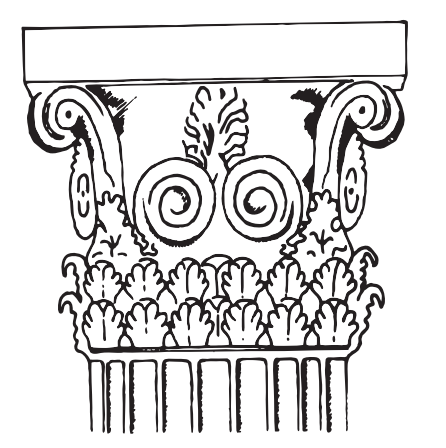
Cont. Corinthian Capital from the Temple of Apollo at Bassae
Somehow add this to your analysis of the Temple of Apollo lol idk
Cont. Corinthian Capital from the Temple of Apollo at Bassae
Doric solves problem of Ionic
Ionic only looks good frontally
When you view it from the side, you can only see side of ram's horn, not the full curve
Corinthian looks the same from every direction
A more decorative version of a doric colum
Looks good in 360, but not confined to Doric rules
Corinthian style architecture same as Ionic but w Corinthian columns
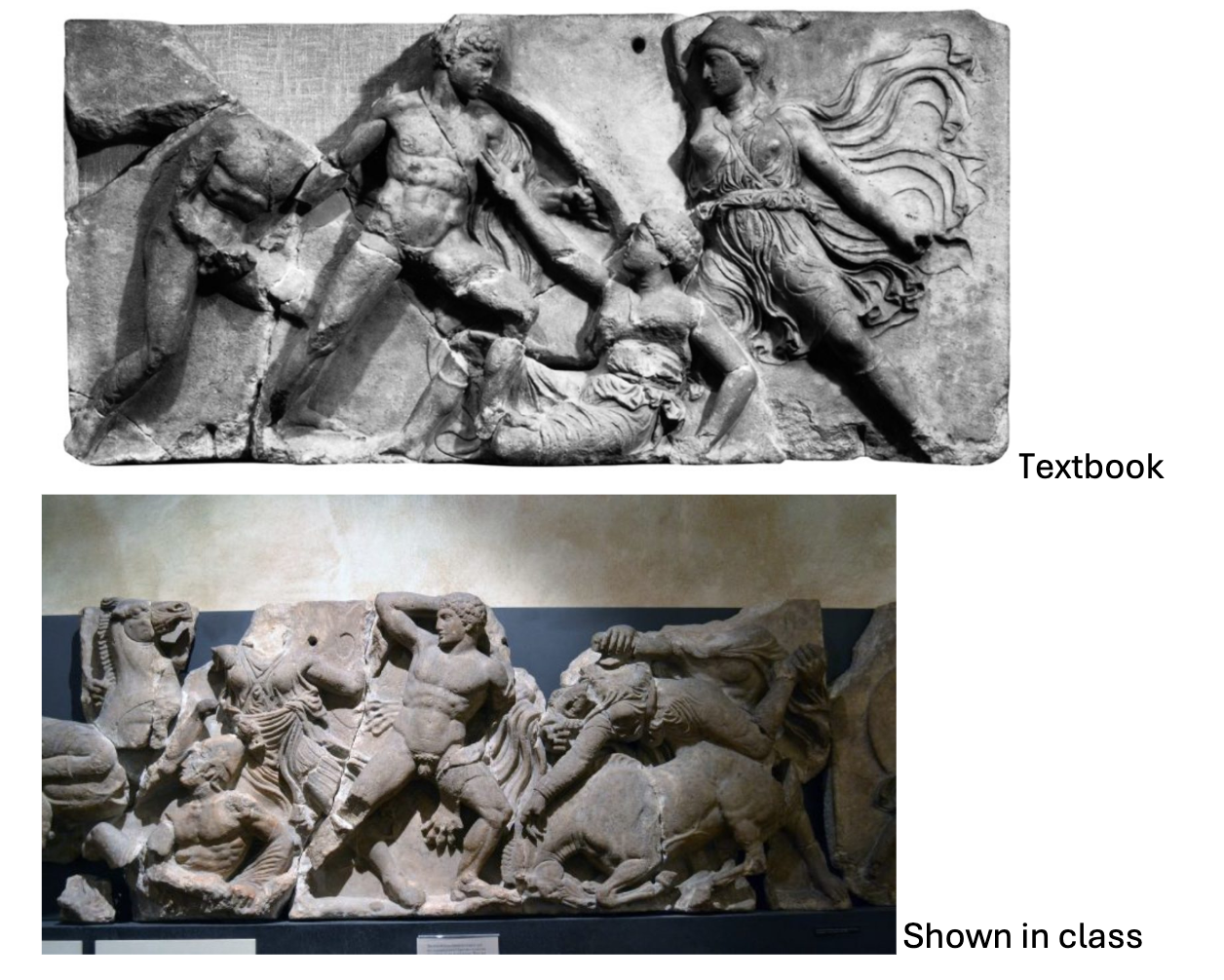
Amazonomachy from the Temple of Apollo at Bassae. Fourth Century. 400 - 300.
Mixed quality in execution
Some figures as good as Parthenon bodies, others have fewer straight lines or look more doughy
Late fifth century:
Large muscles (Parthenon), deep drapery folds, and wet look
But now, we see in the Fourth century:
Exaggerated postures (ex. right amazon pulled off horse fainting w/ downward arm + open mouths, head positions, pleading eyes
Theatrical expressions (ex. horse)
Deep eyes (ex. left soldier about to get killed)
Artists looking to Parthenon as example for style and composition
Since the Parthenon became famous or artists from acropolis came to work here
Ex. Figures like Poseidon and Athena, from the West pediment on Parthenon (story of Poseidon and Athena giving gifts, tree comes up, falling away from e/o)
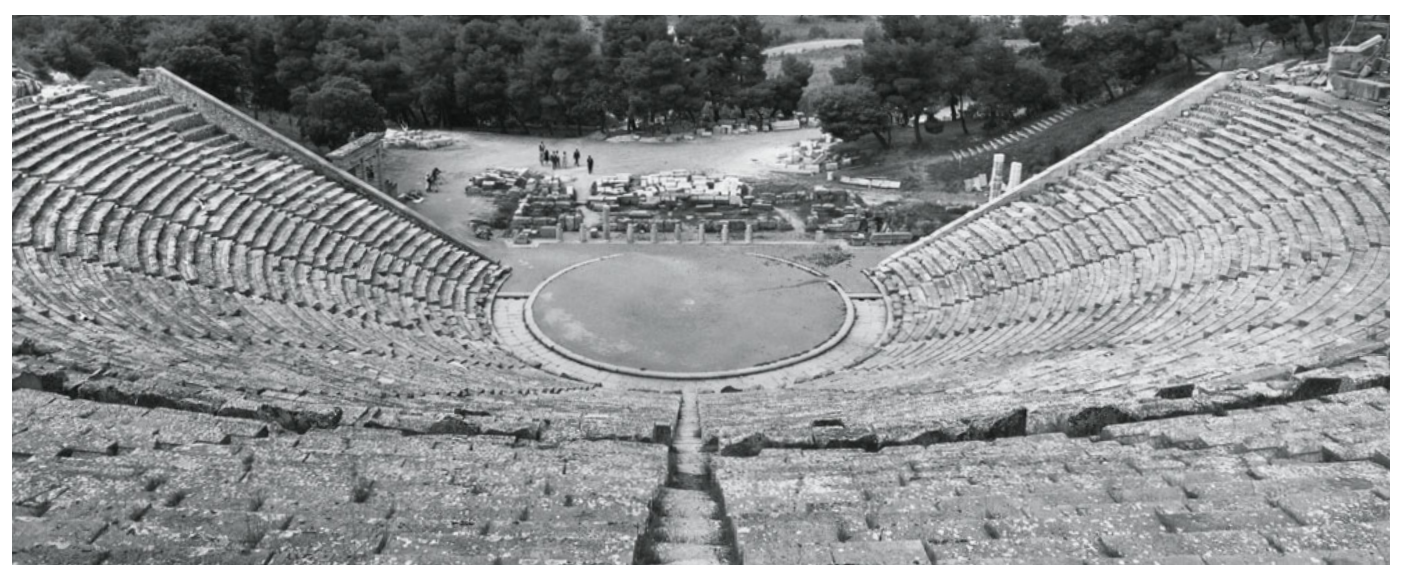
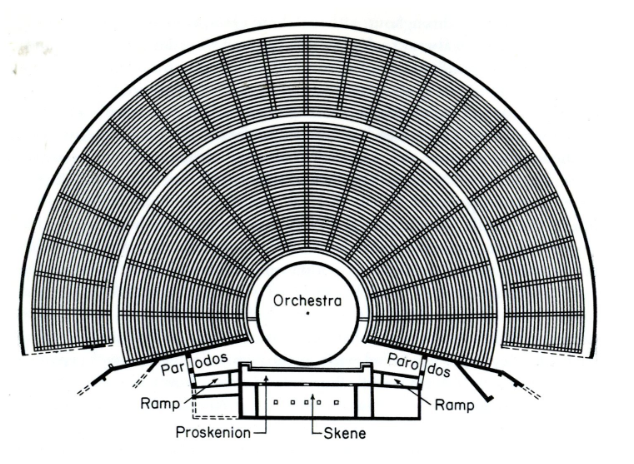
Theatre at Epidauros (and Polykleitos the Younger). Fourth Century. 400 - 300 BCE.
Round buildings get more used in the fourth century
Many theatres start looking like this in Greece
Greek theatres were built their slope into a hill
Theatres dedicated to Dionysus (god of drama) = all theatres are sacred
Epidauros is a sanctuary for Asclepius (god of medicine)
Threatres = “healing for the mind,” plays often discuss social and psychological problems - allows society to work through these tgt
Designed like modern theatres
Ex. Sections to acquire tickets and walkways
Seats at top, orchestra in the middle, stage at bottom
Seats = cheap benches at top, expensive ones at bottom, few individual seats closer to bottom for chief priest/priestess, VIPS
Skene = stage where play occurs, few actors speaking
Orchestra = where chorus (group that responds to actors)
Audience would look at both skene and orchestra
Play depicting countryside, chorus would be “farmers” that would dance and sing
The architect, Polykleitos, is likely related to the sculptor Polykleitos (Doryphoros/Spear Bearer from High Classical period)
PERFECT acoustics, you can hear someone talking from the stage even if you’re sitting very far (unknown reason) + you can hear sound waves bend, ex. if someone claps around the stage (watch a tiktok lol)
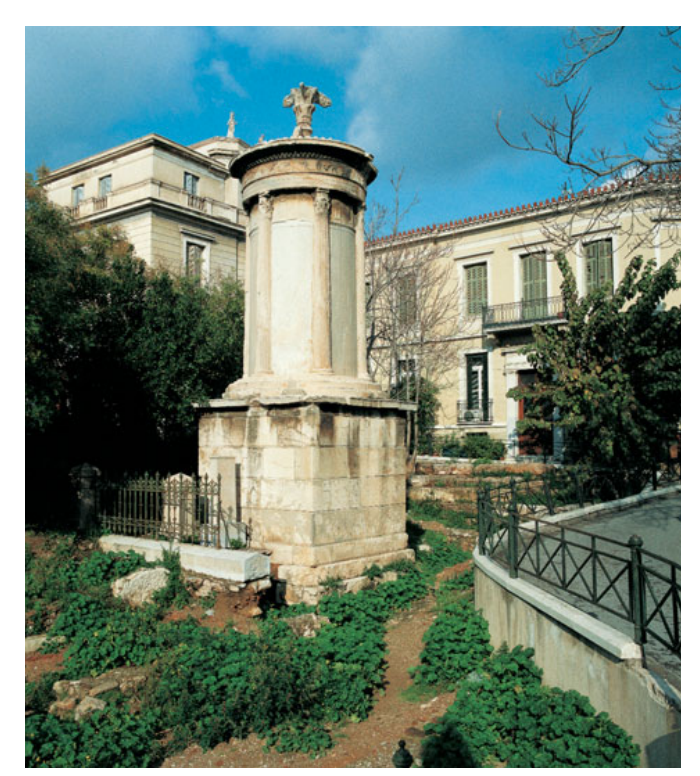
Choregic Monument of Lysikrates. Fourth Century. 400 - 300 BCE.
First evidence of EXTERNAL Corinthian columns, near theatre of Dionysus
Takes long for Corinthian columns to become external: compare to the internal column from the temple of Bassae from the start of the 4th century
After this, we see many Corinthian style temples with exterior Corinthian columns
Not significant by itself, but important in terms of chronology
A victory monument, erected on “the street of monuments”
A prize given to the winner of a tragedy or comedy contest → the choregos
Like modern horse racing where the owner of the horse gets a trophy (not the horse or jockey) - Here, the choregos is the guy who put up the money (not the actors, costume designers, or the play maker)
If a choregos’ play won, they put a trophy to memorialize themself to show their victory
Here, the winning producer was Lysikrates
The picture is modern. Originally, the column would’ve been open with a statue inside
4th century style sculptured decoration on the outside
Shows the myth of Dionysus, where he turns pirates into dolphins
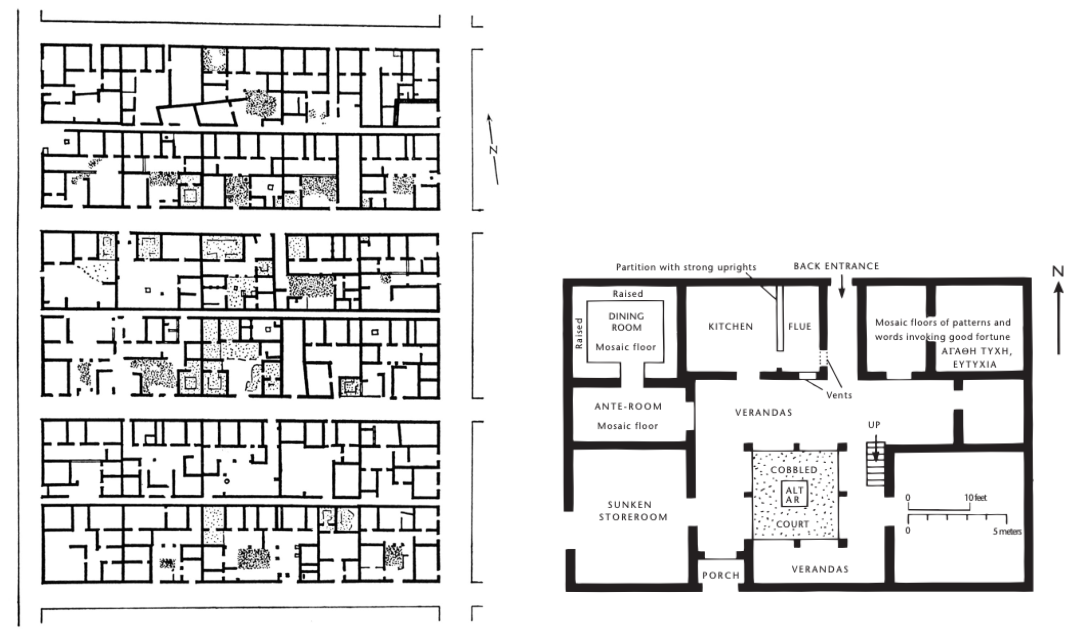
Plan of Olynthos. Fourth Century. 400 - 300 BCE.
By the start of the 4th century, we see regularized urban plans
Cities developed haphazardly prior to the 4th century, usually staring to build near a city core - close to a temple or well
Occupation over two hills
Based on Hippodamos of Miletus
He popularized this Greek urban plan
Essentially a grid plan going North-South, streets meeting at right angles, and houses (4-5) regularly spaced between
Shows advanced urban planning
There were neighbourhoods, ex. merchant & religious districts, affluent section w bigger and fancier houses
Houses look the same architecturally
Similar to modern “row housing”
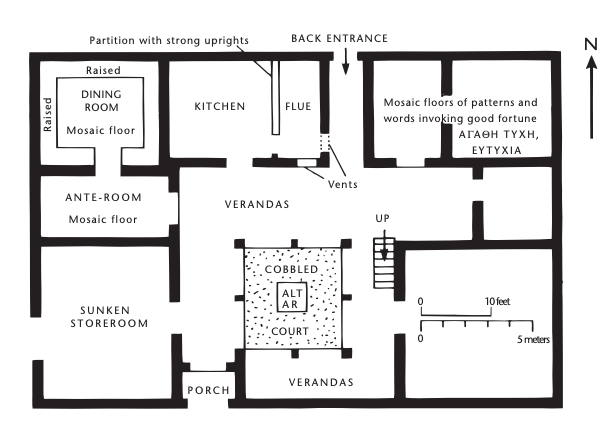
Houses were called pastas house (verandas)
Rooms are usually multifunctional
Ex. sunken storeroom turned into a bedroom, could also sell stuff from the window of the storeroom - turning it into a shop
However, we can recognize that some rooms could perform a function
Flue (room with a chimney) = usually kitchen
Floor raised around the outside = dining room (andron)
Greeks ate on couches on the the raised floor
Formal dining parties (symposium) happened in the andron
Parties were men only (andros = men room)
When parties didn’t happen, it might’ve been used for other functions like a regular dining room, kids playroom, storeroom, etc.
Dining rooms more decorative b/c you’d show off to ppl you’d bring in for parties
In the 5th and 4th century, there’s more control over public vs private
Public rooms are more decorative → dining rooms
Private rooms are on the second floor, ex. bedroom
Control seems to be over women (don’t want outside men to see them)
Later, theres less concern/control over what someone sees when they enter ur house
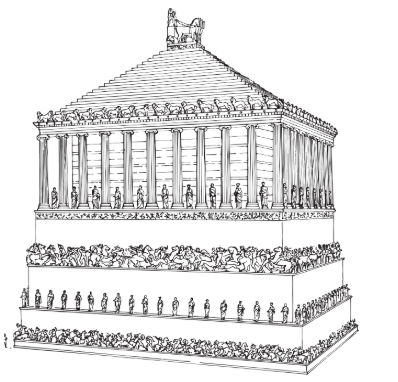
Reconstruction of the Mausoleum – Halikarnassos. Fourth Century. 400 - 300 BCE.
One of the seven wonders of the ancient world
Mausoleum = tomb of the dead
Mausoleum was a tomb for the king Mausolus, corpse in central room
Mausolus was the king of Caria. Halikarnassos was the main city → TURKEY
His wife commissions the Mausoleum, built by leading sculptors (ex. Skopas)
Became a monument to a non-Greek ruler in Greek style
Basically, the monument fused a Near Eastern idea in a Greek way (using Greek architecture and culture)
Ex. the building is ionic, w ionic columns and friezes
Mausoleum sets the stage for future ruler monuments
Ruler monuments were more popular in the near East b/c they had more significant rulers, Greece didn’t have many
Similar buildings would be made for Alexander the Great, roman emperors
Shows that greek cultural style SPREADS from Athens, to Bassae, to even farther (southern Turkey)
Overtime, the stone from the Mausoleum was used for other buildings
Therefore, there’s debate over what the Mausoleum looked exactly like, but we know
The Mausoleum had tiers, but size and # of tiers are unknown
Relief sculpture and free-standing sculptures on tiers
Statues in between columns around the outside
Statue of Mausolus on chariot at the top
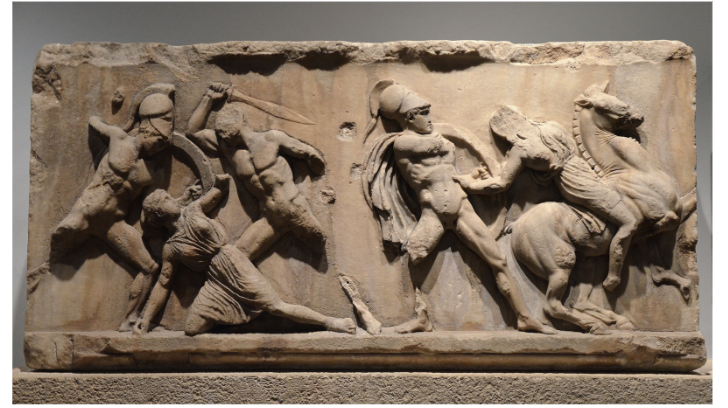
Amazonomachy from the Mausoleum. Fourth Century. 400 - 300 BCE.
Sculpture that survives from Mausoleum, depicting Greeks vs Amazons
Although Mausolus was a non-Greek and the sculpture shows “Greeks superior to non-Greeks”, he probability had it in his tomb because:
He’s probably thinking of it as "I’m superior” (generalizes it as group better than a non-group)
Basically, it recontextualizes what Greek style/art means, fits a general message that one group is better
Shows that Greek art was popular, and that Mausolus was in touch with best sculptors in the world by having stuff in Greek style
He appropriates Greek material, showing he’s as good as the stuff that came before
The picture shows:
Amazon dragged off horse, Amazons chopped up on ground, referencing:
Tyrannicides chop
Temple of Apollo at Bassae amazons getting pulled off hair, also seen at Parthenon with centaur getting pulled by hair
We see a mix of 5th and 4th century in the way they’re executing stuff
Slightly bigger and more expressive eyes, dramatic pose, big musculature
But from the 4th century onwards, we see more DRAMA and THEATRICALITY in the face and body posture (pose + the way they’re expressing themselves)
Ex. girl on the ground pleading not to get hit, one hand down, another hand up to stop them (might’ve lost her shield or smth)
This frieze is similar to the frieze from Apollo at Bassae, but more emotion/drama
If this was from the classical period, even if she was on the ground - her hands would be by her side, standing up, no expression on face
Similar to: the women abducted by centaurs at Parthenon/Temple of Aphaia at Aigina, where it shows no expression and no sense that they’re fistfighting
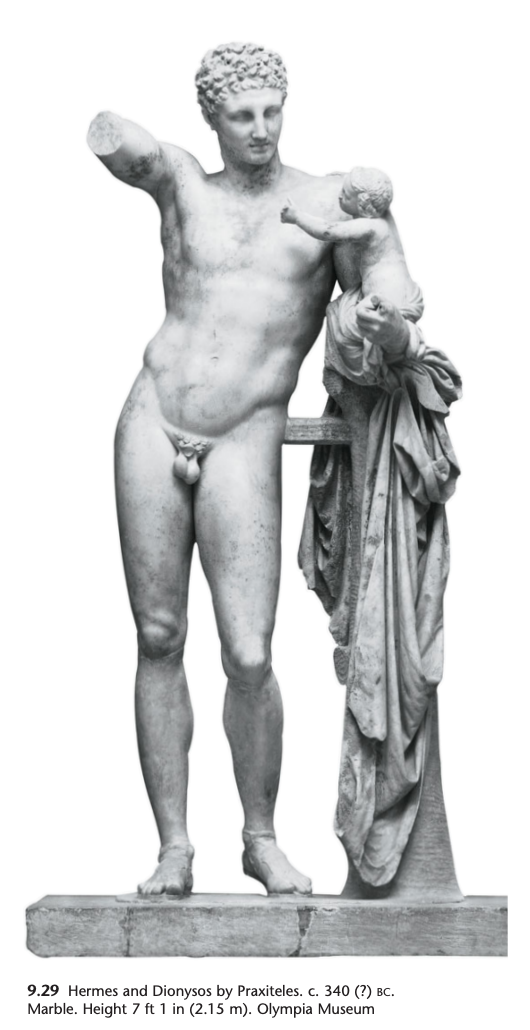
Hermes and Baby Dionysos - Praxiteles. Fourth Century, 400 - 300 BCE.
2.15 m - marble
Sculpted by Praxiteles
Found from the text
Languid “S” curve
Contrapposto stance exaggerated (Hermes), balanced by Dionysus
Playfulness
Dionysus grabbing the grapes held by Hermes, wanting wine
Smokiness = fumato → Lack of harsh lines (ex. undercut of pectoral)
Nice flow of overall piece (s curve, fumato, balance from Dionysus)
What’s new?
More expression (ex. deeper eyes/heavier lids), hair curls more dramatic, babies look more accurate
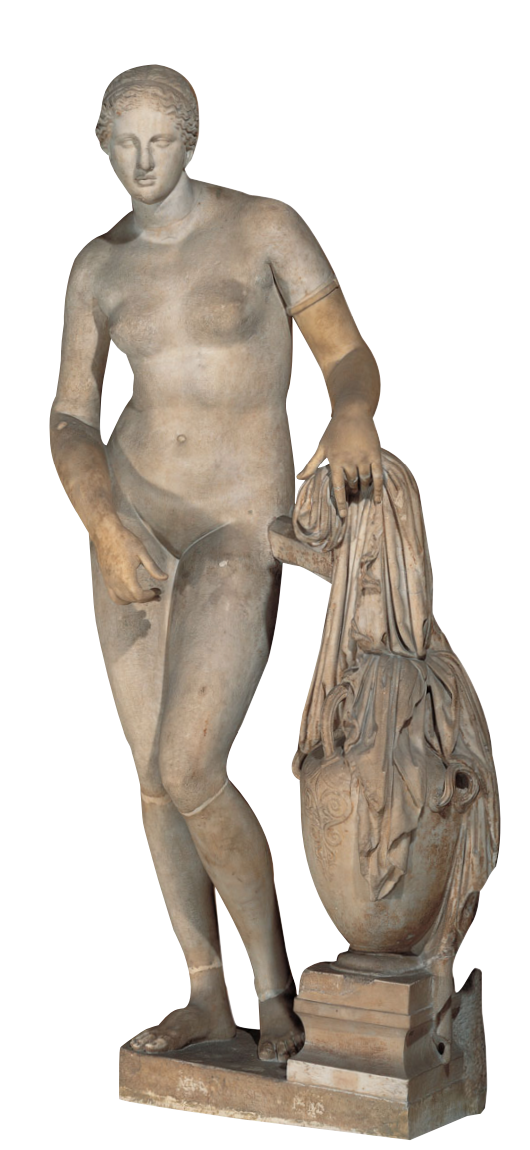
Aphrodite from Knidos - Praxiteles. Fourth Century. 400 - 300 BCE.
2.04 m
Sculpted by Praxiteles
Contrapposto, “S” curve, fumato → 4th century but more detailed
Cult statue (architecture)
Overt sexuality, fully nude female statues are new - modelled after a prostitute
Aphrodite = goddess of love sex
Either taking off/on her clothes
Pudica = playful?
New shorthand: Hand covering genitalia (esp for women)
Like the Tyrranicides chop
Sexual or playful?
Statue inside a round (knidos: new in fourth century)
Can be viewed 360
Genitalia can be seen in other angles
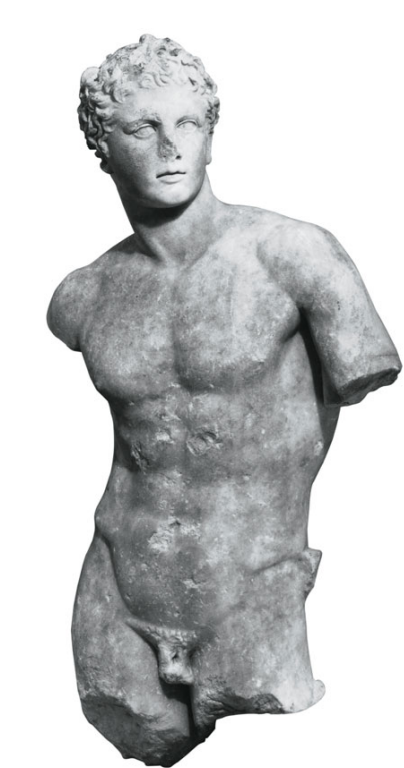
Meleager – Skopas. Fourth Century. 400 - 300 BCE.
1.23 m
Sculpted by Skopas
No fumato
More definition in body (ex. hair, face, clavical, pubic hair, scrotum)
clear-cut muscles
More torsion
Pulls the left shoulder forward to balance the rightward thrust of the hip, to emphasize the importance of the immediate view (3/4 view)
Compare to a statue with no torsion: discus thrower
The full-frontal view of Classical sculpture, seen in the broad expanse of the torso, is now declining
Trying to convey an emotion (ex. face)
Ambiguous expression - self-absorbed far away look? or determined and humanly involved
Deeper cut eyes
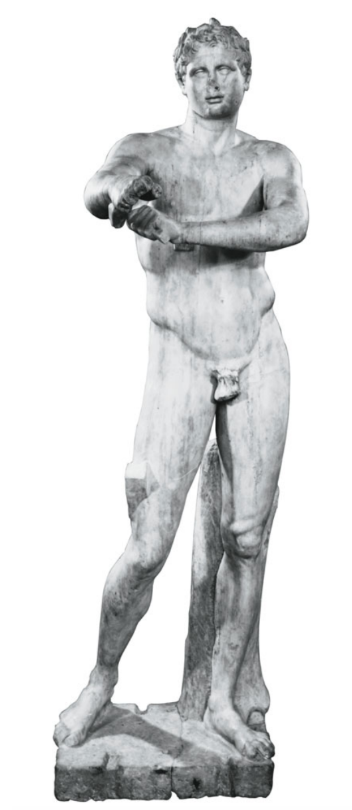
Apoxyomenos (Scraper) – Lysippos. Fourth Century. 400 - 300 BCE.
Called “the scraper” - cleaning body with olive oil + sand
2.05 m
Sculpted by Lysippos
Breaks frontality/square approach
Invades viewers space
Must use multiple viewing angles to understand piece
Unlike Hermes grapes
Better torsion
Contrapposto but muscles more bunched/twisted in the back
Symmetry now is 1:8 (Kouros were 1:6)
Taller to fix foreshortening - looks perfect when you look up
Better biomechanics, use of different viewer angles
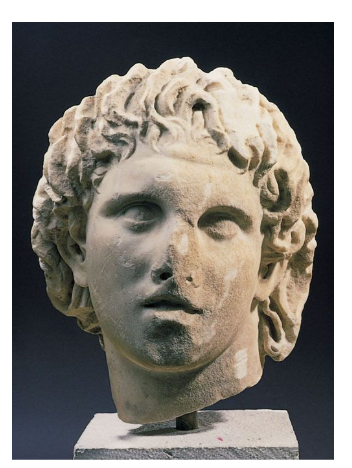
Head of Alexander the Great. Fourth Century. 400 - 300 BCE.
Sculpted by Lysippos
Less frontal and stuff
Tilt of the head
Capture inner qualities of the person, not exactly like actualy face
For A.T.G, he was never satisfied - always thinking for what’s next
Deep cut eyes
Anastole
Small hair curl in the middle of forehead
Physiognomics: connecting facial signs to personality, like analyzing animal faces to understand humans or depicting ideal features linked to cultural superiority
Physical hair = metaphor
Longer 3-D hair > Lion’s mane > Courage
Tilt of the head > Thinking about future
Sharp eyes
Appears in other media like coins
Copied in antiquity - shorthand
Ex. Pomepei the great has an anastole > reference to A.T. G
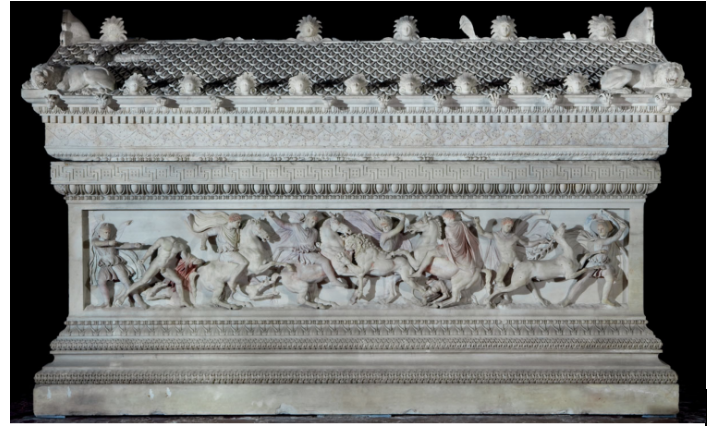
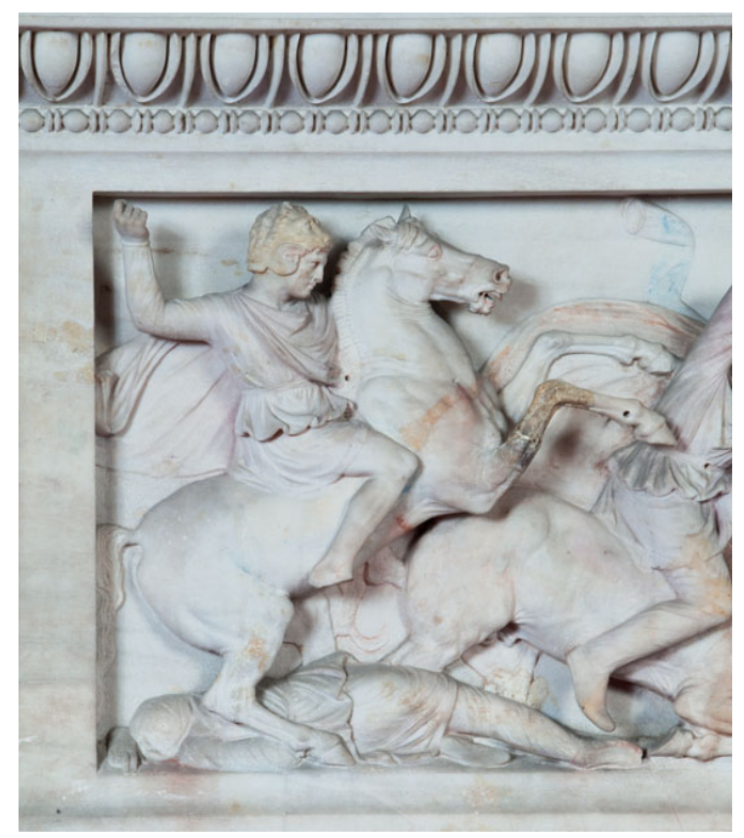
Alexander Sarcophagus. Fourth Century. 400 - 300 BCE.
NOT Alexander’s coffin, but made after his death
Temple-like work
Depicts Macedonians vs Persians
Engaged in lion hunt
Lion in the middle chomping on horse
Overhand chop beside lion (Tyranncides)
Like Dexelias relief - horse rearing, spear to kill lion
Alexander wears a lion hat > earliest 3-D portrait of him > imitating Hercules
Shows 4th century poses, dynamism, and theatricality
More dynamic/force/energy: pulling head
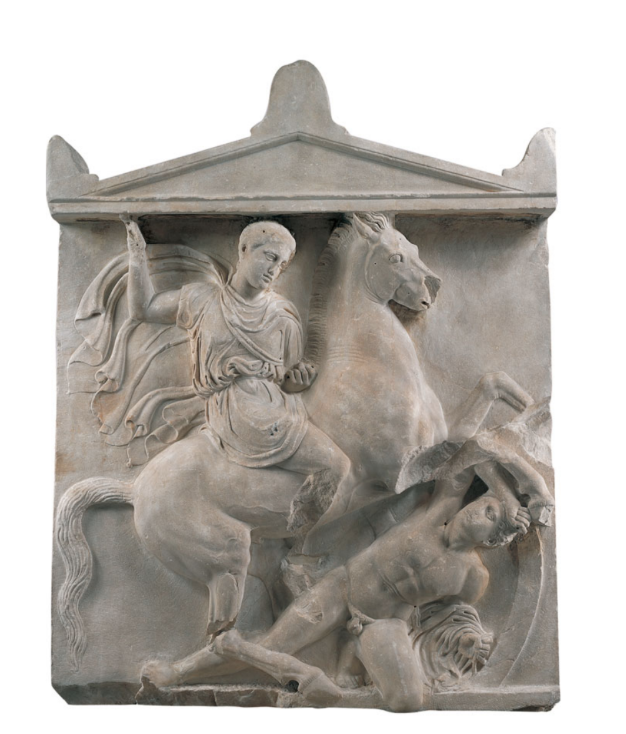
Grave Stele of Dexileos. Fourth Century. 400 - 300 BCE.
Ca. 390 BCE
Gravemarker
Athens - kerameikos
Style from Acropolis
New: pose and energy
Head from Parthenon
Male wet look
Amazon falling away pose
Sumtuary law of 310 BCE - only columns w sculpture
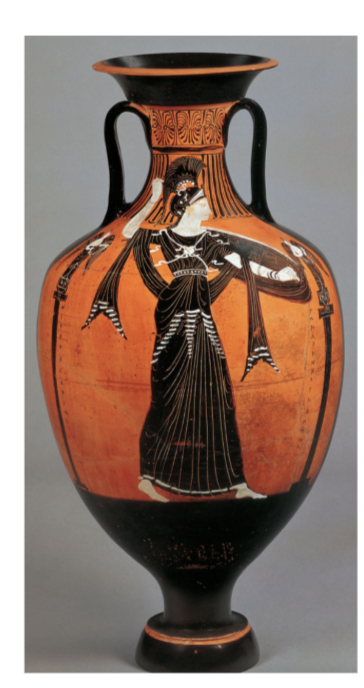
Attic Panathenaic Amphora. Fourth Century. 400 - 300 BCE.
Black-figure technique
Victor prizes for Panathenaic games celebrating Athena
Style never really changes
Usually depicts Athena on one side and a scene from the games on the other
Here it shows an armed Athena, with a scene from the “pankration” (like wresting and boxing) on the other side
Looks Archaic = archaistic
Athena
Painters inscribed the name of the “archon,” chief magistrate, of the year on these pots, so that may can be dated precisely
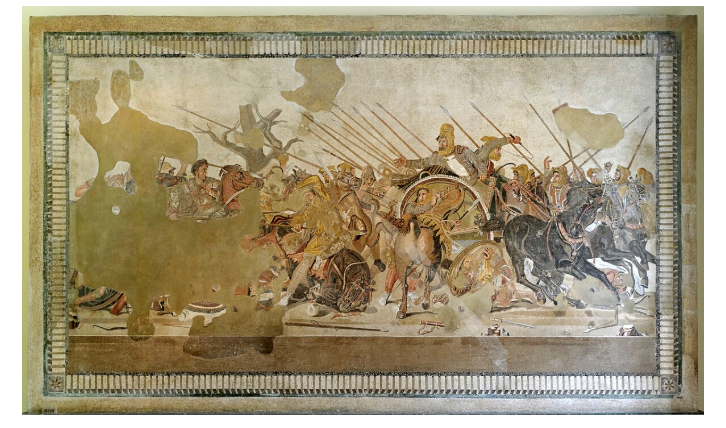
Alexander Mosaic. Fourth Century. 400 - 300 BCE.
Battle of Isos: a Roman copy of a lost Greek painting
Depicts the turning point in the battle
Persian King Darius admits defeat and flees while Alexander charges forward, spear ready, symbolizing the power shift and collapse of Persian resistance
No longer a pebble mosaic, but made of tesserae (2 mil)
Tesserae = small cubes of coloured glass + stone
Background empty
Except for the debris of battle, the foreground is also empty
Focus on the figures
Modelled with foreshortening and bold use of light and shade
Foreshortening of horse
Reflection in shield of killed Persian
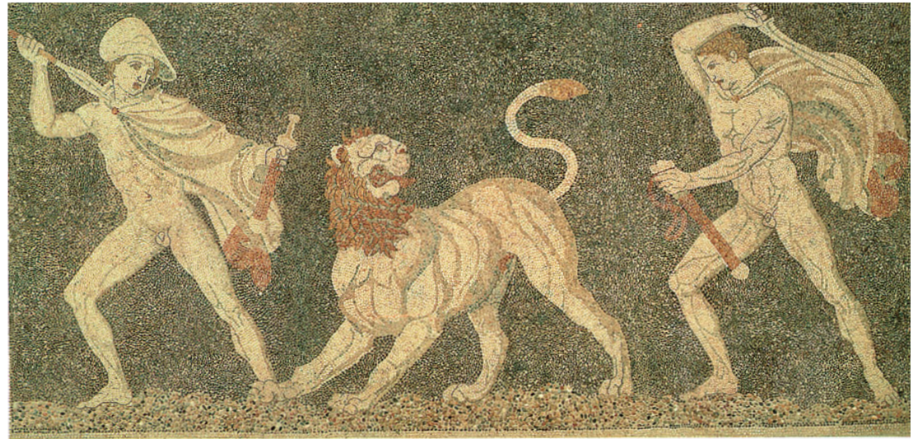
Lion Hunt Mosaic – Pella. Fourth Century. 400 - 300 BCE.
Lion hunt with Alexander the Great (on the right)
Alexander the Great:
Downward chop
About to get killed, but friends distracted the lion, lion killed
Figural mosaic (looks like a picture or painting)
Pebble mosaic
3 colours
Little overlapping of figures and little use of shading
Emphasis on diagonal lines and contours
Metal contours - lead for details
Gives little sense of space
Refers to royal activities
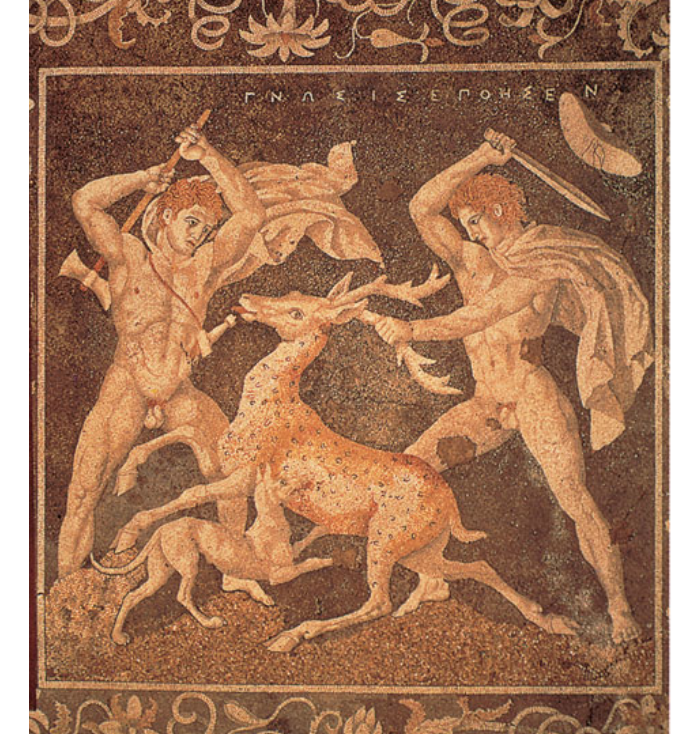
Stag Hunt Mosaic – Pella. Fourth Century. 400 - 300 BCE.
Bordered, but panel in the middle is called an “emblema”
Light figures against a dark background
Musculature modelled by shading
Displays various views of the body
Contours strengthened by strips of terracotta or lead
Pebble mosaic
But more closely packed and uniform in size
Colours other than black and white are used: yellow, brown, red added to highlight details and contribute to shading