Biology 103 (exam 3)
 Call Kai
 Learn
 Practice Test
 Spaced Repetition
 Match
 Flashcards
 Knowt Play
1/15

There's no tags or description
Looks like no tags are added yet.
16 Terms
Cytosolic receptors
Translated by free ribosomes
Plasma membrane receptors
Translated by ER bound ribosomes
Direct ELISA
can be used to detect secreted proteins (such as those found in blood) because we include a standard or calibration curve = exact amount
Indirect ELISA
used for antibodies
Western blot
investigates protein size, cell-associated proteins, or post-translational modifications (phosphorylation)
Immunohistochemistry
Identifies where protein is expressed in tissue
qRT-PCR
used to quantify mRNA
Glucose and Na+ enter the cell
Requires the Na/K ATPase to create a concentration gradient (secondary active transport)
Glucose leaves the cell when the Na/K pump inc.
Facilitated diffusion
Active Transport
- Uses an integral membrane protein
- Polar (e.g., Na+, Ca2+, glucose)
- Low to high
- ATP required
Facilitated diffusion (characteristics)
- Uses integral membrane protein
- Polar (e.g., Na+, Ca2+, glucose)
- High to low
- No ATP
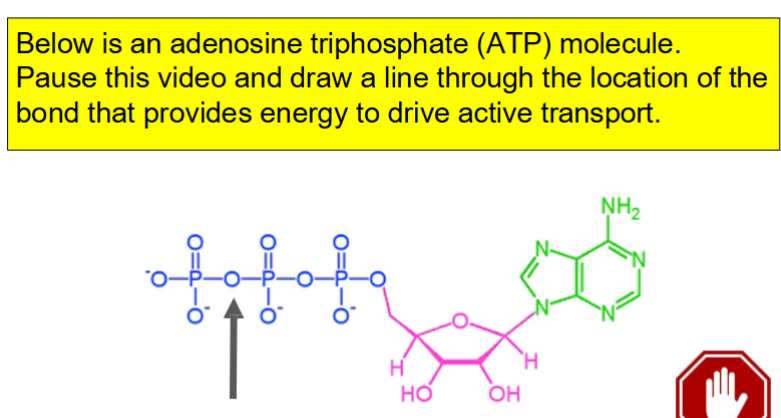
How does ATP drive active transport?
The bond between the beta and gamma phosphate splits creating ADP and one phosphate group
Adaptive Immunity
A “B” or “T” cell binds to an antigen (recognition), self-specific antigen receptors are destroyed, antigen receptor binds to a specific epitope and cloning occur of b and t cells, immunological memory
How adaptive immunity defends against infection
Humoral immune response (antibodies help neutralize or eliminate toxins in blood)
Cell-mediated immune response (specialized T cells kill infected host cells)
How helper t cells activate adaptive immunity
foreign molecule must be present that can bind specifically to the antigen receptor of the helper t cell
antigen must be displayed on the surface of an antigen presenting cell