A&P lab quiz 3
 Call Kai
 Learn
Learn Practice Test
 Spaced Repetition
 Match
Match Flashcards
 Knowt Play
1/102

There's no tags or description
Looks like no tags are added yet.
Name | Mastery | Learn | Test | Matching | Spaced | Call with Kai | Chat |
|---|
No analytics yet
Send a link to your students to track their progress
103 Terms
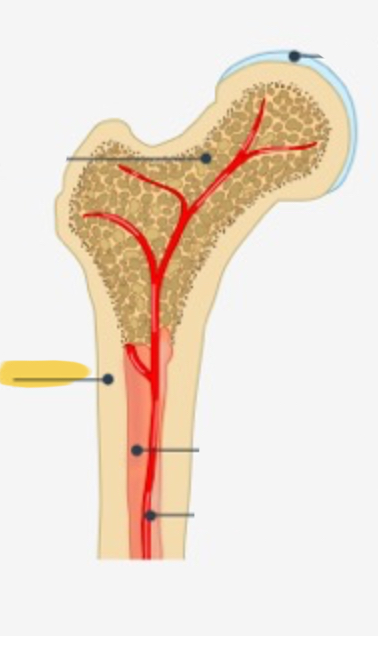
Diaphysis

Epiphysis

Periosteum
a thin, dense membrane that covers the outer surface of most bones in the human body

Endosteum
a thin, vascular membrane of connective tissue that lines the inner surfaces of bones

Articular cartilage
Smooth, white tissue that covers the ends of bones where they come together to form joints

Trabecular (spongy) bone
a porous, lightweight form of bone tissue that makes up about 20% of the human skeleton

Medullary cavity
the hollow central space inside the shaft of long bones where bone marrow and blood vessels are stored

Bone marrow
a soft, spongy tissue inside the center of most bones that acts as the body’s primary factory for producing new blood cells

Compact bone
A dense, hard, outer layer of bone tissue made of organized structural units called osteons
Osteon
the fundamental cylindrical structural and functional units of compact bone

Lacuna
Small, fluid-filled spaces or cavities located between the concentric rings of the bone matrix

Osteocyte
A mature, star-shaped bone cell that forms from an osteoblast trapped inside the hard bone matrix

Canaliculi

Central canal
A narrow, fluid-filled channel that runs the entire length of the spinal cord

Lamellae
thin, flat plates, scales, or membrane layers found across various biological and physical structures

Frontal bone
a single, shell-shaped flat bone that forms the forehead and the upper part of the eye sockets in the human skul

Parietal
Two curved, quadrilateral flat bones that form the upper sides and roof of the human skull

Temporal
A complex, paired bone located at the sides and base of the skull that houses the organs of hearing and balance

Mastoid process
A prominent, cone-shaped bony projection of the temporal bone located directly behind and below the ear

Zygomatic process
a bony projection that extends from the side of the skull to join with the cheekbone

Styloid process
a slender, needle-like piece of bone that sticks out from the base of the skull just beneath the ear

Mandibular fossa
Smooth, oval depression on the temporal bone of the skull that houses the lower jaw’s condyle to form the jaw joint

External auditory meatus

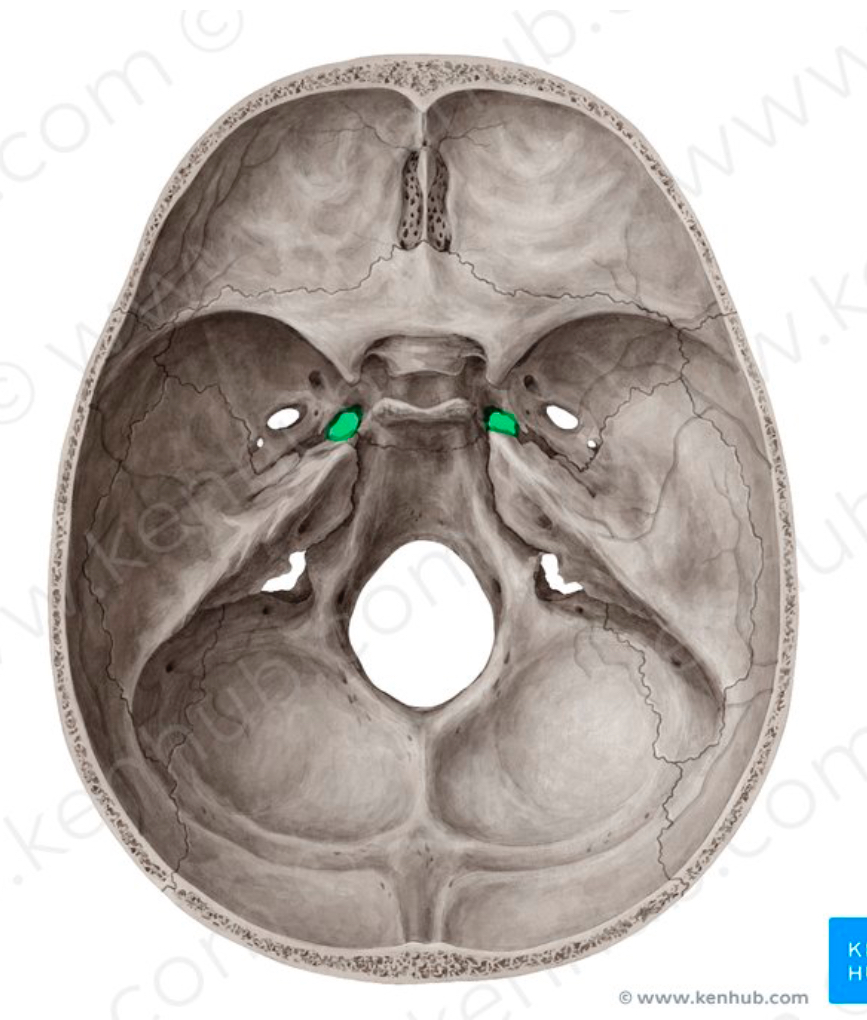
Internal auditory meatus
A small, bony tube in the temporal bone of the skull that connects the inner ear to the brain

Carotid foramen
The external opening of the carotid canal

Jugular foramen
A large opening at the base of the skull that lets major blood vessels and cranial nerves pass between the brain and the neck

Occipital bone
A flat, trapezoidal-shaped cranial bone located at the lower back and base of the skull

Foramen magnum
The largest opening at the base of the skull, through which the spinal cord connects to the brain

Occipital condyles
Two kidney-shaped bony prominences on the base of the skull that link the head to the neck

Sphenoid bone

Lesser wing
a thin, triangular plate that projects sideways from the upper and front part of the sphenoid body in the middle of the skull base

Greater wing
a large, curved bony process extending from the side of the sphenoid bone in the skull, positioned just behind each eye

Sella turcica
A small, saddle-shaped depression located in the sphenoid bones the base of the skull that holds and protects the pituitary gland

Optic foramen
A bony passageway in the sphenoid bones of the skull that connects the eye socket to the middle cranial fossa
Superior orbital fissure
a triangular cleft in the skull located at the apex of the eye socket between the greater and lesser wings of the sphenoid bone, connecting the middle cranial fossa to the orbit

Inferior orbital fissure
An elongated gap in the skull located between the floor and the lateral wall of the orbit

Pterygoid process
a paired bony projection that extends downward from the base of the skull at the sphenoid bone

Ethmoid bone
A lightweight, spongy, and cube-shaped unpaired bone in the skull that separates the nasal cavity form the brain and helps form the inner eye sockets

Cribriform plate
A horizontal, sieve-like bony structure located at the roof of the nasal cavity and the floor of the anterior cranial fossa

Olfactory foramina
tiny openings in the cribriform plate that allow the olfactory nerve fibers to pass from the nasal cavity to the brain

Crista galli
A small, triangular bony ridge that projects upward from the middle of the ethmoid bone inside the skull

Superior nasal conchae
A small, curved bony plate located on the upper-back part of the lateral wall of the nasal cavity

Middle nasal conchae
A thin, curved bony plate attached to the lateral wall of the nasal cavity that warms, moistens, and filters inhaled air

Perpendicular plate
A thin, flat piece of bone inside the skull that forms the upper part of the nasal septum

Coronal sutures
A dense, fibrous joint connecting the frontal bone of the forehead to the two parietal bones across the top of the skull form ear to ear

Sagittal sutures
a fibrous joint running along the top center of the skull that connects the two large parietal bones

Squamous sutures
a paired, arched fibrous joint located on the lateral side of the skull that connects the temporal bone to the parietal bone

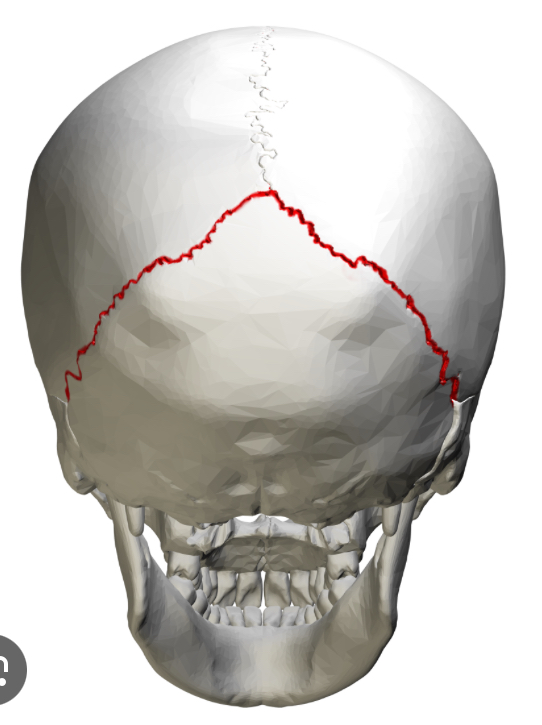
Lambdoid suture
A dense, fibrous joint located at the back of the skull that connects the two parietal bones with the occipital bone
Infant anterior (fontanelle)
diamond shaped membranous gap on top of an infants head where the frontal and parietal skull bones meet

Infant posterior fontanelle (occipital)
a small, triangular soft spot located at the back of a baby’s head that typically closes within 2 to 3 months of birth

Infant anterolateral fontanelle (sphenoidal)
a paired, membrane-covered soft spot located on the side of a newborns skull

Infant posterolateral fontanel (mastoid)
A paired soft spot located on the posterolateral side of an infants skull, just behind the ear where the temporal, parietal, and occipital bones intersect

Maxilla

Alveolar process
The thickened ridge of bone in the maxilla and mandible that contains the tooth sockets and holds the teeth in place

Palatine process
a thick, horizontal bony plate that projects medically from the maxilla

Mandible
The lower jawbone and the largest, strongest bone in the human face

Mandibular ramus

Mandible body
the curved, horseshoe-shaped horizontal portion of the lower jawbone that supports the lower teeth and shapes the lower facial contour

Mandibular condyle
The rounded upper projection of the lower jawbone that connects to the lower skull to form the temporomandibular joint

Mental foramen
a small, safe opening on the front and outside part of the lower jawbone that lets nerves and blood vessels pass through to the face

Palatine
A paired, l-shaped facial bone located at the back of the nasal cavity between the maxilla and the sphenoid bone

Lacrimal
The smallest and most fragile bone of the facial skeleton, tear duct area

Nasal
Two small, oblong bones that sit side by side at the upper middle part of the face to form the bridge of the nose

Vomer

Zygomatic

Temporal process

Inferior nasal concha

Frontal Sinus

Sphenoidal sinus

Ethmoid sinus

Maxillary sinus

Hyoid bone

Vertebral body

Vertebral pedicle

Intervertebral foramen

Lamina

Vertebral foramen

Transverse Process

Spinous process

Superior articular process

Inferior articular process

Transverse foramen

Bifid spinous process

Atlas

Axis

Odontoid process

Facet for rib articulation

Sacrum

Superior articular process of the sacrum

Articular facet
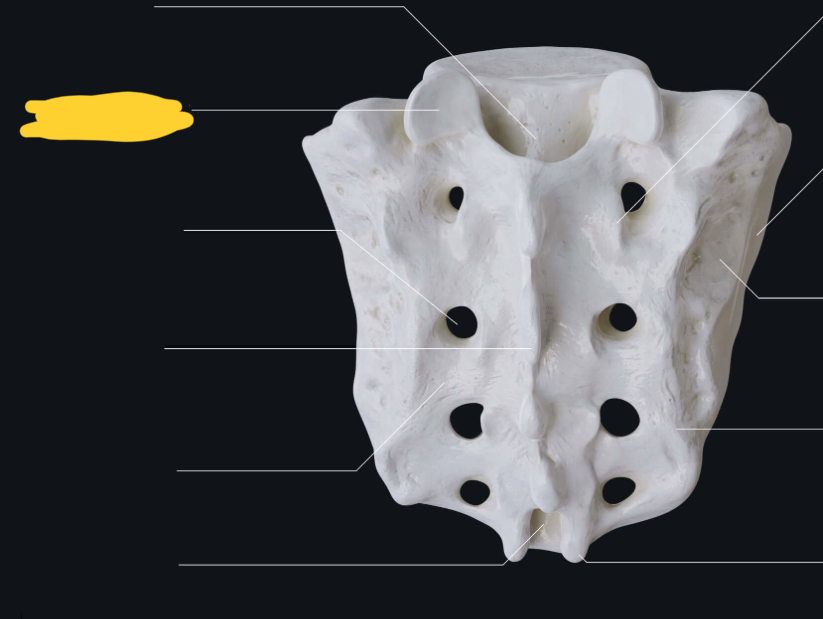
Sacral promontory

Median sacral crest

Anterior sacral foramina

Posterior foramina

Coccyx

Sternum

Manubrium

body

Xiphoid process

spinal head
