MAST451 - Unit 2 Exam
 Call Kai
 Learn
 Practice Test
 Spaced Repetition
 Match
 Flashcards
 Knowt Play
1/99

There's no tags or description
Looks like no tags are added yet.
100 Terms
Phylum Mollusca - Body Plan
Hypothetical Ancestral Mollusc (HAM)
Major features of the Hypothetical Ancestral Mollusc (HAM)
1) Bilateral Symmetry
2) Lack of Segmentation
3) Body organization into:
head, foot, visceral mass, mantle

Phylum Mollusca - Main Body Regions
Head
Foot
Visceral mass
Mantle

Phlyum Mollusca - Head
Mouth w/ radula (radula not always present)
Sensory structures (eyes, tentacles)
Ganglia of nervous system (clusters of nerve cell bodies)
Phylum Mollusca - Foot
muscular for crawling, burrowing, clinging
in-sessile bivalve → secretes attachment material to hard substrate
in cephalopods → modified into tentacles, arms, funnel (if present)
Phylum Mollusca - Visceral Mass
bulk of body, contains:
gut
digestive glands
excretory organs
pericardial cavity
gonads
Phylum Mollusca - Mantle
tissue covering visceral mass
secretes shell, typically hangs as posterior fold creating mantle cavity (gills + anus)
Molluscan Function: Feeding
Radula:
common feeding structure
ribbon of chitin + protein
2 rows of chitinous teeth (point backwards, worn away, replaced)
odontophore below radula/cartilage + muscle (odontophore + radual = buccal mass)

Molluscan Gas Exchange & Circulation - Ctenidium (Ctenidia)
Gill
usually paired, hang in mantle cavity
covered w/ cilia to move water through cavity
Osphradia (sensory)
Exhalant water include waste + gametes

Molluscan Gas Exchange & Circulation - Development of Transport System
Development of Transport System for Body Fluid
lacking in Porifera, Cnidaria, Ctenophora, Platyhelminthes
circulatory system allows for more efficiency
^ size + ^ activity

Molluscan Gas Exchange & Circulation - Heart w/ 2 Atria
which receives oxygenated blood from gills
one ventricle which receives atrial blood + pumps to body via 1 or 2 arteries

Molluscan Gas Exchange & Circulation - Circulatory Systems
Open Circulatory System
blood leaves vessels
ventricle → aorta → smaller arteries → sinuses → veins → gills → atria → ventricle….and so on..
blood = hemolymph
Closed Circulatory System
blood is always in vessels
heart ventricle → aorta → smaller arteries → capillaries → veins → gills → heart atria → heart ventricle…and so on..
Molluscan Gas Exchange & Circulation - Blood
Blood often contains proteins that bind to O₂ to CO₂
which increases solubility of these in blood and magnifies diffusion gradients
Hemocyanin
copper group
pale blue when bound to O₂
Molluscan Gas Exchange & Circulation - With Counter Current Exchange
fully deoxygenated blood meets increasingly oxygenated water, equilibrium never reached

Molluscan Gas Exchange & Circulation - Without Counter Current Exchange
fully deoxygenated blood meets fully oxygenated water, an equilibrium reached

Molluscan Shell
Periostracum (outer organic layer)
cross-linked proteins
added at mantle edge
Prismatic (think + calcareous)
below periostracum
laid by mantle epidermis
prisms of calcium carbonate (calcite) at right angles to periostracum
Nacreous (inner calcareous layer)
thin sheets by mantle epidermis
protein/sugar, surrounded crystals (aragonite)

The Molluscan Groups - 7 Classes
1) Class Monoplacophora
2) Class Polyplacophora (chitons)
3) Class Aplacophora
4) Class Scaphopoda (tusk shells)
5) Class Gastropoda (snails, slugs, nudibranchs)
6) Class Bivalvia (clams, oysters, mussels, scallops)
7) Class Cephalopoda (squid, octopodes, nautilus, cuttlefish)
Class Gastropoda
Largest mollusc class w/ 40,000 species
“Stomach Foot”
Marine, freshwater, terrestrial
Mostly benthic, but some sessile + pelagic
Gastropod - Modifications
1) Dorso-ventral elongation of body
visceral mass sits atop the muscular foot
2) Shell as protection
predation + dessication
body can quickly withdraw
columellar muscle attach body to shell
left or right handed
3) Torsion
4) Gas Exchange
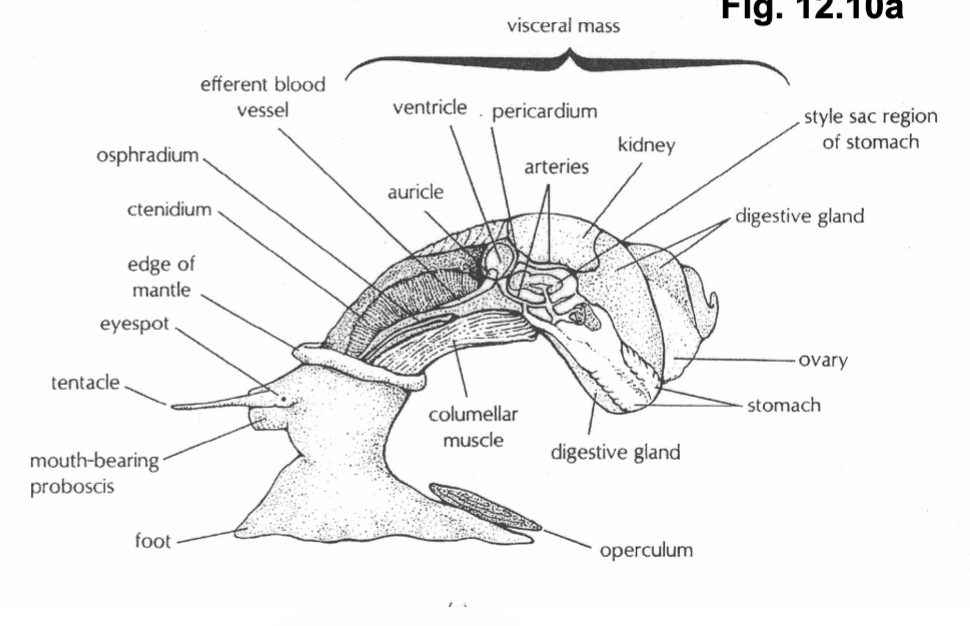
Gastropod - Left or Right Handed Shell
“sinistral” = left
aperture opens to left of columella
“dextral” = right
aperture opens to right of columella

Gastropod - Modifications TORSION
counter-clockwise twisting of the visceral mass by 180 degrees during early development
3 consequences:
1. mantle cavity (ctenidia + anus)
2. digestive tract is now looped
3. Nervous system is twisted into figure 8
What is the adaptive significance of torsion in gastropods?
Torsion is larval adaptation
Larval head is vulnerable + would be the last part withdrawn into untorted shell
Torsion brings mantle cavity anteriorly, for more rapid head withdraw
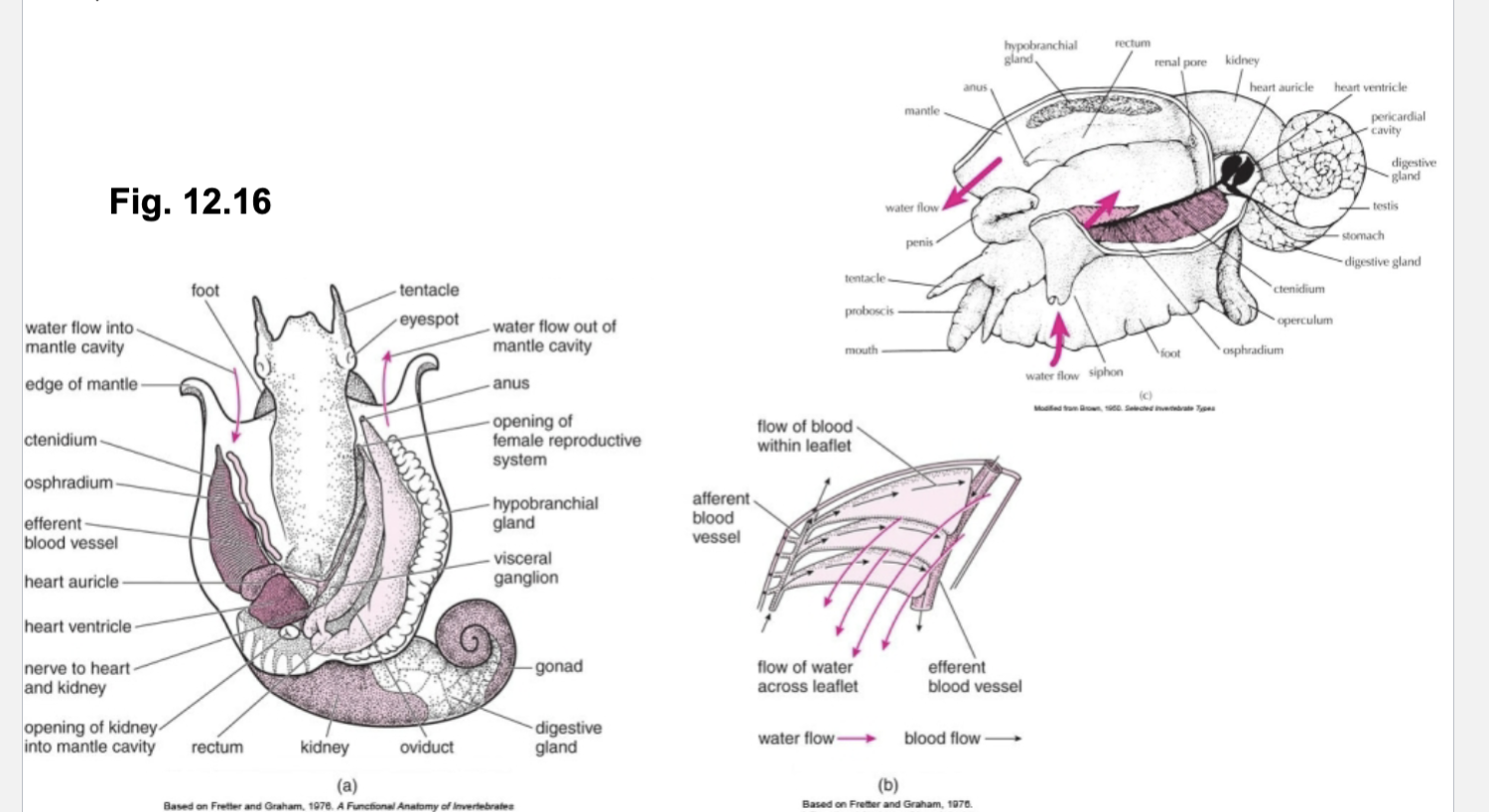
Gastropod - Modifications GAS EXCHANGE
H₂O into animal by siphon, over gills, into mantle cavity
counter-current exchange
oxygenated blood to heart
deoxygenated blood from hemocoel (fluid-filled internal body cavity, for open circulatory system)
Class Bivalvia - Modifications
1) Two-piece shell
2) Lack of cephalization
3) Absence of radula or teeth (crystalline style (rod-like structure found in digestive tract) grinds food against gastric shield)
4) Large mantle cavity (mantle: secrete shell, form mantle cavity, form siphons)
5) Sedentary, burrowing life style
foot reduced in mussels, scallops, oysters, which don’t burrow
6) Respiration + Feeding
food collection is done by labial palps (function similar to arms and push food towards esophagus)
Class Bivalvia - Two-piece Shell
2 valves held together by an elastic ligament
“teeth” near hinge which interlocks + keeps valves from slipping
typically 2 adductor muscles (anterior + posterior)
contracts = shell closes
relaxes = ligaments spring shell open

Class Cephalopda - Modifications
1) Head merged with foot
2) Large size (Largest invertebrate)
3) High Activity
4) Shell is reduced
5) Skin with chromatophores
6) Cephalization + sensory systems
Cephalopods - Head merged with foot
cephalopod = “head foot”
mouth + eyes are part of head, arms + tentacles + funnel are derivatives of foot
funnel is moving water in and out of mantle cavity (propulsion + gas exchange)
Cephalopods - High Activity
jet propulsion (squid, cuttlefish)
crawling (octopus)
closed circulatory system (No Counter Current Exchange)
low O₂ carrying capacity
Cephalopods - Shell is reduced
squid: internal pen (gladius = sword-shaped internal structure, made of chitin)
cuttlefish: internal shell, reduced
octopodes: highly reduced
nautilus have external shell
siphuncle = calcified tube (thread-like tube, used to control buoyancy

Cephalopods - Skin with Chromatophores
cells with pigment
muscles expand and contract chromatophores, changing skin color and pattern
nervous control
skin color influences: predator avoidance, competition, matin displays
Cephalopods - Cephalization + Sensory Systems
highly advanced
learning + memory
excellent eyes → convergent to vertebrate eye (sight-based predators)
bioluminescence in deep sea species

Phylum Annelida
segmented worms
smaller then 1 m to > 2m
+12,500 species
Phylum Annelida - Characteristics
Setae or Chaetae
High degree of Metamerism
Segmentation by transverse septa
Metanephridia

Phylum Annelida - Setae
Setae or Chaetae
chitinous bristles on each segment
locomotion (creates friction)
Class Polychaeta = many setae
Class Clitellata:
Subclass Oligochaeta = many setae (earthworms)
Subclass Hirudinea = no setae (leeches)

Phylum Annelida - High Degree of Metamerism
Serial repetition of the body + organ systems into similar body segments
Arranged in a linear series along the anterior - posterior axis
Some segments fuse to form one specialized segment
(EX: Prostomium = fused anterior segments forming head)

Phylum Annelida - Segmentation by Transverse Septa
Septa form from mesoderm (peritoneum)
Present in larva, adult, or both
Septa divide the coelom into discrete compartments (each with its own coelomic fluid)
Hydrostatic skeleton is created by coelomic fluid
Advantages of a Coelom + Metamerism in Annelids
faster/more efficient burrowing + movement
independen movement of segments
some can bulge, others can narrow
Anterior ▬ Posterior = circular muscles contract, segment narrows/elongates
Anterior ▮ Posterior = longitudinal muscles contract, segment widens/shortens
Phylum Annelida - Metanephridia (excretory organs)
some wastes are excreted at the body wall
most waste is voided at the nephridia
ciliated funnel (nephrostome) draws in coelomic fluid (non-selective)
selective reabsorption into capillaries
aids in osmoregulation
active secretion into neph. tubule
final urine at nephridiopore

Metanephridium
nephridial tubule that opens into the coelom by a ciliated funnel (nephrostome) and exits the body wall by a nephridiopore
Annelids: Major Taxa
Class Polychaeta (30% of Annelid species)
marine polychaetes
deep sea tube worms
Class Clitellata
Subclass Oligochaeta (earthworms)
Subclass Hirudinea (leeches)
Echiurans (spoon worms)
Sipunculids (peanut worms)
Class Polychaeta : Characteristics
1) “Parapodia” extend from body segments
2) Setae (Chaetae) project from parapodia
3) Head (Prostomium)
Polychaeta Characteristics: Parapodia
“Parapodia” extend from body segments
fleshy, paddle-like appendages of body wall
Each parapodium is biramous (2 parts)
w/ dorsal lobe (notopodium)
w/ ventral lobe (neuropodium)
active, benthic crawlers have well-developed parapodia setae
burrowers have reduced parapodia

Polychaeta Characteristics: Setae (Chaetae)
Setae project from parapodia
chitinous
locomotion mostly
some w/ hooks used to grip tube/burrow walls
defense
toxins released when broken
Polychaeta Characteristics: Head (Prostomium)
w/ sensory structures
eyes, antennae, palps
Class Polychaeta: Function Biology
Diversity of feeding strategies
Raptoral feeders, Deposit feeders, Filter feeders
Respiration
Blood + Circulation
Excretion + Osmoregulation
Reproduction

Polychaeta Biological Function: Raptoral Feeders
various inverts, algae, dead animals
capture prey w/ eversible pharynx
w/ jaws (2 or more)
jaws seize food + pharynx retracts
Polychaeta Biological Function: Deposit Feeders
non-selective or selective
non-selective = apply mouth to substrate + consume mud/sand
selective = organic matter selected from between sand/mud particles + conveyed to mouth (ciliated grooves)
Polychaeta Biological Function: Filter Feeders
head w/ specialized feeding structures to collect plankton + direct to mouth (ciliated grooves)
Polychaeta Biological Function: Respiration
most w/ gills on body surface
many pump seawater through burrow
parapodia actas as gills
sedentary w/ gills extending from burrow opening
Hemoglobin is often the blood respiratory pigment
Polychaeta Biological Function: Blood + Circulation
closed circulatory system
blood flows by body peristalsis
vessel contraction in some (no true hearts)
posterior to anterior (dorsal blood vessel)
anterior to posterior (ventral blood vessel)
Polychaeta Biological Function: Excretion + Osmoregulation
metanephridia in most
more primitive species without blood vascular system w/ protonephridia
Polychaeta Biological Function: Reproduction
sexual + gonochoristic
gametes produced by peitoneum + released into coelom to mature
“Epitoky” = morphological transformation in advance of reproduction
Fertilization is external in sea water
Trochophore larvae
Class Polychaeta: Family Siboglinidae
~150 sp. marine, mostly deep sea
gas exchange through cephalic lobe
live in chitinous tube
no septa
trophosome = symbiotic microbes (sulfur/methane oxidizing bacteria), lacks digestive tract (feeds on DOM or carbon from symbionts)

Class Clitellata: Subclass Oligochaeta
~3500 sp. 65% marine
clitellum = thickened anterior region, swollen by mucous producing glands
cocoon production + copulation
simultaneous hermaphrodites w/ testes + ovaries
Oligochaete: Characteristics
1) Well-developed segmentation
2) No parapodia
single chaetae
peristalsis helps movement/burrow
3) Prostomium is simple (not elaborate)
Class Clitellata: Subclass Hirudinea
~600 sp. most freshwater or terrestrial
derived from oligochaete
no parapodia, prostomium appendages
lack chaetae
reduced segmentation
coelom w/ mesenchyme
suckers (anterior + posterior) used for locomotion
Class Echiura (Spoon Worms)
~160 sp.
shallow, sand/mud
2° loss of segmentation
extensible, muscular proboscis
brain located inside
ciliated for deposit feeding
anal sacs + metanephridia
process coelomic fluid + pass to rectum
gonochoristic

Class Sipuncula (Peanut Worms)
~350 sp.
shallow water
mud/sand, vacant shells, tubes
“introvert”
anterior structure fully retracts into body
mucous-covered tentacles for deposit feeding
no chaetae, no segmentation
no circulatory system BUT blood respiratory pigment in hemerythrin = coelomic fluid
“urns” clusters of cells, collect waste in coelomic fluid, release at body wall or metanephridia

Phylum Arthropoda
“jointed foot”
Largest - 75% of described animals
Marine, freshwater, terrestrial
~1 million sp.
Two phyla related to Arthropoda
Onychophora
Tardigrada
Arthropoda: Similarities w/ Onychophora
~100 sp.
Annelid-like:
non-jointed appendages
one pair of excretory organs per segment
muscle
Arthropod features:
some striated/skeletal muscle
trachea-like gas exchange
mouth appendages
reduced coelom (hemocoel)
Arthropoda: Similarities w/ Tardigrada
~900 sp.
“Water bears”
interstitially in marine but most live in freshwater
similar body plan to arthros:
lack jointed appendages
no calcified cuticle
not perfect protostomes
cryptobiosis (metabolic activity stops in response to extreme environmental stress)

Arthropoda: Characterisitics
1) Chitinous exoskeleton
2) Jointed, segmented appendages
3) Striated muscle + neural control
4) Ecdysis
Arthropoda: Chitinous Exoskeleton
support, protection, movement because of a rigid skeleton
polysaccharide + some protein
hardened by:
Calcium Carbonate
Sclerotization (protein cross linking)
Secreted by epidermal cells
Ex: crustacean cuticle
epicuticle ~3% of total exoskeleton thickness
lipoprotein
waterproof but limit gas exchange
procuticle: bulk of exoskeleton (chitin + some protein)

Arthropoda: Jointed, Segmented Appendages
procuticle is thin + flexible in many body regions
joints where segments articulate
pairs of antagonistic muscles
coelom is not involved in locomotion
rather coelom is a small hemocoel (“circulatory system”)
locomotion by contraction/relaxation of striated/skeletal muscles
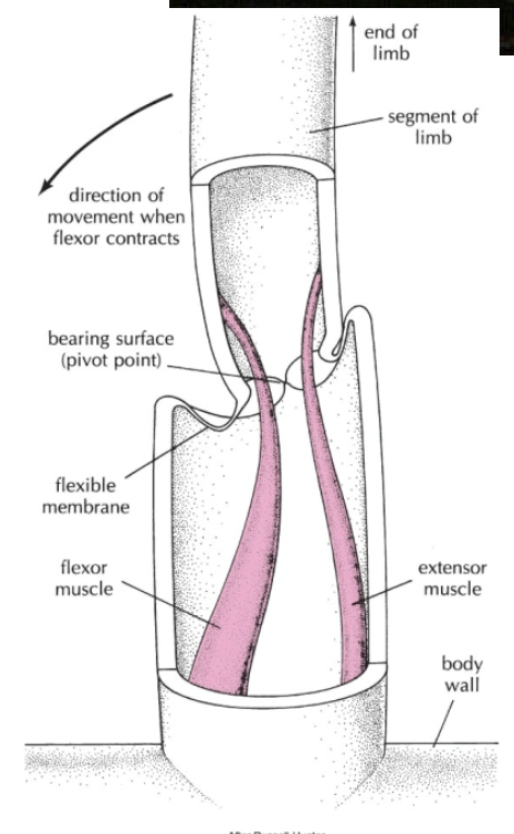
Arthropoda: Striated muscle + Neural control
most inverts have smooth muscles but arthros have striated muscle
quick contractions
poly-neuronal innervation
Arthropoda: Ecdysis
shed exoskeleton to grow
molting
exuvium = old exoskeleton
ecdysis = splitting old skeleton + crawling out + forming new skeleton

Arthropod Growth: 4 stages to molt cycle
Pre-ecdysis - preparatory feeding, Ca²⁺ release into bloof
Ecdysis - shedding of exoskeleton
Post-ecdysis - calcification/hardening of new exoskeleton
Intermolt - period between molts
Arthropod Growth: Epidermis
Epidermis secretes proenzymes
digest base of old exoskeleton
Epidermis secretes a new epicuticle + molting fluid, old exoskeleton about to be shed
Arthropod Growth: Forming New Skeleton
Proenzymes digest endocuticle
New procuticle added
Exoskeleton splits @ weak points
ex: anterior margin in limulus abdomen of crab + animal crawls out
“soft shelled”
shell then hardens
What happens when an arthropod loses a limb?
limb bud forms
new limb forms on new exoskeleton @ pre-ecdysis
new limb unfolds during ecdysis
Arthropod Growth: Control of Molt Cycle
hormones control molt cycle
ex: crustacean = y-organ in head produces ecdysteroid hormones, which trigger ecdysis process
inhibition process - MIH - molt inhibiting protein
produced in x-organ + sinus glands of eye stalks
inhibits ecdysone production + function
other hormones control ecdysone

Main Arthropod Groups
Subphylum Trilobitomorpha = Trilobites
Subphylum Chelicerata (Classes Merostomata, Arachnida (not discussed), Pycnogonida)
Arthropod: Subphylum Trilobitomorpha (Trilobites)
~4000 sp., all extinct
Cambrian, extinct 285 mya.
Benthic
Oval w/ 3 lobes

Arthropod: Subphylum Chelicerata
2 body regions
prosoma
opisthosoma
lack antennae
Chelicerae = 1st pair of feeding appendages
2nd pair are pedipalps
4 pairs of walking legs
Arthropod: Subphylum Chelicerata - Class Merostomata
horseshoe crabs
Cambrian
4 extant sp.
shallow water, soft bottoms
omnivores, feed on molluscs, annelids, algae

Class Merostomata: Characteristics
one pair of lateral compound eyes
8 other “simple” eyes (dorsal + ventral surface)
6 pairs of prosome appendages
Chelicerae = 5 walking legs (pedipalps + 4)
gnathobase (armed, spiny modification, helps eating)
opisthosome is not segmented
6 pairs of appendages
1st are reproduction
other 5 are book gills
respiration
locomotion

Arthropod: Subphylum Chelicerata - Class Pycnogonida
~1160 sp.
lack distinct tagmata
reduced opisthosome
Ovigers - used to carry fertilized eggs
groom legs
carry eggs in males


Class Crustacea: Characteristics
1) 3 tagmata
head, thorax, abdomen cephalothorax
2) Head w/ 5 appendage pairs
1st antennae, 2nd antennae, mandibles, 1st maxillae, 2nd maxillae
3) Thorax w/ 8 thoracopods
maxillipeds (1-3) - handle + sort food
pereopods (4-8) - locomotion
4) Abdomen w/ 6-7 segments
appendages = pleopods
swimming, jumping, respiration, copulation, brooding eggs
5) Biramous appendages
branched

Crab vs. Shrimp
Crab: shortened body, no uropods, pleopods modified for reproduction, enlarged cheliped
Shrimp: elongated body, uropods, pleopods (swimming, respiration, reproduction), reduced cheliped
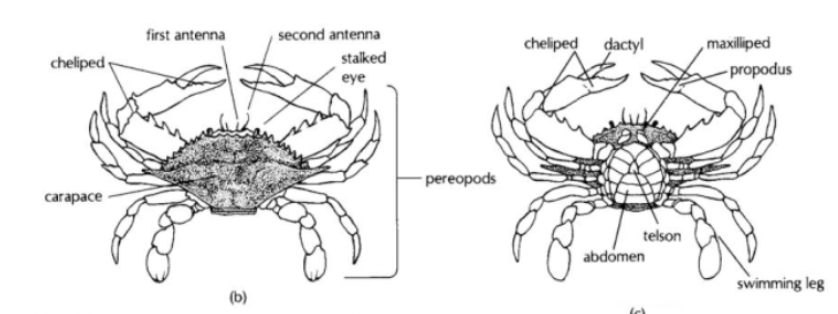
Class Crustacea: Reproduction
Gonochoristic
internal fertilization w/ sperm storage
spermatophore in some sp.
maintenance of eggs or not
Many marine taxa have larvae that hatch from egg + develop w/in plankton (meroplankton)
ex: callinectes

Development in Crustaceans: Copepods
1st - Nauplius
2nd - After 4-5 molts, Copepodite
3rd - After 5 molts, Adult
Development in Crustaceans: Barnacles
1st - Nauplius
2nd - After 3-5 molts, Cyprid
3rd - After smelling SIPC (settlement inducing protein complex, pheromone), Adult
Development in Crustaceans: Arthropods/Isopods
Direct development
Adults use thoracic marsupium (carry their fertilized eggs in a water-filled ventral brood pouch)
Class Crustacea: Respiration & Excretion
Open Circulatory System
Most w/ hemocyanin
Gas exchange @ gills (bronchial chamber or @ base of pleopods)
Ammonia waste (through gills)
Antennal/green glands for salt/water balance

Class Crustacea: Digestion
extracellular digestion
cardiac + pyloric stomachs w/ gastric mill
hepatopancreas

Class Crustacea: Nervous System
highly developed
sensory (eyes + vision)
motor adaptations
conserved
Why is the mantle important in molluscs?
It covers the visceral mass, secretes the shell, and typically forms the mantle cavity containing the gills and anus.
How does counter-current exchange improve gas exchange?
Blood meets increasingly oxygenated water, maintaining an oxygen diffusion gradient and allowing more oxygen to enter the blood.
Why don’t bivalves have a radula?
They commonly filter-feed, using their gills to collect food and labial palps to move it toward the mouth.
How does torsion benefit gastropods?
It moves the mantle cavity toward the front, allowing the vulnerable head to withdraw into the shell more quickly.
How do cephalopods use their funnel?
They force water through the funnel for jet propulsion and water movement through the mantle cavity.
Why is a hydrostatic skeleton useful to annelids?
Coelomic fluid provides support against which muscles work, allowing segments to change shape for movement and burrowing.
What is the difference between setae and parapodia?
Setae are bristles used mainly for locomotion; parapodia are fleshy, paired appendages that often bear setae.
How do metanephridia help annelids maintain homeostasis?
They remove wastes and selectively reabsorb substances, helping regulate water and salt balance.
What is the advantage of segmentation in annelids?
Segments can move somewhat independently, allowing more efficient movement and burrowing.
Why must arthropods molt to grow?
Their rigid exoskeleton limits expansion, so they shed it and form a larger new exoskeleton.
What would happen if MIH stopped inhibiting molting hormones?
Inhibition of ecdysteroid production would decrease, potentially allowing the molting process to begin.
How do crustacean appendages differ from typical chelicerate appendages?
Crustaceans typically have branched (biramous) appendages, while chelicerates have specialized appendages including chelicerae and pedipalps.
How do horseshoe crab book gills function?
They primarily perform gas exchange and can also assist with locomotion.