Knee Gait Deviations
 Call Kai
 Learn
 Practice Test
 Spaced Repetition
 Match
 Flashcards
 Knowt Play
1/21

Earn XP
Description and Tags
Chapter 12
22 Terms
Knee Gait Deviations
Sagittal (most common)
Frontal
Transverse (often inconsistent and unreliable)
Sagittal Deviations
Limited knee flexion
Knee hyperextension
Extensor thrust
Excess knee flexion
Excess contralateral knee flexion
Wobble
Limited Knee Flexion
Definition
Less than normal flexion for given phase
Phases
LR, PSw, ISw
Functional significance
LR: decrease shock absorption and quads demand
PSw, ISw: disrupts foot clearance and may lead to foot drag
Causes
Quads weakness (LR)
Quads or PF spasticity (LR, PSw, ISw)
Knee or patella-femoral knee joint pain
Knee extension contracture
Limited thigh advancement due to over-active hamstrings or weakness of hip flexors
Impaired proprioception
Primitive muscle synergies interfering with ability to combine knee flexion with extension at adjacent joints
Limited Knee Flexion - Causes LR
Quads weakness
Quads spasticity
Limited Knee Flexion - Quads Weakness
This is a VOLUNTARY limitation of knee flexion
Hip extension (glutes, adductor magnus) active to retract thigh
Premature ankle PF (soleus) to limit tibial advancement
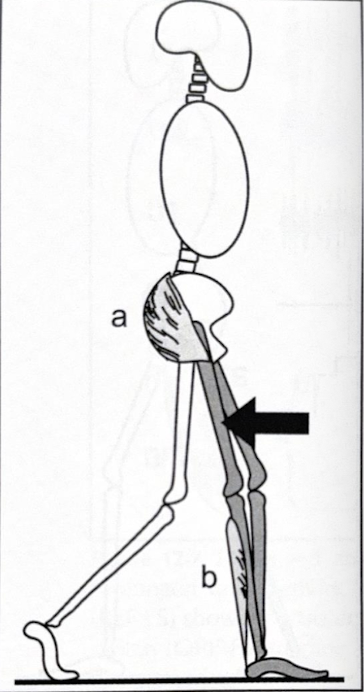
Limited Knee Flexion - Quads Spasticity
This is an INVOLUNTARY limitation of knee flexion
Knee extension (Rectus Femoris, Vastii) extend knee
Quick stretch of Quads during stance phase knee flexion engages spastic response

Limited Knee Flexion - Other Causes
Hip flexor weakness (PSw to ISw)
Passive double-pendulum knee flexion starts with active hip flexion
The thigh stays vertical and the knee relatively extended
Inappropriate hamstring activity
Prolonged or premature hamstrings during PSw
Knee Hyperextension
Definition
Knee posterior to anatomic neutral (genu recurvatum)
Phases
IC, LR, MSt, TSt, PSw
Functional significance
Decreased quads demand
Decreased WA shock absorption and forward progression
Decreased MSt, TSt, PSw forward progression and prep for SLA
Causes
Quads weakness (LR)
Quads weakness + PF weakness (SLS)
Quads and PF spasticity
PF contracture (severe)
One Knee Hyperextension Mechanism
Constraint of tibia during proximal forward momentum

Extensor Thrust
Definition
Forceful motion of knee toward extension (dynamic, rapid)
Phases
LR, MSt
Functional significance
Decreased quads demand
Decreased WA shock absorption and forward progression
Causes
Quads weakness
Quads or PF spasticity
Forefoot contact + PF contracture - “jump knee”
Proprioceptive deficits at knee

Excess Knee Flexion
Definition
Greater than normal knee flexion for given phase (”Crouch gait”)
Phases
LR, MSt, TSt, TSw
Functional significance
WA, SLS: increased quads demand
TSw: decreased step length and forward progression
Causes
PF weakness/excessive length
KF/HF contracture/spasticity
Primitive pattern
Knee pain
Excess Knee Flexion - LR
Excessive ankle DF

Excess Knee Flexion - MSt
Excessive ankle DF

Excess Knee Flexion - TSt
Excessive ankle DF
No heel rise
Lack of trailing limb posture
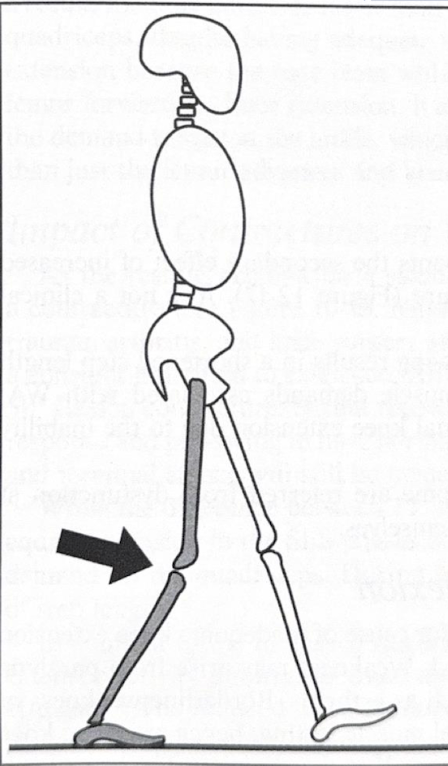
Excess Contralateral Knee Flexion
Definition
Greater than normal knee flexion of contralateral limb
Phases
Contralateral limb’s stance phases
Functional significance
Lowers body toward ground
Functionally lengthens reference limb
Causes
Same as previous
Intentional KF to lower short limb to the ground
Wobble
Definition
Rapid alternating flexion and extension during a single phase
Phases
LR, MSt, TSt
Functional significance
Decreased forward progression and stability
Increased energy cost
Causes
Lack of proprioception (search for stability)
PF or quads hypertonicity (clonus)
Frontal Deviations
Abduction (valgus)
Adduction (varus)
Excessive Valgus
Definition
Excess lateral deviation of distal tibia from knee’s center “knock knee”
Phase
Stance phase
Functional significance
Decreased stability
May necessitate compensation at other joints
Pain
Causes
Joint instability
Bony deformity
Pain
Ipsilateral abductor weakness
Ipsilateral trunk lean

Excessive Varus
Definition
Excess medial deviation of distal tibia from knee’s center
Phases
Stance phase
Functional significance
Decreased stability
May necessitate compensation at other joints
Pain
Causes
Joint instability
Bony deformity
Degenerative joint changes
Pain

Static Causes
Static malalignment mechanisms
Congenital or developmental deformities
Trauma (MCL/LCL strain) → ligamentous laxity → valgus/varus deformity
Dynamic Causes
Dynamic factors
Persistent yielding to malaligned tibia
Longterm OA, RA, paralytic gluteus medius
Static vs. Dynamic Causes
Bone growth responds to the forces it experiences