Pure 2 - Exponential and Logarithm
 Call Kai
 Learn
Learn Practice Test
 Spaced Repetition
 Match
Match Flashcards
 Knowt Play
1/10

Earn XP
Description and Tags
11 Terms
What’s an exponential function?
f(x) = ax
(where f(x) = y)
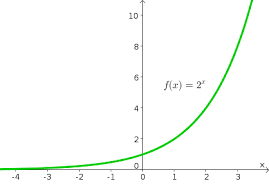
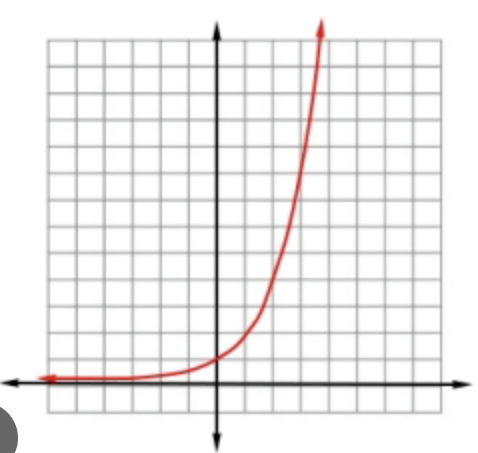
Define increasing function (condition + description) of f(x) = ax
Condition = a > 1
Description = as x increase, f(x) increase exponentially. As x decrease, f(x) get closer to 0
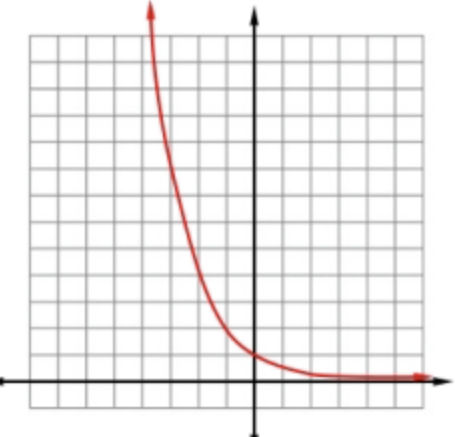
Define decreasing function (condition + description) of f(x) = ax
Condition = a < 1 AND a > 0
Description = as x increase, f(x) get closer to 0. As x decrease, f(x) increase exponentially
Define logarithm and shows the relationship between it and exponential function
Define = an inverse exponential function
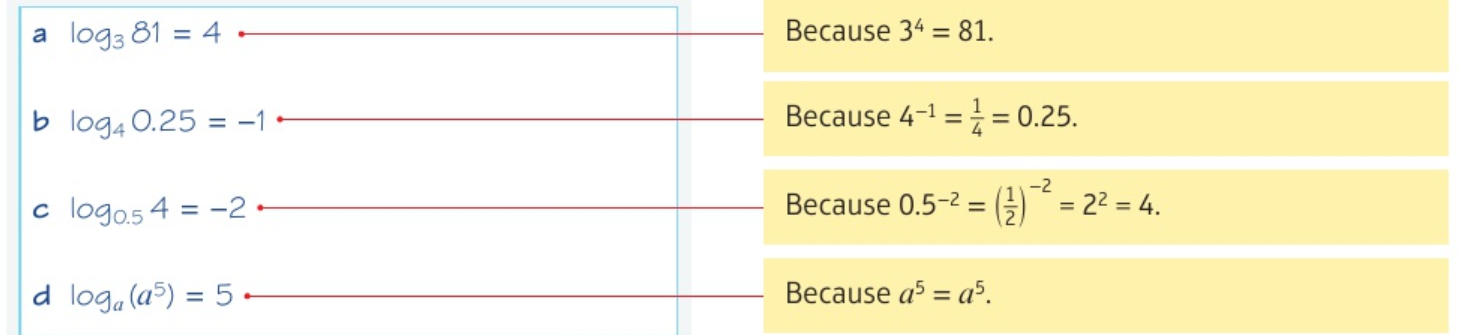
[Loga n = x ] is equivalent to [ax = n] (where ‘a’ is not equal to 1)

What’s Loge x
Inverse function of ex where e is Euler number (2.7182…)
On calculator = [In] button, input [ In(x) ]
Laws of Logarithm
logaX + logaY = logaXY (multiplication law)
logaX - logaY = logaX/Y (Division law)
loga(Xk) = k logaX (Power law)
List all special cases of Logarithm laws
loga(1/x) = loga(X-1) = - loga(X) (power law when k = -1)
loga a = 1 ( a > 0 , a <> 1)
loga 1 = 0 ( a > 0, a <> 1)
Why can’t this work : log2(-4)
logaX is an inverse function of exponential function. There’re no index/power that can make the base number turns negative
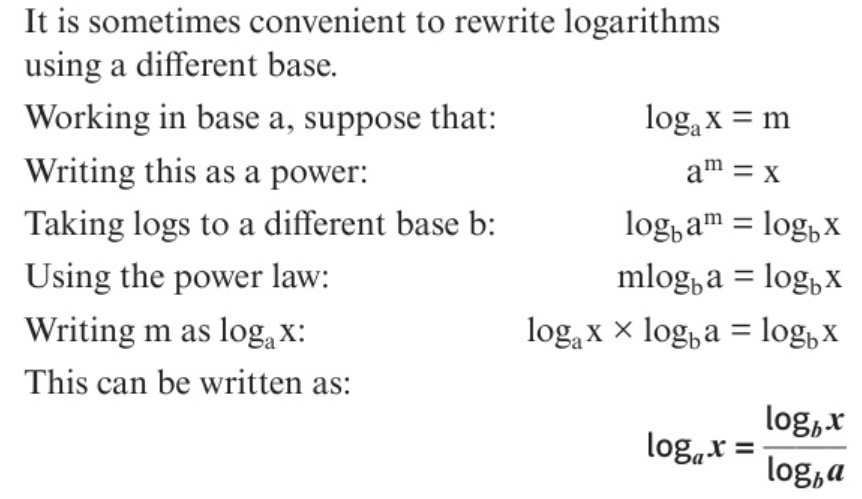
What is the “change of base” formula (and its special case)
logab = logxb / logxa ( x could be any number)
Special case: logab = logbb / logba = 1 / logba
Deduce the “change of base formula”