chapter 11: senses
 Call Kai
 Learn
Learn Practice Test
 Spaced Repetition
 Match
Match Flashcards
 Knowt Play
1/39

There's no tags or description
Looks like no tags are added yet.
Name | Mastery | Learn | Test | Matching | Spaced | Call with Kai | Chat |
|---|
No analytics yet
Send a link to your students to track their progress
40 Terms
transducer/transduction**
transduction: the conversion of stimulus energy into information that can be processed by the nervous system
the first step of how receptors convert diverse physical stimuli, such as light or heat, into electrical signals?
The receptor, or sensor, is a transducer that converts the stimulus into an intracellular signal, which is usually a change in membrane potential.
proprioception**
There are four somatosensory modalities: touch, proprioception, temperature, and nociception, which includes pain and itch.
on the right side (ipsilateral).
chat:
the sense of where your body and body parts are positioned and how they are moving, without needing to look at them.
Example: You can close your eyes and still know that your arm is raised above your head.
chemoreceptor**
Chemoreceptors respond to chemical ligands that bind to the receptor (taste and smell, for example).
Smell and taste are both forms of chemoreception, one of the oldest senses from an evolutionary perspective
It appears that chemoreceptors for “tasting” the environment are also found in other places in the body, including the upper airways and on sperm
Unicellular bacteria use chemoreception to sense their environment, and primitive animals without formalized nervous systems use chemoreception to locate food and mates.
It has been hypothesized that chemoreception evolved into chemical synaptic communication in animals.
mechanoreceptor**
Mechanoreceptors respond to various forms of mechanical energy, including pressure, vibration, gravity, acceleration, and sound (hearing, for example)
thermoreceptor**
Thermoreceptors respond to temperature
photoreceptor**
photoreceptors for vision respond to light.
receptor potential**
the change in sensor membrane potential is a graded potential [Fig. 9.7] called a receptor potential.
In some cells, the receptor potential initiates an action potential that travels along the sensory fiber to the CNS.
In other cells, receptor potentials influence neurotransmitter secretion by the sensor, which in turn alters electrical activity in an associated sensory neuron.
receptive field**
somatic sensory and visual neurons are activated by stimuli that fall within a specific physical area known as the neuron’s receptive field.
For example, a touch-sensitive neuron in the skin responds to pressure that falls within its receptive field.
somatosensory cortex
somatosensory cortex [Fig. 10.13] is the part of the brain that recognizes where ascending sensory tracts originate. Each sensory tract has a corresponding region of the cortex, its sensory field.
All sensory pathways for the left hand terminate in one area, all pathways for the left foot terminate in another area, and so on (FIG. 11.9).
Within the cortical region for a particular body part, columns of neurons are devoted to particular types of receptors.
![<p><strong>somatosensory cortex</strong> [Fig. 10.13] is the part of the brain that recognizes where ascending sensory tracts originate. Each sensory tract has a corresponding region of the cortex, its sensory field. </p><ul><li><p>All sensory pathways for the left hand terminate in one area, all pathways for the left foot terminate in another area, and so on (FIG. 11.9). </p></li><li><p>Within the cortical region for a particular body part, columns of neurons are devoted to particular types of receptors.</p></li></ul><p></p>](https://assets.knowt.com/user-attachments/91ad3d98-02ae-4cef-911f-8c78c579c33d.png)
nociceptor
Nociceptors {nocere, to injure} are the free nerve endings (Fig. 11.1a) of primary sensory neurons.
Nociceptors are found in the skin, joints, muscles, bones, and various internal organs, but not in the central nervous system (one reason patients can be awake during certain types of brain surgery).
Nociceptors respond to a variety of strong noxious stimuli that cause or have the potential to cause tissue damage, and their activation initiates adaptive protective responses.
For example, discomfort from overuse of muscles and joints warns us to take it easy and avoid additional damage to these structures.
Afferent signals from activated nociceptors are carried by primary sensory fibers to the CNS
sensory adaptation
Adaptation of phasic receptors allows us to filter out extraneous sensory information and concentrate on what is new, different, or essential.
In general, once adaptation of a phasic receptor has occurred, the only way to create a new signal is to either increase the intensity of the excitatory stimulus or remove the stimulus entirely and allow the receptor to reset.

olfaction**
Olfaction allows us to discriminate among millions of different odors, and it plays an important role in our sense of taste.
Even so, our noses are not nearly as sensitive as those of many other animals whose survival depends on olfactory cues.

gustation**
Our sense of taste, or gustation, is closely linked to olfaction
hair cell
The fluid waves open ion channels in hair cells, the sensory receptors for hearing.
Ion flow into hair cells creates electrical signals that release neurotransmitter (chemical signal), which in turn triggers action potentials in the primary auditory neurons.
Hair cells, like taste receptor cells, are nonneural receptor cells. The apical surface of each hair cell is modified into 50-100 stiffened cilia known as stereocilia, arranged in ascending height (FIG. 11.18a). The bases of the hair cells rest on the basilar membrane, and the stereocilia of the three rows of outer hair cells are embedded in the overlying tectorial membrane. If the basilar membrane moves, the hair cells move as well.
pupil**
The pupil is an opening through which light can pass into the interior of the eye.
Pupil size varies with the contraction and relaxation of a ring of smooth pupillary muscle.
iris**
The pupil appears as the black spot inside the colored ring of pigment known as the iris.
The pigments and other components of the iris determine eye color.
lens**
The eye itself is a hollow sphere divided into two compartments (chambers) separated by a lens (FIG. 11.24).
The lens, suspended by ligaments called zonules, is a transparent disk that focuses light
Bends the light to focus it on the retina

cornea**
In the first step of the visual pathway, light from the environment enters the anterior surface of the eye through the cornea, a transparent disk of tissue that is a continuation of the sclera.
retina**
The cornea and lens together bend incoming light rays so they focus on the retina, the light-sensitive lining of the eye that contains the photoreceptors.
optic nerve
the optic nerves enter the brain at the optic chiasm.
Increased intraocular pressure is one risk factor for the eye disease glaucoma, characterized by degeneration of the optic nerve.
Research suggests that the optic nerve degeneration in glaucoma may be due to nitric oxide or apoptosis-inducing factors, and studies in these areas are underway
accommodation
The process by which the eye adjusts the shape of the lens to keep objects in focus is known as accommodation, and the closest distance at which it can focus an object is known as the near point of accommodation.
You can demonstrate changing focus with the accommodation reflex easily by closing one eye and holding your hand up about 8 inches in front of your open eye, fingers spread apart.
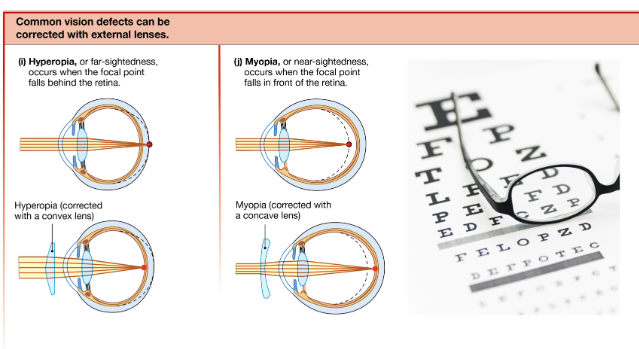
myopia/hyperopia
Two other common vision problems are near-sightedness and far-sightedness. Near-sightedness, or myopia, occurs when the focal point falls in front of the retina (Fig. 11.26j). Far-sightedness, or hyperopia, occurs when the focal point falls behind the retina (Fig. 11.26i).
Recognize that the function of all sensory receptors is transduction of an
environmental signal/energy into an electrical signal**
ok
Distinguish between the special senses and the somatic senses, and give
examples of each**
The five special senses—smell, taste, hearing, equilibrium, and vision—are concentrated in the head region.
There are four somatosensory modalities: touch, proprioception, temperature, and nociception, which includes pain and itch.
Like somatic senses, the special senses rely on receptors to transform information about the environment into patterns of action potentials that can be interpreted by the brain.
chat:
Special = specialized organs
Somatic = body-wide receptors skin/muscles/joints.
Classify a particular sensory receptor as a mechanoreceptor, chemoreceptor, etc.
(e.g. into its “class”)
ok.

Describe the steps of transduction generally in a mechanoreceptor, including
applying your knowledge of how neurons work to these cells
Hearing is a complex sense that involves multiple transductions
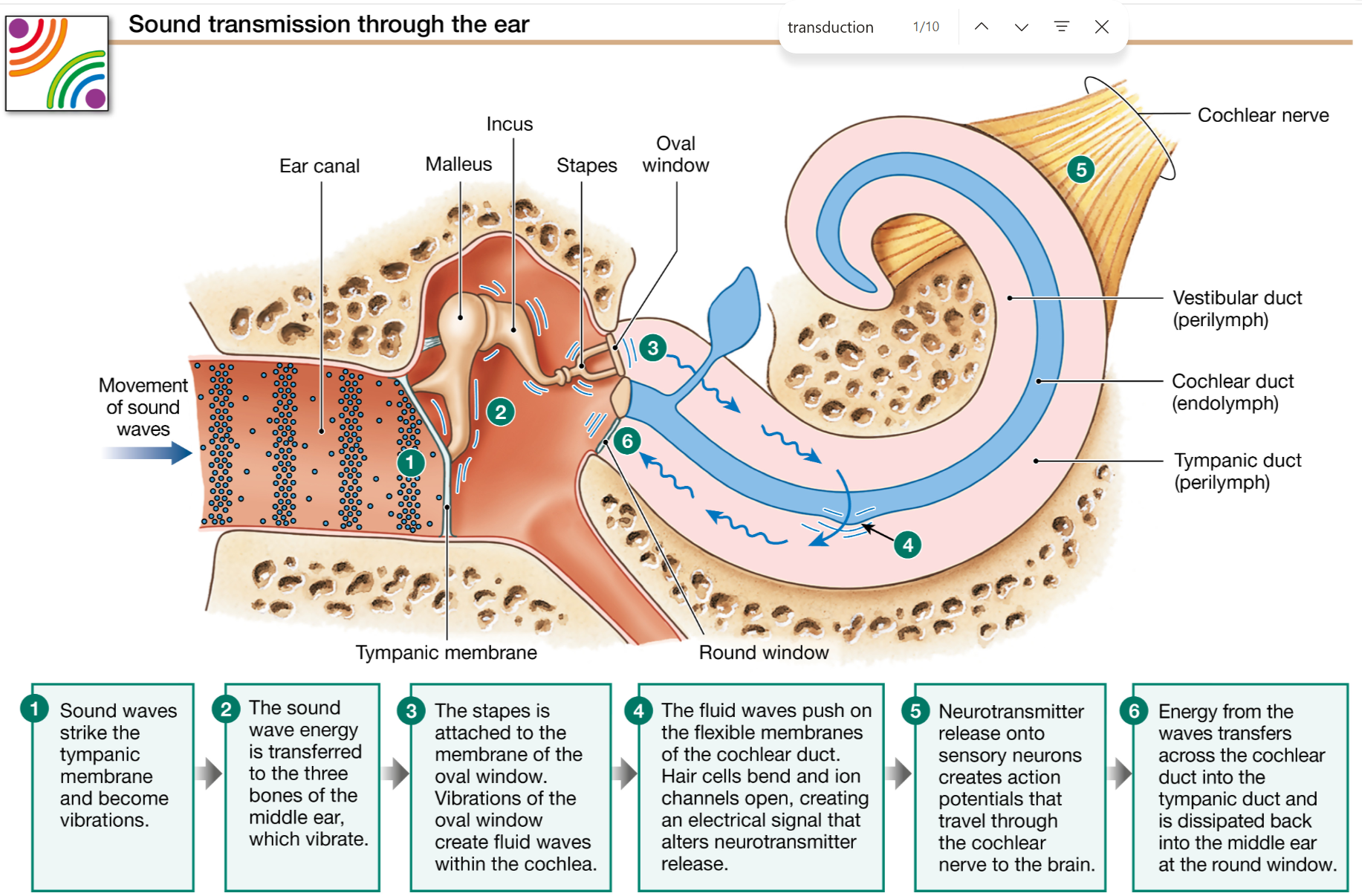
Sound waves striking the outer ear are directed down the ear canal until they hit the tympanic membrane and cause it to vibrate (first transduction).
As the stapes vibrates, it pulls and pushes on the thin tissue of the oval window, to which it is attached. Vibrations at the oval window create waves in the fluid-filled channels of the cochlea (second transduction).
Movement of the cochlear duct opens or closes ion channels on hair cell membranes, creating electrical signals (third transduction).
These electrical signals alter neurotransmitter release (fourth transduction).
Neurotransmitter binding to the primary auditory neurons initiates action potentials (fifth transduction) that send coded information about sound through the cochlear branch of the vestibulocochlear nerve (cranial nerve VIII) and the brain.
Give examples of chemoreceptors and mechanoreceptors
(taste and smell, for example) - chemo
hearing, for example - mechano
Recognize that for a given sensory receptor cell, increased stimulus intensity is
always “coded” as increased action potential frequency, no matter what the
sense**
ok
Distinguish between tonic and phasic receptors, explain the mechanism
underlying the difference and give examples of each
Tonic receptors are slowly adapting receptors that fire rapidly when first activated, then slow and maintain their firing as long as the stimulus is present
In contrast, phasic receptors are rapidly adapting receptors that fire when they first receive a stimulus but cease firing if the strength of the stimulus remains constant
Phasic receptors are attuned specifically to changes in a parameter. Once a stimulus reaches a steady intensity, phasic receptors adapt to the new steady state and turn off.

For each of the major senses, describe the general pathway by which
information travels from sensory receptors to the cerebral cortex
????
Explain how we can identify many more chemicals (smells) than we have
olfactory receptor types
idk
Although smell is sensed by hundreds of receptor types, taste is currently believed to be a combination of five sensations: sweet, sour (acid), salty, bitter, and umami,
Describe or identify several major differences between the human senses of
olfaction and gustation
chat:
Receptors: Olfaction uses true primary neurons; gustation uses modified epithelial cells.
Diversity: Olfaction uses ∼400 receptor types (combinatorial coding); gustation uses 5 basic taste modalities (labeled-line coding).
Brain Pathway: Olfaction bypasses the thalamus; gustation relays through the thalamus (VPM nucleus).
Signal Mechanisms: Olfaction relies on a single cAMP cascade (Golf); gustation uses both direct ion channels (salty/sour) and GPCRs (sweet/bitter/umami).
Stimulus Form: Olfaction detects airborne/volatile chemicals; gustation detects dissolved/water-soluble chemicals.
Describe how people feel touch, hear, taste, smell, and see (e.g., “We hear using
auditory receptors, which are modified mechanoreceptors with cilia on them
that bend when a sound ‘hits’ them, opening ion channels”).
touch: We feel touch using mechanoreceptors (such as Meissner's, Pacinian, and Merkel disks) located in the skin, which open mechanically gated ion channels when physically deformed, stretched, or compressed to trigger action potentials.
hear: We hear using auditory receptors, which are modified mechanoreceptors with cilia on them that bend when a sound ‘hits’ them, opening ion channels
taste: We taste using specialized epithelial receptor cells inside taste buds, where dissolved chemicals either directly enter through ion channels or bind to GPCRs (sweet, bitter, umami) to trigger depolarization and neurotransmitter release onto sensory nerves.
smell: We smell using primary bipolar neurons in the nasal epithelium, whose cilia express ~400 types of G-protein coupled receptors (Golf) that bind volatile airborne molecules, increasing cAMP to open cyclic nucleotide-gated channels.
see: We see using photoreceptors (rods and cones) in the retina, where light photons activate photopigments (like rhodopsin) to trigger a G-protein (transducin) cascade that decreases cGMP, hyperpolarizing the cell to alter neurotransmitter release.
Name the five things we can taste**
taste is currently believed to be a combination of five sensations: sweet, sour (acid), salty, bitter, and umami, a taste associated with the amino acid glutamate and some nucleotides.
Recognize that each of the senses (e.g. hearing, taste, etc.) has a dedicated
region of the cerebral cortex (e.g. auditory cortex) to process its signals
ok
Describe how sound is conducted to the cochlea and then how the sound
stimulates auditory receptors and results in action potentials
The cochlea of the inner ear contains sensory receptors for hearing. On external view the cochlea is a membranous tube that lies coiled like a snail shell within a bony cavity.
The fluid waves open ion channels in hair cells, the sensory receptors for hearing. Ion flow into hair cells creates electrical signals that release neurotransmitter (chemical signal), which in turn triggers action potentials in the primary auditory neurons.
As the stapes vibrates, it pulls and pushes on the thin tissue of the oval window, to which it is attached. Vibrations at the oval window create waves in the fluid-filled channels of the cochlea (second transduction).
Movement of the cochlear duct opens or closes ion channels on hair cell membranes, creating electrical signals (third transduction)
These electrical signals alter neurotransmitter release (fourth transduction)
Neurotransmitter binding to the primary auditory neurons initiates action potentials (fifth transduction) that send coded information about sound through the cochlear branch of the vestibulocochlear nerve (cranial nerve VIII) and the brain.

Explain how the mammalian cochlea provides information about both amplitude
and frequency of sounds to the brain
The cochlea of the inner ear contains sensory receptors for hearing
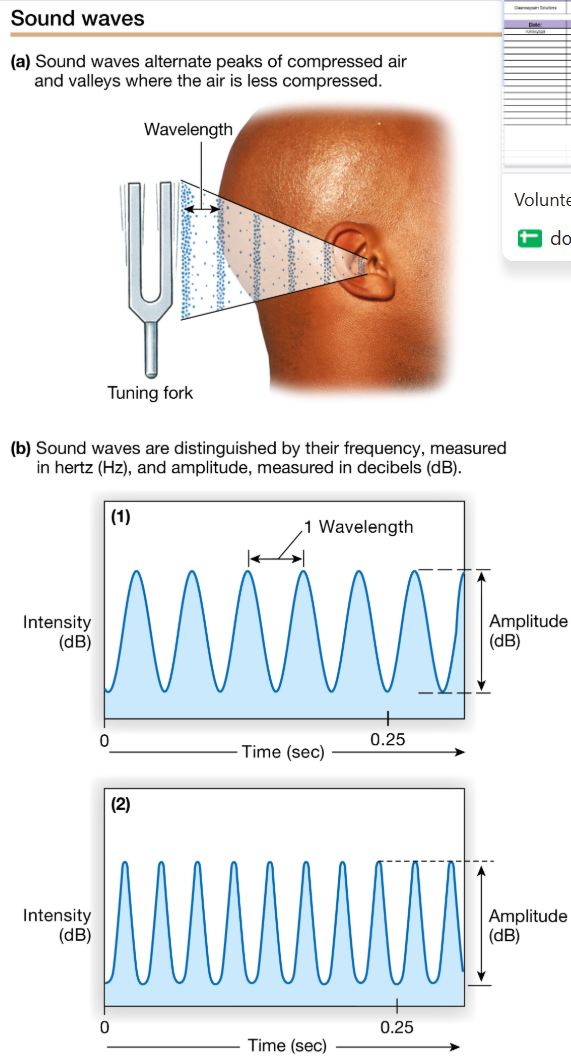
-the initial processing for pitch and loudness takes place in the cochlea of each ear.
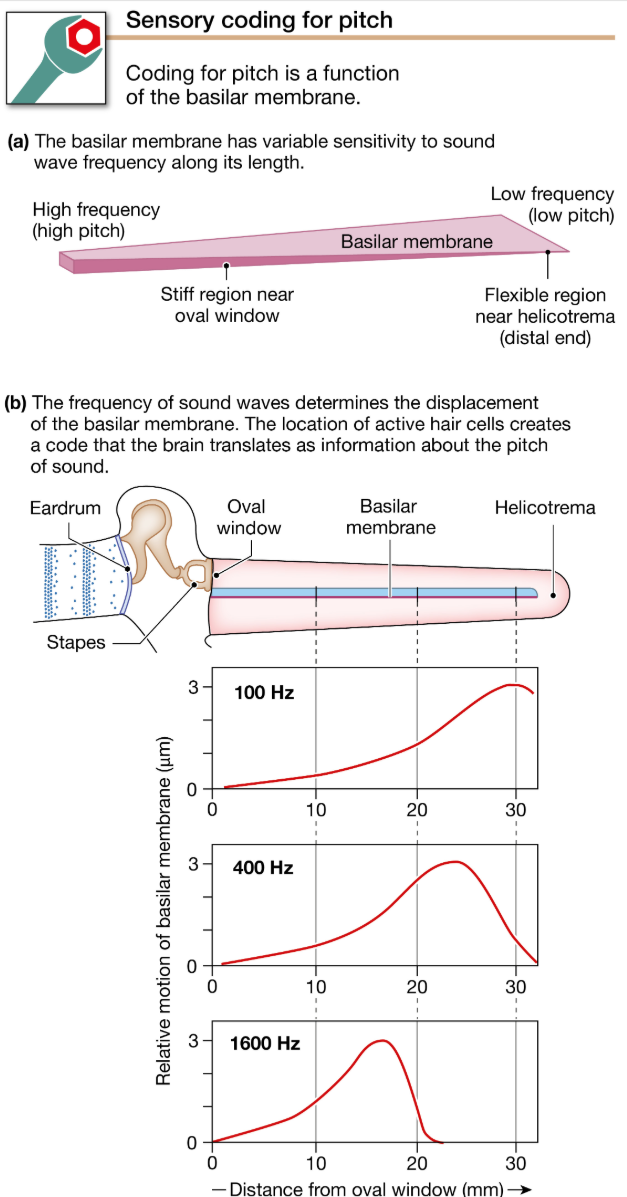
Coding sound for pitch is primarily a function of the basilar membrane. This membrane is stiff and narrow near its attachment between the round and oval windows but widens and becomes more flexible near its distal end (FIG. 11.19a). High-frequency waves entering the vestibular duct create maximum displacement of the basilar membrane close to the oval window and consequently are not transmitted very far along the cochlea. Low-frequency waves travel along the length of the basilar membrane and create their maximum displacement near the flexible distal end.
Explain what it is that changes in the eye to allow you to focus on close objects**
First, the amount of light that reaches photoreceptors is modulated by changes in the size of the pupil. Second, the light is focused by changes in the shape of the lens.
the process by which the eye adjusts the shape of the lens to keep objects in focus is known as accommodation, and the closest distance at which it can focus an object is known as the near point of accommodation
the ciliary muscle contracts under parasympathetic control.
This releases tension on the zonular ligaments, which are attached to the lens.
The lens becomes more rounded, increasing refraction so light focuses on the retina
Distinguish between the function of rods and cones**
There are two main types of photoreceptors in the eye: rods and cones.
Rods function well in low light and are used in night vision, when objects are seen in black and white rather than in color.
Cones are responsible for high-acuity vision and color vision during the daytime, when light levels are higher.

Explain the steps of phototransduction
Phototransduction is the process by which animals convert light energy into electrical signals. In humans, phototransduction takes place when light hits the retina, the sensory organ of the eye
image**
