Sociology unit 3- Crime and Deviance
 Call Kai
 Learn
Learn Practice Test
 Spaced Repetition
 Match
Match Flashcards
 Knowt Play
1/15

There's no tags or description
Looks like no tags are added yet.
Name | Mastery | Learn | Test | Matching | Spaced | Call with Kai | Chat |
|---|
No analytics yet
Send a link to your students to track their progress
16 Terms
Crime and deviance definitions
Deviance is when someone breaks an unwritten rule of society, this person behaves in an unusual way. Deviance is relative and will depend on cultures, time periods etc.
Deviance is controlled by formal / informal sanctions.
Crime is “an act punishable by law as being forbidden by statue” (OED). Laws are the written rules of society. All crimes are deviant but not all deviance is crime.
Crime is not fixed and some people regularly flout laws.
Mooney et al (2000) suggests a normative definition of crime.
Are criminals born or made?
Born: Lombroso said that some peoples skulls are different shapes from the rest of us as they are less evolved.
Psychological: PMT- stress makes women act irrationally. 80% of crime occurs during the period of mensuration.
Made: Socialisation, peer pressure, labelling etc.
Becker and labelling theory
No action itself is deviant. It has to excite some social reaction from others. It depends upon who commits it, who sees it and what action is taken about it
Medias representation of crime
Left realists argue the media increases fear of crime and sensitises people to certain activities. It selectively focuses on some victims, e.g. “missing white woman syndrome,” and can “play up” the image of black offenders.
Pearson (1983) argues the middle-aged see their youth as a “golden age” of morality.
Deviancy amplification
Deviancy amplification was coined by Leslie Wilkins (1964) to describe how agencies like the police and media can increase deviance.
Lynd and Lynd identified how community and religious leaders in “Middleton” condemned radio for promoting immoral behaviour.
Implications- society creates greater levels of deviance, media influences public opinion and an individuals self concept.
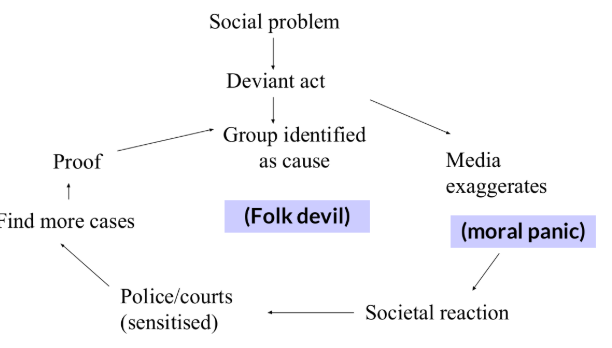
Stan Cohen and moral panics
Moral panics are a false or exaggerated idea that some groups behaviour is deviant and is a menace to society. They are fuelled by media.
Stan Cohen studied mods and rockers in 1964. The media then developed these groups into folk devils and constructed a moral panic about young people generally.
Symbolisation → Exaggeration → Prediction
Activity gains media attention, Agencies of control respond, deviance becomes, symbolisation-exaggeration-prediction, problem is redefined.
Miller and Reilly (1994) see some moral panics used to soften up public opinion and act as a form of 'ideological social control'.
Theories on media and crime
Marxist- It’s not surprising that moral panics centre around groups viewed as deviant. Criminals are working class, they ignore white collar crime.
Functionalist and pluralist- The media is a window on the world so reflects a true picture of crime.
Feminist- The media plays down the extent of women as victims of crime.
McRobbie and Thornton
Moral panics are outmoded because-
The frequency has increased and aren’t noteworthy.
The context has changed.
Some groups might try to create moral panics for their own benefit.
Moral panics are harder to start as there’s no idea of what’s definitely bad.
Moral panics might rebound on the person who starts them.
What is white collar crime?
Can be-
Occupational crime- committed by employees for their own personal gain against the organisation they work for.
Corporate crime- committed by employees for their organisation in pursuit of it’s goals.
Pearce and Tombs widened the definition of crime to ‘Any illegal act or omission that is the result of deliberate decisions or culpable negligence by a legitimate business organisation and that is intended to benefit the business’
The invisibility of corporate crime
The crimes of the powerful are invisible and not seen as real crime. This is because:
The media gives limited coverage of them and don’t represent them as real crime.
Lack of political will- Politicians argue they are tough on crime, but this is only for street crime.
The crimes are complex and law enforcement agencies are often understaffed, under resources and lacked technical expertise.
Under reporting- the victim is often society at large rather than an individual and they might not be aware they’ve been victimised.
De-labelling- Corporate crime is filtered out of the process of criminalisation.
Globalisation and global crime
Globalisation is the way in which the world has become more interconnected, the cultural and political boundaries are dissolving.
Taylor claims globalisation creates crime at both ends of the social spectrum. Lower social groups have less social opportunities so illegal options are more rational. Higher social groups have more tax evasion etc due to globalisation.
Hobbs and Dunningham use the term global organisation to explain how new types of gang structures have emerged to facilitate new global markets.
Green crime and Green criminology
Green crimes are crimes committed against the environment. They are subjective and pollution from one country causes pollution in another.
Green criminology adopts a global perspective on crimes against the environment and challenges powerful corporations.
Anthropocentrism states humans have the right to dominate nature, but the ecocentric view sees humans and the society as interdependent.
Its difficult to define right and wrong boundaries.
Human rights and state crimes
Human rights involve Civil rights and natural rights. Stan Cohen studied how countries cover up or legitimise their human rights crimes- Dictatorships (deny acts of torture) and Democracies (use complex laws to legitimise acts of torture).
Cohen borrows Matzas idea to show how governments use the same techniques to explain their actions- Denial of victim, injury, responsibility, condemning the condemners, appealing to higher loyalty.
Functionalism view on crime
Functionalism provides a normative definition of crime and deviance, it is an action that violates social norms. It presents an image of society with shared norms and values.
Emile Durkheim said Anomie is being insufficiently integrates into societies norms and values and causes society to be more individualistic. Crime is associated with the decline of mechanical solidarity.
Crimes can be negative for society but it can also be positive, helping to promote change and reinforce values. Crime is Normal, universal and functional.
Dysfunctional behaviour within social institutions make some people into criminals.
FIN
Functional
Public opinions can change laws. Boundaries of acceptable behaviours are made known by those who break laws.
Inevitable
Its impossible for everyone to be equally committed to norms and values.
‘Even in a society of saints, a distinction would be made between acceptable and unacceptable behaviour’.
Normal
The power of collective conscience is weakened and a state of anomie develops as people look our for themselves.
Individualism can be seen as a source of crime.
Evaluations of functionalism
Strengths
Demonstrates how crime is useful.
Avoids biological theories.
Explains the reason for unhealthy levels of crime which could be altered by social engineering (new laws etc).
Weaknesses
Doesn’t explain why only some people commit crime.
Over emphasises the degree of consensus in society.
May result in a pessimistic approach in the control of crime (more laws, harsher sentencing etc).