language production
 Call Kai
 Learn
 Practice Test
 Spaced Repetition
 Match
 Flashcards
 Knowt Play
1/63

There's no tags or description
Looks like no tags are added yet.
64 Terms
sucking habituation paradigm
a paradigm that measures the rate of sucking an artificial pacifier as a measure of interest by the infant in a novel stimulus
true
true or false: it has been observed that babies prefer novel stimuli as opposed to stimuli they are familiar with
preferential looking technique
when children look longer at scenes that are consistent with what they are hearing
vegetative sounds
infants make _____ from birth to six weeks, which include crying, sucking noises, and burps
cooing
around 6 weeks, babies start making ____ noises
laughing
at 16 weeks, babies start _____
vocal play
_____ starts at 16 weeks-6 months
babbling
____ is observed around 6-10 months
it contains true syllables
how does babbling differ from vocal play?
single word utterances
children produce _____ around 10 months followed by an extraordinary expansion of vocab around 18 months
two word utterances
around 18 months, children begin to produce
telegraphic speech
at 2 years, children produce ______, or utterances which lack grammatical elements
around two and a half years
when do grammatically complex utterances emerge?
overextensions
when a given word is used in a broader context than appropriate
a child calling all four-legged animals 'doggies'
what is an example of an overextension
imitation
the simplest form of language acquisition
B.F. Skinner
argued that language acquisition happens through the same mechanisms as operant conditioning and learning language is just like learning any other skill
learning rules
language seems to be based off of _____ rather than learning associations
Noam Chomsky
argued that humans are born with the innate capacity to learn language and argued for the existence of a language acquisition device
language acquisition device
a hypothesized innate structure separate from intellectual ability or cognition
universal grammar
the language acquisition device was later replaced by the concept of _____
cochlear implant (CI)
an electronic prosthetic device that takes sound from the environment and converts it into electrical signals, which get transmitted to the brain via the auditory nerve
because the electrical signals from a CI are not a sufficient language environment for typical development
why do many children with CIs still score well below hearing children on language proficiency tests
true
true or false: when deaf children of hearing parents have access to ASL by 6 months, their vocabulary develops at a comparable rate to deaf children of deaf signing parents
sociolect
speaking differently with different social groups
A
Which of the following statements about bilingualism is TRUE?
A. Bilinguals have sometimes been found to have better cognitive functioning, cognitive flexibility, and analytic skills in comparison to monolinguals
B. There is a critical period for language learning after which language learning is extremely difficult
C. Most children around the world are monolingual
D. The best way to teach adults a second language is to focus on teaching grammar and vocabulary
speech errors
spontaneous mistakes we sometimes make in casual speech
conceptualization, formation, and articulation
speech production falls into three broad areas....?
conceptualization
during _____, we develop an intention and select relevant information from the internal (memory) or external (stimuli) environment to create an utterance
macroplanning and microplanning
Levelt divided conceptualization into two categories: _____ and ______
macroplanning
the elaboration of a communication goal into subgoals and connecting them with relevant information
microplanning
assigns the correct shape to these pieces of information and decides on the focus of the utterance
formulation
takes conceptual entities as input and connects them with the relevant words associated with them to build a syntactic, morphological, and phonological structure
lexicaliztation and syntactic planning
formulation is divided into _____ and _____
lexicalization
when we select the relevant word forms
syntactic planning
when we put the relevant word forms together in a sentence
word exchanges
exchange across different phrases and exchange within the same syntactic category
segment exchanges
occur within the same phrase and do not make any references to syntactic categories
lemma retrieval ; word-form encoding
word exchanges are assumed to occur during ______ and segment exchanges occur during _____
phonetic level
the standard understanding of speech is that there must be a _____ that represents the actual articulated speech as opposed to the stored representations of sound
aphasia
a disorder that results from damage (usually a stroke or traumatic brain injury) to areas of the brain that are responsible for language
left
for most people, aphasia affects areas in the ____ side of their brain
primary progressive aphasia (PPA)
whenever aphasia is the first and most noticeably sign of dementia
fluent and nonfluent
aphasia is divided into two broad categories: ____ and _____
wernicke's aphasia
damage to the temporal lobe may result in ____, the most easily recognizable form of fluent aphasia
they speak fluently in long, complete sentences that have little meaning, adding unnecessary words and even making up words
what happens when people with wernicke's aphasia try to speak?
no, they are often unaware
do people with wernicke's aphasia know they're making mistakes when speaking?
broca's aphasia
damage to the frontal lobe may result in ____, the most recognizable type of nonfluent aphasia
apraxia of speech
broca's aphasia may co-occur with?
right-sided weakness or paralysis of the arm and leg
because the frontal lobe also controls voluntary movement, people with broca's aphasia may also experience?
they speak in short phrases produced with great effort and often omit small words
what happens when people with broca's aphasia try to speak?
broca's
people with which type of aphasia usually have an easier time understanding language?
yes and they often become frustrated
do people with broca's aphasia know they're making mistakes when speaking?
damage to extensive portions of the language areas of the brain
global aphasia results from?
wernicke's
people with ____ aphasia have difficulty in understanding language, whether spoken, written, or signed
true
true or false: though people with broca's aphasia have an easier time understanding language than people with wernicke's, they still have some difficulty with spoken, written, or signed language
global
people with ___ aphasia have severe communication difficulties and may be extremely limited in their ability to produce or comprehend language
they may be unable to say even a few words or may repeat a limited set of words or phrases
how do people with global aphasia speak?
conduction aphasia
a fluent aphasia in which a person has difficulty repeating words and simple phrases
broca's aphasia=A
wernicke's aphasia=B
which section does broca's aphasia occur in? which section does wernicke's aphasia occur in?
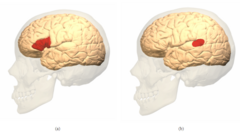
the interpretation of language
wernicke's region is associated with?
articulation and the controlling of speech
broca's region is associated with?
arcuate fasciculus
we know the that the interpretation of language is associated with wernicke's aphasia and is connected to broca's region via a group of nerve fibers known as the?
wernicke-geschwind model
brings together what was known about language at the time to describe language production (Broca's region), comprehension (Wernicke's region), reading (visual cortex), and spelling (angular gyrus)