Amino Acids and Protein Structure
 Call Kai
 Learn
Learn Practice Test
 Spaced Repetition
 Match
Match Flashcards
 Knowt Play
1/31

There's no tags or description
Looks like no tags are added yet.
Name | Mastery | Learn | Test | Matching | Spaced | Call with Kai | Chat |
|---|
No analytics yet
Send a link to your students to track their progress
32 Terms
What is the roadmap for amino acids in biochemistry?
Side-chain chemistry → molecular interactions → protein folding → protein function

Describe the components of all amino acids
Attached to the alpha carbon is (with the exception of proline):
A carboxylic group (negative)
An amino group (positive)
A hydrogen atom
A substituent (R side chain)
What allows amino acids to behave different from one another
What is a Zwitterion?
It means that an amino acid contains both positive and negative formal charges
What feature allows amino acids to behave differently from one another?
The R group
Leucine: a hydrocarbon R group
Hydrophobic, no interactions
Explain the chemistry of nonpolar R side chains
Hydrophobic / poorly compatible with water
Tend to cluster away from water through the hydrophobic effect
Explain the chemistry of polar R side chains
Uncharged
Hydrophilic / compatible with water
Can form hydrogen bonds and/or dipole-dipole interactions with water
Explain the chemistry of negatively charged R side chains
Strongly hydrophilic
Highly compatible with water
Interact strongly with water via ion-dipole interactions and hydrogen bonding
Explain the chemistry of positively charged R side chains
Strongly hydrophilic
Highly compatible with water
Interact strongly with water via ion-dipole interactions and hydrogen bonding
Nonpolar/Hydrophobic Amino Acids
Amino acids that feature hydrocarbon chains that avoid water and form the hydrophobic cores of folded proteins
Alanine (Ala, A)
Glycine (Gly, G)
Allow for high backbone flexibility
Isoleucine (Ile, I)
Leucine (Leu, L)
Methionine (Met, M)
Contains a sulfur
Valine (Val, V)
Aromatic Hydrophobic Amino Acids
Amino acids that contain bulky ring structures and contribute to hydrophobic interactions
Phenylalanine (Phe, F)
Tryptophan (Trp, W)
Tyrosine (Tyr, Y)
Contains a hydroxyl group
Polar Uncharged (Hydrophilic) Amino Acids
Amino acids whose side chains contain oxygen, sulfur, or nitrogen atoms that can form hydrogen bonds with water
Asparagine (Asn, N)
Cysteine (Cys, C)
Can form covalent disulfide bonds with other cysteines
Glutamine (Gln, Q)
Serine (Ser, S)
Threonine (Thr, T)
Proline (Pro, P)
Basic (Positively Charged)
Amino acids that have nitrogen-rich groups in their side chains that readily accept protons (carry a net positive charge at physiological pH)
Arginine (Arg, R)
Histidine (His, H)
Contains an aromatic imidazole ring that can be neutral or positive depending on the local pH
Lysine (Lys, K)
Acidic (Negatively Charged)
Amino acids that possess extra carboxyl groups in their side chains that can donate protons (leaves them negatively charged at cellular pH)
Aspartic acid / Aspartate (Asp, D)
Glutamic acid / Glutamate (Glu, E)
Define hydrophobic interactions
Nonpolar surfaces minimizes unfavorable contact with water
Noncovalent
Define hydrogen bond interactions
Polar donor/acceptor atoms that share favorable interactions
Noncovalent
Define ionic attraction/interactions
Opposite charges attract; affected by pH
Noncovalent
Define aromatic/Van der Waals interactions
Rings and nonpolar surfaces pack favorably
Noncovalent
Define disulfide bond interactions
Cys-S-S-Cys covalent linkage
The only covalent interaction out of the five major types
How do IMFs relate to side chain chemistry?
Protein structure and function depend on intermolecular forces which are determined by the chemical structures and properties of amino acid side chains as well as pH
pH → chemical properties → control interactions with water → drive residue-residue interactions → promote protein folding → shape protein structure and function
Example of predicting consequences of amino acid substitutions
Asp → Val. Loss of charge and H-bonding may result in lower solubility and lower protein stability
Asp
Negatively charged
Hydrophilic
Can form H-bonds and ionic interactions
Val
Nonpolar
Hydrophobic
No ionic interactions
What is the roadmap for protein structure in biochemistry?
Amino-acid sequence → side chain chemistry → molecular interactions → protein folding → protein function
How does the hydrophobic effect impact protein folding?
An unfolded polypeptide is flexible and disordered with both polar and nonpolar side chains exposed to water
A folded globular protein has a compact, ordered 3D structure
Nonpolar side chains are largely buried
Polar/charged side chains are largely exposed to water
Entropy gain favors protein folding
How does a protein’s 3D structure help enable its function?
The amino acids are positioned close to each other and can interact in order to create cavities that serve as binding sites for a variety of compounds or molecules

What is a peptide backbone?
A strong covalent bond formed between the backbone of a carbonyl carbon of one AA and the backbone nitrogen of the next AA
Protein structure is simplified by repetition
Peptide-bond resonance creates partial double-bond character (strong), resulting in restricted rotation
How do pH and pKa determine amino acid charge?
As pH increases, an amino acid will generally lose H+
Would cause the [A-]/[HA] ratio to go up (more base)
Creates a more negative charge
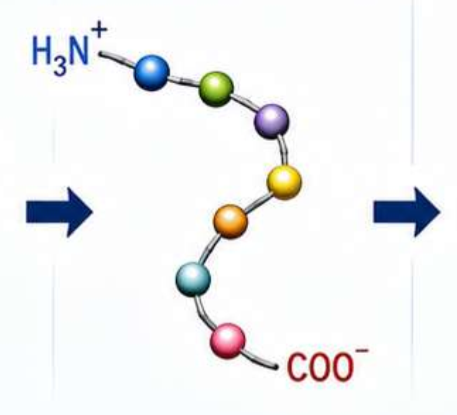
Describe primary structure
An unfolded peptide
Linear chain of amino acids
Stabilized/linked by covalent peptide bonds
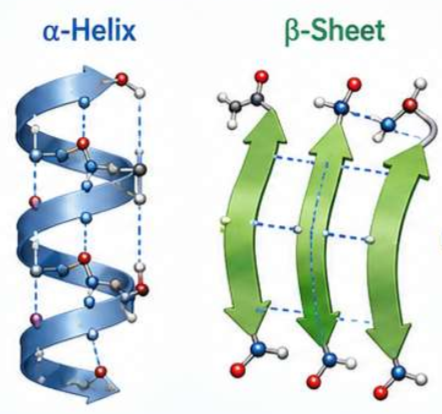
Describe secondary structure
Local folding
Stabilized by backbone hydrogen bonds

Describe the makeup of an alpha-helix in secondary structure
The polypeptide backbone C=O of one amino acid will form a hydrogen bond with the backbone N-H after four residues (i + 4)
C=O …. H-N

Describe the makeup of beta-sheets in secondary structure
Antiparallel beta-sheets generally have slightly stronger hydrogen bonding compared to parallel sheets because the polypeptide backbone C=O … H-N bonds are more linear
Gives better alignment between the donor N-H and acceptor C=O groups
Makes the interaction more favorable

Describe connectors between secondary structural elements
The frequency of secondary structure elements is the reason globular proteins are globular
Essentially how the protein folds into a compact, roughly spherical, or ball-like shape
The backbone C=O of residue 1 to the N-H of reside 4 helps stabilize tight turns
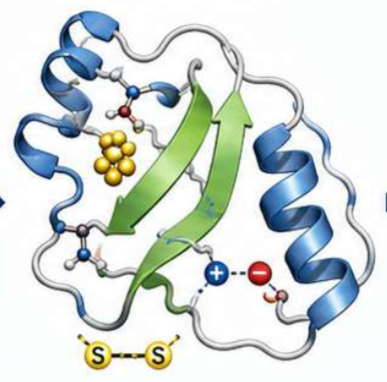
Describe tertiary structure
Folded peptide (monomeric)
Stabilized by hydrophobic effect, hydrogen bonds, ionic interactions, van der Waals, and disulfide bonds

Describe quaternary structure
At least two folded peptides together
Dimer (2), trimer (3), tetrameter (4), etc.
Stabilized by noncovalent interactions between subunits
Can sometimes be disulfide bonds