Anatomy Chapter 13 Nervous Tissue
 Call Kai
 Learn
Learn Practice Test
 Spaced Repetition
 Match
Match Flashcards
 Knowt Play
1/62

There's no tags or description
Looks like no tags are added yet.
Name | Mastery | Learn | Test | Matching | Spaced | Call with Kai | Chat |
|---|
No analytics yet
Send a link to your students to track their progress
63 Terms
What does the CNS include?
Brain and Spinal Cord
What does the PNS include?
Any nervous tissue outside the CNS
What are the two subdivisions of the PNS?
Afferent (sensory) and Efferent (motor)
Function of the CNS?
Control centers that process and integrate sensory information, plan and coordinate responses to stimuli, and control activities of other systems
Function of the PNS?
Efferent & afferent nervous tissue that links the CNS with sense organs and other systems
Afferent means:
Sensory
It carries info towards the CNS
Efferent means:
Motor
carries information from the CNS
What is the flow of the nervous system?
PNS (sensory afferent)
CNS (brain or spinal cord)
PNS (motor efferent)
Effector muscles or glands
What are the two divisions of the efferent division of the PNS?
1) Somatic Nervous System (controls skeletal muscle)
2) Automatic Nervous System (controls smooth muscle, cardiac muscle, glands, and adipose tissue)
What are the two divisions of the autonomic nervous system?
1) parasympathetic
2) sympathetic
What are the effectors of the somatic nervous system?
?
What are the effectors of the autonomic nervous system?
?
What are the three types of sensory receptors?
1) special
2) visceral
3) somatic
What is the function of special sensory receptors?
monitor smell, taste, vision, balance, and hearing
What is the function of visceral sensory receptors?
monitor cardiovascular, respiratory, digestive urinary, and reproductive system
What is the function of somatic sensory receptors?
monitor skeletal muscles, joints, body position, skin surface
also provide position sense and touch, pressure, pain, and temperature sensation
The glial cell that forms the blood brain barrier is -
astrocytes
The lipid rich material that is important for insulating axons is known as -
neurolemma
Factors that affect speed of action potential?
Diameter of axon (wider = faster)
Mylan = faster

What tyle of neuron structure is this?
anaxonic
The type of neuron that has two processes separated by the cell body is
bipolar


What type of neuron structure is this?
pseudounipolar
What type of neuron has many dendrites and one single axon is
multipolar

Synapses exist between neurons and other cells. The other cells can be -
other neurons, skeletal muscle cells, or gland cells
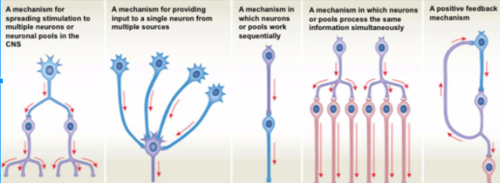
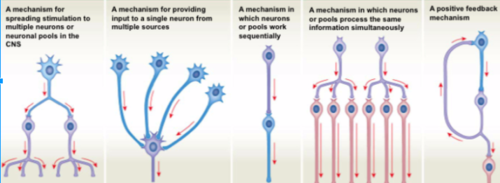
What is a divergence neural circuit?
A circuit for spreding stimulation to multiple neurons of neuronal pools in the CNS
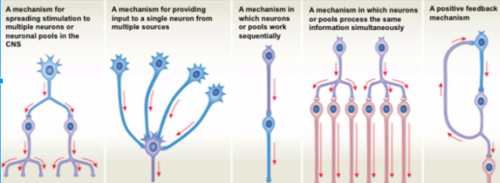
What is a Convergence neural circuit?
A circuit for providing input to a single neuron form multiple sources
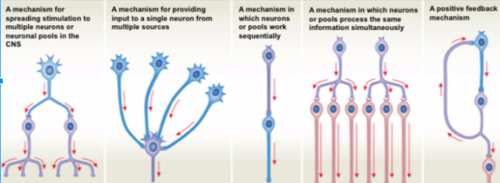
What is a serial processing neural circuit?
A circuit in which neurons of pools work sequentially
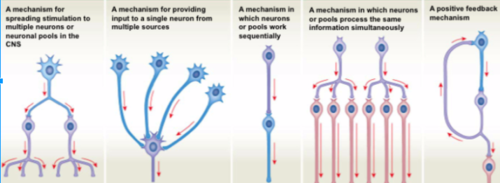
What is a parallel processing neural circuit?
A circuit in which neurons or pools process the same information semiseriously
What is a Reverberation neural circuit?
A positive feedback circuit
gray matter
unmyelinated structers
white matter
myelinated structures
CNS: cortex
gray matter on the surface of the brain
CNS: nuclei
collections of neuron cell bodies in the interior of the CNS
CNS: tract
bundles of axon
PNS: ganglia
groups of neuron cell bodies
PNS: nerves
axons bundles together
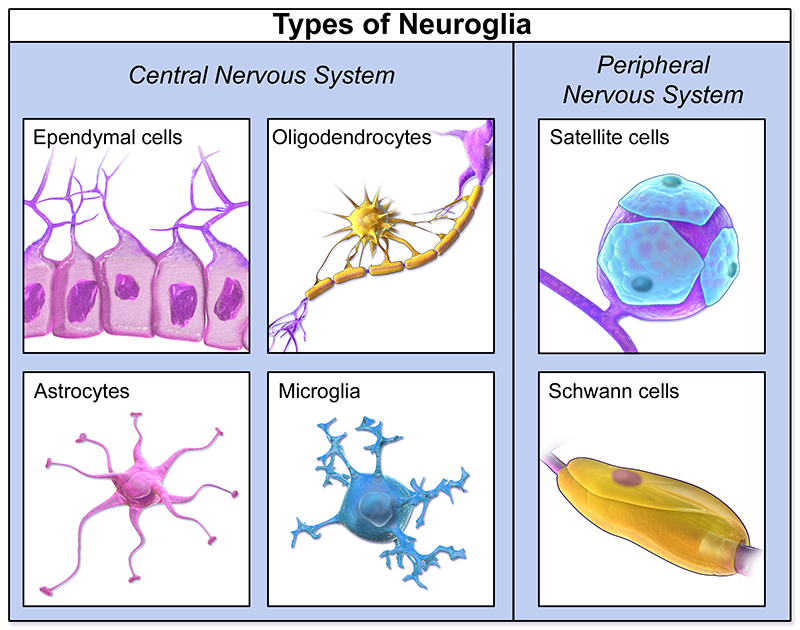
What are the 6 types of neurogila cells (also state what group they are in)
CNS:
1) Astrocytes
2) Oligodendrocytes
3) Microglia
4) Ependymal
PNS:
1) Satellite
2) Schwann Cells
Astrocytes functions
Largest and most numerous
Maintain BBB
Supports neurons structurally
Repairs damaged nervous tissue
Control interstitial environment

Oligodendrocytes function
Myelinate CNS axons
Provide structural framework
Microglia function
Removes cell wastes & pathogens by phagocytosis

Ependymal function
line ventricles and central canal
assist in producing and circulating cerebrospinal fluid
contains cilia

Satellite function
Surround neuron cell bodies in some parts of PNS
Regulate exchange of nutrients and waste products between neuron’s cell body and extracellular fluid

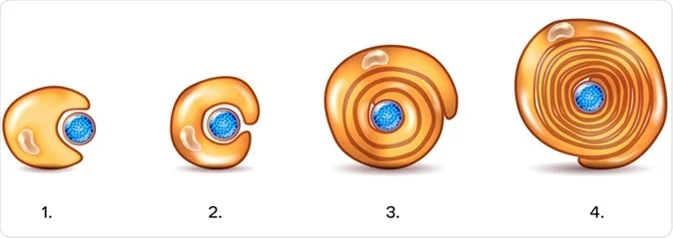
Schwann Cells function
surround axons of neurons in the PNS
covering is called neurolemma
Describe the autonomic nervous system
The ANS is a component of the peripheral nervous system that regulates involuntary physiologic processes such as heart rate, blood pressure, respiration, digestion, and sexual arousal. Has three divisions: sympathetic, parasympathetic, and enteric
What does the CNS consists of?
Is the central system of the body consisting of the brain and spinal cord
Cerebellum
A portion of the brain in the posterior inferior region that processes information for coordination and movement
Diencephalon
Area between the cerebrum and brainstem. Includes the thalamus and hypothalamus
Gyri
Folds on the surface of the cerebrum
Sulci
Grooves between the folds of the cerebrum
What does the frontal lobe process
Processes information involving motor movements, concentration, planning, and problem solving as well as sense of smell and emotions

What does the parietal lobes process?
sensory information with the exception of hearing, smell and vision

What does the temporal lobes do?
Process information related to hearing, smell, and memory as well as abstract thought and making judgements.

What does the occipital lobe process
Visual information

What does the thalamus do?
Carries all sensory information to the cerebral cortex (except for smell).
Sometimes referred to as “a relay station”.
Is also intimately involved in emotions due to its connection to the limbic system.
What does the hypothalamus regulate?
Intimately connected with the endocrine system and helps regulate hormones.
Helps regulate body temperature, thirst, hunger, and sexual drive.
Is also involved in processing emotions, mood, and sleep along with the reticular activating system.
What does the pineal gland do?
Secretes melatonin to help regulate sleep and wake cycles
What does the brainstem consist of?
Midbrain, pons, medulla oblongata
What does the medulla oblongata control?
controls heart rate, respiration, swallowing, vomiting and blood vessel diameter
What do the pons do
Contain spinal cord tracts and nuclei that help to control respiration and sleep
What does the midbrain do
Helps to process motor and hearing information
What helps regualte sleep-wake cycles
The reticular formation
What is the limbic system
Consists of portions of both the cerebrum and diencephalon.
Is involved with emotions, reproduction, and memory.
What does the limbic system include
portions of the thalamus, hypothalamus, mamillary and amygdaloid bodies, hippocampus, and nucleus accumbens.