Animal Behavior Exam 1
 Call Kai
 Learn
Learn Practice Test
 Spaced Repetition
 Match
Match Flashcards
 Knowt Play
1/97

There's no tags or description
Looks like no tags are added yet.
Name | Mastery | Learn | Test | Matching | Spaced | Call with Kai | Chat |
|---|
No analytics yet
Send a link to your students to track their progress
98 Terms
What are each of Tinbergen’s Four Questions?
Function: Why does the animal display the behavior?
Phylogeny: Why did the behavior evolve in the population or species?
Mechanism: How does the behavior work?
Ontogeny: How did the behavior develop in the individual?
Which of Tinbergen’s questions are ultimate vs. proximate questions?
Ultimate: function and phylogeny
Proximate: mechanism and ontogeny
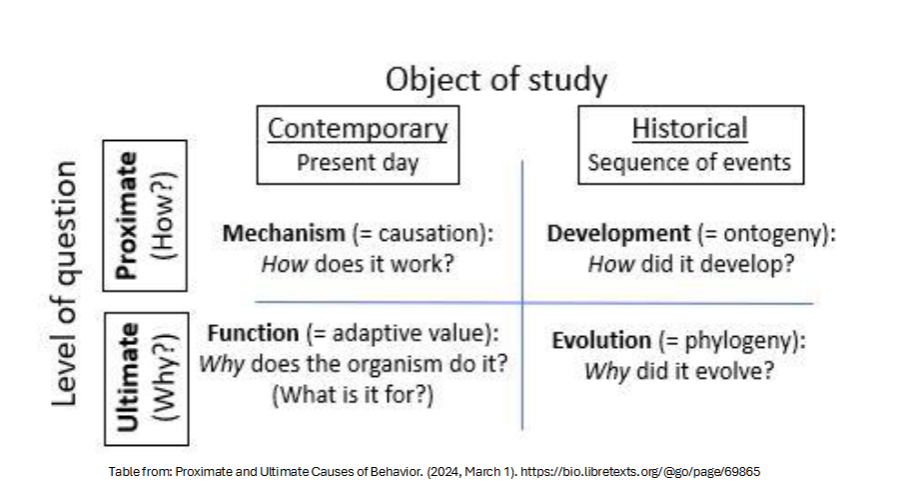
Which of Tinbergen’s questions are contemporary vs. historical questions?
Contemporary: mechanism and function
Historical: ontogeny and phylogeny

Learned (nurture) behavior
Behavior formed through acquisition of information
This could be from the environment, from conspecifics (e.g. parents or siblings), or from experience
Learned behaviors improve with practice and are flexible
Habituation/sensitization – simple form of learning where behavioral response adjusts to stimulus frequency
Unlearned (nature) behavior (includes reflex and instinct)
Any innate, genetically determined behavior
Work right the first time, but are inflexible
Reflex – simple, localized automatic responses to stimuli
Instinct – automatic, complex whole-body responses to stimuli
Fixed action patterns
Stereotypical characteristic of fixed action patterns
They are inflexible and always follow the same sequence
Complex characteristic of fixed action patterns
They have many steps, often involving the whole body
Species Specific characteristic of fixed action patterns
All individuals within the species display the fixed action pattern
“Released by a key stimulus” characteristic of fixed action patterns
Fixed action patterns are produced by a specific feature of stimuli (e.g. shape, size, or color of an object)
“Once triggered, they continue to completion” characteristic of fixed action patterns
Even if the stimulus is removed, the behavioral sequence continues to some final end point
Unlearned characteristic of fixed action patterns
The pattern of behavior does not change in response to experience
Supernormal stimuli
Tinbergen observed that exaggerated, or supernormal, key stimuli
such as an unnaturally large goose egg or a fish model redder than
would naturally occur, elicit a stronger response
This means even fixed action patterns, that are entirely genetically
determined, can result in variation in behavior
Examples
Greylag geese would preferentially retrieve larger eggs, sometimes
choosing large models over smaller, real goose eggsMale sticklebacks would attack more aggressively model fish with
brighter red or a greater area of red coloring
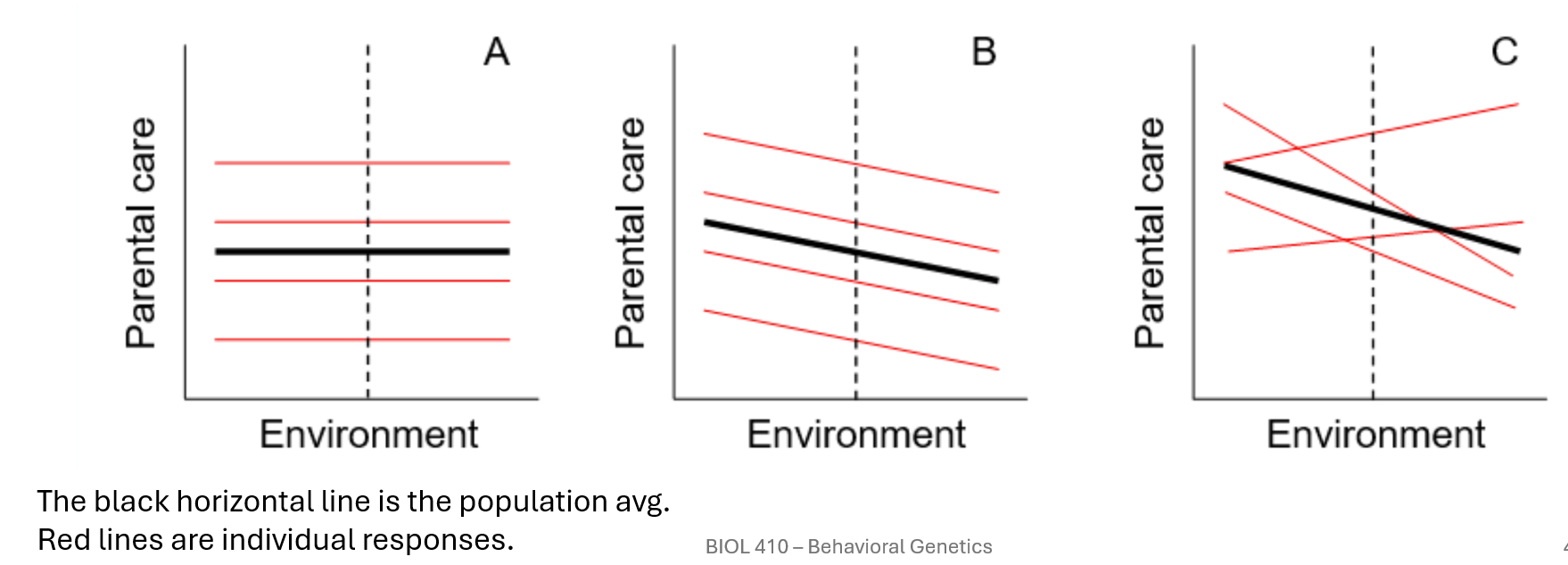
Reaction norm plots (environmental variation, genetic variation, and gene by environment interactions)
In reaction norm plots, the slope of a line indicates the effect of environment (with a slope of zero, i.e. horizontal line, meaning no effect of environment). Differences in y-values between lines indicate genetic differences between individuals.
A) Genetically dependent, environment not impacting
B) Parental care affected by environment but they all change the same. Mixture of both
C) Mixture of both, populations affected/change differently
Repeatability estimates
Compare variation in behavior among individuals in a population (𝑺𝑨) to variation in behavior within an individual (𝑺)
Polygenic
Several genes, one effect
e.g., multiple genes code for a biochemical
sequence that produces a behavior
Pleiotrophic
One gene, several effects
e.g., a gene that codes for a common enzyme
used in multiple pathways that affect different
behaviors

Broad sense heritability
Measuring the proportion of phenotypic variance due to
genetic variationMeasure of the ‘degree of genetic determination’ (°GD)
i.e. a population measure of variation, not applied to an individual’s
inheritance of a particular trait.High GD: Most of the variation between individuals is genetic.
Low GD: Most of the variation between individuals is environmental.
Vg = genetic variance
Ve = variance due to environment
VT = total variance (for our purposes, = Vg + Ve )
Narrow sense heritability (including the selection differential, response to selection, and realized heritability)
Selection can be used to determine heritability for individual traits
Measure of ‘realized heritability’ (h2)
i.e. a measure of the response of a particular trait to selection
Narrow sense heritability Selection Differential (S)
Difference between mean of selected parents and mean of population
Narrow sense heritability Response to Selection (R)
Difference between mean of offspring of selected parents and mean of overall population
Narrow sense heritability Realized Heritability (h2)
R/S = percent of trait that responds to selection (i.e. is heritable)
Common Garden Experiment
Transplant individuals from populations under different environmental conditions into
an area with a common environmental conditionObserve offspring phenotypes
If the populations still differ when raised in the same environment → the difference is likely due to genetic variation.
If the differences disappear → the original difference was likely caused by environmental effects.
Modern genetic technologies that are used to identify genes associated with behavior
Knockout genes – produce mutants that are
homozygous for inactive geneGene transfer – use molecular techniques to
insert gene into DNA of another speciesGenome-wide association studies (GWAS) –
correlational analysis using whole genome
mapping and behavioral observations
Three major types of hormones we discussed
Peptide hormones
Steroid hormones
Monoamines
Peptide hormones
Chains of 3 to 300 amino acids that bind to receptors on cell surfaces, water soluble
Stress, growth, metabolism
Steroid hormones (secreted by gonads and adrenal glands)
Group of closely related hormones secreted mainly by gonads and adrenal glands, fat soluble so can enter cell membranes
Cortisol is one
Stress, reproduction, immune, metabolism
Monoamines
Small molecules (dopamine, serotonin, thyroid hormones). Most are water soluble, though thyroid hormone is lipid soluble due to its benzene ring
Hormonal axes of control
Hypothalamus (in brain)
Hypophysis (pituitary)
Targets in body (adrenals, pancreas, gonads, thyroid)

Hamilton-Zuk and Immunocompetence Handicap hypotheses
Females prefer to mate with brightly- colored males because they have fewer parasites and diseases (“good genes”)
Testosterone can be immunosuppressive and cause more aggressive/sexual behavior
Tradeoff between developing secondary sexual characteristics and the functioning of the immune system
Males with “good” genes can better tolerate this tradeoff and develop greater secondary sexual characteristics (e.g. larger horns, brighter plumage, etc.)
Testosterones not always immunosuppressive
Factors that influence behavioral development and examples (5)
Development of the nervous system (example is brain structures which allow for cheetah balance and coordination as they run and hunt)
Hormonal development (Secondary sex characteristics in adult male satin bowerbirds)
Changes in non-neural morphology (paddlefish foraging, anatomical features that aid in their feeding strategies, excluding neural structures)
Changes in environment (for reptiles sex is temperature determined)
Learning and memory (permanent change in behavior from experience, recalling what happened)
Different types of social learning (4)
Local enhancement
Social facilitation
Copying
Imitation
Social Learning - Local Enhancement
Animal is drawn to where others are and observes how others interact with the environment (e.g. learning where resources are and how to exploit them)
Social Learning - Social Facilitation
Presence of others increases the intensity, frequency, or efficacy of a known behavior
Social Learning - Copying
Observer repeats what others do (does not need to be novel, this is a broad term)
Social Learning - Imitation
Observer acquires a novel response via observing a demonstrator
Single Stimulus learning
Assessing preferences by presenting one item at a time
ae.g. red stick repeatedly dropped into rat’s cage, does the rat turn its head more or less with each subsequent drop?
Habituation
Sensitization
Single Stimulus - Habituation
Animal becomes less sensitive to stimuli over time (a decrease in behavioral response after repeated exposure to stimulus)
Single Stimulus - Sensitization
Animal becomes more sensitive to stimuli over time
Associative learning, including the differences between Pavlovian (including condition and unconditioned) and Operant conditioning and give examples
Pavlovian: e.g. pair the stick (CS) with the odor of cat (US). Does rat learn to associate the stick with the cat, and responds fearfully just in response to the stick?
Conditioned Stimulus (CS): A previously neutral stimulus that, after being paired with the US, elicits a similar response (e.g., a bell sound).
Unconditioned Stimulus (US): A stimulus that naturally elicits a response (e.g., food causing salivation).
Instrumental (operant) conditioning: learning that occurs when a response made by an animal is somehow reinforced
An animal must take some action or response in order for the conditioning process to produce learning. E.g. rat pressing lever to get food
What is the principle of equipotentiality? Is it a well-supported principle?
All organisms are capable of learning to associate anything. The principle has been rejected, but how can we explain why organisms learn to associate some things but not others?
E.g. Rats can make associations between taste and nausea, but not between sounds and nausea. Similarly, they can make associations between sound and electric shock, but not taste and electric shock.
Basic steps to develop an optimality model (4)
1. Identify the problem to be solved
• Finding food? Mates? Etc.
2. Choose a currency
• Ideally, a measure of fitness. When that’s not possible, then a fitness correlate, e.g. energy gain, time, rate of fertilization, minimize risk of predation
3. Identify alternatives and constraints
4. Quantify costs and benefits of available
alternatives (in the relevant currency)

Charnov’s optimal diet model, including how handling and search times relate to predator decision making when deciding which prey to consume (don’t just memorize equations, make sure you understand why profitability is related to energetic value and handling time)
Predators choose prey to maximize their rate of energy gain.
Prey profitability depends on energetic value (E) and handling time (h): profitability = E/h.
A high-energy prey is not necessarily more profitable if it takes a long time to handle.
When a predator encounters less-profitable prey, it should decide whether to eat it or reject it and search for more-profitable prey.
If the more-profitable prey is abundant (short search time), specialize on it; if it is rare (long search time), eat both types.
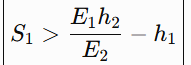
Charnov’s optimal diet model equation
E = Energy
h = Handling time
S = Search time
1 = more profitable prey
2 = less profitable prey
Marginal Value Theorem, including how to determine optimal patch time given travel time to other patches
Predicts the optimal amount of time a forager should spend in a patch.
Rate of energy gain decreases as time in the patch increases.
Longer travel time between patches → stay longer in the current patch.
Shorter travel time → leave sooner.
The point at which the forager should leave is the giving-up time (GUT).

Marginal Value Theorem Graph
Longer travel time → stay longer in patch
Shorter travel time → leave sooner
Distance C (farther) → later optimal departure
Distance D (closer) → earlier optimal departure
GUT (giving-up time) = optimal time to leave patch
When game theory can help predict optimal behavior
Type of optimality theory where the optimal strategy depends on the behavior of others
For example, if individuals can either fight aggressively or retreat, the payoff of being aggressive depends on how often other individuals are aggressive.

Payoff matrices
What the player “takes home” i.e the benefits - the cost
Strategy equilibrium (ESS=evolutionarily stable strategy, a type of Nash Equilibrium)
Evolutionary stable strategy when the payoffs to both strategies are equal; equilibrium.
Neither strategy can be “invaded” by the other
The stable equilibrium (ESS) is when the average payoff for hawks (H) is equal to average payoff to doves

In the Hawk-Dove game, understand when doves are expected vs only hawks
h = proportion of hawks in population
V= victory C= cost
0 = dove loss
Equilibrium = equally valuable to play either one
If V > C then you should always play hawk
If V< C then you should sometimes play hawk and sometimes play dove
What are the two main types of predation we discussed?
Pursuit predation – chasing and capturing prey (often relies on speed, endurance, and/or group coordination) (Cheetahs)
Ambush predation – sit-and-wait, luring, or stalking strategies relying on camouflage or stealth (Mountain lion)
In pursuit predation, what are common morphological adaptations seen in mammalian predators and prey?
For Predators: Flexion and extension of the spine combined with a long tail for stabilization and powerful hind legs. Digitigrade: Walking on phalanges (Cheetah)
For Prey: Unguligrade locomotion contributes to greater limb length and elongated spinous processes = greater stability and maneuverability. Unguligrade: walking on tips of digits (Wildebeest)
What are some common anti-predator behavioral strategies? 8
Avoidance
Vigilance
Camouflage
Playing dead
Pursuit-deterrence (Signaling to the predator that they have been detected) (A gazelle leaps high into the air when it thinks a predator is near)
Startling
Defensive structures
Mimicry and aposematism
What are role-reversal predators?
A species typically considered prey exhibits predatory behavior towards its usual predator.
Epomis beetles are obligate role-reversal predators
Beetles are usually prey to amphibians, but these
beetle lure amphibians inPretend to be prey but turn into predator
Beetles able to do this by latching on to prey and can make incisions
to cut tendons, muscles to paralyze prey
Be familiar with the different types of mutualisms 5
Obligate mutualists
Facultative mutualists
Defensive mutualism
Trophic mutualism
Dispersive mutualism
Obligate mutualists
Neither species can survive without the other (e.g. acacia ants and acacia trees)
Facultative mutualists
Can survive independent of each other (e.g. mice in eagle’s nest)
Defensive mutualism
Food or shelter to one species, protection against antagonisms to the other (also mouse in eagle’s nest)
Trophic mutualism
Relationship based on transfer of energy/nutrients (e.g. mycorrhizal fungi)
Dispersive mutualism
Food in exchange for spreading pollen, seeds, etc. (e.g. pollinators like bees and wildflowers)

In the reaction norm plots below, which panel shows the strongest gene by environment (GxE) interaction? Pay close attention to which choice you select, e.g. Panel (a) does NOT necessarily equate to option A, etc.
Panel (e)
True or False: The hypothalamus-pituitary-adrenal (HPA) axis is the main axis of control regulating the production of glucocorticoid, or stress, hormones.
True
True or False: Peptide hormones are lipid soluble and so are able to cross cell membranes.
False
True or False: The Immunocompetence Handicap Hypothesis (ICHH) attempts to address the paradox of the Hamilton-Zuk hypothesis.
True
Which of the following is NOT TRUE of fixed action patterns?
Option A
Once triggered, they continue to completion.
Option B
They are stereotypical.
Option C
They are unlearned.
Option D
They are simple, involving few steps.
D
In narrow-sense heritability, which of the following is the difference between the mean trait value of the population and the mean trait value of the offspring of selected parents?
Option A
Variance due to environment (Ve)
Option B
Response to selection (R)
Option C
Selection differential (S)
Option D
Realized heritability (h squared)
B

In the reaction norm plots below, which panel best describes a trait with a degree of genetic determination equal to zero (i.e. °GD=0)? Pay close attention to which choice you select, e.g. Panel (a) does NOT necessarily equate to option A, etc.
Panel (a)
The SILV/PMEL gene is one of many genes involved in determining fur color and pattern in domestic dogs, and is linked to merle, or mottled, coat patterns. The SILV/PMEL gene is also linked to some auditory and ocular abnormalities in dogs. Which of the following is true of SILV/PMEL and fur color in dogs?
Option A
Fur color in dogs shows a low degree of genetic determination.
Option B
Fur color in dogs is polygenic.
Option C
SILV/PMEL is pleiotropic AND fur color in dogs is polygenic.
Option D
SILV/PMEL is pleiotropic.
C
SILV/PMEL gene associated with multiple things so one gene gives multiple traits which is pleiotropy
Many genes cause the fur color so polygenic
As tadpoles, American Bullfrogs (Lithobates catesbeianus) are herbivorous, grazing mostly on algae. After metamorphosis, these frogs develop teeth and their foraging behavior shifts toward carnivory as they hunt other animals. Which factor influencing behavioral development is most responsible for this change in foraging behavior?
Option A
Changes in the environment
Option B
Development of the nervous system
Option C
Changes in non-neural morphology
Option D
Learning and memory
C
In Charnov's optimal diet model, the choice to consume the less profitable of two prey depends on which of the following?
Option A
The handling time of the less profitable prey
Option B
The handling time of the more profitable prey
Option C
The search time for the less profitable prey
Option D
The search time for the more profitable prey
D
Match each species interaction with the correct pair-wise fitness effects.
Competition, Antagonistic, Mutualistic, Commensalism, Amensalism
(-,-) (Both are harmed)
(+, -) (One benefits, one harms)
(+,+) (Both benefit)
(+,0) (One benefits, the other is unaffected)
(-,0) (One is harmed, the other is unaffected)

In the hawk-dove game, when is a mixture of both hawks and doves in an environment expected?
When V<C
The marginal value theorem (MVT) deals with which of the following?
Option A
When to leave a patch of resources
Option B
What food to include in your diet
Option C
How long to stay hidden from a predator
Option D
When to flee from a threat
A
Which of the following is an example of associative learning?
Option A
A black rat (Rattus rattus) learns how to eat pine cones by observing another rat eating a pine cone
Option B
A squirrel habituates to the presence of humans and no longer reacts to humans walking past
Option C
A dog learns to sit and wait by the front door after being asked if they want to go for a walk
Option D
A bird sensitizes to the sound of car traffic and now flees immediately upon hearing a car
C
You are studying the behavior of male satin bowerbirds, and observe that some males decorate their bowers (tall nest structures) by spending time and energy to search for objects to decorate with, while other males focus on stealing decorations from other bowers rather than finding their own decorations. If you wanted to determine the expected number of each behavioral type in a population, which of the following frameworks would prove most useful?
Option A
Optimal escape theory
Option B
Optimal foraging theory
Option C
Game theory
Option D
Marginal value theorem
C
Which of the following prey behaviors would best be described as pursuit-deterrence
A) A meerkat watches for predators while other meerkats forage nearby
B) A gazelle leaps high into the air when it thinks a predator is near
C) An anteater stands on its hind legs and spreads its arms wide when threatened
D) A rabbit runs to a burrow after detecting a predator
B
Which of the following would be considered a common garden experiment?
A) Studying the behavior of identical twins that were raised in different environments
B) Altering mice DNA to make the fosB gene inactive or non-functional and then measuring changes in behavior
C) Selecting specific foxes for breeding based on their social behavior and measuring changes in fox behavioral responses to human contact
D) Raising garter snakes from different populations together in a lab and testing their food preferences
D
This is a measure of the degree of genetic determination of a trait
A) Repeatability estimate
B) Broad-sense heritability
C) Narrow-sense heritability
D) Genome-wide association study (GWAS)
B
Which of the following is an example of single stimulus learning?
A) A human living in the city habituates to the sound of car traffic and no longer responds when hearing a car horn
B) A coyote living in the city learns to wait for traffic signals before crossing the road after observing traffic stop when the traffic signal changes
C) A rat is trained to expect food when a lever is pulled, and now pulls the lever when hungry
D) A baboon observes another baboon eating a red, hard-boiled egg and now will also eat red, hard-boiled eggs upon encountering them
A
Glucocorticoids like cortisol and corticosterone are an example of which class of hormone?
A) Steroids
B) Peptides
C) Monoamines
D) Thyroid hormones
A
Which of the following is NOT an example of antagonism?
A) An elephant crushes insects while walking
B) A human cuts down a tree for lumber
C) A catfish eats a pigeon
D) A flea bites a dog
A
In Charnov’s Optimal Diet model, which of the following is NOT included (neither explicitly or implicitly) in the model of mantid foraging?
A) The profitability of prey items
B) The time spent handling prey
C) Competition with other predators
D) Prey abundance
C
Which of the following statements about the marginal value therom (MVT) is FALSE?
A) The MVT yields the giving up time (GUT)
B) The MVT deals with diminishing returns of foraging for resources in a patch
C) The MVT predicts that foragers should always stay in a patch until all the resources have been found before moving to a new patch
D) The MVT predicts that the amount of time spent in a patch should maximize energy gain over time
C
What is the primary control of behavior in animals?
A) Hormones
B) The nervous system
C) The environment
D) Sensory organs
B
Which of the following deals with the ontogeny of bubble-net feeding in humpback whales?
A) Bubble-net feeding is a foraging behavior that assists in the capture and consumption of prey like krill or herring
B) Whale ventral pleats expand during dive-and-lunge feeding, allowing for more prey to be captured at once
C) Bubble-net feeding is learned through social interactions with other whales
D) Both humpback whales and Bryde’s whales have been observed bubble-net feeding
C
Learns this complex feeding behavior by observing and interacting with other whales so example of social learning. This is how it developed.

Along with the screenshot: Imagine that player 1 and 2 are going to play the Ultimatum Game many times in a row. What would be the optimal strategy for players 1 and 2 in this scenario? Explain your reasoning
UA is the Match equilibrium because if player 1 switched to U to F while player 2 still accepts they’d get 5 instead of 8. If player 2 switched from A to R while player 1 still chooses U, they’d get 0 instead of 2. Neither can improve payoff by changing strategy alone.
U= unfair F= fair
Player 1: Decides fair or unfair. Always choose unfair because everyone’s screwed or wins and it wants to win
Player 2: Always choose R if unfair so both lose. Tie if they choose fair.
Only player 1 can win
FA is the repeated one. Repeated interaction changes the incentives. Player 1 has reason to maintain a good relationship/reputation, while Player 2 can reject unfair offers and punish Player 1 in future rounds.

1. Mechanism
Hypothesis: Water vibrations interfere with web vibrations
2. Ontogeny
Hypothesis: Spiders develop slower responses through experience living near streams
3. Function
Hypothesis: Slower response prevent reacting to harmless water vibrations
4. Phylogeny
Hypothesis: Slower responses evolved because they increased fitness near streams

Common garden experiment → environmentally determined → acquired through social learning/observation of parents.
Example of knockout gene
fosB gene in Mice
Example of gene transfer
Per gene in fruit flies
ACTH (adrenocorticotrophic hormone) (via adrenal glands)
Stress, digestion, circadian rhythm (via adrenal glands)
Prolactin
Brooding behavior, milk production, amphibian metamorphosis, fish migration
LH & FSH (gonadotropins)
Reproduction, development
Melatonin
Pigment modification, biological rhythmicity
Competition (-,-)
Both species are harmed because they are competing for the same limited resource
Two bird species competing for the same food
Antagonistic (+,-)
One species benefits while the other is harmed. This includes predation, herbivory and parasitism.
Wolf eats deer → wolf + and deer -
Mutualism (+,+)
Both species benefit from the interaction
Bees get nectar from flowers, and flowers get pollinated
Commensalism (+, 0)
One species benefits, while the other is unaffected
Barnacles hitching a ride on whales
Amensalism (-, 0)
One species is harmed while the other is unaffected
A plant releases chemicals that inhibit another plant’s growth while the releasing plant isn’t affected