OMFPR 13 - Developmental Disturbances (Dr. Menon)
 Call Kai
 Learn
 Practice Test
 Spaced Repetition
 Match
 Flashcards
 Knowt Play
1/109

There's no tags or description
Looks like no tags are added yet.
110 Terms
4th week
When does the central face develop?
6/7th week
What weeks of development does the following happen?
- Upper lip form from merging of medial nasal processes and maxillary processes of 1st branchial arches
6/7th week
What weeks of development does the following happen?
- The ala of the nose form from the lateral process
medial nasal processes and maxillary processes
What does the upper lip form from?
lateral process
What does the ala of the nose form from?
cleft lip
What is a defect in fusion of the medial nasal process with maxillary process?
6th-7th week
At what weeks does a cleft lip defect occur?
cheft palate
What is the result of the failure of palatal shelves developing?
8th week
When does cleft palate occur?
true
T/F: Cleft lip and palate are congenital structural anomalies with an incidence of 0.4-3.6 live births, and has complex etiopathologies (some include folic acid and orofacial clefts)
Cleft palate
Is bifid uvula more common with cleft lip or cleft palate?
females
Does cleft lip affect more males or females?
males
Does the combination of cleft lip AND palate affect more males or females?
microform CL
What type of cleft?

left unilateral CL
What type of cleft?

left unilateral CL + CP
What type of cleft?
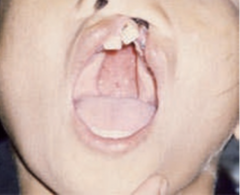
bilateral CL + CP
What type of cleft?

Van der Woude syndrome (bilateral CL + CP w/ lip pits, repaired)
What type of cleft?

CP, soft palate only
What type of cleft?
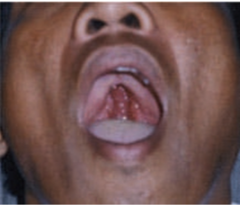
CP (only), hard and soft palate
What type of cleft?
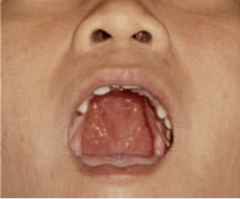
CP, only uvula affected
What type of cleft?

bilateral CP, hard and soft palate
What type of cleft?

Pierre Robin Sequence (orofacial clefts)
What disease has the following characteristics?
- Cleft palate
- Mandibular micrognathia
- Glossoptosis (airway obstruction caused by lower, posterior displacement of tongue)
Pierre Robin Sequence (orofacial clefts)
What disease?
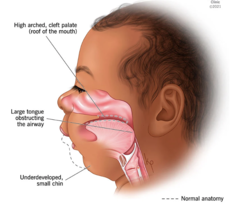
Pierre Robins Sequence (orofacial clefts)
What disease?

- Micrognathia
- Glossoptosis
- Cleft palate
What is part of the classic triad of Pierre Robin sequence?
paramedian lip pits
What disease has the following characteristic?
Bilateral and symmetric fistulas on either side of midline of vermilion of lip
autosomal dominant (with a high degree of penetrance)
Van der Woude syndrome is what type of genetic mode of transmission?
Van der Woude syndrome
What disease has the following characteristics?
- Cleft lip with or without cleft palate
- Isolated cleft palate
- Bilateral lip pits
- Hypodontia
- Normal intelligence
IRF6
What gene mutation occurs with Van der Woude syndrome?
paramedian lip pits
What condition?

Van der Woude syndrome
What condition? (hint: note the fistula on the lower lip)

commissural lip pits
What condition?
- Mucosal invaginations at corners of mouth on vermilion border
- Unilateral or bilateral, blind fistulas and may express fluid
- Not associated with facial or palatal clefts
adult males
Commissural lip pits are most common in what population?
commissural lip pits
What condition?

double lip
What condition?
- Redundant fold of tissue on mucosal side of lip
upper
Is the upper or lower lip affected more with double lip?
double lip
What condition?

Ascher syndrome
What condition?
- Double lip + Blepharochalasis (eyelid edema) + Non-toxic thyroid enlargement
Exact cause is unclear- sporadic and familial
Ascher syndrome
Patient presents with this presentation of his eyes, a double lip and non-toxic thyroid enlargement. What condition does he have?

double lip (or ascher syndrome but would need more info)
What condition?

Crouzon Syndrome
What condition?
- Craniofacial Dysostosis
- Triad of skull deformities and proptosis
craniosynostosis syndrome
What is the mildest form of Crouzon Syndrome?
Autosomal Dominant (FGFR)
What is the genetic inheritance pattern of Crouzon Syndrome?
- Skull deformities
- Facial anomalies
- Proptosis
What is the triad for Crouzon syndrome?
severe phenotype of Crouzon Syndrome
All of the following are findings for what?
- Brachycephaly
- Trigonocephaly
- Scaphocephaly
- Kleblattschel (Cloverleaf) deformity
A) Brachycephaly
Which of the following means a widened and shortened, bi-coronal skull?
A) Brachycephaly
B) Trigonocephaly
C) Scaphocephaly
B) Trigonocephaly
Which of the following means a triangular skull?
A) Brachycephaly
B) Trigonocephaly
C) Scaphocephaly
C) Scaphocephaly
Which of the following means a long and narrow skull?
A) Brachycephaly
B) Trigonocephaly
C) Scaphocephaly
crouzon syndrome
All of the following are findings for what?
- Hypertelorism
- Proptosis
- Flattened forehead
- A beaked nose
- Midface
- Hypoplasia
- Cleft palate
beaten metal appearance of the skull
What is the CT finding of Crouzon Syndrome?
Craniosynostosis
Define the following:
Premature closing of cranial sutures
Crouzon Syndrome
What condition?

Crouzon Syndrome
[brachycephaly, wide-set (hypertelorism), bulging eyes (proptosis), a flattened forehead, a beaked nose, and an underdeveloped upper jaw (maxillary/midface hypoplasia)]
What condition?

Apert Syndrome
What condition?
- Acrocephalosyndactyly (digits, head, fused)
- Craniosynostosis syndrome
- Skull deformities, facial anomalies, proptosis AND symmetric syndactyly of the hands and feet
Autosomal Dominant (FGFR, increased paternal age)
What is the genetic inheritance pattern of Apert Syndrome?
Crouzon syndrome and Apert Syndrome
These are more features of what?
- Hypertelorism
- Proptosis
- Flattened forehead
- A beaked nose
- Midface hypoplasia,
- Cleft of soft palate or bifid uvula
Apert Syndrome
These are more features of what?
- Downward slanting of lateral palpebral fissures
- Mandibular prognathism
- Trapezoid-shaped lips
apert syndrome
What condition has an "open mouth" appearance?
Syndactyly
Define the following:
Soft tissue and/or osseous fusion of adjacent digits in either the upper or lower extremity.
apert syndrome
What condition?

apert syndrome
Patient presents with syndactyly of their hands and this scan. What condition?

apert syndrome
Patient presents with syndactyly of their hands and this palate. What condition?
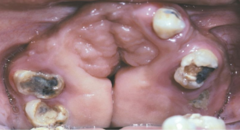
Treacher Collins Syndrome
These are also names for what syndrome?
- Franceschetti syndrome
- Mandibulofacial dysostosis
first and second
Treacher Collins Syndrome is an abnormal defect of what pharyngeal arches?
treacher collins syndrome
What condition?
- 1 in 50,000 live births: 40% de novo and clinically heterogeneous
- Microtia with conductive hearing loss
- Slanting palpebral fissures with possibly coloboma of the lateral part of lower eyelids
- Midface hypoplasia
- Micrognathia
- Sporadically cleft palate
treacher collins syndrome
What disease?

treacher collins syndrome
What disease?

Progressive Hemifacial Atrophy
Parry-Romberg syndrome is another name for what condition?
progressive hemifacial atrophy
What is a rare craniofacial disorder affecting one side of face with an unknown etiopathogenesis that affects areas supplied by various branches of the trigeminal nerve?
female (5:1)
Does progressive hemifacial atrophy have male or female predilection?
progressive hemifacial atrophy
What condition?
- Self-limiting period 2-10 years before stabilization
- Atrophy of the skin, subcutaneous tissue, fat, and even muscles and bones
- Linear scleroderma (coup de sabre)
- Mouth and nose deviated to affected side
progressive hemifacial atrophy
What condition can have a large linear scar near midline of forehead between normal/abnormal skin?
progressive hemifacial atrophy
What condition?

progressive hemifacial atrophy
This scar called "en coupe de sabre" is a feature of what condition?
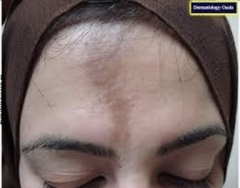
progressive hemifacial atrophy
What condition?

Patient's right side (atrophy and linear sclerodoma)
The image on the right shows the post-op care of this patient. What side of the patient was affected?

hemihyperplasia (hemihypertrophy)
What condition?
- Asymmetric overgrowth involving one or more body parts
hemihyperplasia (hemihypertrophy)
What condition?
- Isolated or can occur as part of a syndrome
(Beckwith-Wiedemann syndrome (BWS), Proteus syndrome, Russell-Silver syndrome, Neurofibromatosis type I (NF I) and Klippel-Trénaunay-Weber syndrome (KTW)
hemihyperplasia (hemihypertrophy)
What conditions has these characteristics?
- Hypertrichosis
- Telangectasias or nevus flammeus (port-wine stain)
- Increased risk of abdominal tumors (Wilms, Adrenal cortical carcinoma, Hepatoblastoma)
- Dental and maxillofacial anomalies
hemihyperplasia (hemihypertrophy)
What condition?

- Hemihyperplasia (hemihypertrophy)
- Patients right side is affected
What condition? What side is affected?

hemihyperplasia (hemihypertrophy)
What condition?
- Maxillofacial bones - unilateral enlargement
- Unilateral macroglossia
- Increased size of mandibular canal
- One sided dental anomalies
hemihyperplasia (hemihypertrophy)
What condition on the patient's right side of tongue?

hemihyperplasia (hemihypertrophy)
What condition?
hemihyperplasia (hemihypertrophy)
Nevus Flammeus or "Port Wine Stain" is an indication of what condition?

segmental odontomaxillary dysplasia
What condition?
- Rare non hereditary developmental disorder of posterior maxilla
- Hemimaxillofacial dysplasia
segmental odontomaxillary dysplasia
What condition?
- Unilateral expansion of the maxillary alveolus, dental abnormalities, facial asymmetry
- Mistaken for craniofacial fibrous dysplasia or hemifacial hyperplasia
segmental odontomaxillary dysplasia
What condition?

11
What is the mean age of segmental odontomaxillary dysplasia?
male
Does segmental odontomaxillary dysplasia have a male or female predominance?
- Dental abnormalities
- Delayed eruption
What are two dental related issues to segmental odontomaxillary dysplasia?
segmental odontomaxillary dysplasia
What condition?
- 50% had cutaneous changes
- Hypertrichosis
- Hyper/hypopigmentation
- Erythema
- Ectopic eyelashes
- Becker nevus
segmental odontomaxillary dysplasia
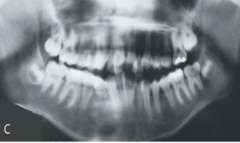
What condition (bone is spaced out on right side of mouth, spacing out teeth)?

True
T/F: This image is an example of a developmental disorder of the posterior maxilla in Segmental Odontomaxillary Dysplasia

becker nevus
This is a what feature of segmental odontomaxillary dysplasia?

eagle syndrome
These are also names for what syndrome?
- Stylohyoid syndrome
- Carotid Artery Syndrome
- Cervical pain
- Foreign-body sensation in throat
- Dysphagia
What is the triad of eagle syndrome?
eagle syndrome
What condition?
- Caused by the elongation of the styloid process or ossification of the stylohyoid ligament
- Compression/impingement: facial nerve, auriculo-temporal nerve, lingual nerve, chorda tympani, glossopharyngeal nerve, and hypoglossal nerve
CT scan
How can you diagnosis eagle syndrome?