ACER 9/30 Lecture #10: Covalent Bonding (Polarizability, Bond trends, and VSEPR Theory)
 Call Kai
 Learn
Learn Practice Test
 Spaced Repetition
 Match
Match Flashcards
 Knowt Play
1/25

Earn XP
Description and Tags
Continuation from 9/28 Lecture #9 slide 18
Name | Mastery | Learn | Test | Matching | Spaced | Call with Kai | Chat |
|---|
No analytics yet
Send a link to your students to track their progress
26 Terms
What is lattice enthalpy? How do we calculate it?
the net energy released when an ionic lattice forms
It is approximated by Coulomb’s law.
What is Coulomb’s law? What does it calculate?
κ (kappa) is the proportionality constant (aka Coulomb’s constant or electrostatic constant) 8.99 x 10⁹ N.m2/C2
q1 and q2 are the charges of the ions (in Coulombs)
r2 is the distance between the ions
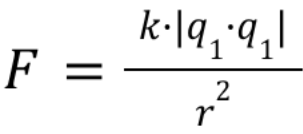
What formula do you use to calculate the electrostatic potential energy between the two ions? (two formulas, one simplified)
e is the fundamental charge (1.602 × 10⁻¹⁹ C)
Z1 and Z2 are the ionic charges (+1, +2, -1, -2, …)
0 is the vacuum permittivity
r1,2 is the distance between the nuclei. It can be calculated as the sum of the two ions’ radii: r1,2 = r1 + r2
κ (kappa) is the proportionality constant (aka Coulomb’s constant or electrostatic constant) 8.99 x 10⁹ N.m2/C2

Strengths and Weaknesses of Lewis Dot Diagrams (What is a solution?)
They are descriptive, showing valence electrons and bonds, but do not explain anything about why atoms prefer eight valence electrons or how electrons share space or why there are exceptions to the octet rule. It does not show molecular structure. Additionally, it treats electrons only as particles.
VSEPR theory supplements Lewis Dot Diagrams by predicting 3D structure.
Quantum description (VB and MO theory) is better for explaining electron behavior and treats electrons as waves.
Describe VSEPR theory and what is it used for.
It is used to predict the 3D structures of molecules based on the concept that lone pairs and bond pairs will orient themselves as far away from each other in order to minimize repulsion.
What are heterodiatomic molecules?
Molecules that are made of two non-identical atoms
Why do ionic and covalent bonding models not work for most molecules?
Most bonds are not purely covalent or purely ionic.
For example, HCl has a covalent bond between two atoms with very different electronegativities which creates a small net negative charge on Cl and a small net positive charge on H.
This reveals a limitation of formal charge which would predict a net charge of zero.
What is a mnemonic for the electronegativity for some common elements?
FOClNBrISCH
In order of decreasing electronegativity: Fluorine - Oxygen - Nitrogen, Chlorine, Bromine, Iodine, Carbon, Sulfur, Hydrogen
How much of an electronegativity difference creates a polar covalent bond? How much of a difference for an ionic bond?
Typically, in chemistry, a difference greater than 1 for a polar covalent bond and a difference greater than 2 for an ionic bond
What is polarizability?
It describes how easily an atom/molecule’s electron cloud can be distorted by an external electric field to create an induced dipole moment.
In terms of ions, what determines polarizability?
Size and charge.
A smaller, more positive cation will be more polarizing.
A larger, more negative anion will be more polarizable.
Bond Dissociation Energy (D, BDE): what is it, how is it represented, which does it indicate
measures the strength of a bond
It is the energy needed to break a bond homolytically. A higher BDE shows as a deeper well on a potential energy diagram. This indicates more possible vibrational energies.
Homolytic
a type of bond breaking where the electrons of the bond are split evenly between the bonded atoms
Why is a double bond not twice as strong as a single bond?
Partly due to electron repulsions between the bond pairs and larger electron clouds
Explain the relationship between atomic radius and bond strength.
Atomic radius and bond strength have an inverse relationship.
As atomic radius increases, the bond electron pair get further away from the nucleus and the bond length increases. A longer bond length is always weaker.
What is Bond Order? What is it used for? How is it calculated?
the net number of bonds that link a group of atoms
It is useful for determining the strength of a bond.
BO = # of bonds/# of bond groups
Ex. CO32- has three bonding groups and a total of four bonds. The bond order is 1.33, meaning each bond group actually has 1.33 bonds (not actually two single bonds and two double bonds).
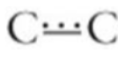
What does the dotted line mean?
It represents half a bond.
What is Vibrational Excitation?
occurs when molecules absorb infrared radiation, causing the molecule to move between vibrational energy levels and the bonds to vibrate (either stretching or bending)
Is stretching or bending higher energy?
Stretching is generally higher in energy than bending
What are two types of stretching?
symmetric
asymmetric
What are four types of bending?
wagging
scissoring
rocking
twisting
How does the strength of a bond relate to the amount of infrared radiation needed to make the bond vibrate?
The stronger the bond, the more infrared radiation is needed
How do you determine the number of vibrational modes that a linear or non-linear molecule has?
A linear molecule has 3N - 5 modes of vibration.
A non-linear molecule has 3N - 6 modes of vibration.
N is the number of atoms in the molecule.
What is the Steric Number?
the total numbers of bonds and lone pairs, determined from a Lewis diagram
What is an electron domain?
A bond, lone pair, or single electron
What is the three different types of electron repulsion in VSEPR theory? List them in terms of strength (and explain).
Lone pair-Lone pair repulsion (strongest)
Lone pair-Bond pair repulsion
Bond pair-Bond pair repulsion (weakest)
Lone pairs cause greater repulsion than bond pairs because they are attracted to only one nucleus and therefore occupy more space than bond pairs, which are kept in a small space due to attraction to two nuclei.