Goniometry, GM + ROM measurements
 Call Kai
 Learn
 Practice Test
 Spaced Repetition
 Match
 Flashcards
 Knowt Play
1/68

There's no tags or description
Looks like no tags are added yet.
69 Terms
What should you be feeling for when performing a passive range of motion test?
Symptoms, quality of movement, range of motion and end feel
AIDET components of consent
Acknowledge, Introduce, Duration, Explanation, Thankyou
ORDER during a physical exam
Observation, active range of motion, passive range of motion, palpation, muscle strength test, muscle length test, passive assecory movements
IN LUSH
Letter | Stands for | What it means in practice |
|---|---|---|
I | Indication | Explain why you want to do the assessment/treatment. |
N | Nature | Explain what you're going to do and what it involves. |
L | Likely risks | Explain any relevant risks or possible adverse effects. |
U | Uncertainties | Explain anything that is uncertain, including limitations. |
S | Success | Explain the likely benefit/outcome or chance of success. |
H | Hereafter | Explain what happens afterwards/nex |
Psoas major + iliacus — gravity-minimised MMT?
Position: Side-lying. Test leg supported on a powder board/friction-free surface. Knee = 90° flexion, Hip = neutral rotation. Movement: Slide the thigh forward into hip flexion. AG: sitting → lift knee UP; GM: side-lying → move knee FORWARD. This is shown as Fig. 12.25 in the textbook.
Gluteus maximus — gravity-minimised MMT?
Position: Side-lying with test leg supported. Hip starts at 90° flexion, Knee flexed. Movement: Move the thigh backwards into hip extension. AG: extend hip against gravity; GM: side-lying → slide thigh backwards. This is shown as Fig. 12.31 in the textbook.
Glute med + min — gravity-minimised MMT?
Position: Supine, opposite leg neutral, test leg supported on a powder board. Movement: Slide the test leg out to the side into hip abduction. Don't allow: hip flexion, lateral rotation, pelvic hiking. AG: side-lying → leg UP; GM: supine → leg OUT. This is Fig. 12.34 in the textbook.
TFL — gravity-minimised MMT?
Position: Semi-sitting, hips = 45° flexion, hip neutral rotation, arms support trunk, test leg on powder board. Movement: Abduct the hip while maintaining 45° hip flexion. This is different from glute med/min; TFL likes both flexion and abduction. This is shown in Fig. 12.39 in the textbook.
Hip adductors — gravity-minimised MMT?
Position: Supine, opposite leg abducted about 25°, test leg starts in slight abduction and is supported on a friction-free surface. Movement: Slide test leg IN toward the other leg = hip adduction. AG: side-lying → lift bottom leg UP; GM: supine → slide leg IN. This is shown in Fig. 12.44 in the textbook.
Hip external rotators — gravity-minimised MMT?
Position: Supine with test knee extended, hip starts medially rotated. Movement: Laterally rotate the hip. The textbook gives another GM option in standing, non-weight-bearing on the test leg while knee extended and hip medially rotated. In GM, the knee must move beyond the midline.
Quadriceps — gravity-minimised MMT?
Position: Side-lying, test leg supported on friction-free surface, hip = 45° flexion, knee starts = 90° flexion. Movement: Straighten the knee to 0° extension. AG: sitting → kick lower leg UP; GM: side-lying → straighten knee horizontally. This is Fig. 13.10 in the textbook.
Hamstrings — gravity-minimised MMT?
Position: Side-lying, test leg on friction-free surface, hip slightly flexed, knee starts at about 10° flexion. Movement: Flex knee to 90°, allowing heel to slide back towards the bum horizontally. This is Fig. 13.15 in the textbook.
Gastrocnemius — gravity-minimised MMT?
Position: Side-lying, knee extended, ankle starts anatomical/neutral. Movement: Plantarflex — point the foot. The knee staying straight is important because you're testing gastrocnemius. This is shown in Fig. 14.24 in the textbook.
Soleus — gravity-minimised MMT?
Position: Side-lying, knee = 90° flexion. Movement: Plantarflex the ankle. Difference to gastrocnemius: Gastroc = knee straight; soleus = knee bent. Flexing the knee reduces the contribution of gastrocnemius.
Tibialis anterior — gravity-minimised MMT?
Position: Side-lying, test leg = uppermost, knee flexed. Movement: Dorsiflexion + inversion, bringing the foot UP + IN. The textbook identifies tibialis anterior's motion as dorsiflexion with inversion and uses side-lying for GM.
Tibialis posterior — gravity-minimised MMT?
Position: Supine, foot hanging over edge of table, leg/ankle start anatomical. Movement: Inversion + slight plantarflexion. Think: Foot IN + DOWN. This is Fig. 14.33 in the textbook.
Fibularis longus + brevis — gravity-minimised MMT?
Position: Supine, foot hangs over edge of table, ankle neutral. Movement: Eversion while keeping the ankle neutral. Think: Sole turns OUT. This is Fig. 14.37 in the textbook.
What is normal hip flexion ROM?
115–125°
What is normal hip extension ROM?
Return to 0°
What is normal hip hyperextension ROM?
10–15°
What is normal hip abduction ROM?
45°
What is normal hip adduction ROM?
20–30°
What is normal hip medial rotation ROM?
30–45°
What is normal hip lateral rotation ROM?
45°
What is normal knee flexion ROM?
120–130°
What is normal knee extension ROM?
0°
What is normal ankle dorsiflexion ROM with the knee flexed?
20°
What is normal ankle plantarflexion ROM?
45°
What is normal foot inversion ROM?
30°
What is normal foot eversion ROM?
25°
What is the normal hamstring length on a straight-leg raise?
70–80° of hip flexion
What does less than 70° hip flexion during a straight-leg raise suggest?
Possible hamstring or gluteus maximus tightness
What does greater than 80° hip flexion during a straight-leg raise suggest?
Excessive hamstring length
In the Thomas test, what is considered normal hip-flexor length?
The test thigh should reach the table / 0° hip extension
How is hip-flexor shortening recorded in the Thomas test?
As the number of degrees lacking from full hip extension
Example: if the thigh remains 12° flexed in a Thomas test, what does that mean?
Approximately 12° of hip-flexor shortening
In the Ober test, what indicates normal TFL/ITB length?
The thigh should reach horizontal or adduct toward the table
What suggests TFL/ITB shortening during the Ober test?
The thigh stays abducted above horizontal
How can TFL/ITB shortening be measured in the Ober test?
Measure the distance between the medial knee and the table
What reference knee-flexion angle does the textbook use for the rectus femoris muscle-length test?
80° ( you start at 80 but they should be able to flex to 125 degrees)
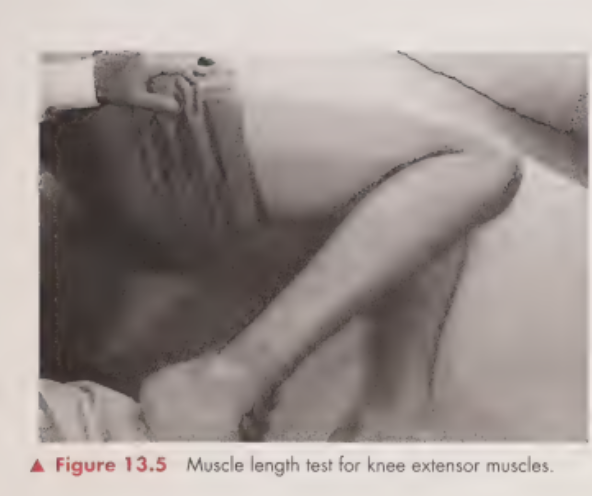
For the side lying monoarticular quadriceps test what is the expected ROM?
the expected range of motion is 125 degrees
What suggests rectus femoris tightness during its muscle-length assessment?
The knee extends as the hip is extended
How is rectus femoris shortening measured?
By measuring how far the knee-flexion angle differs from the 80° reference
How is gluteus maximus length assessed?
Flex the hip with the knee flexed until the sacrum begins to lift
Why is the knee flexed during the gluteus maximus length test?
To reduce the effect of the hamstrings
What is gluteus maximus muscle length compared against?
Normal hip-flexion ROM (115-125 degrees)
What is the normal end point when testing the one-joint knee flexors such as short-head biceps femoris and popliteus?
Full knee extension to 0°
What suggests tight one-joint knee flexors?
The knee cannot fully extend to 0°
How do you record one-joint knee-flexor tightness?
Record the number of degrees lacking from full knee extension
What is the expected muscle-length ROM for the one-joint quadriceps muscles?
About 125° of knee flexion
Which quadriceps are mainly one-joint muscles?
Vastus medialis, vastus lateralis and vastus intermedius
Why is the hip flexed during the one-joint quadriceps length test?
To reduce tension from the two-joint muscles crossing the hip
What dorsiflexion ROM is expected when testing soleus length?
About 20° dorsiflexion

What position is the knee in when testing soleus length?
Flexed
Why is the knee flexed during the soleus length test?
To minimise the contribution/tension of the gastrocnemius
What dorsiflexion ROM is expected when testing gastrocnemius length?
About 10° dorsiflexion
What position is the knee in when testing gastrocnemius length?
Extended
Why is dorsiflexion usually less with the knee extended?
Because the gastrocnemius is stretched across both the knee and ankle.
ROM for the 1st MTP joint FLEXION
from 0 to 45 degrees of flexion
ROM for the 1st MTP joint EXTENSION
45 to 0 degrees of extension and 90 degrees of hyperextension
ROM for MTP joints of digits 2-4 FLEXION
From 0 to 40 degrees of MTP joint flexion
Extension and hyperextension of the lateral four metatarsophalangeal joints
From 40 to 0 degrees of extension and 0 to 45 degrees of hyperextension
FLEXION OF THE FIRST INTERPHALANGEAL
JOINT AND THE LATERAL FOUR PROXIMAL
INTERPHALANGEAL JOINTS
From 0 to 90 degrees for the great toe; 0
to 35 degrees for the lateral four toes.
EXTENSION AND HYPEREXTENSION OF
THE FIRST INTERPHALANGEAL JOINT AND EXTENSION OF THE LATERAL FOUR JOINTS
From 90 to 0 degrees for the great toe
and 35 to 0 degrees for the lateral four toes. Hyperextension is minimal at the IP joints.
What does a hard end feel indicate?
A bony end feel indicates that the movement is limited by bone-on-bone contact, typically perceived as a hard stop at the end of a joint's range of motion.
what does a soft end feel indicate?
A soft end feel suggests that the movement is limited by soft tissues, such as muscle or fat, leading to a gradual and yielding stop at the end of a joint's range of motion.
What structures are you working over duirng passive assecory glides of the patellofemoral joint?
Passive accessory glides of the patellofemoral joint primarily involve the movement of the patella over the femur, affecting the underlying retinaculum, joint capsule, and surrounding soft tissues. The patella tendon, and the quadriceps tendon
What structures are you working over during passive assecory glides of the talocrural joint?
the talus and the distal parts of the tibula and the fibula. The tibialis anterior and extensor tendons anteriorly