Polisci Intro to Internation Relations Exam 1
 Call Kai
 Learn
Learn Practice Test
 Spaced Repetition
 Match
Match Flashcards
 Knowt Play
1/358

There's no tags or description
Looks like no tags are added yet.
Name | Mastery | Learn | Test | Matching | Spaced | Call with Kai | Chat |
|---|
No analytics yet
Send a link to your students to track their progress
359 Terms
Mercentilism
an economic policy focused on maximizing exports and accumulating wealth
Economic system of the major trading nations during the 16th, 17th, and 18th cent., based on the premise that national wealth and power were best served by increasing exports and collecting precious metals in return.
Imperial governments used military power to enrich themselves
Established state-backed monopolies in trade
Required colonies to buy and sell only with colonial power Reduced prices they paid for products and increased sale prices
Imperialism
Transferred political authority from local rulers to imperialist home country
The extent to which local institutions were suppressed or incorporated depended on many factors
Lack of self rule gave rise to demands for independence Economic and military dominance from Europe
Peace of Westphalia
1648
ended 30 Year's War (the French, Dutch, and other allies sealed the decline of Spain)
stabilized the borders of the belligerents and attempted to resolve some of the religious conflicts that had complicated their relations
modern state system
respect sovereignty
sovereignty
Ability of a state to govern its territory free from control of its internal affairs by other states.
states have ultimate authority within borders
hegemony
leadership or dominance, especially by one country or social group over others.
French Revolution
After the French Revolution (1789-99), the emphasis shifts from defeating each other to defeating democratic revolutionaries
asserting that the will of the people and the nation should determine state borders and governance
Concert of Europe
commitment to consultation of other major powers on diplomatic affairs
common interest of the European rulers in suppressing revolution helped them overcome their political difference
Pax Britannica
1815-1914
British hegemony = stabilizing force, prevents supremacy of others
After the French Revolution (1789-99), the emphasis shifts from defeating each other to defeating democratic revolutionaries
Also focused on getting rich and maintaining colonies
Concert of Europe: commitment to consultation of other major powers on diplomatic affairs
free trade, gold standard
Britain tried to prevent the supremacy of any one country on the European continent, acting to maintain a balance of power. If one country or coalition seemed too strong, Britain would ally itself with an opposing country or coalition. This rough balance, which was the general goal of British foreign policy throughout the century, helped deter military conflict among the European powers.
gold standard
1870-1914
countries tie currencies to gold at legally fixed price
Hegemonic Stability Theory
a global hegemon will benefit all, as they provide public goods: stability, commerce, gold standard, punish defectors
incentive to invest in public goods - benefit from an stable international order
Age of exploration
World becomes more closely connected
1500
innovation: magnetic compass, astrolab, Gutenberg printing press
reformation: Martin Luther challenges Catholic Church - separation from Church
War making = gunpowder
Why so much focus on Europe?
dominated trade
acute competitions between European countries --> adopt innovations quickly
nation states
property rights --> states effective at fighting wars bc ppl willing to lend to govt
protestant work ethic
science, medicine, consumerism
fought each other
Realism
1. World is anarchic
2. Actors are countries or 'states'
3. States try to maximize power
4. Relative power matters - anything that makes one country more powerful, makes others less powerful (security dilemma)
5. We see smaller states balancing the power of larger states
International politics is primarily about bargaining, in which coercion always remains a possibility.
Asia (6th - 19th century)
Organizing principle in Asia was hierarchy and relationships were maintained through tribute
1. Investiture - diplomatic recognition and granting of titles 2. Missions - diplomatic exchanges of envoys and trading
3. Core - autonomy in exchange for deference: China (center), Korea, Japan and Vietnam
4. Opposition - suppress border skirmishes and domestic dissent
Constructivism: actors, interactions, institutions
Culture, identity and ideas matter
Actors tend to do what is believed to be right and proper
Socialization is important to regulate behavior
Institutions can help identify what behavior is appropriate
Westphalian system of nation states is one order
Hierarchy and tribute is another order
Many types of actors are important. Actors' interests are influenced by culture, identity, and prevailing ideas. Actors' choices often reflect norms of appropriate behavior rather than interests.
Interactions socialize actors to hold particular interests, but transformations in patterns of interaction can occur as actors come to understand their interests differently.
International institutions define identities and shape action through the norms of just and appropriate behavior that they prescribe.
How did the system of state sovereignty spread
First Opium War (1839-1842)
The Opium Wars shattered China's traditional tributary world order and forcibly integrated the Qing Empire into the European Westphalian system of sovereign, equal nation-states
1. Britain refuses to accept tribute system
2. China accepts payment for goods in silver
3. British East India company turns to smuggling (opium)
4. Chinese destroy smuggled opium and Britain attacks
Power shifts before WW1/Thirty Years' crisis
1. Decline of Ottoman and Austro-Hungarian Empires
2. Russian expansion
3. Crimean War (1853-56) and Russian defeat
4. Prussia (kingdom in German empire) consolidates empire in Central Europe --> Germany more powerful
5. France tries to balance in Franco-Prussian War (1870-71) and fails
6. Growth of Germany, Japan, and US
7. Germany left behind in colonial race and seeks expansion into neighboring countries. Realist ideas are self-fulfilling
Bretton Wood System:
The economic order negotiated among allied nations at Bretton Woods, New Hampshire, in 1944, which led to a series of cooperative arrangements involving a commitment to relatively low barriers to international trade and investment.
Power transition theory
expects war to be more likely when one country's international influence is waning and another is ascending
WWI
(1914-1918)
Europe divides into two alliances: 1. Central powers: German, Austria-Hungary, Ottoman 2. Allied powers: France, Britain, Russia, US (enters 1917)
Treaty of Versailles - ended WWI 1. imposed reparation payments on Germany (resentment) 2. did not resolve territorial dispute between Germany and France League of Nations fails
countries dismantled post WW1 --> nation state model (realism)
Hyper-inflation and the Great Depression
1929
1. Stock market crash; policies (tariffs) deepen crisis --> crisis spread internationally as global trade halts.
2. Alienated citizens from new democratic systems --> Support for far-right (Fascists and Nazis) and far-left (Communists - government ownership of means of production); nationalist; anti-trade
WWII
(1939-1945)
Two alliances: 1. Axis powers: Germany, Italy, Japan 2. Allied powers: France, US, Britain, Soviet Union
Timeline: Germany annex Austria --> Germany occupied Czechoslovakia and attacked Poland (Britain and France declare war to protect ally) --> Germany attacks France --> Germany invades USSR, Japan attacks Pearl Harbor and US declares war --> Germany surrenders unconditionally; US drops nuclear weapons on Japan and they surrender
US and USSR emerge as only powers who can project force abroad
Charter of the UN
maintain international peace and security
friendly relations
formalization of sovereign state system (realism)
Cold War
Discord between US and USSR - democracy versus autocracy; free market versus planned economy; bipolar system (power most important thing, competition)
1. WEST - $14 billion Marshall Plan, NATO alliance and Bretton Woods economic system (GATT, Gold Standard and IMF, World Bank); combined social welfare systems (unemployment, healthcare, pensions, etc) with economic integration
2. EAST - Central Europe to China, North Korea, and North Vietnam; communist; central control of economy; different nations specialize in different products through the Council for Mutual Economic Assistance, Warsaw Pact
By 1954 - US and USSR have nuclear weapons (atomic and hydrogen) - mutually assured destruction
fights for influence - Korea, Vietnam
Marshall Plan
A United States program of economic aid for the reconstruction of Europe (1948-1952)
decolonization
During war and interwar years, Africa, Asia, and Latin America cut off from colonial powers --> Self-sufficiency, nationalism, and anti-imperialism --> Create nonaligned movement --> Formed cartels to elevate commodity prices
Decolonization examples
Post WWII: India peaceful but others were very violent; US supported decolonization - wants market access, fear that anti-imperialists would turn to communist bloc
independence from British rule on August 15, 1947
WWII severely drained British financial and military resources
European union
An international organization of European countries formed after World War II to reduce trade barriers and increase cooperation among its members.
Pax Americana
US-supported international institutions thrive
Dissolution of the Soviet Union in 1991 --> Creation of a liberal order in the West --> Countries seek prosperity and can have interests in commo: They can build international institutions to facilitate cooperation --> WTO, IMF, NATO
Chips in the hegemony (not always sucessful): Overreach - Somalia, Rwanda, Afghanistan, Second Iraq War, NAFTA, global financial crisis, China joins WTO - blowback to economic integration, populism
Liberalism: actors, conflict, institutions
Many types of actors are important, and no single interest dominates. Wealth is a common goal for many actors. Actors often have common interests, which can serve as the basis for cooperation.
International politics has an extensive scope for cooperation. Conflict is not inevitable but occurs when actors fail to recognize or act on common interests.
International institutions facilitate cooperation by setting out rules, providing information, and creating procedures for collective decision making. Democratic political institutions increase the scope for international politics to reflect the common interests of individuals.
Actors
the basic unit for the analysis of international politics; can be individuals or groups of people with common interests
international: states
domestic: bureaucracies, government officials, interest groups, political parties, ethnic groups, economic classes, etc
Supra-national level: Non-Governmental Organizations, (NGOs) and Inter-Governmental Organizations (IGOs)
Interests
what actors want to achieve through political action; their preferences over the outcomes that might result from their political choices
Frequently seen interests for states (3)
power or security: prerequisite for other interests, national interests (belong to the state itself)
economic or material welfare: high standard of living, prosperity
ideological goals: human rights, religion, nationalism
Nationalism
political ideology
prioritizes attachment to one's nation (group with common origin, ethnicity, language, or cultural ties)
Anarchy
absence of central authority with ability to make and enforce laws that bind all actors
defining feature of international relations
Applying framework
need to know issue/issue area, then actors, then interactions (status quo, included, possible provisions), then possible outcomes (associated with benefits), then interests, then institutions, then predictions
Interactions
ways in which choices of 2+ actors combine to produce political outcomes
Reversion outcome
the outcome that occurs when no bargain is reached
strategic interactions
strategy depends on anticipated strategies of others
cooperation
2+ actors adopt policies that make at least 1 better off relative to status quo without making others worse off
coordination and collaboration
coordination
type of cooperative interaction in which actors benefit from all making the same choices
no incentive not to comply/to defect
collaboration
type of cooperative interaction in which actors gain from working together but have incentives not to comply with any agreement
collective action problems
obstacles to cooperation that occur when actors have incentives to collaborate but each acts in anticipation that others will pay the costs of cooperation
public goods
nonexcludable (all can enjoy) and nonrival (quantity available not diminished if one enjoys)
ex., national defense, climate change, etc.
hegemon: individual benefit large, so incentive to contribute
free ride = issue
free ride
to fail to contribute to a public good while benefiting from the contributions of others
no international authority to force countries to contribute
What facilitates cooperation? (4)
small numbers of actors
iteration
linkage
information (knowing if someone defected)
iteration
repeated interactions with the same partners
linkage
the linking of cooperation on one issue to interactions on a second issue
Bargaining
2+ actors must decide how to distribute something of value
increasing 1 actor's share decreases the share available to others
cost/benefit analysis
coercion
imposing/threatening to impose costs on other actors in order to induce a change in their behavior
power
ability to get other side to make concessions to avoid having to make concessions oneself
outside options
the alternatives to bargaining with a specific actor
leverage to get a better bargain
Commitment Problem
a situation in which people cannot achieve their goals because of an inability to make credible threats or promises
would like to coordinate but cannot commit
individual incentive to defect
state cannot make promise in a credible manner (ie. may use force to revise a settlement later)
prisoner's dilemma
prisoner's dilemma
a game in which pursuing dominant strategies results in noncooperation that leaves everyone worse off

prisoner's dilemma criteria
1. both players have a dominant strategy to defect: always best response to all of the other players' strategies
2. both players prefer cooperate-cooperate box over the nash
prisoners' dilemma example
two self-interested nations choose to compete or build up arms rather than cooperate, resulting in a worse outcome for both
nuclear arms race during the Cold War
stag hunt
A game that is a metaphor for problems of coordination. It resembles the problem of setting international standards. The primary barrier to cooperation is a lack of trust. Best outcome is for both to cooperate and the worst is to cooperate while the other defects.
assurance game
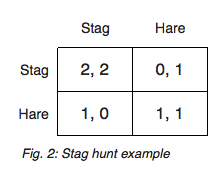
stag hunt/assurance game criteria
1. 2 nash equilibria
2. one nash is better for both
3. the worse nash is associated with lower risk if there is uncertainity about other player following through
stag hunt example
global climate change mitigation, where countries must choose between the high collective reward of cutting carbon emissions (hunting the "stag") or pursuing short-term independent economic growth (hunting the "hare").
chicken game
a version of the battle of the sexes game that results in disaster if each player plays his or her tough strategy; players want to play opposing strategies. So Player 1 wants to play cooperate if she thinks Player 2 wants to play defect, but Player 1 will play defect if she thinks Player 2 will play cooperate.

chicken game criteria
1. 2 nash
2. each player prefers a different nash
3. one "off equilibrium" is worse for both
4. the other "off equilibrium" is better for the loser
chicken game example
Cuban Missile Crisis of 1962, where the United States and the Soviet Union engaged in nuclear brinkmanship
the Soviet Union secretly placed nuclear missiles in Cuba, just 90 miles from U.S. soil. U.S. President John F. Kennedy responded with a naval quarantine (blockade) of Cuba rather than an immediate airstrike, forcing Soviet leader Nikita Khrushchev to decide whether to push Soviet ships through the blockade
U.S. president John F. Kennedy took steps toward nuclear war—for example, putting missile crews on alert—in order to pressure the Soviets to dismantle nuclear missile sites in Cuba.
Information problem
they do not know what the other actor's interests are
Describe how the assurance game and the prisoner's dilemma (commitment problem) differ?
The assurance game is a coordination problem where cooperation is safe if you trust the other person, while the prisoner's dilemma is a temptation problem where betraying the other person always gives you a better individual payoff.
Coordination problem
gains to cooperation, but need assurance
stag hunt
individuals achieve the best outcome by matching their choices, but struggle because there are multiple ways to succeed and no obvious way to agree
Standard types of cooperation problems (4)
commitment, coordination, distribution, information
Distribution problem
they disagree about how coordination should occur ('battle of the sexes')
both players want to cooperate but don't know how
outcome one prefers and an outcome another prefers, but coordination preferred over not coordinating
battle of the sexes game criteria
1. 2 nash
2. players have different favorite nash
3. the off equilibrium outcomes are worse for both than the nash
Distribution problem example
International Telegraph Union (1865): They needed to coordinate telegraph fees 1. Non-European countries want single-word fees 2. European countries want 20-word fees 3. Germany wanted low charges to increase flow (intermediary) 4. Need to reach agreement on size of fees and how to charge 5. There is also an information problem here. They didn't really know demand. Solution was 20-word fees for European traffic; one-word fees for extra-European traffic
Climate change agreements: Who should have to cut emissions? Who should have to pay the cost of adaptation? 1. Developing nations argue rich countries grew without restraint and should carry heavier reduction burdens 2. Rich countries argue that they can't do it alone, and middle income countries are now top emitters
Institutions
sets of rules, known and shared by the community, that structure political interactions in specific ways
How do international institutions encourage cooperation?
setting standards of behavior, verifying compliance, reducing costs of joint decision making, and resolving disputes (mechanisms for reolution)
Actors comply with institutions because
there are sanctions for violating them
there may be broader cooperation with other beneficial rules
since they are already in place, complying with them is cheaper than renegotiation
Policy bias
Institutions reflect past political bargains/interests of strongest actors when institutions are created
Equilibrium behavior
Rationality
acting in best interests to maximize payoffs
anticipating actions of other actors
Best response function
actor's plan, which maximizes interests, considering how they expect others to behave
look at every possible action for each actor, costs, status quo, preference ordering
Nash equilibrium
a situation in which economic participants interacting with one another each choose their best strategy given the strategies that all the others have chosen
stable preduction, both players best responding
Pareto efficiency/optimality
there is no other outcome that is simultaneously more preferred for one player and at least as good for all other players (one player is better off without harming other players)
War
event involving organized use of military force by at least 2 parties that reaches a minimum threshold of severity (ex. 1000 battle deaths)
Are interstate or civil wars more common?
civil
Realism and war
war is inevitable result of international anarchy
states seek to increase power or counter power of others
Proximate cause of war
precondition, war stems from disagreement (ex., territory, policies, regime type)
Goods that underlie most conflicts (3)
territory, policy, regime type
Crisis bargaining
a bargaining interaction in which at least one actor threatens to use force in the event that its demands are not met
coercive diplomacy
bargaining range
a set of deals both prefer over the reversion outcome of war
value of war = share of good - cost of war
compellence
an effort to change the status quo through the threat of force
deterrence
An effort to preserve the status quo through the threat of force
general, extended
Rationalist puzzle of war
bargaining range will always exist because cost for every war
why rational leaders still choose to fight costly wars when a negotiated peace deal would always leave both sides better off than the destruction of conflict
Ultimate causes of war
bargaining failure
Rationalist explanations for war (3)
Incomplete information, commitment problems, and indivisibility.
credible coercion
A will follow through
effective coercion
B will back down
Incomplete information
actors in a strategic interaction lack information about other actors' interests, capabilities, resolve (willingness to endure costs to aquire a good)
Incomplete information example
In face of Putin's demands, it was hard to believe that Putin would pull the trigger given the costs and risks of all-out war (resolve)
Putin clearly believed that the invasion would be quick and easy. - poorly informed about resistance Ukrainians would put up and quick response of Western countries
Non-credible threat example
US joined South Korea to repel North Korean invasion
Chinese diplomats conveyed a message through the Indian ambassador that a move across the 38th parallel would trigger Chinese intervention
Threat ignored
The U.S. operation had been planned and authorized under the assumption that the Chinese would not intervene - not credible
risk-return trade-off
in crisis bargaining, the trade-off between trying to get a better deal and trying to avoid a war
credibility
the target believes a credible threat will be carried out
threat is effective if credible
hard to achieve
Ways to make threats credible (4)
brinksmanship
tying hands
paying for power
shows of force
Brinksmanship
A strategy in which adversaries take actions that increase the risk of accidental war, with the hope that the other will "blink," or lose its nerve, first and make concessions.
Brinksmanship example
Cuban Missile Crisis of 1962, where the United States and the Soviet Union engaged in nuclear brinkmanship
the Soviet Union secretly placed nuclear missiles in Cuba, just 90 miles from U.S. soil. U.S. President John F. Kennedy responded with a naval quarantine (blockade) of Cuba rather than an immediate airstrike, forcing Soviet leader Nikita Khrushchev to decide whether to push Soviet ships through the blockade
U.S. president John F. Kennedy took steps toward nuclear war—for example, putting missile crews on alert—in order to pressure the Soviets to dismantle nuclear missile sites in Cuba.