Multi 2
 Call Kai
 Learn
 Practice Test
 Spaced Repetition
 Match
 Flashcards
 Knowt Play
1/110

There's no tags or description
Looks like no tags are added yet.
111 Terms
graph of x²+y²=1

equation of a sphere with center (h,k,l) and radius r
r² = (x-h)² + (y-k)² + (z-l)²
a · b
|a| |b| cosθ (θ is angle between a and b and is always between 0 and pi)
a · a
|a|²
a · (b + c)
a · b + a · c
(ca) · b
c (a · b) = a · (cb)
a is perpendicular to b if a · b = 0
a · b = |a||b|cosθ
comp ab
scalar projection = signed magnitude of PS
comp ab =
(a · b) / |a| = (|b|cosθ)
vector projection of b onto a
projab = ( (a · b) / (a)² ) a = (|b|cosθ a) / |a|
a x b =
i (a2b3 - a3b2) - j(a1b3 - a3b1) + k(a1b2-a2b1)
a x a =
0 (area of a parllelogram is 0)
a x (ca) =
0
Cross product rules
Cross product it 1) orthogonal to a and b and 2) the length of the resulting vecto is equal to the area of the parallelogram generated by a and b.
a x b =
-(b x a) (right hand rule)
|a x b| =
|a||b|sinθ = area of the parallelogram
a || b iff
a x b = 0 (a,b x= 0)
scalar triple product:
let a, b, c be vectors in R³. The scalar triple product of a,b,c is a · (b x c). To solve, replace ijk in cross product matrix with a1, a2, a3
Volume of a box =
|a · (bxc)| (STP)
vector equation of a line
r = v0 (vector from origin to point on a line (x0, y0, z0) + tv (direction vector of a line), t ∈ R
Parametric equations
x = x0 + at
y = y0 + bt
z = z0 + ct
P = (x0, y0, z0),
v = <a,b,c>
Symmetric equation of a line
t = (x-x0) / a = (y-y0) / b = (z-z0) / c. a,b,c x= 0
skew lines
2 different planes, not parallel but don’t intersect. set line coordinates equal to each other and see if they intersect
for a line segment…
give t parameters
how to describe a plane in R³
to describe a plane in R³ we need a point on it and a vector orthogonal to it
Equation of a plane
a(x-x0) + b(y-y0) + c(z-z0) =0 (right before 9/16)
equation of an ellipse
center = (h,k),
Semi-major axis (a): The distance from the center to a vertex along the longer axis. [1]
Semi-minor axis (b): The distance from the center to a co-vertex along the shorter axis. [1]
Orientation:
If a² is under x², the ellipse is horizontal.
If a² is under y², the ellipse is vertical.

Equation of a hyperbola
Horizontal Hyperbola:
(x-h)²/(a²) - (y-k)² / (b²)
Vertical Hyperbola:
(y-k)² / (a²) - (x-h)²/(b²)
a = distance from center to vertices
sphere
ax²+by²+cz² = 1 if a=b=c
r(t) is continuous at t=a if
lim r(t) = r(a)
t→ a
describe r(t) = <cost, sint, t>

unit tangent vector to a curve (T(t)) =
r’(t) / |r’(t)|
r(t) = tan-1(t); r’(t) =

d/dt [u(t) + v(t)] =
d/dt [u(t) ]+ d/dt [v(t)] =
d/dt (c u(t))
c d/dt u(t)
d/dt [u (f(t))]
u’ (f(t)) * f’(t)
d/dt [u (t) · v(t) ]
u (t) · v(t) + u’(t) · v’(t)
d/dt [u (t) x v(t) ]
u (t) x v(t) + u’(t) x v’(t)
r(t) · r’(t)
= 0
Du = <a,b>f(x,y) =
fx (x,y)a + fy(x,y)b
Du f(x,y) =
gradient f · u = |gradient f| |u| cos ϴ. (ϴ is the angle between gradient and u)
2nd derivative test
fxxfyy-(fxy)²
In calc one local max/min has f’(x) = 0, but converse
isn’t always true.
In calc 1, if 2nd derivative is pos =
local min
In calc 1, if 2nd derivative is neg =
local max
In calc 1, if 2nd derivative is 0 =
test is inconclusive
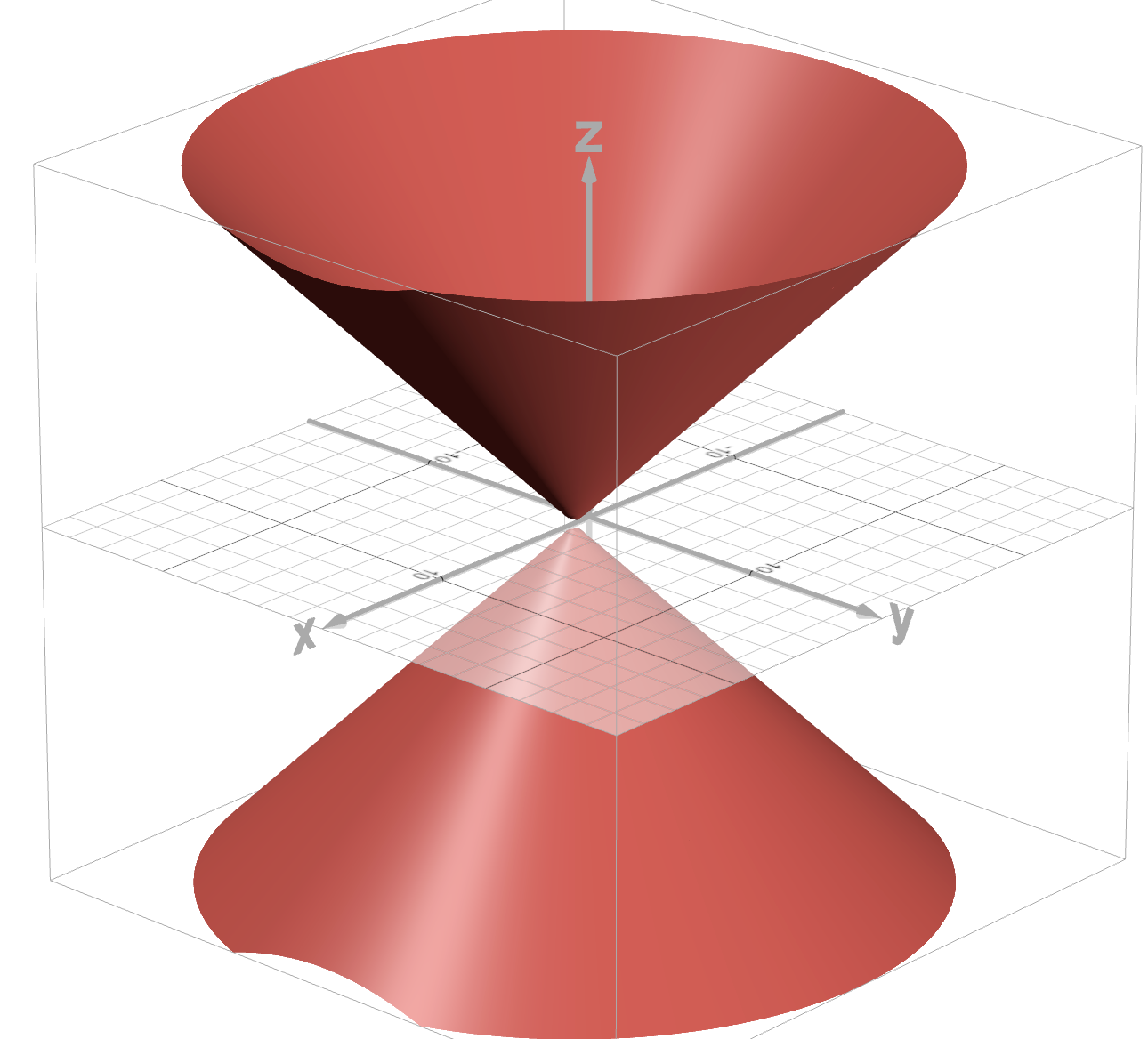
If the cone's vertex is point (x0, y0, z0), the equation becomes:
[(x-x0)² / (a²) ] + [(y-y0)² / b²] = [(z-z0)² / c²]
as c gets bigger, cone gets skinnier
a stretches in x direction, b stretches in y direction
If (a = b), it is a circular cone.
If a x= b, it is an elliptic cone (its cross-sections are ellipses instead of circles).

[z/c] = sqrt ([(x-x0)² / (a²) ] + [(y-y0)² / b²] )
for 3d, local max has to be
the local max sideways fy=0, and forward and backwards fx=0
for 3d, saddle point means
the sideways path has a local max/min (fy=0) and the forward and backwards path fx=0 has the opposite
3d local min
the local min sideways (fy=0), and forward and backwards (fx=0)
Theorem: if f has a local max/min at (a,b), then
fx(a,b) = 0 and fy(a,b) = 0, if they exist. so, if fx = 0 and fy = 0, the ∇f = <fx,fy> = 0. ∇f = derivative in 2-d setting. Thus, ∇f(a,b) = 0.
f(x,y) is a 2-variable funtion if ∇f(a,b) = <0,0> or ∇f(a,b) DNE.
Then (a,b) is called a critical point, f(a,b) = critical value!
2nd derivative test:
Suppose the second partials of (x,y) are all continuous on a mixed partials are equal disk centered at (a,b) and that f has a critical point (a,b). Let D = |fxx fxy|
|fyx fyy| = fxxfyy = (fxy)²
If D(a,b) = 0
Nothing, inconclusive
If D(a,b) < 0
We have a saddle point at (a,b)
If D > 0
a) fxx (a,b) or fyy (a,b) > 0 —> local min
b) fxx (a,b) or fyy(a,b) < 0 —> local max
When f(x,y) is subject to g(x,y) =k. The largest value that satisfies the requirement is when the level curves of f(x,y) and g(x,y)= k…
intersect tangentially
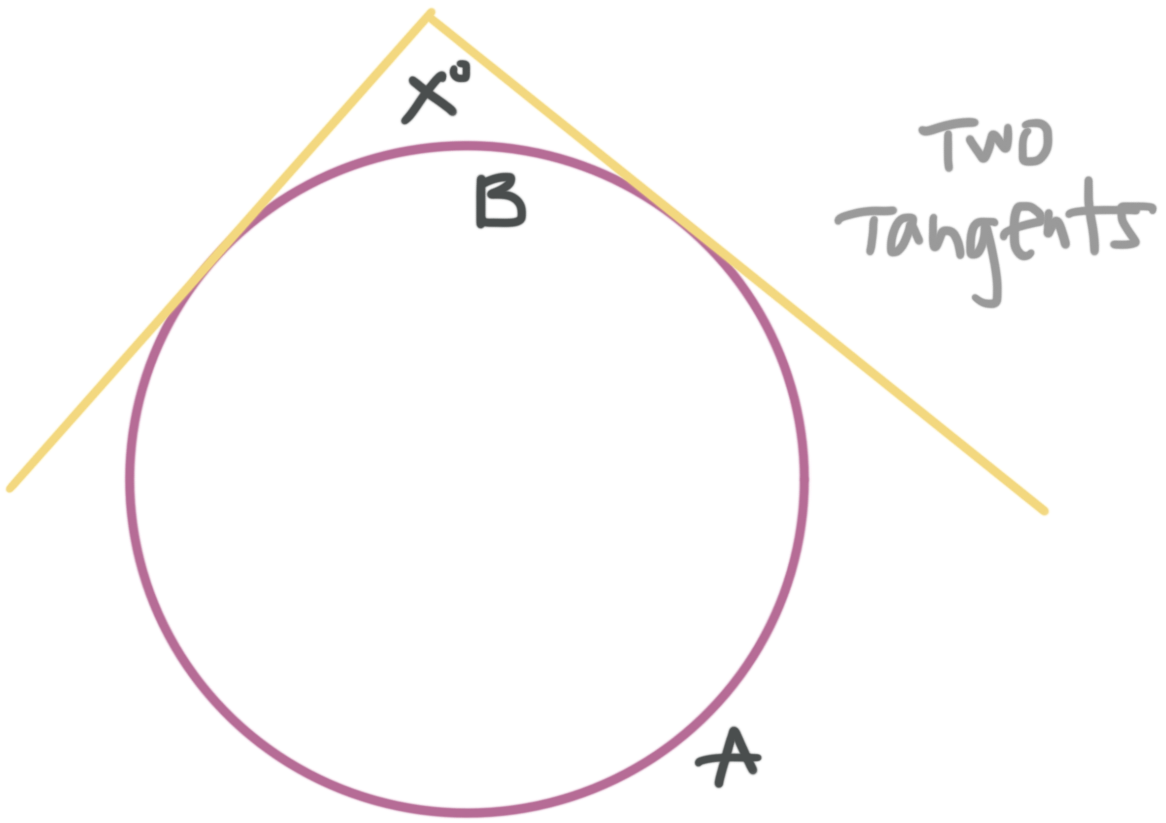
For Lagrange multiplier og equation
∇f = λ∇g. So, if ∇f = <a,b> and ∇g = <c,d>, then a = λc and b = λd
If you optimize (max/min) f(x,y) subject to a constraint g(x,y) = k, then
∇f = λ∇g, λ is ℝ, ∇g ≠ 0
Rectangle where a<=x<=b and c<=y<=d
R = [a,b] x [c,d]
volume of f(x,y) defined on a rectangle "R”
∫Rf(x,y)dA
Fubini’s Theorem: If f is continuous on the rectange R = [a,b] x [c,d] then,
∫ba ∫cd f(x,y)dxdy = ∫∫R f(x,y) dA
Type 1 region D:
{(x,y) , a ≤ x ≤ b, f1(x) ≤ y ≤ f2(x) }
Type 2 region:
{(x,y) , c ≤ y ≤ d, g1(y) ≤ x ≤ g2(y) }
D = D1 U D2. ∫∫D f(x,y) dA =
∫∫D f(x,y) dA = ∫∫D1 f(x,y) dA + ∫∫D2 f(x,y) dA
r and θ on a graph

x in polar coordinates
x = r cos θ
y in polar coordinates
y = r sin θ
θ =
tan−1(y/x)
Polar rectangle:
{ (r,θ) | a ≤ r ≤ b, c ≤ θ ≤ d}
dA (polar coordinates) =
lim dr → 0 (dA) = rdθdr
r² in polar coordinates
r² = x²+y²
when do you use polar coordinates
circular regions

Paraboloid at center (h,k,j)
a = stretch along x-axis
b= stretch along y- axis
c = larger z = skinnier parabola


Hyperbolic paraboloid. b = stretch inner parabola towards y, a = gets skinnier, c= gets skinnier

Fubini’s theorem for triple integration
Let f(x,y,z) be a continuous function on B = [a,b] x [c,d] x [r,s]. Then ∭Bf(x,y,z)dV ∫cd∫rs∫ab f(x,y,z)dxdzdy = …dxdydz = …dzdxdy = dzdydx = dydxdz = dydzdx (6 different ways)
∫∫D(height)dA =
∫∫∫E1dv
cyllindrical coordinates

x in cyllindrical
x = rcosθ
y in cylindrical
y = rsinθ
z in cylindrical coordinates
z = z
r = 1
cylinder

θ = pi/4
half of a plane

z = 2
plane

sin²θ
(-1/2) [cos(2θ)-1]
∫∫∫Ef(x,y,z)dv in cylindrical coordinates
= ∫∫∫Ef(x,y,z)dz(r)drdθ OR ∫∫∫Ef(x,y,z) r dzdrdθ
cos(2θ) =
cos²θ + sin²θ
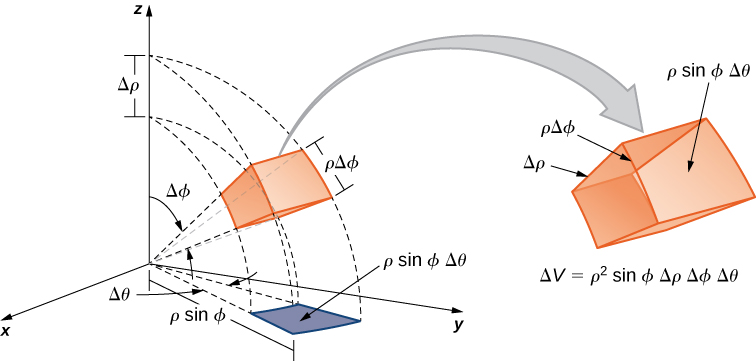
spherical coordinates
ρ = distance from the origin, θ = same θ as in cylindrical coordinates, ϕ = angle with the positive z-axis.
0 ≤ θ ≤ 2pi; 0 ≤ ϕ ≤ pi; 0 ≤ ρ ≤ infinity
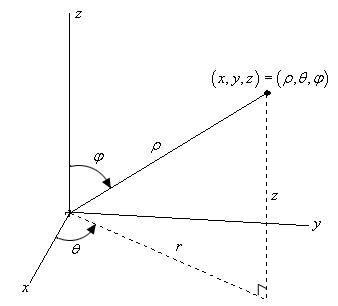
z in spherical =
z = ρ cos (ϕ)
x in spherical
x = ρ sin (ϕ) cos θ
y in spherical
y = ρ sin (ϕ) sin θ
spherical dv =
dv = ρ² sin (ϕ) dρ dθ dϕ
ρ = 1 or ρ = c
sphere or radius c

ϕ = pi/4
cone

θ = pi/4
half plane

cylindrical rectangular box =
{(r,θ,z) | a≤ r ≤b, c≤θ≤d, r≤z≤s }
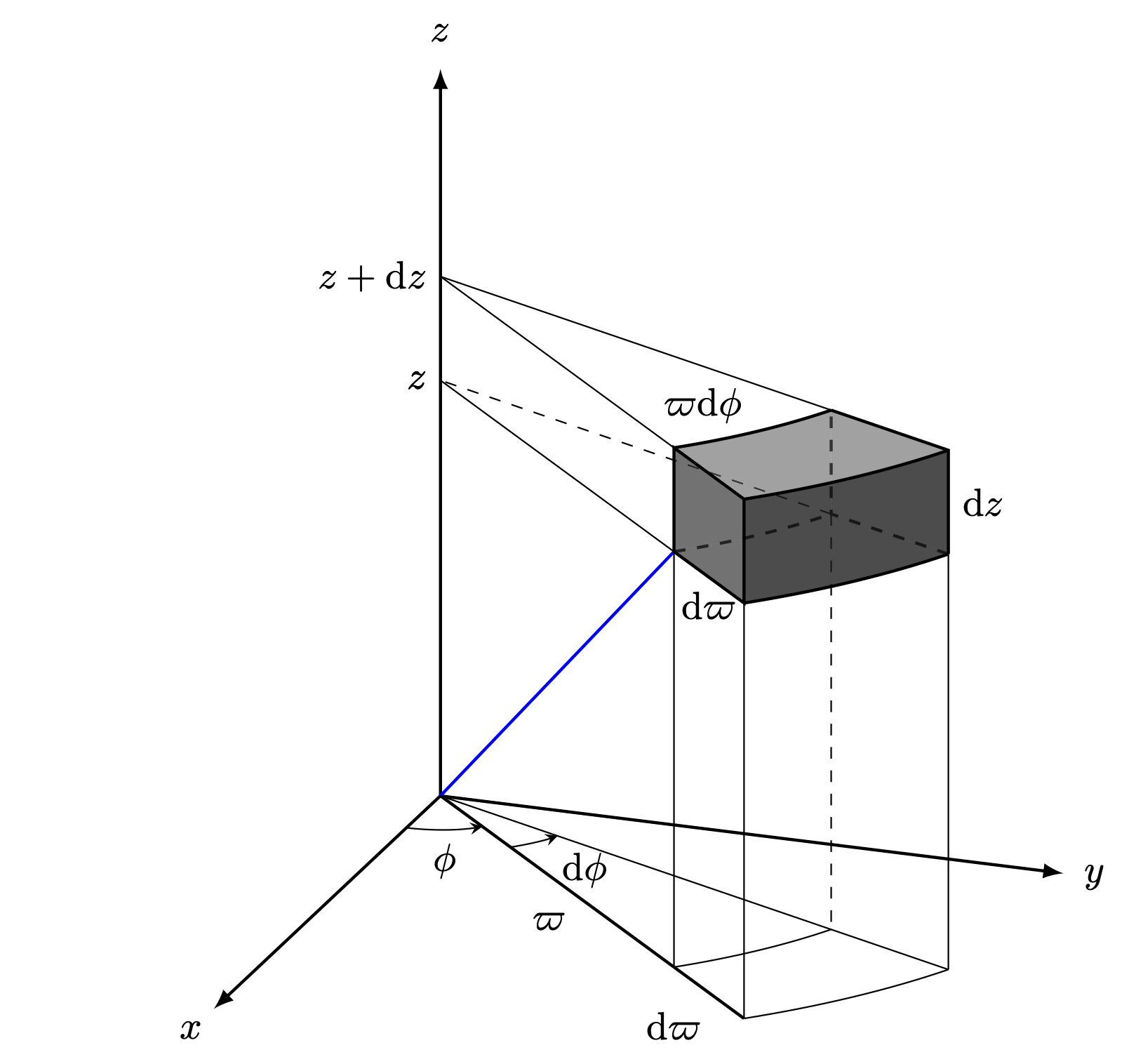
spherical coordinates rectangular box
{ (ρ,θ,ϕ) | a≤ρ≤b, c≤θ≤d, r≤ϕ≤s }
ball
sphere and everything inside
Use spherical if…
your shape looks like a cone, half-plane, or sphere