Lab 2 - Reproductive system & hatching
 Call Kai
 Learn
 Practice Test
 Spaced Repetition
 Match
 Flashcards
 Knowt Play
1/76

There's no tags or description
Looks like no tags are added yet.
77 Terms
Name parts of the male reproductive & urinary system in birds
Testes, epididymis, ductus deferens
Kidneys, ureter, cloaca

Name parts of female reproductive system in birds
LEFT!!
1. Ovary - several follicles
2. Oviduct:
- infundibulum: 8cm, ovum here for 18-20 mins - receives ovary after release, fertilisation occurs here
- magnum / ampulla: 33cm, ovum here 180mins (3hrs) - secretes most of albumin
- isthmus: 10cm, 75min, secrete shell membrane
3. Uterus or shell gland: 8-12cm, ovum here for 20hrs
- shell & pigment form, outer cuticle (mucin) deposited on egg surface
4. Vagina: 6cm, ovum here for 5-10min, ends in urodeum
Cloaca

Infundibulum: length, time ovum spend, function
8cm
18-20 mins (15-30m)
Receives yolk after release, fertilisation occurs
Magnum / ampulla: length, time ovum spend, function
33cm
180 mins (3hrs)
Secretes most of albumen
Isthmus: length, time ovum spend, function
10cm
17 mins
Secretes shell membranes
Uterus / shell gland: length, time ovum spend, function
8-12cm
20hrs (1200 min)
Shell & pigment is formed
Outer cuticle (mucin) is deposited on egg surface
Vagina: length, time ovum spend, function
6cm
Ovum 5-10 min
Ends in middle of cloaca - urodeum
Describe structure of a hens egg
Shell, shell membrane, air space,
Egg white: inner thin albumin, fibrous layer, outer thin albumin, chalaza
Yolk: chalaziferous layer, vitelline, blastoderm, white yolk, yellow yolk, nuculus of pander, latebra

Describe the structure of the egg shell
Pore, cuticle
Palisade layer, cleft, mammillary layer, outer membrane, inner membrane

What does the success of hatching depend on
1. Genetic potential of chickens
2. Managing fertility
3. Quality of hatching eggs
4. Transport, storage & incubation of eggs
What is the aim of genetic selection
Aim to improve genetic potential of chicken lines in aspect such as:
- Liavibility, quality of semen, egg weight, fertility, hatchability
- improve growth rate, feed conversion ratio
- disease resistance
- gut efficiency
- reduce issue with leg, feet & feathers
What does the percentage of fertile eggs indicate
Describing the
- condition & activity of males
- condition of females
- propensity of sexual behaviour of both
(closely related to contentment of flock - reliable measurement of well being)
What can be considered as a basic reliable measurement of flock well being
Fertility
To ensure fertility of flocks, what conditions should be met in regards to groups of male & female breeder
Both groups should be
- uniform
- similar maturity
- well matched in size
- good feather, & strong legs
- low stress, space to promote natural behaviour & optimum diet
What is the mating ratio (MR) in natural or AI
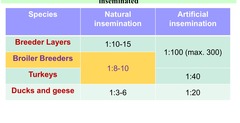
What is the hatch of fertile percent
Measurement of efficiency of hatchery machine
Takes into account flock fertility & hatchabiltiy
(% hatch / % fertile) x100
How to calculate: % feriltility, % hatchability, % hatch fertile
% fertility = #fertile eggs / #total eggs produced x100
% hatablility = #egg which hatch live young / #fertile eggs x100
% hatch fertility = %hatch/%fertile x100
Incubation period of chickens, ostrich & turkeys, ducks geese
Chicken - 21d
Turkey - 28d
Ostrich - 42d
Ducks - 28d
Geese - 28-33d

Lay out of a hatchery

Reason to remove / discard eggs unsuitable for hatching
1. Dirty
2. Cracked
3. Small
4. Very large / double yolk
5. Poor shells (any colour is acceptable tho)
6. Grossly misshapen
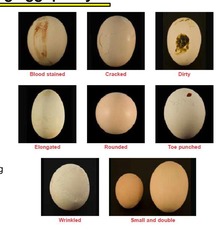
Normal egg weight of chickens, turkey
Chicks - 53-65g
Turkey - 65-95

Transport, storage & incubation rules of eggs
1. Do not wash eggs, unless needed & dry before storage
2. Store clean fertile eggs only
3. 13-15C 70-75% humidity (never >24C or
What is the temperature & humidity of storing eggs
13-15C, 70-75% humidity
What limits should eggs never be stored at & why
Never store gags at >24C or humidity
How long should eggs be stored for
Rules of egg disinfection
1. Disinfect ASAP after collection
2. Dry methods - fumigation, UV, ozone
Preferred - fumigation with formaldehyde gas
Describe preferred process of egg disinfection
Preferred method is - fumigation with formaldehyde gas
- 21ml formalin (37.5%) + 17g potassium permanganate + 21ml water
(In fumigation room)
- 20-30 min
- >24C >60% humidity
Levels of fumigation in incubation
10ml formalin (37.5%) + 4g potassium permanganate
Do not do it between 24-96hr bc onset of blood circulation
Levels of fumigation in fumigation room vs incubation room
Fumigation room - 21ml formalin + 17g K+ permanganate + 21ml water
Incubation - 10ml formalin + 4g of K+ permanganate
When should fumigation not be done during incubation, & why?
Do not fumigate between 24-96hr of incubation
Bc this is the onset of blood circulation
Four factors of major importance of incubation eggs artifically
1. Temp - most critical
2. Humidity - overlooked but causes hatching problems
3. Ventilation - Ox conc >20%, CO2
What is the mort critical parameter during artificial incubation of eggs
Temperature
What is should the air composition & movement be in artificial incubation of eggs
Ox 20%, CO2
Hatching condition of Chickens eggs
Temperature
Setter: 37.2-37.8 for 18-19d
Hatcher: 36.5-37.2 for 18-19/21d
Humidity
Setter: 50-55
Hatcher: start 55, end 80%
Hatch time - 504hrs
Hatching process - 8-12

What is the role of turning durning incubation of eggs
Prevents the embryo sticking to shell membrane esp in week 1
Aid development of embryonic membranes
Day 1-7 - 1x/hr
Days 8-15 - 1x/2-3hrs
How often should eggs be turned during incubation
Day 1-7 - 1x/hr
Day 8-15 - 1x/2-3hrs
When should chicks be pulled?
Ready to be taken off when most are dry & fluffed up
5% may have still some moisture on back of necks
Do not leave them in too long or they will dehydrate
What has to be done after pulling chicks from incubation
Separated from debris
Graded & counted by - first quality & culls
Additional operations incl:
- sexing, based on feathers on broilers or vents in breeding stock
- vaccination - pray or injection, manual or automatic
- beak conditioning
- maintain correct temp & humidity to reduce weight loss
-> 23C, 65-70%
How are broilers & breeders sexed after hatching
Broilers - feathers
Breeders - vents
Method of vaccination after hatching
Spray or injection
Manual or automatic vaccinators
What temperature & humidity must be maintained for chicks after hatching & why is this important
Temp - 23C
Humidity - 65-70%
Why? Reduce weight loss
What is first quality chicks
Occur when eggs are collected, stored, transported & incubated
In which areas can the process of producing first quality chicks fail
1. Temp & humidity monitoring i.e., egg handling, incubation
2. ID need for removal of eggs / clears i.e., infertile, early/late or dead
(Recc candling eggs 2x)
3. Measure of Eggs weight loss & temp
4. Evaluation of hatching process
5. Evaluation of hatched chicks
6. Analysis of embryonic mortality pattern & development of abnormalities of hatching debris
7. Analysis of fertility & hatchability results
In all these areas there room of failure
(Wrong temp / humidity, no noticing eggs should be removed, eggs weight loss, in proper evaluation / analysis of different steps)
Describe the pattern of embryonic mortality of broilers parent stock
Follows a predictable pattern
- high in early stage i..e. 0-6d -> non viable embyryos die
- stable in middle i.e., 7-18d
- peaks as they hatch i.e., 19-21d
(Peak, dip & stable, peak)
Meat lines: avg hatchabiltiy 85% (15% infertile or dead)

How is biological emulation of hatching process performed?
Randomly mark 1000 egg before putting into setter: 8 trays = 125 eggs
Analysis is done by:
- evaluation of shell quality
- evaluation of embyro morphology
- Necropsy examination of dead embryos
- sample collection i.e., bacteriology, virology, Histopath, serological
How many eggs are marked for biological examination
100 eggs before putting into setter
8 trays = 125 eggs
What types of eggs should be cleared & how are they checked
Incubation clears incl: infertile, undeveloped - early/late dead embryos
Evaluation: candling x2 (d5-7/10 & d18)
VIP to distinguish infertile from early embryonic mortality so correct action can be taken
How to tell if egg needs to cleared
Candling x2
1. Day 5-7/10
2. Day 18
Distinguish infertile or early / late embryonic death
When should candling be done during incubation
Day 5-7/10
Day 18
What should the measurement of weight & temp be during incubation of eggs for best hatchabiltiy
Weight For best hatchabiltiy
- eggs loose 12% weight by day 18
- egg size is main factor affecting chick size
- chick is 66-68% if egg weight
- egg avg 60g, chicks will be 40g (avg 34-46g)
Temperature of egg shell for best hatchabiltiy
1-9d: 0.1C less than in setter
9d: equal temp
>9d: >2C at end of incubation
How much weight should egg lose for best hatchabiltiy
12% by d18
What percentage of egg weight does a chick weight
66-68% of egg weight
60g = 40g chicken
Avg weight of chicken - 34-36g
What does "hatch window" mean
Time from first & last chick hatching in one particular Hatcher
When is it possible to stop & open Hatcher?
Minus 36, 24, 12hr before planned chick take off to estimate when first chick appeared
What is the risk of eggs hatching too early
They become susceptible to dehydration, bc they will be left in incubator too long waiting on other eggs to hatch
List hatching problems
Early hatching
Late hatching
Stick chicks
Malposition
Unhealed naval
Crippled chicks
Abdominal chicks
What parameters should be met in hatched chicks / evaluation first class vs inferior quality chicks
Chick of good quality:
1. Individual weights (34-46g)
2. Rectal temp 40-40.6C
3. Alert active
4. Closed naval
5. Well developed legs - soft, hydrated with extended toes
6. No welling of hocks & normal skin (first class)
7. Growth in line with genetic potential
Chicks of inferior quality
- DH legs, red swollen hocks
What main parameter distinguishes first class chicks from inferior quality day old chicks
First class - hocks not swollen & normal skin colour
Inferior - DH legs, red swollen hocks
List the major causes of failure of eggs to hatch
1. Incubation faults - temp, humidity, O2, CO2 conc
2. Diseases - viral, bacterial, molds
- viral: CELO, EDS'76, IB, AL, AE, CIA, REO
- Bacteria: Mycoplasma gallisepticum, salmonella, E. Coli, proteus
Strep, staph etc.
- molds: Aspergillus etc.
3. Breeder nutrition - def of hens
- vits: A, E, B2, B12, D3, H, Folic acid
- mineral: Mn, Zn, Mo, I
Name viruses that may cause failure of hatching
CELO - chicken embryo Lethal orphan
EDS'76 - Egg drop syndrome'76
IB - infectious bronchitis
AL - avian leucosis
AE - avian encepthalomyelitis
CIA - chicken infectious anemia
REO - respiratory enteric orphan
What is the procedure for analysis of embryonic mortality pattern & developmental abnormalities when examining hatch debris
1. Open each egg
2. Classify contents: when the died, bacterial contamination or not
3. Record developmental abnormalities
4. Sort eggs by stage, record # in each category by tray
5. Total # of egg in each category for each flock, calculate % of total eggs in set
6. Plot results & compare with targets
7. Mark which categories have greatest difference from target & id problem
What to look for when investigating poor hatchabiltiy / dead eggs
1. Egg size & shell quality
2. Egg space
3. Position of embryo in shell
4. Anatomical abnormalities
5. Nutritional abnormalities
6. Unused albumin
7. Age of embryo
Describe the normal hatching position of embryos in eggs
Spine is parallel with long axis of eggs
Beak is unseated right wing
Name different malpositions of embryos in eggs
1 - head between thighs
2. Head in small end of egg
3. Head turned left
4. Head under left wing
5. Break away from air cell
6. Feet over head
Not all are lethal, but some cause failure to hatch
List sections of the oviduct
Infundibulum, magnum, isthmus, uterus, vagina
Which part of oviduct is the cuticle formed
Shell gland / uterus
Location of nucleus of pander
In white yolk - in blastocytes disk we're fertilisation takes place - place of start of embryo formation
Closed to vitali membrane
What is phallus
Part of male repro tract, only in ostriches, cassowaries, Kiwis, swan, geese, ducks
Name extraembryonic membrane
Yolk sac, amnion, chorion, Allantois
Where does fertilisation occur
infundibulum
Which part of oviduct produces the shell
Shell gland / uterus
Longest part of the oviduct
Magnum / ampulla
Major incubation failures
Temp - too high over heating
Humidity
Oxygen & CO2 levels
Ventilation
Turning
What is candling / when should it be done
It is method of assessing quality & embryonic growth & development
Done at day 7-10 & day 18
Location of testes in cock
Paired abdominal testes - craniovenrally to first lobe of kidney
What is stigma
Area on follicle w/o BV where it rupture from
Pasgar score unit - what is it
Objective measure of day old chick quality
Based on morphology of - beak, legs, naval, yolk
Days of embryonic development & what happens in each
