ME115 - Week 11
 Call Kai
 Learn
 Practice Test
 Spaced Repetition
 Match
 Flashcards
 Knowt Play
1/16

Earn XP
Description and Tags
Polymers, Composites
17 Terms
Polymers
Huge, chain-like molecules where there are (usually) carbon atoms forming a backbone that is linked by covalent bonds.
Polymerization
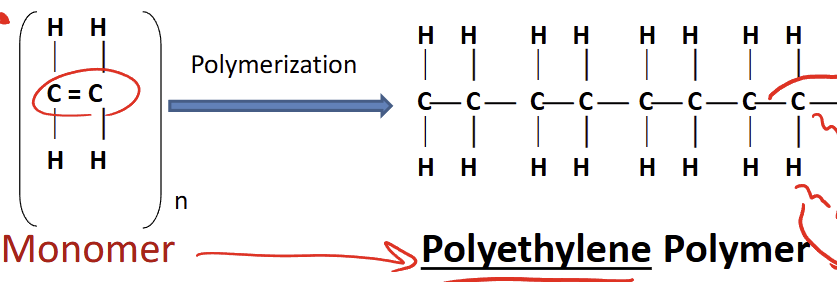
A process many monomers join into long chains or networks to form a polymer.
e.g. Ethylene (C2H4) that breaks its double bonds to join with other monomers
Thermoplastics
One of the three types of polymers. Linear or branched weak chains that can slide past each other when heated. This produces a very ductile material that can be recycled; has a very high strength to weight ratio.
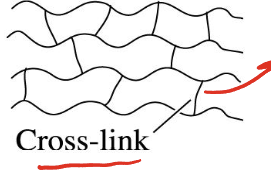
The photo is what the chains kind look like together.

Thermosetting
Another type of polymer. Have strong cross links that form a 3D network of chains (very strong), heat causes degradation, cannot be reshaped like thermoplastics since the crosslinks do not reform after breaking.
e.g. epoxy, resin, etc.
Elastomers
The final type of polymer. Cross links prevent the chains from permanent deformation e.g. natural rubber

Examples of Polymers
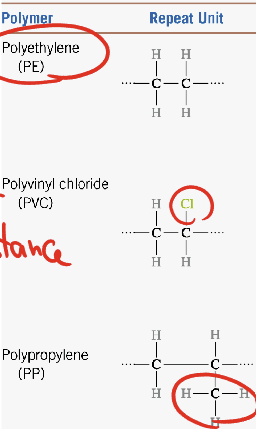
Polyethylene (PE): Household items, wire insulation, squeeze bottles, tubing
Polyvinyl Chloride (PVC): Pipe, valves, fitting, floor tile
Polypropylene (PP): Tanks, carpet fibers, rope, packaging
Degree of Polymerization
The # of repeat monomers in a polymer chain.

Mechanical Behavior of Polymers
(Thermoplastic) Tangled chains (linear elastic deformation) → yield strength reached → neck formation → chain alignment (oriented in direction of pull) → fully drawn polymers → fracture (covalent bonds can no longer support load)
Strain hardening only happens after the chains are fully drawn

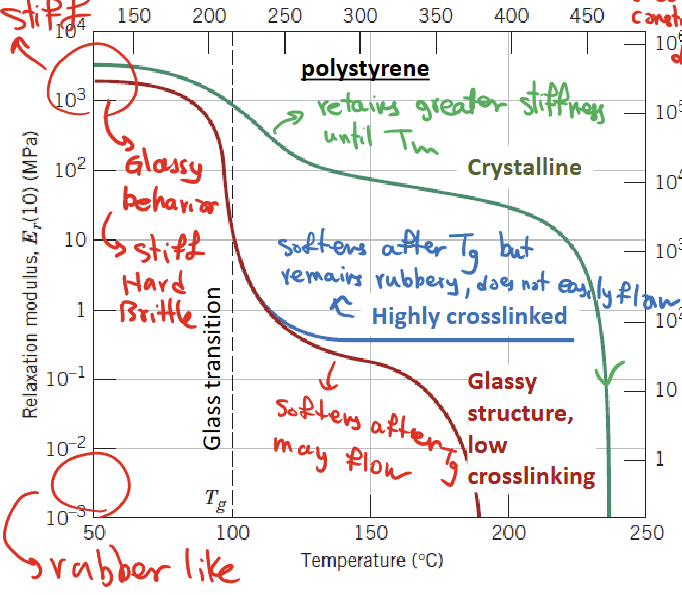
Relaxation Modulus
Describes how well a polymer maintains stress when it’s help at a constant deformation level (low relaxation modulus = doesn’t maintain deformation e.g. rubber)
Effect of structure and temperature
Polycrystalline polymers maintain stiffness until Tm
Highly crosslinked polymers soften after Tg and become rubbery but do not easily flow
Polymers with glassy structures (low cross linking) soften after Tg and may flow
Composites
Combine two (or more) different materials or phases, they are mixed together to get the best qualities of both materials
Phase
e.g. oil in water or CO2 in water, distinguishable elements that are mixed together. Sugar dissolved in water is considered one phase as they cannot be distinguished macroscopically
Dispersed Phase
Phase or phases that are dispersed in a continuous matrix (filler material, solvent) of the composite.
Reinforcing Phase
Elements that bring a superior property e.g. dual phase steel that becomes both ductile and strong once the phase is introduced.
Theory of Fiber Reinforced Composites
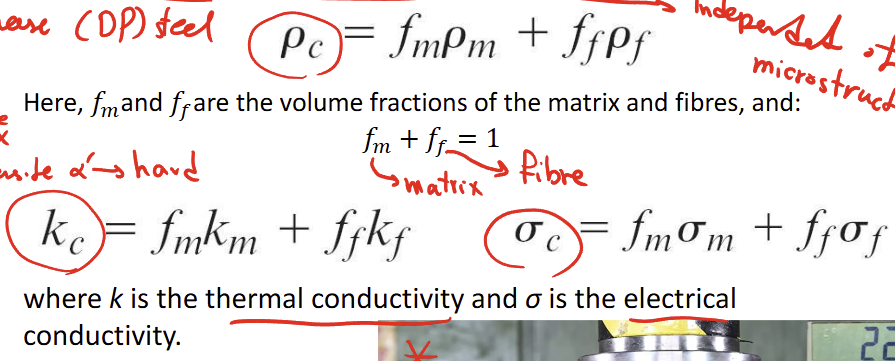
The top equation is how the density of the whole composite is made up of the fractions of the densities of the matrix and phase.
The bottom two equations are the same thing but for thermal and electrical conductivity.