Ch. 7: Regulation of Gene Expression in Prokaryotes I
 Call Kai
 Learn
Learn Practice Test
 Spaced Repetition
 Match
Match Flashcards
 Knowt Play
1/55

There's no tags or description
Looks like no tags are added yet.
Name | Mastery | Learn | Test | Matching | Spaced | Call with Kai | Chat |
|---|
No analytics yet
Send a link to your students to track their progress
56 Terms
The human body contains many different cell types, but they share the same genomic sequence. How can cells with the same genome develop and maintain such different identities and functions?
These differences do not arise from the differences in the DNA sequence itself, but from differences in which genes are turned on or off, when they are expressed, and at what levels. This depends on the regulation of gene expression.
Are all gene regulated?
yes, but not in the same way
gene expression
the process of turning on a gene to produce RNA and protein
What are the 2 ways genes are expressed?
constitutively and under specific conditions
constitutively expressed
constitutively stressed in cells under all conditions, because their products are needed for basic cellular functions and viability in all conditions
ex. the proteins or enzymes that make energy are constitutively expressed, because we always need energy
regulated genes
Genes that are expressed under specific conditions, because they’re often only required for specialized functions rather than basic viability.
They are not always needed, but can provide a fitness advantage under specific conditions.
Ex. genes induced by heat stress can help cells survive elevated temperatures

Prokaryotes gene expression is controlled at what level(s)?
transcriptional level
When more protein is needed, transcription increases.
When the protein is no longer needed, transcription decreases or stops.
Eukaryotes gene expression is controlled at what level(s)?
at all stages of the process
What multiple levels are regulated in eukaryotic gene expression?
epigenetic level
transcriptional level
post-transcriptional level
translational level
post-translational level
epigenetic level
when DNA is uncoiled and loosened from nucleosomes to bind transcription factor (DNA is only recognized by RNA polymerase when it is unpackaged)
transcriptional level
when the RNA is transcribed
post-transcriptional level
when the RNA is processed, exported to the cytoplasm, or selectively degraded after it is transcribed
translational level
when the RNA is translated into protein
post-translational level
after the protein has been made

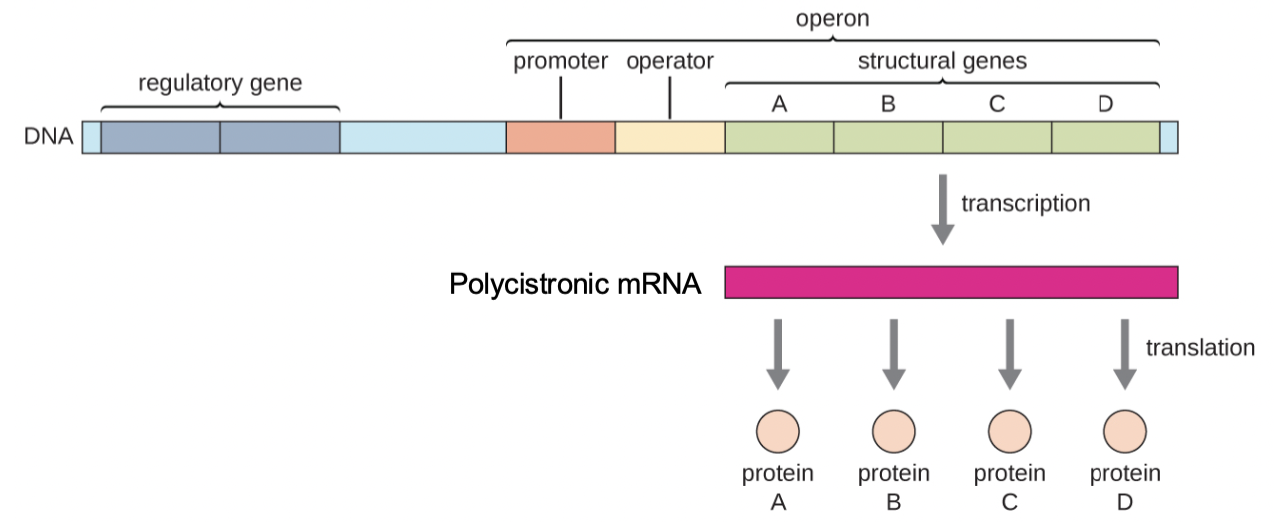
In prokaryotes, genes with related functions—such as the genes that encode the enzymes catalyzing the many steps in a single biochemical pathway— are regulated together and found where?
next to each other on the DNA

What do the cluster of genes shown in the image share?
1 promoter and regulatory sequence that control the transcription unit

The promoter has simultaneous control over what?
the regulation of the transcription of the structural genes, because they will either all be needed at the same time, or none will be needed

What is the benefit of grouping related genes under a common control mechanism?
it allows bacteria to rapidly adopt to changes in the environment

What are the 3 major components of an operon?
structural genes
regulatory region
regulatory gene

structural genes
encode proteins involved in metabolism, biosynthesis, or cellular structure

regulatory region
includes the promoter and the region surrounding the promoter, to which transcription factors, proteins encoded by regulatory genes, can bind

regulatory gene
encode regulatory proteins (repressors and activators)
transcription of these genes is under the control of its own promoter but often found next to the operon on the same DNA

True or False: The regulatory gene has its own operator.
True
True or False: Both the repressor and activator bind to the operator.
False. The operator is only a place for a repressor to bind, not the activator.
transcription factors
influence the binding of RNA polymerase to the promoter and allow its progression to transcribe structural genes
What are the 2 types of transcription factors?
repressor and activator
Which of these is not a protein: repressor, activator, inducer?
inducer. it is a small molecule
repressor
a transcription factor that suppresses transcription in response to an external stimulus

How does a repressor work?
Binds to a DNA sequence within the regulatory region called the operator, which is located between the RNA polymerase binding site of the promoter and the transcriptional start site of the 1st structural gene.
Repressor binding physically blocks RNA polymerase from transcribing structural genes.
Activator
a transcription factor that increases the transcription of a gene in response to an external stimulus by facilitating RNA polymerase binding to the promoter (usually upstream of the promoter)

inducer
A small molecule that either activates or represses transcription by interacting with a repressor or an activator. It is not a transcription factor.
How does one transcript code for multiple proteins?
Just like DNA replication and transcription have different start and stop signal, translation also has its own start and stop signals


Where does translation begin and end?
It begins at the translation start codon (AUG) and ends at the translation stop codon (UAA, UAG, or UGA) on mRNA

open reading frame (ORF)
the region between the start codon and stop codon

leader sequence
5’ untranslated region, or 5’ UTR located at the 5’ end of mRNA. Contains a ribosome-binding site (RBS)

ribosome-binding site (RBS)
allows the ribosome to bind to the mRNA and initiate translation

The ribosome-binding site (RBS) is similar to what?
This is similar to the promoter on DNA, which allows RNA polymerase to bind and signals where mRNA transcription begins
A polycistronic mRNA contains one ORF or multiple ORFs within a single mRNA molecule?
multiple ORFs
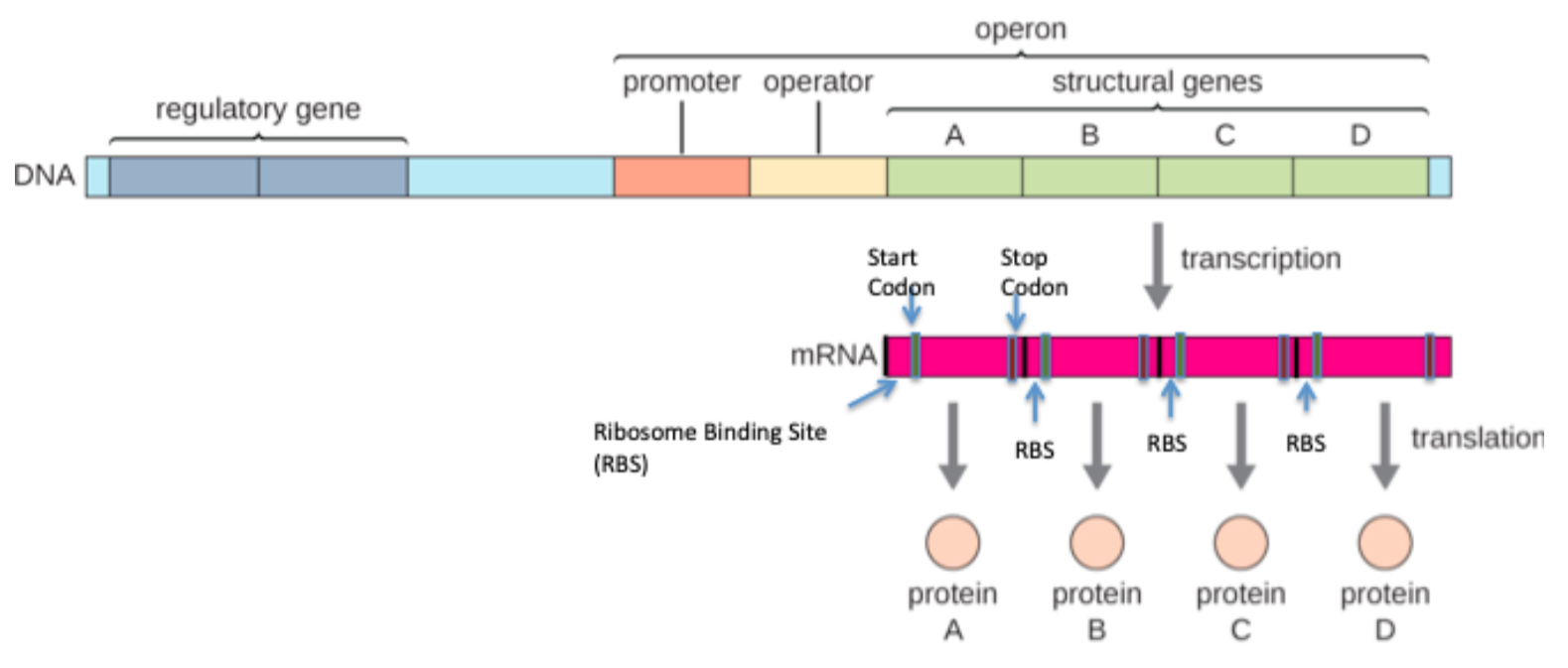

Each ORF has its own translation start and stop signal. What does this tell us?
one mRNA can be translated into multiple different proteins

cis-elements
DNA sequences that provide binding sites for proteins involved in transcriptional regulation.

Where are cis-elements located?
on the same piece of DNA as the gene they regulate

Promoter, operator, and activator-binding sites. Are these examples of cis-elements or trans-regulators?
cis-elements

Trans-regulators
proteins that bind cis-elements to regulate transcription

Where are trans-regulators located?
They do not necessarily need to be encoded on the same piece of DNA as the genes they regulate. They are located anywhere in the genome, often far away from or even on a completely different chromosome than the target genes they regulate
What are the types of gene regulation?
inducible operon and repressible operon
negative and positive control
inducible operon
the operon is normally OFF
something must happen to turn it ON to induce transcription
Often activated in response to a metabolite that regulates the operon
metabolite
a small molecule undergoing metabolism
repressible operon
the operon is normally ON.
something must happen to turn it OFF to repress transcription
typically regulated in response to a metabolite
negative control
the regulatory protein used is a repressor
the operon will be turned OFF when the repressor is present
the operon will be turned ON when the repressor is absent or inactivated
positive control
the regulatory protein used is an activator
the operon will be turned ON when the activator is present
the operon will be turned OFF when the activator is absent or inactivated

positive inducible operon
inducible= the operon is normally off
positive control= activator protein is used to control gene expression
The operon is normally off because the activator does not bind to the DNA.
Metabolite accumulates and binds to the activator protein, enabling it to bind to the DNA. This turns the operon ON and inducing transcription.

Negative inducible operon
inducible= the operon is normally OFF
negative control= repressor protein is used to control gene expression
The operon is normally OFF because the repressor protein is bound to the operator, preventing RNA polymerase to bind.
Metabolite accumulates and binds to the repressor protein, preventing it form binding to the DNA. This turns the operon ON and inducing transcription.

Positive repressible operon
repressible= operon is normally ON
positive control= activator protein is used to control gene expression
The operon is normally ON because the activator protein is present and binds to the DNA.
Metabolite accumulates and binds to the activator protein, preventing it from binding to the DNA. This turns the operon OFF and repressing transcription.

negative repressible operon
repressible= the operon is normally ON
negative control= repressor protein is used to control gene expression
The operon is normally ON because repressor protein does NOT bind to the DNA.
Metabolite accumulates and binds to the repressor protein, enabling it to bind to the DNA. This turns the operon OFF and repressing transcription.
In a positive inducible operon, what is the normal state of transcription when the inducing
metabolite is absent?
A. Transcription is ON at a high level
B. Transcription is OFF or very low
C. Transcription alternates between ON and OFF
D. Transcription is independent of the activator
B. Transcription is OFF or very low

What type of operon is represented by the schematic?
A. Positive inducible operon
B. Negative inducible operon
C. Positive repressible operon
D. Negative repressible operon
A. Positive inducible operon