6. Water & Electrolytes
 Call Kai
 Learn
Learn Practice Test
 Spaced Repetition
 Match
Match Flashcards
 Knowt Play
1/40

There's no tags or description
Looks like no tags are added yet.
Name | Mastery | Learn | Test | Matching | Spaced | Call with Kai | Chat |
|---|
No analytics yet
Send a link to your students to track their progress
41 Terms
What is the primary intracellular fluid electrolyte? What are the 2 primary extracellular fluid electrolytes?
ICF: Potassium
ECF: Sodium and Chloride
What is responsible for keeping K+ inside the cells and Na+ outside the cells?
The ATPase pump
What is the difference between blood plasma and interstitial fluid?
Blood plasma contains a way higher [ ] of proteins (particularly albumin) that is responsible for oncotic pressure (aka colloid osmotic pressure)
What are the definitions & differences between osmosis and diffusion?
osmosis: movement of water from low solute [ ] to high solute [ ]
diffusion: movement of solutes from high [ ] to low [ ]
What are the references ranges for the 4 primary electrolytes? (Na+, K+, Cl-, HCO3-)
Na+: 135-145 mmol/L
K+: 3.5-5 mmol/L
Cl-: 98-105 mmol/L
HCO3-: 23-29 mmol/L
What are the main renal processes of the 4 electrolytes & hydrogen?
Na+: reabsorbed through nephron, coupled with water
K+: reabsorbed through nephron then excreted in the distal tubules
Cl-: reabsorbed alongside sodium to maintain electroneutrality
HCO3-: almost completely reabsorbed through nephron
H+: actively secreted in urine
What is a major role of sodium?
maintain osmotic pressure
What is the sodium “buffer system” that’s involved with lactate and after bicarbonate buffers a metabolic acid?
NaHCO3 + H-Lactate → Na-Lactate (salt) + H2CO3 → CO2 + H2O
How does severe hyponatremia and hypernatremia affect the way water shifts in/out of brain cells?
hyponatremia: water shifts into brain cells (cerebral edema)
hypernatremia: water shifts out of brain cells (brain cell shrinkage)
Explain what hyponatremia with high serum osmolality may be due to?
Hyperglycemia
Because glucose draws water into the ECF space → lower measured Na+
Explain what hypernatremia with low urine osmolality may be due to?
diabetes insipidus
body cannot retain H2O → increased urination of diluted urine. ECF loses water as well, concentrating ECF and increasing serum sodium
What is the major role of potassium?
maintain cardiac rhythm and contribute to neuromuscular conduction
What 2 symtpoms can imbalanced potassium levels such as hyperkalemia or hypokalemia cause?
cardiac arrhythmias & neuromuscular weakness
What can cause hyperkalemia and what is it a response to?
renal failure
electrolyte imbalance aka acidosis
Explain how acidosis can lead to hyperkalemia?
Excess H+ ions in the ECF will diffuse into the cells, creating an imbalance of + ions in the cell. To compensate, K+ will diffuse out, leading to increase in K+ → hyperkalemia
What are 3 illnesses that can cause hypokalemia?
vomiting, diarrhea, and hypderaldosteronism (excess excretion of K+)
Hyperchloremia and hypochloremia may be caused by what 2 conditions?
hyper: hypernatremia (since Cl- follows Na+ to maintain electroneutrality) or excess loss of HCO3-
hypo: hyponatremia & conditions like vomiting (because you vomit HCl from stomach acid)
What is the chloride shift?
It is when bicarbonate is the cell diffuses into the plasma, so chloride shifts into the cell to maintain electriconeutrality. If bicarbonate diffuses into the cell, then chloride shifts out to the plasma

What is bicarbonate the major buffer for and where is it reabsorbed?
metabolically produced acids
PCt and DCT in kidneys
What conditions are associated with increased vs decreased bicarbonate levels?
increased: metabolic alkalosis
decreased: metabolic acidosis (b/c excess acids consume bicarbonate → decreased levels)
What does the anion gap represent & and what is the equation w/ the reference range?
It represents the unmeasured anions
[Na+] - [Cl- + HCO3-] = anion gap (7-14 mmol/L)
What can the unmeasured anions be? (4)
albumin/proteins, alcohol, organic acids, phosphate, sulfate,
What are the 3 conditions that can lead to an increased anion gap?
metabolic acidosis (increase in acids → HCO3- consumed → decrease HCO3- in plasma → increase AG)
Decreased HCO3-
low albumin can decrease AG → mask actual increase in AG
abnormal Na+ increase (not matched by Cl- or HCO3-)
Why does an increase K+ or chloride not usually affect the anion gap?
K+: patient would be dead at levels that would significantly alter the gap
Cl-: usually increased to replace HCO3-
What does osmolality measure and what are the 4 major contributors to serum osmolality?
the number of dissolved solutes in a solution
Na+, Cl-, glucose, and urea
What are the normal osmolality ranges for plasma and urine?
plasma: 275-300 mOsm/kg
urine: 300-900 mOsm/kg
What is the calculation for serum osmolality?
2[Na+] + [Glucose]/20 + [BUN]/3
What is the osmol gap? What is the equation for it? What is the normal value of an osmol gap?
It is the value of osmolality that is affected by the unmeasured dissolved solutes (everything except Na+, glucose, and BUN)
Measured osmolality (from osmometer) - calculated osmolality = osmolality gap
9 mOsm/Kg
What are 2 responses to decrease osmolality in the case of increased osmolality?
being thirsty → increased water consumption dilutes ECF
secretion of ADH → retain water
What are the 2 hormones that control blood volume and what organs are they produced from?
Aldosterone: adrenal gland
ADH (antidiuretic hormone) or vasopression: posterior pituitary gland
What are the hormones that control blood pressure? Where is it released from?
epinephrine and norepinephrine
adrenal glands (adrenal medullar)
What is the stimulus for activating ADH and what is the action of ADH?
stimulus: plasma with increased osmolality circulates around posterior pituitary gland
action: ADH travels to collecting ducts of kidneys → more water reabsorption
What is the stimulus for activating aldosterone?
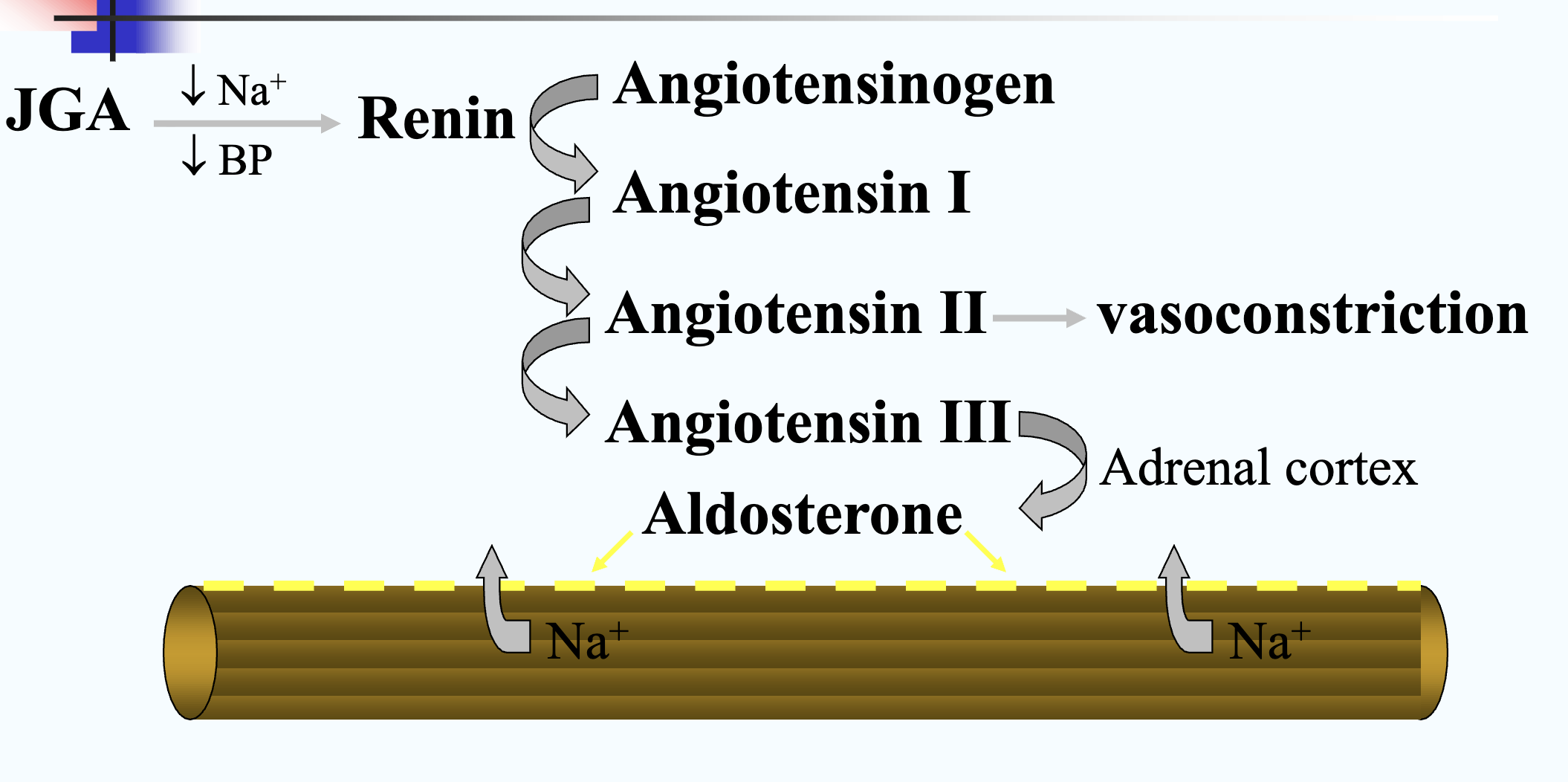
JGA(juxtaglomerulus-apparatus) in the nephrons (kidney cells) are stimulated by low blood pressure/volume to the kidneys
What are the 5 steps in the mechanism of aldosterone?
JGA secretes protease renin to convert plasma angiotensinogen → angiotensin 1
Angiotensin 1 travels to lungs where protease angiotensin-converting-enzyme (ACE) converts → angiotensin 2
Angiotensin 2 responsible for
vasoconstriction → increased blood pressure
circulating to adrenal cortex to stimulate aldosterone secretion
aldosterone circulates from adrenal → kidneys
Stimulates tubules to reabsorb Na+ and excrete K+
What class of compounds are epinephrine and norepinephrine called?
catecholamines (modified amines)
What is the stimulus and action of epinephrine and norepinephrine?
stimulus: physio/psychological threat → nerve impulse
action: increased heart rate & heart beat strength → increased blood pressure
What is pheochromacytoma? What does it cause increases in?
Rare tumor of the adrenal medulla
increased secretion of epinephrine & norepinephrine. increased production of metanephrine & normetanephrine → increased VMA
What metabolites are now used to analyze for pheochromacytoma?
plasma and urine metanephrines because they they offer higher sensitivity for testing
What is aldosterone induced hypertension?
Increase in secretion of aldosterone commonly due to adrenal adenoma (adrenal tumor)
What is the syndrome of inappropriate ADH (SIADH)?
Tumor that produces excess ADH → water retention → hyponatremia, low serum osmolality, and concentrated urine
What is diabetes insipidus? What does it NOT cause?
Lack of ADH secretion or kidney response to ADH → dilute urine excretion
abnormal blood pressure (because epinephrine & aldosterone maintain pressure despite water loss)