U4: Chemical Systems and Equilibrium (SCH4U)
 Call Kai
 Learn
 Practice Test
 Spaced Repetition
 Match
 Flashcards
 Knowt Play
1/31

Earn XP
Description and Tags
credits: quizlette8196534
32 Terms
Le Chatelier's Principle
States that if a stress is applied to a system at equilibrium, the system shifts in the direction that relieves the stress.

dynamic equilibrium
a balance between the forward and reverse reactions occurring at the same rate. It can be achieved in a closed system (matter musn't be be lost).
- a system appears to be unchanging at equilibrium when observed macroscopically
-microscopically, reactants and products are continuously being formed at equal rates

equilibrium position
the relative concentrations of reactants and products of a reaction that has reached equilibrium; indicate whether the reactants or products are favored in the reversible reaction

Gas pressure
a force generated by the bombardment of gas particles with themselves and the container
S.I. unit is kilopascals (kPa)
stressors of equilibrium
1) If the pressure increases, the equilibrium shifts to favour fewer moles or molecules.
2) If the pressure decreases, the equilibrium shifts to favour more moles or molecules.
3) if the temperature increases, the equilibrium shifts to favour the endothermic reaction.
4) if the temperature decreases, the equilibrium shifts to favour the exothermic reaction.
5) If something is added to a system at equilibrium, the system will move in a direction to use the added material until a new equilibrium is established.
6) If something is removed from a system at equilibrium, the system will move in a direction to replace that which has been removed.

Equilibrium Law
Proposed by Guldberg and Waage, that the proportions of concentrations of reactants and products at equilibrium were constant regardless of the initial concentrations. This only applies to gases and aqueous reactants and products

homogenous equilibria
an equilibrium system in which all reactants and products are in the same state

heterogenous equilibria
an equilibrium involving reactants and/or products in more than one phase

How can the magnitude of K reveal the relative concentrations?
K >> 1 : [products] > [reactants] at equilibrium
K = 1 : [products] = [reactants] at equilibrium
K << 1 : [products] < [reactants] at equilibrium
The "Hundred Rule"
- take the [initial] and divide by K. If the answer is > than 100 you can use the Hundreds rule
- all "X" terms being added or subtracted can be removed.
-x values that are multiplied or ÷ cannot be ignored
reaction quotient
-measures concentrations of reactants and products at any point in time during a reaction
-used to determine the direction of the reaction from the initial concentrations
-looks identical to the equation for Keq
-used to make a comparison b/w Keq and Q
- Q=K at equilibrium
-Q>K the system must shift left (towards reactants) to reach equilibrium. (too much product)
-if Q

Solubility equilibrium
Saturated solutions have solubility equilibrium. the physical state in which the opposing processes of dissociation and crystallization (precipitation) of a solute occur at equal rates

dissociation equation
chemical equation representing the process that occurs when compounds dissociate

saturated solution
Defines a solution in which no more solvent can be dissolved.
-solubility equilibrium is established in a saturated solution

Solubility
The amount of a substance that dissolves in a given quantity of solvent to make a saturated solution at constant temperature and pressure

Solubility product constant (Ksp)
the equilibrium expression for a chemical equation representing the dissolution of a slightly to moderately soluble ionic compound
-the product of the molar concentrations of the ions in the saturated solution

Arrhenius' Theory
acids are characterized by their sour taste, low Ph, and the fact that they turn litmus red. Bases are characterized by their bitter taste, slippery feel, high pH, and the fact that they turn litmus paper blue
-focuses on properties
-only exist in water solutions
Arrhenius Base
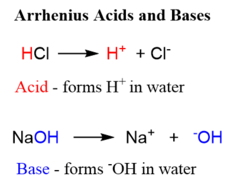
Produces OH- ions when dissolved in water
-metal bonded to the hydroxide ion
- the process of the solid separating into its ions is dissociation

Arrhenius Acid
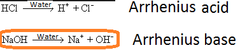
a chemical compound that increases the concentration of hydrogen ions, H+, or hydronium ions (H30+) in aqueous solution
-molecular compounds
-the process of converting neutral molecules or atoms into ions is called ionization
Bronsted-Lowry Theory (Acids and bases)
This theory focuses on the role they have in a reaction rather than the basic or acidic properties of their aqueous solutions
Acids- proton donor in a reaction (H+ donor)
Bases- Proton acceptor in a reaction (H+ acceptor)
acids and bases under this theory are specific to the reaction and it is not a general property for a compound to be one or the other.

Amphoteric
a substance that can act as both an acid and a base (Bronsted-Lowry Theory)
water etc.

Acid-Base Equilibrium
Acid - Base reactions involve the transfer of protons. Therefore, the products formed in these reactions must differ by a proton (H+). These reactions are universally reversible and result in an acid-base equilibrium. In a proton transfer reaction at equilibrium, both forward and reverse reactions involve Bronsted-Lowry acids and bases.

Conjugate Acid-Base Pair
consists of two substances related to each other by the donating and accepting of a single hydrogen ion
A pair of substances whose molecular formula differ by a single H+
To find the conjugate base - remove one H+
from a given acid.
To find the conjugate acid - add one H+
to a given base.

Strong Acids
an acid that ionizes almost 100% in water, producing hydrogen ions. The equilibrium position in a strong acid solution lies far to the right. This means that, at equilibrium, almost all the acid molecules have broken apart to produce ions.

Weak Acids
an acid that only partially ionizes in water, producing hydrogen ions. The equilibrium position in a weak acid solution lies far to the left. This means that, at equilibrium, there are primarily nonionized acid molecules.

Strong Bases
A strong base is a compound that dissociates completely in water, producing hydroxide ions. A strong base forms an equilibrium that lies far to the right.

Weak Bases
a base that undergoes an equilibrium reaction with water to produce hydroxide ions. A weak base forms an equilibrium that lies far to the left when it reacts with water.

autoionization of water
when pure water reacts with itself to form hydronium and hydroxide ions
-water can behave as both an acid and a base in the same reaction.
-Kw - equilibrium constant for the ionization of water.
-Kw is always equal to 1.0x10^-14
reasoning behind the autoionization of water
A sample of water has a very slight conductivity that is observable if measured with a very sensitive conductivity meter. According to Arrhenius's theory, conductivity is due to
the presence of ions. Since conductivity is very low, there must be considerably more water molecules than ions in the equilibrium mixture. Of the billions of random collisions
occurring among water molecules, a few have the right orientation and the right energy to cause an ionization reaction.
pH scale
measurement system used to indicate the concentration of hydrogen ions (H+) in solution; ranges from 0 to 14

pOH scale
measures the concentration of OH- ions in a solution

pH and pOH relationship
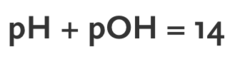
pH + pOH = 14