CH 5 GASES
 Call Kai
 Learn
 Practice Test
 Spaced Repetition
 Match
 Flashcards
 Knowt Play
1/37

There's no tags or description
Looks like no tags are added yet.
38 Terms
Boyle’s Law
Pressure and volume are inversely proportional when temperature and moles of the gas are kept constant:

Charles’ Law
Volume and temperature are directly proportional when pressure and moles of gas are constant

How is Celsius converted to Kelvin?
Add 273.15
What variable is constant in the mixed gas law?
n (Number of moles)

What is Avogadro’s Law?
Moles and volume are directly proportional when pressure and temperature of gas are constant.

What’s the ideal gas law?
PV = nRT
what is STP?
Standard temperature (273K) and pressure (1 bar)
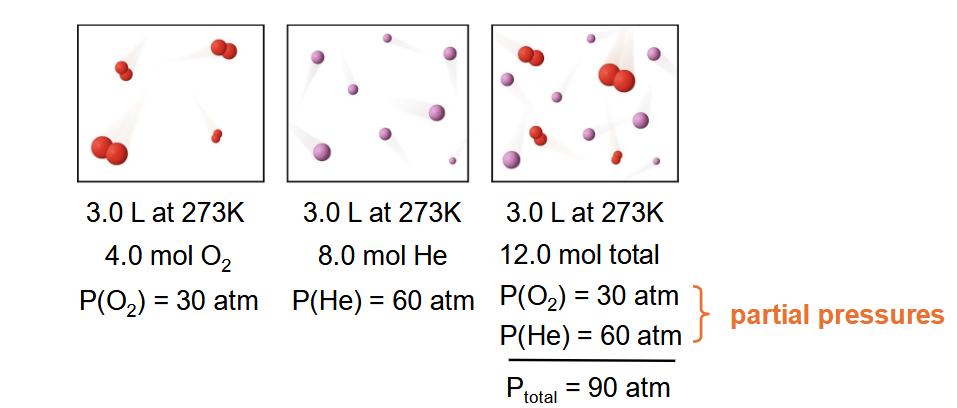
(T/F) Gases in an ideal mixture behave independently of each other
True

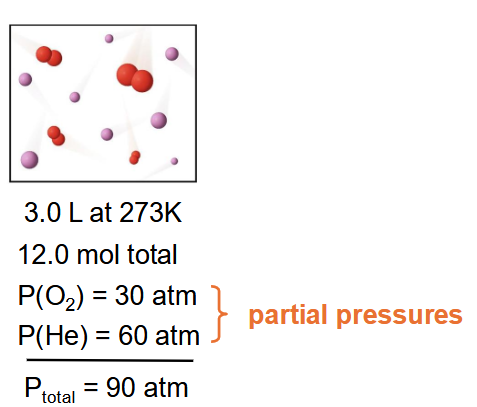
What is the total pressure of an idea mixture?
The total pressure is the sum of the partial pressures of each component.
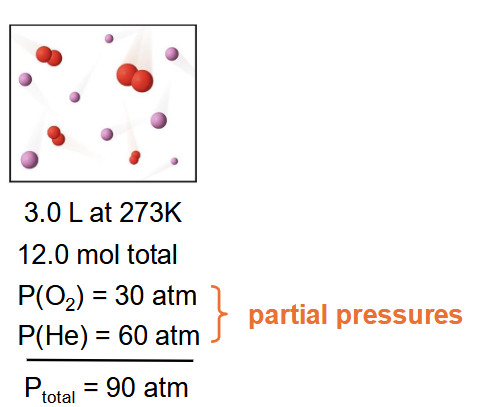
What is a mole fraction (Xi)?
Ratio of the number of moles of a component to the total number of moles in the mixture
How do you find the partial pressure of a component in a gaseous mixture?
Mole fraction x total pressure


when a mixture of gases is collected over water, what are the components of the mixture collected?
the gas produced in the reaction and H2O (g) (water vapour)


The partial pressure of water vapour in a mixture is dependent on its:
Temperature.

Postulates of Kinetic Molecular Theory
1. Gases are made of tiny particles that move
randomly.
2. The volume of the particles is small
compared to the size of the container.
3. The average kinetic energy of a particle
increases with temperature.
4. Particle collisions are elastic (no energy is
lost).
What is Dalton’s Law?
particles do not interact
average kinetic energy depends on
temperature only and not the identity
of the particles

what are the variables m an u?
m=mass
u=velocity


What is KE ?
Kinetic energy

The average kinetic energy of one mole of gas particles is:
KEavg = (1/2)NAmu²


per what?
per 1 mole of gas


Purpose of this formula
Find root mean square velocity of a collection of particles.

units of urms = m/s if:
The urms will be in units of m/s if:
• R is in SI units (i.e., R = 8.314 J/mol·K)
• T is in K
• M is in kg/mol

What is true of gases with higher molar masses?
They move slower/at lower velocities


What happens to the root mean square velocity and distribution as temperature rises?
the root mean square velocity increases and the distribution broadens.


Whats a mean free path?
The average distance a gas molecule travels between collisions.


The mean free path decreases as…
Concentration & partial pressure decreases


What is diffusion?
The process by which gas molecules spread
out in response to a difference in
concentration.


What is effusion?
The process by which gas molecules escape
through a hole into a vacuum

What is a rate of effusion/diffusion?
the amount of gas effused/diffused per unit time

What is Graham’s Law of Effusion?
the rate of diffusion or effusion of a gas is inversely proportional to the square root of its molar mass


(T/F) High pressure is ideal
False.


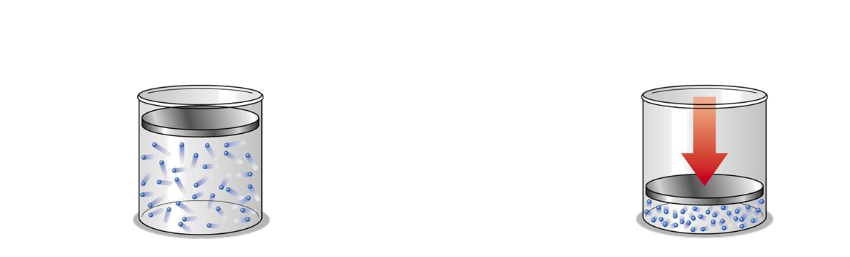
Is the volume of particles significant under high or normal pressure?
high pressure

What is this formula?
Ideal gas law corrected for volume of particles


what are variables n and b?
n = n moles
b = constant determined by gas identity in L/mol
Volume occupied by gas particles

What is the effect of intermolecular forces on the ideal gas law?
At low temperatures, the kinetic energy of gas particles is lower and so
intermolecular forces become more significant. This leads to a lower number and force
of collisions with the surface and a lower pressure than predicted.
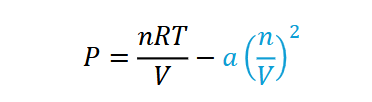
What is the variable a?
constant that depends on gas identity (L2·bar/mol2) “strength of force between particles”


What is this formula called?
the Van Der Waals equation

Positive deviations
High pressure
• Gas molecules occupy volume (“b” factor)
• Vreal > Videal
Negative Deviations
Low pressure
• Gas molecules have intermolecular forces (“a” factor)
• Preal < Pideal