NCSF - CPT - Part 2
 Call Kai
 Learn
 Practice Test
 Spaced Repetition
 Match
 Flashcards
 Knowt Play
1/44

There's no tags or description
Looks like no tags are added yet.
45 Terms
Bioenergetics
Describe the various process of energy/macronutrients use in our body and the energy system to fuel us during exercise
Different energy sources are used as the duration of time under stress increase:
Less time = greater force capabilities, Greater time = lower force capabilities
Immediate energy (<15 second): _____
Intermediate energy (<90 second): _____
Continuous energy (>3 mins): _____
(All three energy systems work simultaneously, but their relative contributions change, e,g. at 10–90 seconds: Glycolytic energy dominant)
Immediate energy (<15 second): ATP and phosphagen
Intermediate energy (<90 second): Glycolytic
Continuous energy (>3 mins): aerobic
ATP
The only energy source to drive the _____
Its location inside muscle cells makes it readily-usable for immediate needs during maximal-effort and powerful work (1RM)
Fuel maximal muscular work lasting ___ sec
Rest periods of ~ ___ sec allow for full recovery
ATP is broken down by ATPase to liberate _____ ion producing _____ + _____
Muscle contractions (Sliding filament theory)
1-3 sec
~ 90 sec
phosphate, producing ADP + Energy

Phosphagen system
ATP is depleted depleted so rapidly, so an additional pool of high energy phosphate is maintained in the form of _____
CP continue to fuel ATP for powerful burst of work up to ______ sec
CP recovery time is 2-5 mins depends on volume of activities
Creatine phosphate
10-15 sec (e.g, 3RM squat)
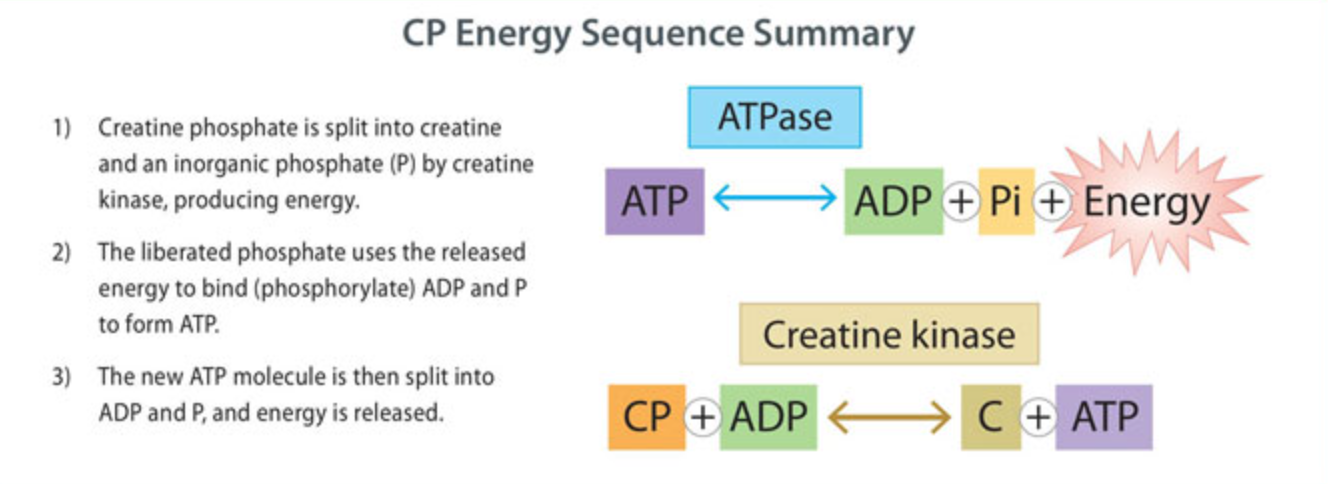
How does creatine claim to adds more reps (generate more ATP) but ATP system only works the max during the first 3 second of exercises?
Because the ATP system doesn’t vanish completely, phosphate can be added back to ADP to make ATP again, and we can reuse them
Glycolytic system
Working longer than 10-15 sec will require the body to metabolize glucose and glycogen to maintain adequate ATP production
Where are the primary storage sites for glycogen (2)?
The glycolytic system supports moderate-intensity work for ___sec
Liver and skeletal muscle
~90 sec (e.g., set of 10-15 reps)
What are the three byproducts of glycolysis? What is Ischemia? What are the 3 things that a drop of pH by ischemia can cause?
Lactate, pyruvate and H+
Ischemia is the low O2 state caused by tissue acidity (H+ accumulation), caused obstruction of arterial blood supply
Inhibition of enzymatic reactions, alter Ca2+ handling, Muscular fatigue
What does lactate do?
It is used in various tissues (like heart) to fuel continuous work via aid in gluconeogenesis, and serve as initial buffer for H+
____ has been blamed for DOMS and inhibiting recovery after exercise, but it actually helps maintain energy levels during intense glycolytic work and is used in immediate recovery in metabolic organs and the heart
lactate
What’s DOMS
Delayed onset muscle soreness: muscle soreness expedited by an inflammatory response to cellular damage, ischemia, and tonic spasms which presents 24-72 hours following an intense bout of exercise; new exercises, heavy eccentrics, and high work volume increase the response
Gluconeogenesis happens mostly in _____
During exercise glycolysis happens mostly in _____
Liver
Muscle
What is steady state and what HR indicates steady state, what is oxygen deficit?
Steady state: When oxygen use matches demand, it is signified by HR + / - 5 BPM
Oxygen deficit: An elevation in oxygen consumption after exercise discontinues (being out of breath after a sprint)
What is EPOC?
Excess post-exercise oxygen consumption
EPOC is attributed to 6 things:
Elevated body temperature
Ion leakage → More energy to restore ion balance
Calcium uptake → Reduced mitochondrial efficiency
Increased thermogenic hormones
Glycogen restoration → Lactate converted to glucose in liver
Lactate oxidation → Lactate used for energy in mitochondria
What is METs?
Clinical way to measure intensity of exercise and caloric expenditure.
Relative to O2 uptake per kg of body weight per min
Aerobic system:
A metabolic pathway where mitochondrion utilizes fats, CHO, and protein to produce ATP in the presence of oxygen
Pyruvate from glycolysis sparks the _____ within mitochondria to initiate the process of using all available energy sources which causes release of _____ to breakdown fat and protein
Fuels ongoing efforts lasting ____ mins and maintains energy production until CHO runs out
Krebs cycle
adrenal hormones
> 3mins
Is fat burning zone best for weight loss a myth? If so, what is better for weight loss?
Yes, Fat-burning zone is lower intensity training (<65% of VO2 max) where fat is the predominant fuel source. However, it is not optimal for weight loss because the relative quantity of total calories burned is too low compare to higher intensities.
FatMax is better, it usually lies between 60-70% of VO2 max, when you can hold a conversion but not singing.
What cut Triglycerides into glycerol backbone and FFA?
Lipase
What happens to excess macronutrients
They all turned into fat from Acetyl-CoA
Muscular Fatigue
Fatigue sets in when the body experiences a significant decline in muscle and liver _____ stores, along with elevated byproduct concentrations within working muscles
Low-intensity exercise = Primarily sustained by _____ metabolism, _____ use is minimal
glycogen
Lipid, Glycogen
CHO are vital to performance and maintaining lean mass:
What are the three reason why?
1) Intest work required CHO because it is metabolized faster than fat
2) Protein-sparing (蛋白质节约效应), because when glycogen is depleted, the body is forced to metabolize branched-chain amino acids liberated from muscle tissue to maintain blood glucose.
3) Lack of CHO will cause significant fatigue, reducing performance, even when oxygen and lipids are adequate to meet the demands of work.
Types of fatigues:
1) Cells are dysfunction because of acidity which limits enzyme activity, it needs buffering compounds and rest period.
2) Occurs with a lack of energy in working tissues due to low pre-exercise stores; or localized depletion of anaerobic stores from activity, rest intervals will not help, a recovery period is needed
3) When systemic depletion of CHOs happened (including central and peripheral nervous system), resulting in reduced motor unit recruitment and firing rate.
1) Acute peripheral fatigue
2) General peripheral fatigue
3) Central fatigue
Cellular permeability and heightened hormone sensitivity allow for increased glycogen storage and protein use in the 3-hour period following exercise:
Higher glycemic foods are recommended within the prime metabolic window (45 min)
Post-exercise muscle glycogen can be further enhanced with a CHO/protein meal (3-4:1 ratio) or supplement
Oxygen delivery
What is VO2?
What is cardiac output?
What’s (a-v)O2 difference?
What is Stroke volume?
VO2Max = ?
Volume of Oxygen consumed by our body per mins
Heart rate x stroke volume
Difference in oxygen saturation when comparing the arteries and veins; Basically how much oxygen tissues uptakes
Volume of blood expelled per contraction from the left ventricle
Cardiac Output x (a-v)O2 difference
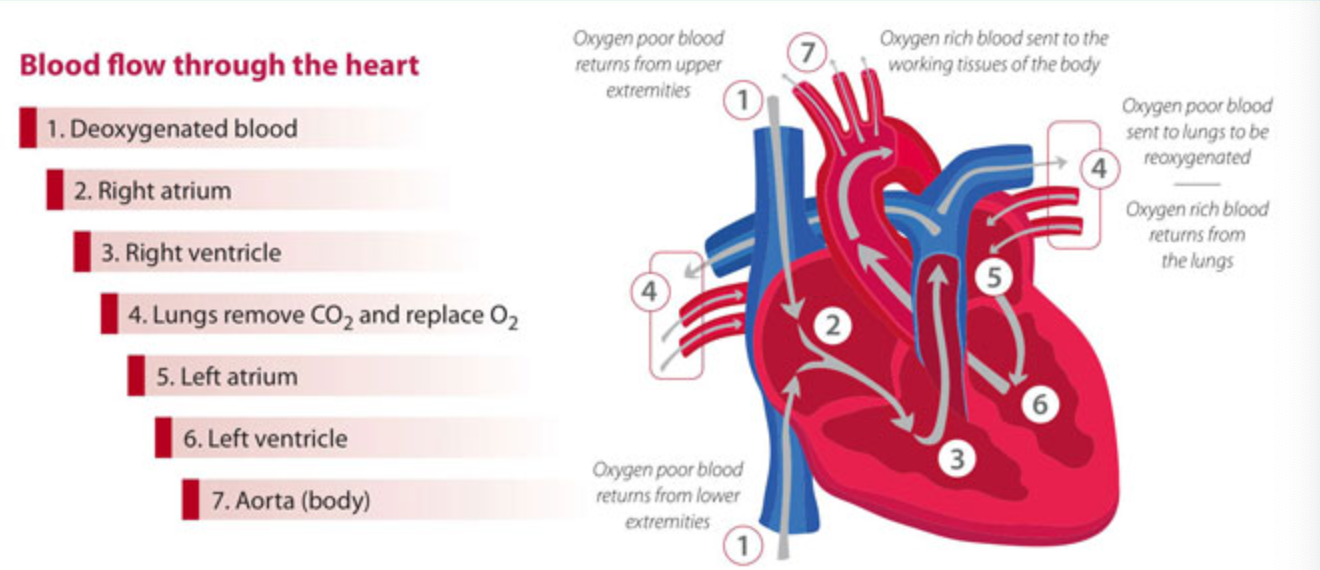
How does the blood flow through the heart to the lung and the rest of the body (7)?
1) Deoxygenated blood returned from the vena cava
2) Right atrium
3) Passing the tricuspid valve and reach the right ventricle
4) Goes to lung through pulmonary valve, lung removed CO2 and replace O2
5) Oxygenated blood return to the heart to the left atrium
6) Passing the mitral valve and enters the left ventricle
7) Left ventricle bump blood to the rest of the body via aorta
What characteristics does myocardium process that allow then for continuous contractions?
They have an enhanced sarcoplasmic reticulum and Ca2+ delivery system to allow it to manage rapid and non-stop neural impulses
What muscle in our body is versatile in its use of fuel including fatty acids, glucose, amino acids, lactate and even ketone bodies?
Cardiac muscle
The Circulatory System
What is Venous pooling?
When blood collects in the lower extremity, it can cause acute ischemia, fainting.
Therefore, an adequate cool down period after intense exercise is needed so that rapid blood flow back to the heart is not impeded.
The role of blood
It flows quickly through _____ to transport oxygenated blood
It flows slowly through _____ to allow for oxygen and waste product diffusion across their thin walls
It flows quickly through _____ to get deoxygenated blood back to the heart and maintain cardiac output
large arteries
capillaries
larger veins
Which gender have higher CO and VO2 max?
Male, because larger heart size and more muscle mass
How does endurance training improve cardiac output?
Increased ventricular mass and strength
Increased volume of blood expelled per heart beat
Blood pressure = _____ x _____
Cardiac output x total peripheral resistance
What are baroreceptors?
Specialized receptors in the large arteries that detect changes in pressure and tell the CNS to regulate blood pressure or HR
T/F Aerobic exercise increases mean arterial pressure much less than weightlifting
T
What is valsalva maneuver?
When attempt to move a heavy load while holding one breath, those with hypertension should not practice it
Mechanisms that regulates blood flow to working muscles:
CNS via adjustments in mean BP and shunting of flow from one area to another
Hormonal communication between tissues that impacts blood flow characteristics
Increased capillary activity in muscles that need the most oxygen (muscle grow in size during resistance training due to blood flow
What is Rate Pressure Product (RPP)?
Estimate of myocardial oxygen demand and efficiency as well as cardiovascular disease risk.
Systolic BP x HR
Low fitness and cardiovascular compromise increase the value. (values over 11,000 are high risk)
Ventilation during exercise
Increases in ventilation during exercise so our body can meet oxygen demands
Once an individual’s lactate threshold has been crossed, breathing rate spikes quickly - what is a lactate threshold?
Lactate accumulation causing acidity in the tissue and blood.
During exercises, stimulation of our brain to ventilate more
During continuous steady-state exercise:
During intense exercise:
During heavy resistance training in a short bouts
Ventilation is linear to oxygen uptake
Ventilation increases disproportionately to oxygen uptake (your body needs to eliminate more CO2)
HR and ventilation rate inc dramatically due to blood lactate accumulation.
What region of the forebrain that coordinates the autonomic nervous system? Direct maintenance activities for homeostasis including hunger, thirst, body temperature regulation, sleep and emotional responses.
Hypothalamus
Gland that secretes digestive enzymes into the small intestines for macronutrient breakdown; produces insulin and glucagon.
Pancrea
What’s Eustress and Distress?
Eustress: Positive form of stress that influence physiological/psychological health; sources can include exercise.
Distress: Negative form of stress that influence physiological/psychological health; sources as anxiety and lack of sleep
cholesterol-based compounds that serve various functions related, but not limited to: sexual development, reproduction, tissue synthesis, inflammation regulation and metabolism (e.g., cortisol, estrogen, testosterone)
chains of amino acids synthesized within endocrine cells that attach to membrane receptors on cells to activate secondary messenger systems (e.g., insulin and glucagon)
Steroid hormones
Polypeptide hormones
Which gland in our body regulates anabolic hormones, such as growth hormone?
Pituitary gland
Which hormone promotes cell division by facilitating protein synthesis; it protect glycogen reserves & limits carbs metabolism by using lipids for fuel during exercise, and also play a role in recovery.
Growth hormone