BIOC192 - module 1 and 2
0.0(0)
Studied by 0 people Call Kai
 Learn
 Practice Test
 Spaced Repetition
 Match
 Flashcards
 Knowt Play
Card Sorting
1/371

Earn XP
Description and Tags
372 Terms
1
New cards
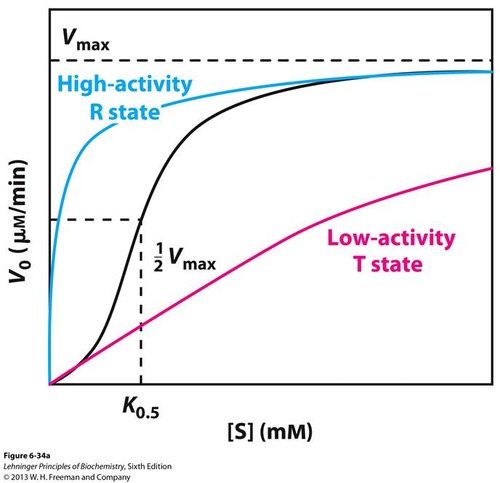
Haemoglobin in red blood cells in the blood n eeds to be able to :
-Binding O2 in the vicinity of the lungs where pO2 is ~100 torr
-Release the O2 in the vicinity of peripheral tissues where the pO2 is ~20 Torr.
Haemoglobin is therefore evolved to bind O2 LESS tightly than myoglobin. Can change shape
-Release the O2 in the vicinity of peripheral tissues where the pO2 is ~20 Torr.
Haemoglobin is therefore evolved to bind O2 LESS tightly than myoglobin. Can change shape
2
New cards
Protein
Non-branching polymers that form macromolecules about 50-100A. 1A=1-^-10m. A bag of lipids and nucleic acids
Each protein has specific sequence of amino acids joined together by chemical peptide bonds.
20 amino acids
e.gs: table salt, cheese,sucrose, hair, haemoglobin
Each protein has specific sequence of amino acids joined together by chemical peptide bonds.
20 amino acids
e.gs: table salt, cheese,sucrose, hair, haemoglobin
3
New cards
Atomic structure determination of proteins
Protein crystallography
Cryo-electron microscopy
NMR spectroscopy.
Cryo-electron microscopy
NMR spectroscopy.
4
New cards
Cell signaling-insulin
-Hormone insulin.
Generated and binds insulin receptor to signal cell to take up glucose.
Structure
Generated and binds insulin receptor to signal cell to take up glucose.
Structure
5
New cards
cell signaling-digestion
Trypsin: breaks down proteins during digestion. called PROTEASES
Amylase: starch breaker and secreted by pancreas
Amylase: starch breaker and secreted by pancreas
6
New cards
cell signaling-metabolism
Alcohol dehydrogenase: helps metabolise ethanol.
1cza Hexokinase: adds phosphate to glucose, after glucose is taken up by cell, they usually add phosphates to molecules.
1cza Hexokinase: adds phosphate to glucose, after glucose is taken up by cell, they usually add phosphates to molecules.
7
New cards
Oxygren transport: Metabolism
Hemoglobin, binds to oxygen in lungs and carries it in blood to tissues for use in metabolism.
8
New cards
Metabolism and energetics-Membrane proteins
Atp synthase: generates ATP for use in cellular function
9
New cards
Immune protection
Antibodies bind to cellular invaders like bacteria and viruses to help protect the body from infection.
10
New cards
Replication and maintenance signalling
DNA polymerase: Binds to one strand of DNA and adds the complimentary strand to it
RNA polymerase: creates a single strand of RNA that is complementary to one of the strands of duplex DNA.
RNA polymerase: creates a single strand of RNA that is complementary to one of the strands of duplex DNA.
11
New cards
Amino acids are
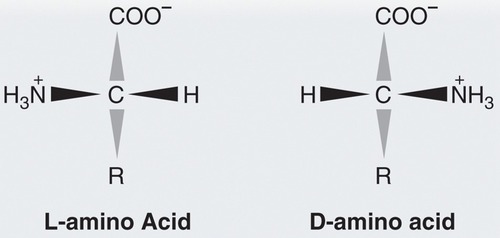
Chiral
L-form- Co group on left
D-form- co group on right
L-form- Co group on left
D-form- co group on right
12
New cards
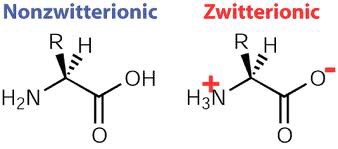
amino acid zwitterion
13
New cards
Amino acid facts
20 amino acids have common backbone but different side chains.
14
New cards
Non polar side chains amino acids
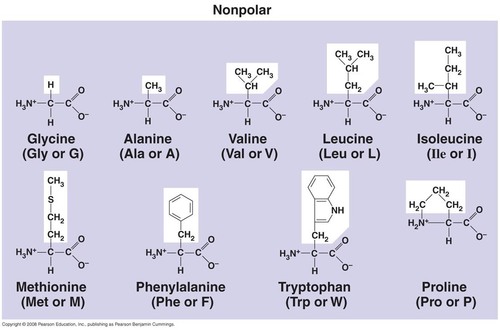
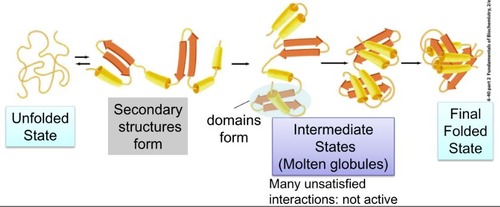
These side chains on amino acids will be mostly hydrophobic (insoluble in water). No charged or electronegative atoms are present to form H bonds
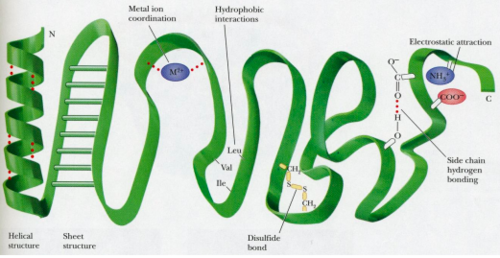
Top row: Help drive protein folding, found inside protein.
Bottom row: Larger hydrophobic, have larger sidechains. They absorb ultraviolet light, used in protein spectroscopy.
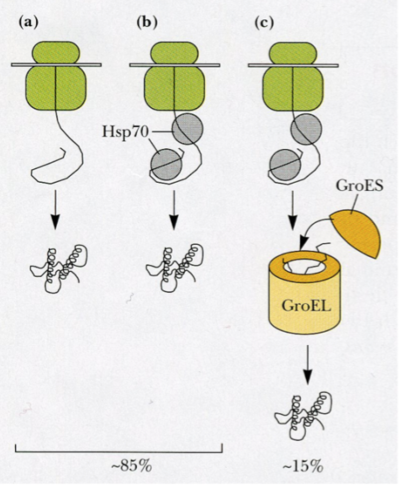
Top row: Help drive protein folding, found inside protein.
Bottom row: Larger hydrophobic, have larger sidechains. They absorb ultraviolet light, used in protein spectroscopy.
15
New cards
Glycine, Gly, G
Not chiral, flexible, almost in a group by itself
16
New cards
Proline, Pro, P
Sidechain binds to amino groups, IMINO acid, rigid, almost in a group by itself
17
New cards
polar side chains Charged
Divided into acidic and basic.
Acidic: aspartate(D) Asp
Glutamate (e) Glu
Basic: Lysine (K)
arginine (R)
Histidine(h)
Acidic: aspartate(D) Asp
Glutamate (e) Glu
Basic: Lysine (K)
arginine (R)
Histidine(h)
18
New cards
Difference between aspartate and glutamate
Aspartate has 4 C
Glutamate has 5 C
Glutamate has 5 C
19
New cards
Where is histidine normally found
active sites
20
New cards
Polar sidechain uncharged
serine, threonine, cysteine, tyrosine, asparagine, glutamate.
All of them can participate in hydrogen bonds
All of them can participate in hydrogen bonds
21
New cards
Serine
found in active sites, involved in catalyzing protease reaction
22
New cards
Threonine and asparagine
known to be glycosylated in mammalians/to improve solubility of protein, to lead them in correct sites
23
New cards
Cysteine
good Nucleophile, can be involved in disulphide bonds in an oxidising environment. in reducing environment they can split up
24
New cards
Tyrosine
susceptible to phosphorilation, turn enzyme on/off.
It has an amromatic sidechain it can absorb ultraviolet reactions.
It has an amromatic sidechain it can absorb ultraviolet reactions.
25
New cards
One letter abbreviation
E6V
-1st: original or native amino acid
-Number= location of mutation of protein
-Second letter: new or mutated residue.
-1st: original or native amino acid
-Number= location of mutation of protein
-Second letter: new or mutated residue.
26
New cards
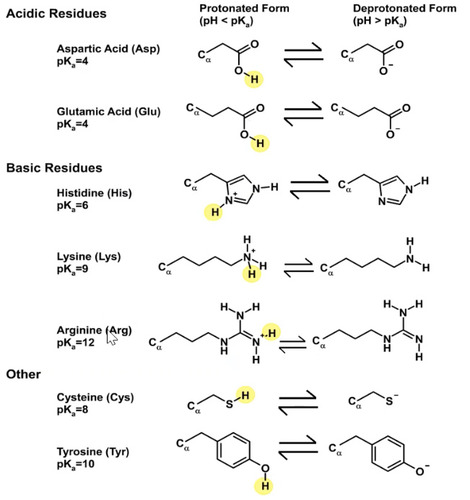
How can ionisable sidechains be classified
by their pka value
27
New cards
pKa
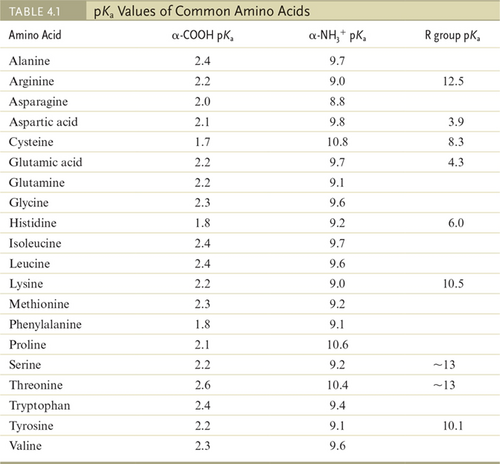
value for an amino acid or protein is the pH at which the group is 50% ionised
28
New cards
pI, isoelectric point
ph at which the net charge on an amino acid/protein is ZERO
29
New cards
Amino acids that have ionisable side chains
30
New cards
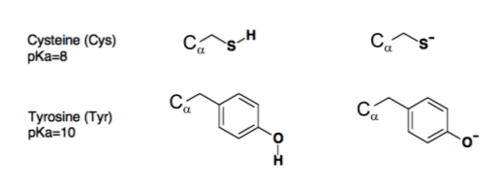
Amino acids that have ionisable side chains 2
cysteine is a good nucleophile. pka 8
'Tyrosine has hydroxide group pka 10 (basic)
'Tyrosine has hydroxide group pka 10 (basic)
31
New cards
Pka values for amino acids
32
New cards
Modified amino acids are
translated from RNA proteins at ribosome, some are modified after they are added to proteins, post translational modification.
33
New cards
what type of bond can a cysteine form with another nearby cysteine
Covalent bond which is called the disulphide bond
34
New cards
Examples of amino acid modification
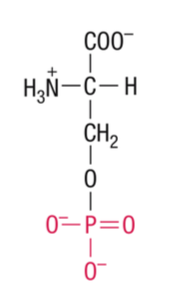
Phosphorylation
Hydroxylation
Carboxylation
Metal binding
iodination
Glycosylation
Hydroxylation
Carboxylation
Metal binding
iodination
Glycosylation
35
New cards
Phosphorylation
Used to control enzyme activity
36
New cards
Hydroxylation
needed to prevent connective tissues diseases and scurvy
37
New cards
Carboxylation
needed for blood clotting, often glutamate involved
38
New cards
Phosphoserine
39
New cards
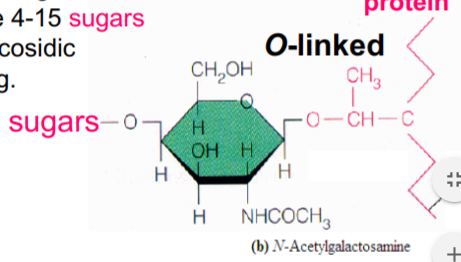
Glycosylation of threonine
Asparagine can often be glycosylated as well. Haemoglobin also which is used to diagnose and follow patients with diabetes
40
New cards
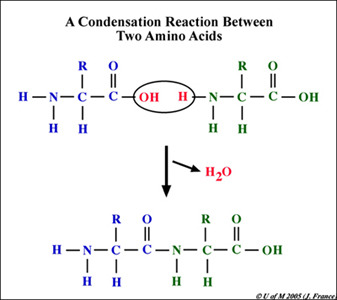
Peptide bond
covalent bond formed between amino acids
41
New cards
Dehydration reaction
A chemical reaction in which molecules combine by removing water
42
New cards
Peptide bond characteristics
-40% double bond character leads to planarity. planar conformation maximizes pie bond overlap.
-Rotational barrier of ~80kJ/mol
-Peptide bond is predominantly trans.
PLANAR, TRANS, DIPOLE
-Rotational barrier of ~80kJ/mol
-Peptide bond is predominantly trans.
PLANAR, TRANS, DIPOLE
43
New cards
Methaionine 184, met 184, M184
Methionine residue at position 184 in a protein or peptide
44
New cards
Description of protein shape
Mostly globular so amin chain is to form a more compact shape and be able to double back.
Globular proteins will turn out to be comprised of primarily alpha helix, beta structure and turns.
Globular proteins will turn out to be comprised of primarily alpha helix, beta structure and turns.
45
New cards
Levels of protein structure
1. Primary- amino acid sequence of protein
2. Secondary-local 3d arrangement of protein chain over short stretch of adjacent amino acid residues
3. Tertiary-3D structure of a complete protein chain
4. Quaternary-interchain packing and structure for a protein that contains multiple protein chains
2. Secondary-local 3d arrangement of protein chain over short stretch of adjacent amino acid residues
3. Tertiary-3D structure of a complete protein chain
4. Quaternary-interchain packing and structure for a protein that contains multiple protein chains
46
New cards
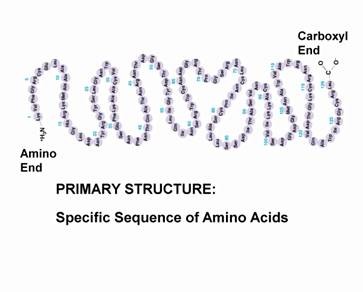
primary protein structure
sequence of amino acids
47
New cards
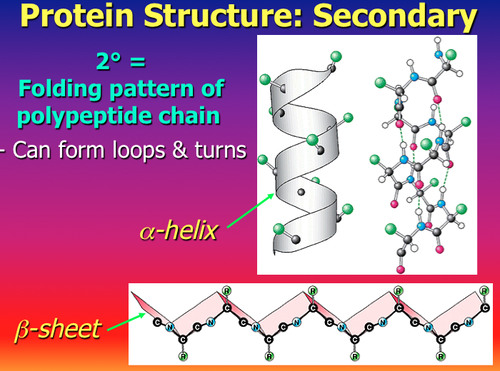
secondary protein structure
coiling or folding of a polypeptide due to H-bonding between amino acids
48
New cards
Tertiary protein structure
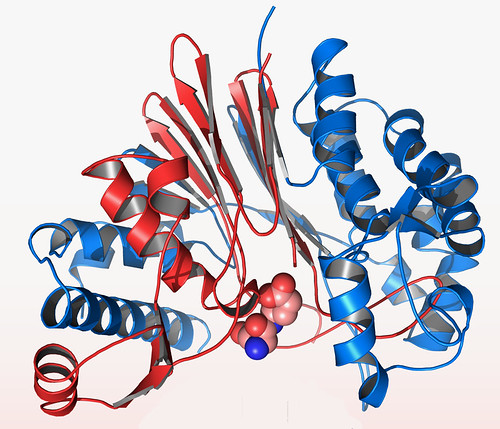
3D folding pattern of a protein due to side chain interactions
MYOGLOBIN
MYOGLOBIN
49
New cards
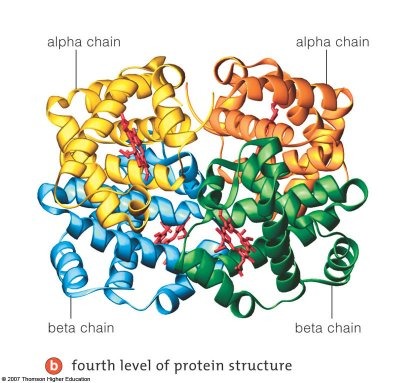
quarternary protein structure
A number of polypeptide chains linked together, and sometimes associated with non-protein groups to form a protein.
50
New cards
What are the main chain atoms of a protein
N, C alpha, C'
51
New cards
Name of bond angle between N and C'
omega (W) very clost to 180 0r 0
52
New cards
Name of bond angle between N and C alpha
phi(ϕ) 0 to +/- 180
53
New cards
Name of bond angle between C alpha and C'
psi(Ψ) 0 to +/- 180
54
New cards
Protein structure contain many _________ bonds
flexible
55
New cards
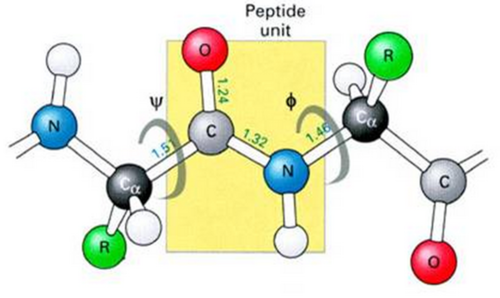
phi and psi bond angles
N and C alpha phi
C alpha and C' PSI
C alpha and C' PSI
56
New cards
Phi-Psi Restrictions
-Phi rotation can lead to O-O collisions
-Psi rotation can lead to NH-NH collisions
due to STERIC HINDRANCE
-Psi rotation can lead to NH-NH collisions
due to STERIC HINDRANCE
57
New cards
Peptide bonds can be trans or cis
Most are trans.
58
New cards
trans peptide bond
W is about 180 and C alpha atoms are found on opposite sides of the peptide bond
59
New cards
Cis peptide bond
atoms found on same side of the peptide bond, w is about 0 degrees.
Steric hindranc eis increased for cis peptide bonds
Steric hindranc eis increased for cis peptide bonds
60
New cards
protein secondary structure
Dominated by two canonical structures.
B strand
B sheet
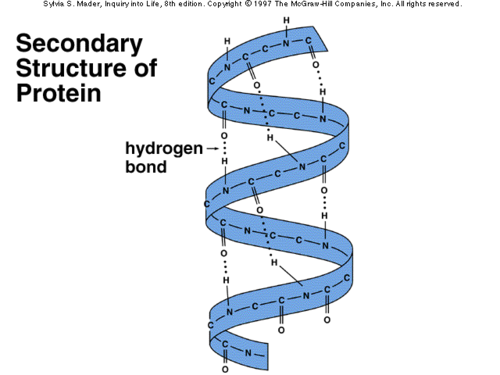
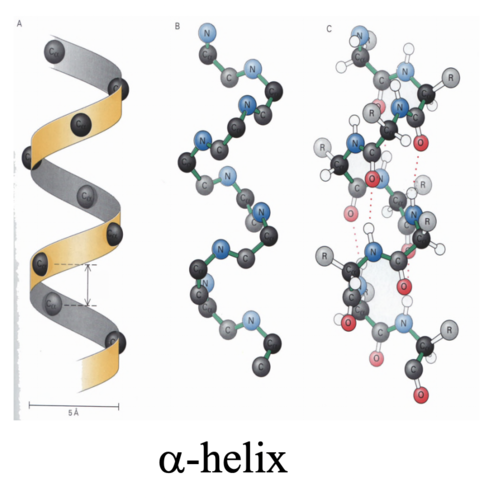
In the alpha-helix, the main chain spirals around the central axis like a spiral staircase. RIGHT HANDED spiral.
B strand
B sheet
In the alpha-helix, the main chain spirals around the central axis like a spiral staircase. RIGHT HANDED spiral.
61
New cards
What are non covalent interactions in helices called
Hydrogen bond, between the carbonyl residue "n" and n-h residue of "n+4"; o-n distance ~2.9A
62
New cards
What do hydrogen bonds help do
stabilise the alpha helix structure
63
New cards
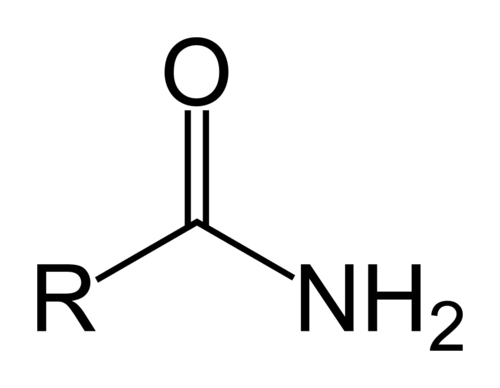
Amide hydrogens
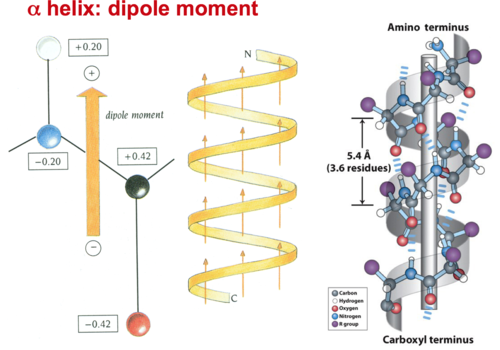
Have a partial positive charge
64
New cards
Carbonyl oxygens
have partial negative charge
65
New cards
Key properties of alpha helix
-Spiral is right handed
-Sidechains point out from the helix axis; help stabilise helix.
-Stabilising hydrogen bonds, 3-7kcal/mol or 12-28
phi=~-57 deg
psi=~-47 deg
-Some residues are helix breakers like glycine and proline
-Helix dipole exist,~positive at N terminus
-Sidechains point out from the helix axis; help stabilise helix.
-Stabilising hydrogen bonds, 3-7kcal/mol or 12-28
phi=~-57 deg
psi=~-47 deg
-Some residues are helix breakers like glycine and proline
-Helix dipole exist,~positive at N terminus
66
New cards
Helix dipole depiction
67
New cards
Helix wheels
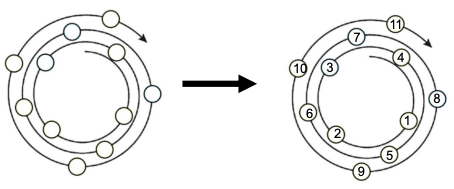
Help illustrate helix side chain arrangements .
3.6 residues/turn
One full tuen is 360 deg.
IN an alpha helix, each amino acid side chain is seperated by 100 deg
3.6 residues/turn
One full tuen is 360 deg.
IN an alpha helix, each amino acid side chain is seperated by 100 deg
68
New cards
Beta structure
-Comprises of stretches of residues called B-strands
-Hydrogen bonding occurs between adjacent chains (strands)
-Adjacent chains can often form a B-sheet> 2 B-strands
-2 to 10 strands per sheet
-Average strand length contains ~6 amino acid residues and each strand contain up to 15 residues.
-2 types of hydrogen bonding interaction in B-sheet
-Hydrogen bonding occurs between adjacent chains (strands)
-Adjacent chains can often form a B-sheet> 2 B-strands
-2 to 10 strands per sheet
-Average strand length contains ~6 amino acid residues and each strand contain up to 15 residues.
-2 types of hydrogen bonding interaction in B-sheet
69
New cards
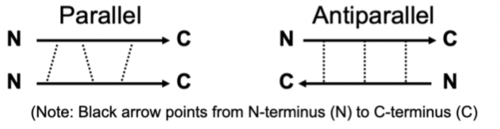
What are the 2 types of hydrogen bonding interaction in a B-sheet
Parrallel and antiparallel
70
New cards
Finding the direction of the strand
Find amide nitrogen and look for alpha carbon, direction is from N to C alpha
71
New cards
B-structure properties
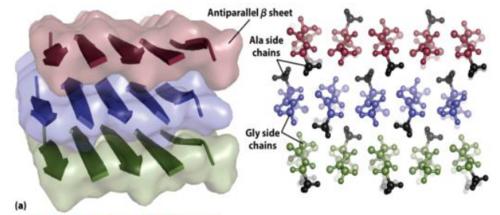
-Extended, pleated, 'B-pleated sheet"
-"Sheet" versus " strand"
-Sheets not planar, r-handed twost
-Side chains point above and below sidechains.
-Any NP-P-NP-P stretch of residues commonly form a B-strand
-"Sheet" versus " strand"
-Sheets not planar, r-handed twost
-Side chains point above and below sidechains.
-Any NP-P-NP-P stretch of residues commonly form a B-strand
72
New cards
beta structure in silk
Different physical properties, it is antiparrallel strand. very flexible
73
New cards
Turns: key properties
Needed to form globular proteins
-often short, involve 3-4 residues
-30% of residues involved in turns.
-High gly, pro content
-h-bond across turn is common
-type 1 and 2 are common.
-often short, involve 3-4 residues
-30% of residues involved in turns.
-High gly, pro content
-h-bond across turn is common
-type 1 and 2 are common.
74
New cards
Consensus protein structural display
-helices shown as spiral/cylinders
-Strands shown as arrows, pointing from N to C.
-Turns and random coil, shown as loops or rope like stretches
-Strands shown as arrows, pointing from N to C.
-Turns and random coil, shown as loops or rope like stretches
75
New cards
Protein structure shorthand
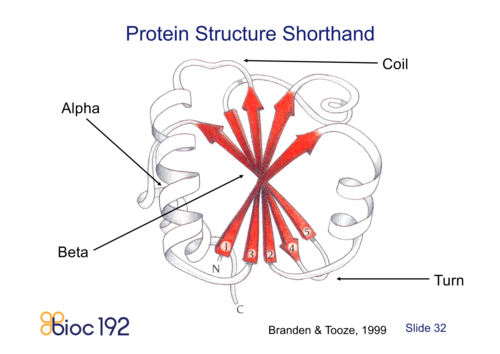
76
New cards
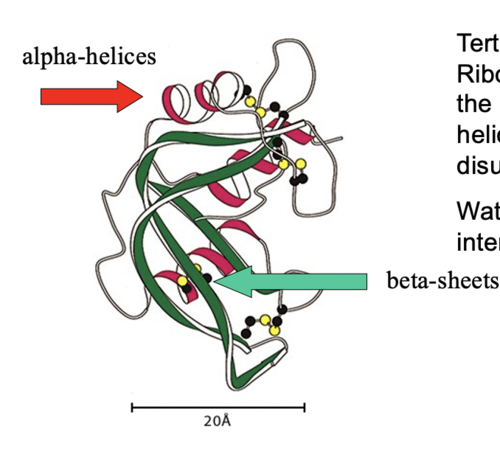
Ribonuclease A structure shorthand
77
New cards
Protein structure shorthand advantages
Easily visualioze main path of protein
-identify elements of secondary structure
-comparison
-identify elements of secondary structure
-comparison
78
New cards
Lecture6
79
New cards
Common motifs of supersecondary structure
helix-turn-helix,
beta hairpin,
greek key,
strand-helix-strand
beta hairpin,
greek key,
strand-helix-strand
80
New cards
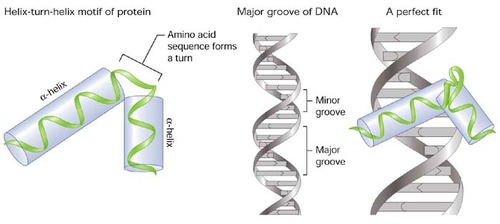
helix-turn-helix
most common DNA binding motif (dimmers). Also present with loop in calcium binding proteins
81
New cards
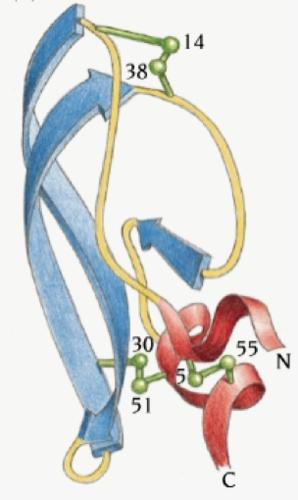
b-hairpin
-common
-antiparallel
-length vaires
-antiparallel
-length vaires
82
New cards
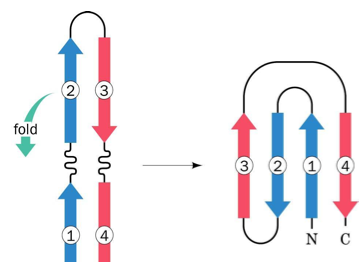
Greek key
4 antiparallel strands (strands 1,2 in the middle, 3 and 4 on the outer edges)
83
New cards
Strand, helix, strand
arrow, strand, arrow
84
New cards
what combines to form domains
supersecondary structure elements
85
New cards
Domain
independently folded regions that often possess a specific function within the protein
86
New cards
Protein domain
has a hydrophobic core and the hydrophilic parts of the protein are arranged on the surface in contact or near solvent.
87
New cards
Hydrophobic cores
Important for protein stability
88
New cards
Name the 3 domain families based on tertiary structure
-alpha domain family
-alpha/beta family
-antiparrallel b family
-alpha/beta family
-antiparrallel b family
89
New cards
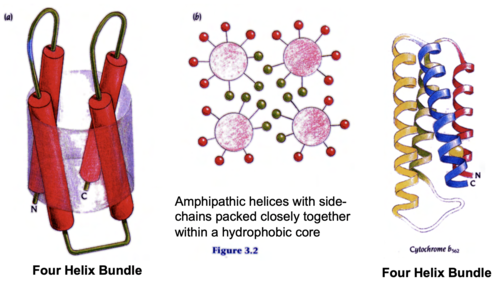
Alpha domain family
mostly helical
90
New cards
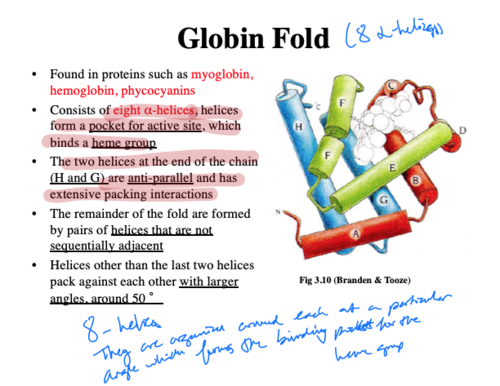
alpha domain family globin fold
Amphipathic helices with side chains closely packed together within hydrophobic core.
Packing can occur between nonadajacent helices
Packing can occur between nonadajacent helices
91
New cards
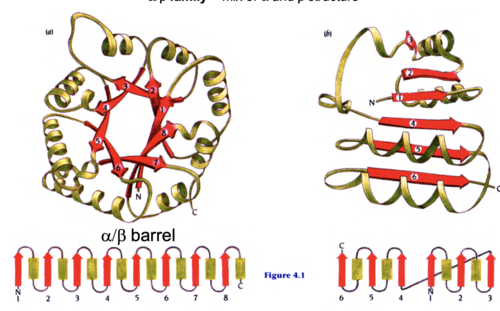
alpha/beta family
mix of alpha and beta structure
92
New cards
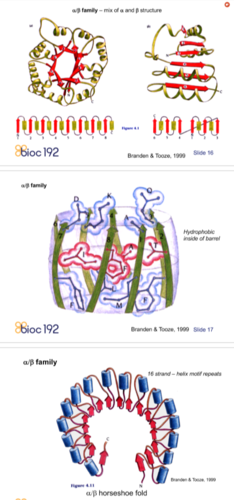
Alpha/Beta Family
The ones sticking out of the barrel are all polar or charged
93
New cards
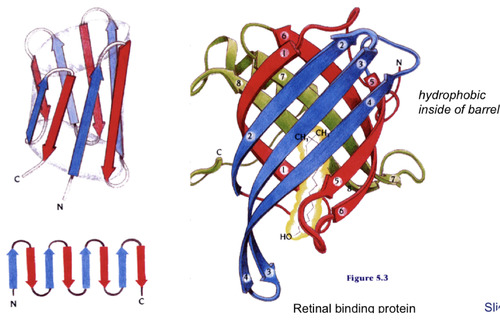
anti-parallel beta family
Mostly antiparallel structure
94
New cards
Protein folding
The physical process by which a polypeptide folds into its characteristic three-dimensional structure, which is essential to the protein's function.
95
New cards
The Anfinsen experiment
The hypothesis that "protein amino acid sequence determines the final shape a protein assumes in a water solution" was proven to be correct when Christian B. Anfinsen showed that if the enzyme ribonuclease was opened out into a linear chain and then allowed to reform, it reassumed the correct catalytic shape.
96
New cards
Folding pathways
1. formation of short sec structure segments.
2. subdomains forms
3. Subdomains come together to form a partly folded domain; a molten globule that can rearrange.
5. final domain structure emerges, small conformational adjustments to give final compact native structure
2. subdomains forms
3. Subdomains come together to form a partly folded domain; a molten globule that can rearrange.
5. final domain structure emerges, small conformational adjustments to give final compact native structure
97
New cards
Stabilisation of protein folding
• Non-covalent interactions, while individually weak in proteins, collectively make a significant contribution to protein conformational stability
• In some proteins additional covalent bonds (eg. disulfide bonds) may be present that contribute to conformation stability
• The hydrophobic core is likely the most important noncovalent contributor to protein stability in aqueous solution.
• In some proteins additional covalent bonds (eg. disulfide bonds) may be present that contribute to conformation stability
• The hydrophobic core is likely the most important noncovalent contributor to protein stability in aqueous solution.
98
New cards
What is the most important noncovalent contributor to protein stability in aqueous solution
Hydrophobic core
99
New cards
some protein folding is assisted by
chaperones
A. Chaperone-independent
b. Chaperone-dependent
c. Chaperone dependent
A. Chaperone-independent
b. Chaperone-dependent
c. Chaperone dependent
100
New cards
What do chaperones do
The are responsible for the correct folding of proteins and help proteins reach their correct tertiary structure.