Audiology Test #4
 Call Kai
 Learn
 Practice Test
 Spaced Repetition
 Match
 Flashcards
 Knowt Play
1/38

Earn XP
Description and Tags
Speech audiometry, Masking, Immittance, and Evoked Potentials
39 Terms
What is the benefit of speech audiometry?
Speech audiometry helps assess an individual's ability to understand and process speech, providing valuable insights for diagnosing hearing loss and evaluating communication abilities. It also helps determine appropriate interventions and hearing aid adjustments.
Speech Recognition Threshold (SRT)
A speech audiometry test that determines the lowest level at which a patient can correctly identify words at least 50% of the time
Speech Detection Threshold (SDT)
A speech audiometry test that determines the lowest level at which a patient indicates they are aware that a sound was presented, but does not require the patient to repeat the word
Most Comfortable Loudness Level (MCL)
dB HL of a tone or speech that is judged to be at a comfortable (preferred) level to listen
Uncomfortable Loudness Level (UCL)
Intensity level where the patient finds tones or speech to cause discomfort
What is the speech banana, and what is its clinical importance?
The speech banana shows how different speech sounds are distributed on an audiogram. Clinically, it helps identify which speech sounds a person may have difficulty hearing due to hearing loss, which can affect speech understanding and language development.
What is the audibility index (AI)?
Predicts how much speech information is available to a listener; later revised and renamed the Speech Intelligibility Index (SII).
What is the purpose of clinical masking?
Used to prevent the better-hearing ear from detecting the sound presented to the poorer-hearing ear, ensuring accurate hearing test results.
Undermasking
Levels used in clinical masking that are not sufficient to eliminate cross-hearing in the nontest ear (NTE)
Overmasking
A situation that may arise in clinical masking in which the level of the masker is sufficient to exceed the interaural attenuation, and the noise maker crosses over to the test ear (TE), which interferes with establishing the true threshold
Effective Masking (EM)
Calibrated amount of narrowband noise that provides a threshold shift to a corresponding dB HL for a tone centered within the noise
Cross-hearing
Sound presented to the test ear is heard in the non-test ear.
Interaural Attenuation (IA)
Loss of sound intensity when sound crosses over from one ear to the other
How to determine if masking is needed for Air Conduction (AC)
ACTE – BCNTE ≥ IA
What sounds are used for masking? What sound is presented to the TE, and what is presented to the NTE?
Sounds used for masking: Narrowband noise (pure-tone testing) and speech noise (speech testing).
Test Ear (TE): Pure-tone test signal.
Non-Test Ear (NTE): Masking noise.
Admittance (Y)
Amount of applied energy that flows through a system, measured in millimhos (mmhos)
Impedance (Z)
Total opposition to the flow of energy in an acoustic/mechanical system, measured in units of ohms
Immittance
Term used to encompass both admittance and impedance
How are admittance and impedance related?
Admittance and impedance are reciprocals (opposites) of each other. High admittance means low impedance, allowing more sound energy to flow through the system, and vice versa. Because they are reciprocals, you can calculate one if you know the other: Y = 1/Z or Z = 1/Y, where Y is admittance and Z is impedance.
Describe the purpose of immittance
Immittance tests provide a look at how well sound energy is transmitted through the outer and middle ear, but can also provide important information about the cochlea, as well as the 7th and 8th cranial nerve
What are the two immittance assessments, what information does each provide, and how is each performed?
Tympanometry: Measures how admittance changes with air pressure to evaluate middle ear function. A probe is placed in the ear canal, delivers a tone while changing air pressure, and measures the ear's response. Produces a graph called a tympanogram.
Acoustic Reflex Testing: Measures the involuntary contraction of the stapedius muscle in response to loud sounds. A probe is placed in the ear canal, and loud tones are presented while admittance changes are measured. Provides information about middle ear function and the auditory reflex pathway, including cranial nerves VII and VIII.
Describe the pathway of the acoustic reflex
A loud sound enters the outer ear → middle ear → inner ear → auditory nerve (CN VIII) → ventral cochlear nucleus (VCN) → superior olivary complex (SOC) → facial nerve nucleus → facial nerve (CN VII) → stapedius muscle contracts.
The reflex occurs bilaterally, meaning the stapedius muscles contract in both ears through the ipsilateral (same side) and contralateral (opposite side) pathways.

Describe the parts of an immittance assessment instrument and the functions of each
Probe Tone Generator: Produces a 226 Hz tone at 85 dB SPL to measure admittance.
Measuring Microphone: Monitors the sound pressure level of the probe tone in the ear canal.
Automatic Gain Control (AGC) Circuit: Adjusts the probe tone to maintain 85 dB SPL and helps measure admittance.
Air Pressure Pump: Changes air pressure in the ear canal during tympanometry (−400 to +200 daPa).
Reflex-Eliciting Tone Generator: Presents loud tones to trigger the acoustic reflex in the same ear (ipsilateral) or opposite ear (contralateral).
Middle Ear Analyzer and Recorder: Processes and records the measurements.
Probe Tip: Fits into the ear canal and delivers the probe tone and air pressure while allowing sound measurements.

What are the ear canal volume (acoustic equivalent volume) and admittance at the tympanic membrane (TM)?
Ear Canal Volume (Vea): Estimates the volume of the ear canal using admittance measured at +200 daPa. Helps identify abnormalities such as a perforated eardrum or a blocked ear canal.
Admittance at the TM (Ytm): Measures how easily sound energy flows through the middle ear after subtracting ear canal admittance. Helps evaluate middle ear function.
Define tympanometric peak pressure (TPP)
Pressure (in daPa) where the peak admittance of the tympanogram occurs
Define tympanometric width
A measurement (in daPa) that describes the shape of a tympanogram by calculating the difference between the two pressure values at half the peak height. Calculate it as TW = |P₂ − P₁|, where P₁ and P₂ are the two pressure values.
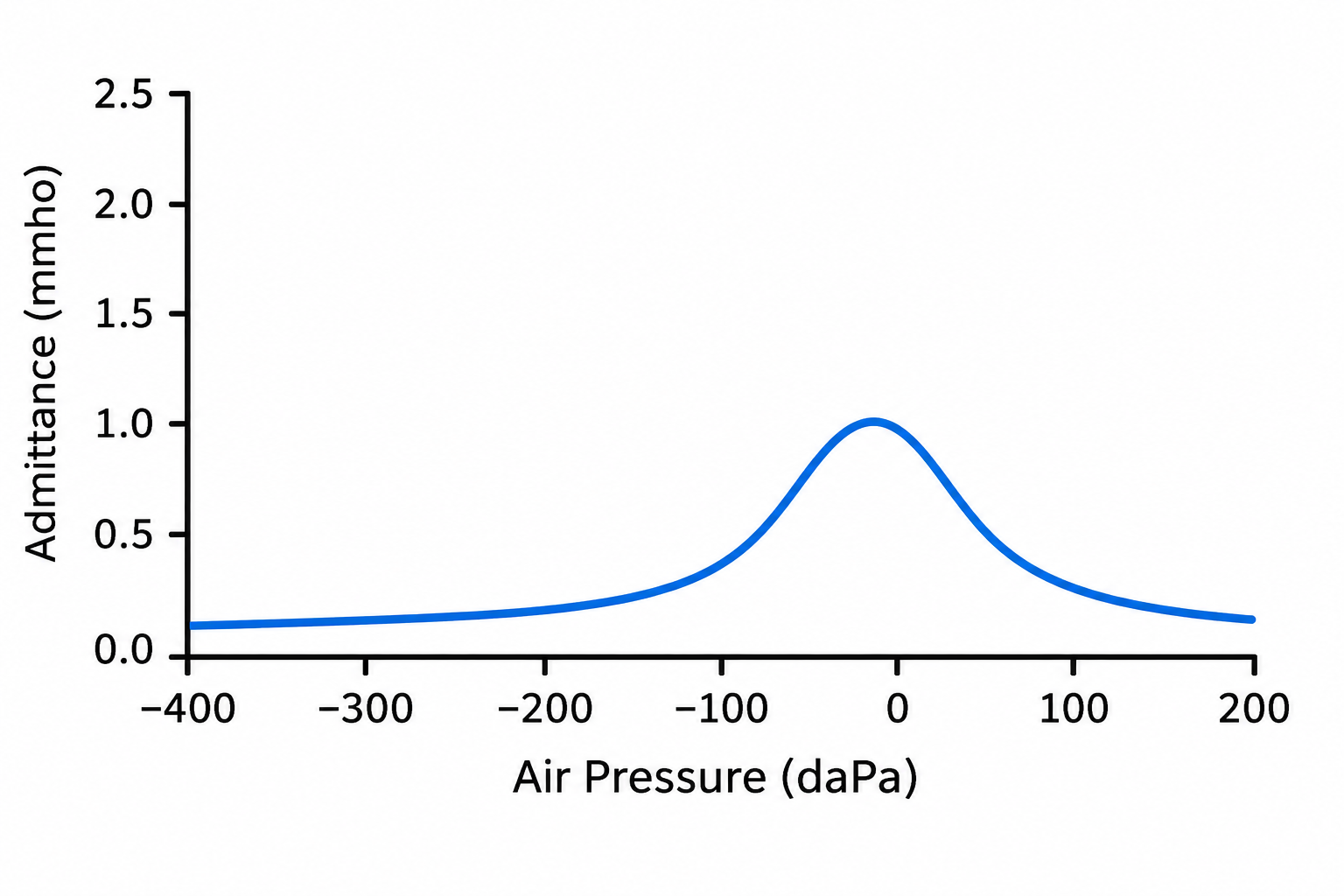
What shape is this tympanogram?
Type A – Normal Tympanogram
Characteristics: Normal peak near 0 daPa with normal admittance and middle ear movement.
Associated Diagnosis: Normal middle ear function.
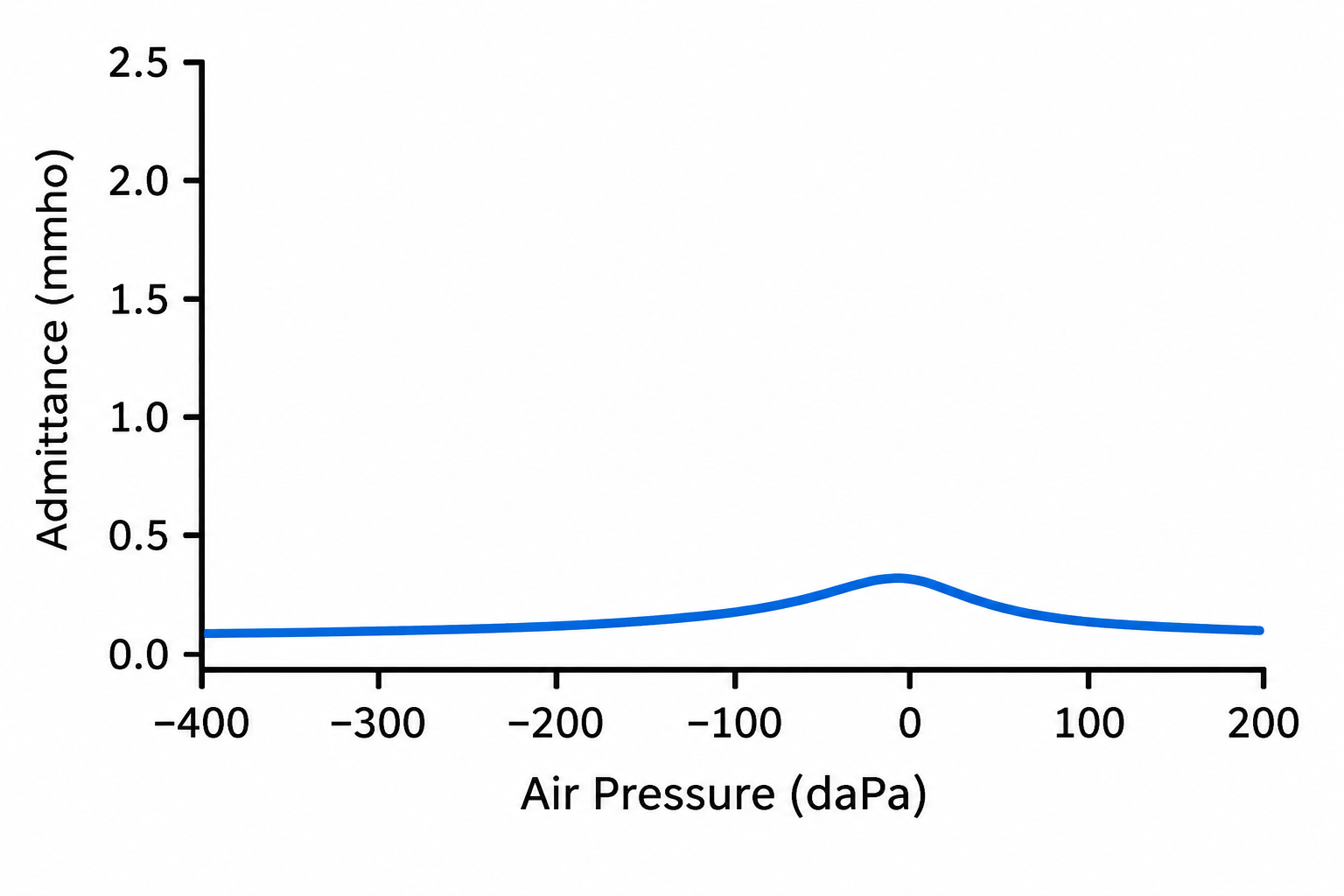
What shape is this tympanogram?
Type As – Reduced Admittance (Shallow)
Characteristics: Shallow peak with reduced admittance (stiff TM) and normal peak pressure.
Associated Diagnoses: Otosclerosis or otitis media (middle ear fluid)

What shape is this tympanogram?
Type Ad – High Admittance (Deep)
Characteristics: Very tall peak with increased admittance (hypermobile TM) and normal peak pressure.
Associated Diagnoses: Ossicular chain disarticulation or thinned TM from previous middle ear infections.

What shape is this tympanogram?
Type B – Flat Tympanogram
Characteristics: Flat tracing with no distinct peak.
Associated Diagnoses: Middle ear fluid (otitis media), TM perforation, PE tube, impacted cerumen, or a blocked probe.
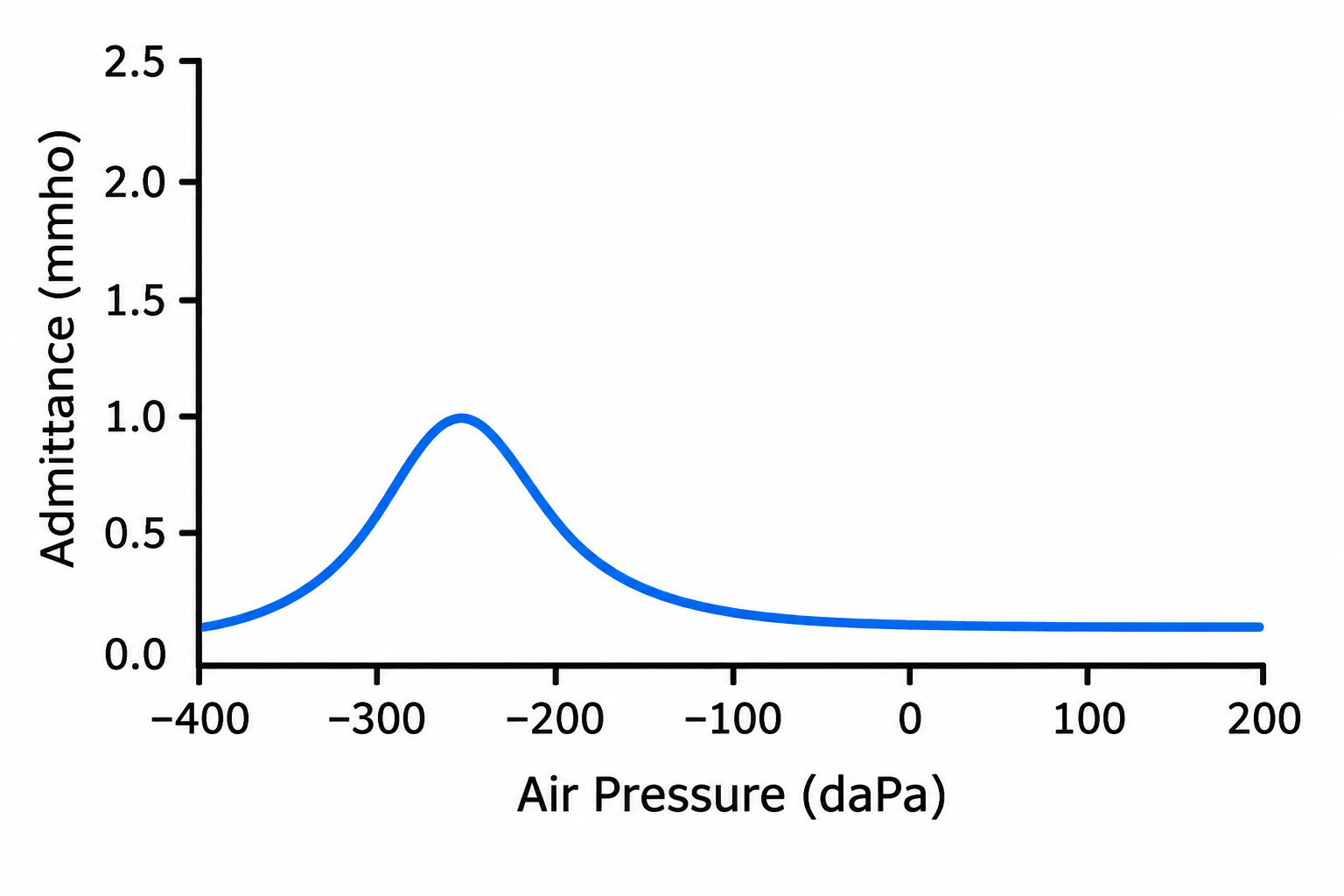
What shape is this tympanogram?
Type C – Negative Pressure
Characteristics: Peak shifted toward negative pressure, indicating abnormal middle ear pressure.
Associated Diagnoses: Poor Eustachian tube function, which may lead to fluid in the middle ear.
What parts of the auditory system are assessed by tympanometry?
Tympanometry assesses the outer and middle ear, primarily evaluating the mobility of the tympanic membrane (TM), the ossicular chain, and middle ear pressure. It helps identify abnormalities affecting middle ear function.
What parts of the auditory system are assessed by acoustic reflex testing?
Acoustic Reflex Testing assesses the middle ear, cochlea, auditory nerve (CN VIII), brainstem, and facial nerve (CN VII). It helps evaluate the integrity of the acoustic reflex pathway and identify possible abnormalities.
Describe the purpose of evoked potential assessment.