Unit 2 Technology + incentives
 Call Kai
 Learn
 Practice Test
 Spaced Repetition
 Match
 Flashcards
 Knowt Play
1/49

There's no tags or description
Looks like no tags are added yet.
50 Terms
What is opportunity cost?
The value of the next best alternative foregone
What is a reservation option?
The next best alternative option
What is an economic cost?
=direct cost incurred by the action + opportunity cost
What is economic rent?
=net benefit from option taken - opportunity cost

You take the action of going to a concert.
what is the opportunity cost?
What is the reservation option?
What is the economic cost?
What is the economic rent?
Opportunity cost: $22
Reservation option: Babysitting
Economic cost: $25 + $22 = $47
Economic rent: $30 - $22 = $8
What is innovation rent? (example of economic rent)
The extra profits made by exploiting your invention
=profit from using new technology - profit if you continued using the same technology as your competitors
it provides incentives for taking action as the rent is the reward for taking action
A competitor sells at $10 per unit and it costs them $8 to produce. Your new method costs you $3 per unit and you price it at $10 per unit. What is the innovation rent?
Profit made by competitor: $10 - $8 = $2
Profit made by you: $10 = $3 = $7
Innovation rent = $7 - $2 = $5
What are relative prices?
The price of one good/ service compared to another, often expressed as a ratio of the two prices
an important factor in determining economic incentives (as people compare and choose options by what the give up)
What is specialisation?
The concentration of individuals on producing a narrow range of goods/ services
What are the 3 reasons specialisation happens?
learning by doing: we acquire skills as we produce things
difference in ability: because of skill or natural characteristics e.g. soil quality, some people are better at producing certain things than others
economies of scale: producing a large number of units of a good is often more cost effective than producing a smaller number.
What is absolute advantage?

Who has AA in producing apples?
Given a set of available inputs, a person/ country can produce more of a particular good than another.
Greta has AA in producing apples
What is comparative advantage?

Who has CA in producing apples?
Who has CA in producing wheat?
A person/ country can produce a particular good at a lower opportunity cost than another, meaning they give up less of other goods to make it.

Greta has CA in producing apples
Carlos has CA in producing wheat
What is self sufficiency?
Consuming exactly what you produce
Why is specialisation + trade more beneficial than self sufficiency?
(Column 1)With SS: Greta must split her time into 40% on apples + 60% on wheat, Carlos must split his time into 30% on apples + 70% on wheat.
Total production of both crops are lower
(Column 2)If the specialise in their CA: total production of both crops are higher
(Column 3)Their trade when they both specialise: total production of both crops are higher

What is division of labour?
Specialisation in producing things either within a firm or across society
What are factors of production?
The inputs into the production process e.g. land, labour, capital, enterprise
What is production technology?
The process that a firm uses to convert a set of inputs into an output that it can sell
What is the production function
A relationship that tells us how much output will be produced given the amounts of input used.
Q = f(K,L)
Q(output), K(capital), L(labour)
What is fixed proportions technology?
A technology that requires inputs in fixed proportions to each other. To increase output, all inputs (e.g. no. of workers, energy) must be increased by the same percentage (so they all remain in the same fixed proportions to each other)
Using fixed proportions technology, if you had 6 machines, what would the output be if you were to increase the no, of workers to 3?

Output will remain at 100 litres.
What is constant returns to scale(CRS)?
Increasing all inputs to a production process by the same proportion will increase output by the same proportion.
Using constant returns to scale, if you doubled the no. of machines from 6 to 12, no. of workers from 2 to 4, and energy from 160, what would the output be?

The output would double from 100 to 200 litres.
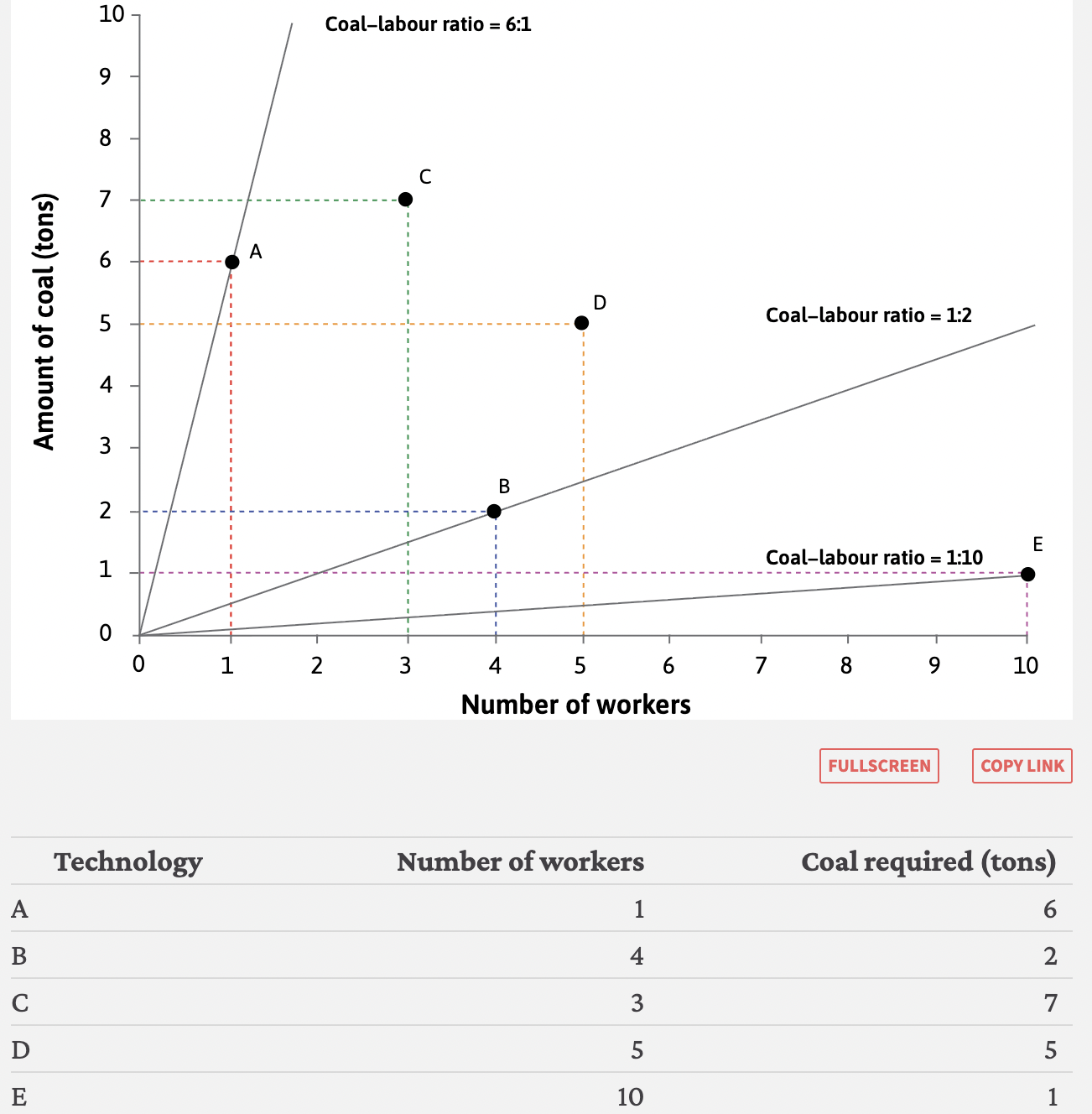
Modelling technology: Each of these fixed proportion technologies with a CRS produce 100m of cloth.
Which one is the most labour-intensive, and which is most energy-intensive?
What movement does the Industrial Revolution represent?
Which technologies would the firm choose and why?
E is most labour-intensive, C is most energy-intensive
E→C (more manufacturing meant less workers to do the job as they became automated + more energy to power machinery)
Technologies A, B, or E.
A dominates C as C uses more workers + more energy to produce the same amount of cloth, therefore C is inferior to A
B dominates D
choice between A, B, or E depends on cost, as they want to maximise profit e.g. E would be chose in labour was cheap relative to the cost of coal
How does a firm evaluate the cost of production using different technologies?
Use inputs of workers + coal
cost = (wage x workers) + (price of a tonne of coal x no. of tons)
= (w x N) + (p x R)
Suppose the wage is £10 and price of coal is £20 per ton.
Using the formula,
What is the cost of employing 2 workers and 3 tons of coal?
What is the cost of employing 6 workers
=(w x N) + (p x R)
= (10 × 2) + (20 × 3)
= 20 + 60 = 80
(10 × 6) + (20 × 1)
= 60 + 20 = 80W
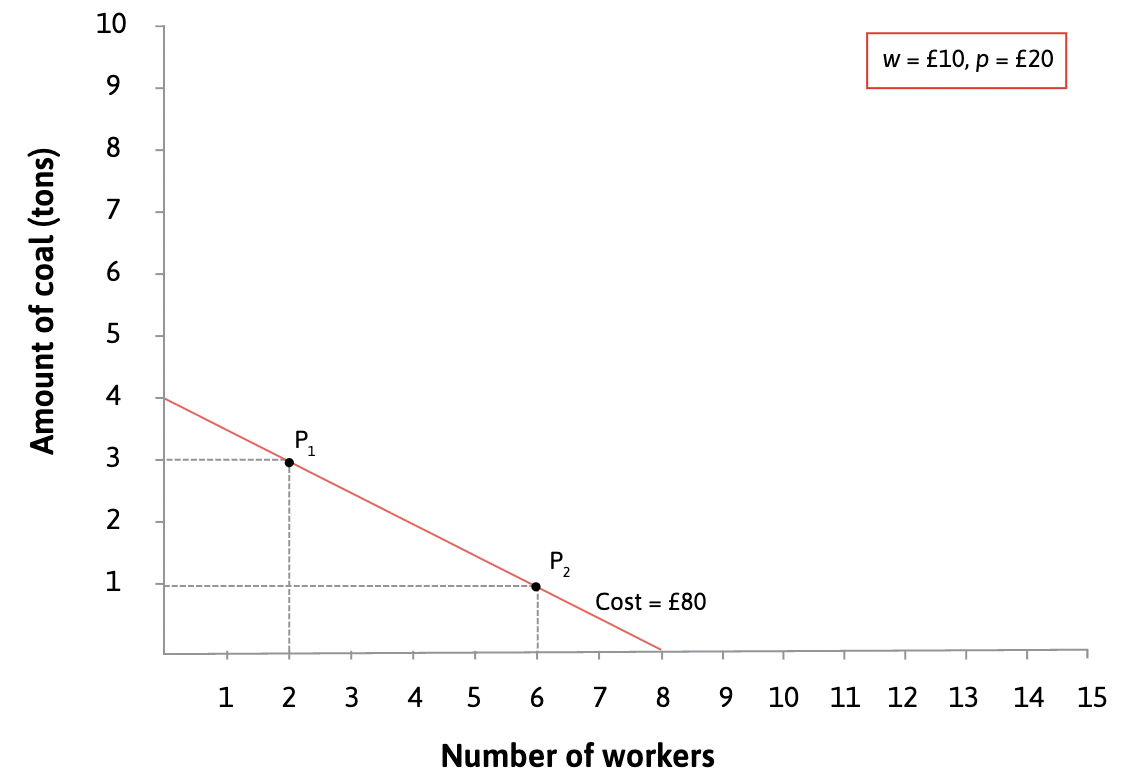
What is an iso-cost line?
A line that represents all combinations of inputs that give the same cost
e.g. the straight red line that runs through P1 and P2

all iso-cost lines are parallel (as wage + price of coal stays the same)
iso-cost lines lying further away from the origin represent higher cost

What technology is preferred- A or B?

B
What is the formula for the slope of the iso-cost line?
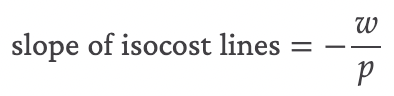
(rearranged cost equation to find gradient of equation)
What does w/p represent?
The relative price of labour in terms of capital
Suppose the price of coal decreases to £5 a ton. What technology is now preferred?

original w/p = 10/20 = ½
new w/p = 10/ 5 = 2slope is now -2
new cost of A= 10(1) + 5(6) = 40
new cost of B = 10(4) + 5(2) = 50
so A

What is the equation for profit?
profit = revenue - cost
What is the economic rent for a firm switching from B to A after this fall in price of coal?
change in profit from switching = change in revenue - change in cost
= 0 - (40 - 50)
= £10 per £100m of cloth
What is an entrepreneur?
A person who creates or is an early adopter of new technologies, and other opportunities.
they will enjoy innovation rents
What is creative destruction? give examples
Process by which old technologies and the firms that don’t adapt are swept away by the new, as they can’t compete in the market given their higher costs + lower profits.
e.g. driverless cars replace taxis, self-checkouts replace cashiers
developed by Joseph Schumpeter
takes time for labour + capital goods from failed firms to be used in new combinations which contribute to upswings + downswings in the economy
What sector first went through technological change during the industrial revolution + how?
Production of textiles + clothes
involved time-consuming + labour intensive
new machines were powered by water wheels + later coal-powered steam engines instead of human labour
Why was Britain the first to undergo the industrial revolution?
capacity to innovate: had many skilled engineers + machine makers
changing relative prices of inputs: 1600s wages relative to price of coal was low → 1700s wages rose relatively higher than coal as it was coal rich
falling energy costs due to e.g. cheaper transportation- allowed countries to import energy cheaply from abroad
How did Britain escape the Malthusian trap?
the permanent technological revolution offset the diminishing APL + increased it
workers wages became more protected through social + political forces- helped ensure the economic gains went into wages
What 2 factors influence wages?
How much is produced- total output that rises with technology + productivity
The share going to workers- bargaining power e.g. trade unions
What social + political forces helped Britain escape out of the Malthusian trap?
Labour market regulation:
Factory Act: no child labour under 9 years
Ten hours Act: limits hours for women + children
Extension of voting rights:
1928 universal Suffrage (equal rights to vote over 21)
1+2→ labour supply falls → power of workers rose → wages rose
3 → power of workers rose → wages rose
How do we create an effective model mathematically?
Capture the element of the economy that matter for our question, holding everything else constant (ceteris paribus)
Describe how agents act + interact with each other and with elements of the model
Determine the outcomes of these actions (often located at an ‘equilibrium’)
Study what happens to the equilibrium outcomes when conditions change
What is equilibrium?
A situation that is self-perpetuating, meaning there is no tendency for the situation to change unless an external force(outside the model) for change is introduced
How is equilibrium proved in the Malthusian model when technology improves?
Living standards at a given level →tech improves → avg output per worker rises→ pop rises→ less land per worker → avg output falls → living standard back to original (equilibrium)
What are endogenous variables?
Variables whose value is determined by the workings of the model
e.g. when incomes rise, population rises
What are exogenous variables?
Variables whose value is determined outside the model
e.g. technology- the model doesn’t explain it
What other 3 factors are important to consider as the reason for Britain’s Industrial Revolution?
the scientific revolution + diffusion of technical knowledge: transfer of elite knowledge provided the tools for engineers to build machines at the time (Joel Mokyr, 2004)
the rule of law + other political institutions: culture in China favoured stability over change (David Landes, 2006)
new individual values: importance of hard work + savings spread + promoted increases in labour productivity (Gregory Clark, 2007)
What were the impacts of the transition from photosynthesis sourced energy to fossil fuel sourced energy?
increases in per capita income + material wellbeing
increases in the surface temp of the Earth
What is the stock of CO2?
The amount of CO2 in the atmosphere
global warming results from the stock
What are flows of CO2?
Distinguish between examples of inflows + outflows.
The amount of CO2 being added per year
matters only as it alters the stock (stock is increasing as inflows > outflows)
Inflows (increase amount): CO2 emissions from greenhouse gases
Outflows (decrease amount): natural decay of CO2, absorption of CO2 by forests
What is the typical relationship between a country’s living standards and CO2 emissions? Why does this occur?
Higher GDP per capita = Higher CO2 emissions
higher level of production of goods+services per capita due to higher incomes per capita, involving greater use of fossil fuels
What is changing this relationship in recent years?
decreasing cost of renewable energy
increased use of renewable energy in high income countries- Sweden, Norway, Switzerland
carbon taxes