TEAS PNS
 Call Kai
 Learn
 Practice Test
 Spaced Repetition
 Match
 Flashcards
 Knowt Play
1/124

There's no tags or description
Looks like no tags are added yet.
125 Terms
cranial nerves, spinal nerves, and autonomic nervous system
peripheral nervous system includes
PNS
divided into the somatic nervous system and the autonomic nervous system
somatic nervous system
which controls voluntary information such as with skeletal muscles
autonomic nervous system
which control involuntary information such as with organs.
also known as a visceral motor system.
maintain homeostasis in the body even when it is in an unconscious state.
2 subdivisions
parasympathetic and sympathetic
what are the two subdivisions of the ANS?
cranial nerves
important in assessing the function of the nervous system
CN I
CN II
CN III
CN IV
CN V
CN VI
CN VII
CN VIII
CN IX
CN X
CN XI
CN XII
what are the 12 cranial nerves?
CN I
Olfactory nerve: Sense of smell.
CN II
Optic nerve: Vision.
CN III
Oculomotor nerve: Eye movement (pupil and eyelid).
CN IV
Trochlear nerve: Downward/inward eye movement.
CN V
Trigeminal nerve: Facial sensation and jaw movement (mastication).
CN VI
Abducens nerve: Lateral eye movement.
CN III, IV, VI
what cranial nerves work together to move eyes?
CN VII
Facial nerve: Facial expressions, taste (from anterior 2/3).
CN VIII
Vestibulocochlear nerve: Hearing, equilibrium and balance.
CN IX
Glossopharyngeal nerve: Throat sensation(swallowing) and taste (from posterior 1/3).
CN X
Vagus nerve: Parasympathetic control of heart, lungs, and digestion.
CN XI
Spinal Accessory nerve: Neck sternocleidomastoid and trapezius muscle movement.
CN XII
Hypoglossal nerve: Tongue movement.
I, II, VIII
what cranial nerves carry sensory information?
III, IV, VI, XI, XII
what cranial nerves carry motor information?
V, VII, IX, X
what cranial nerves carry sensory & motor information?
Olfactory, Optic, Oculomotor, Trochlear, Trigeminal, Abducens, Facial, Vestibulocochlear, Glossopharyngeal, Vagus, Accessory, Hypoglossal
Oh Oh Oh To Touch And Feel Very Good Velvet AH
8 cervical, 12 thoracic, 5 lumbar, 5 sacral and 1 coccygeal
what are the 31 pair of spinal nerves?
spinal nerves
formed by dorsal and ventral nerve roots.
The nerves branch to the body with some nerves traveling to the autonomic nervous system.
carry both sensory and motor information.
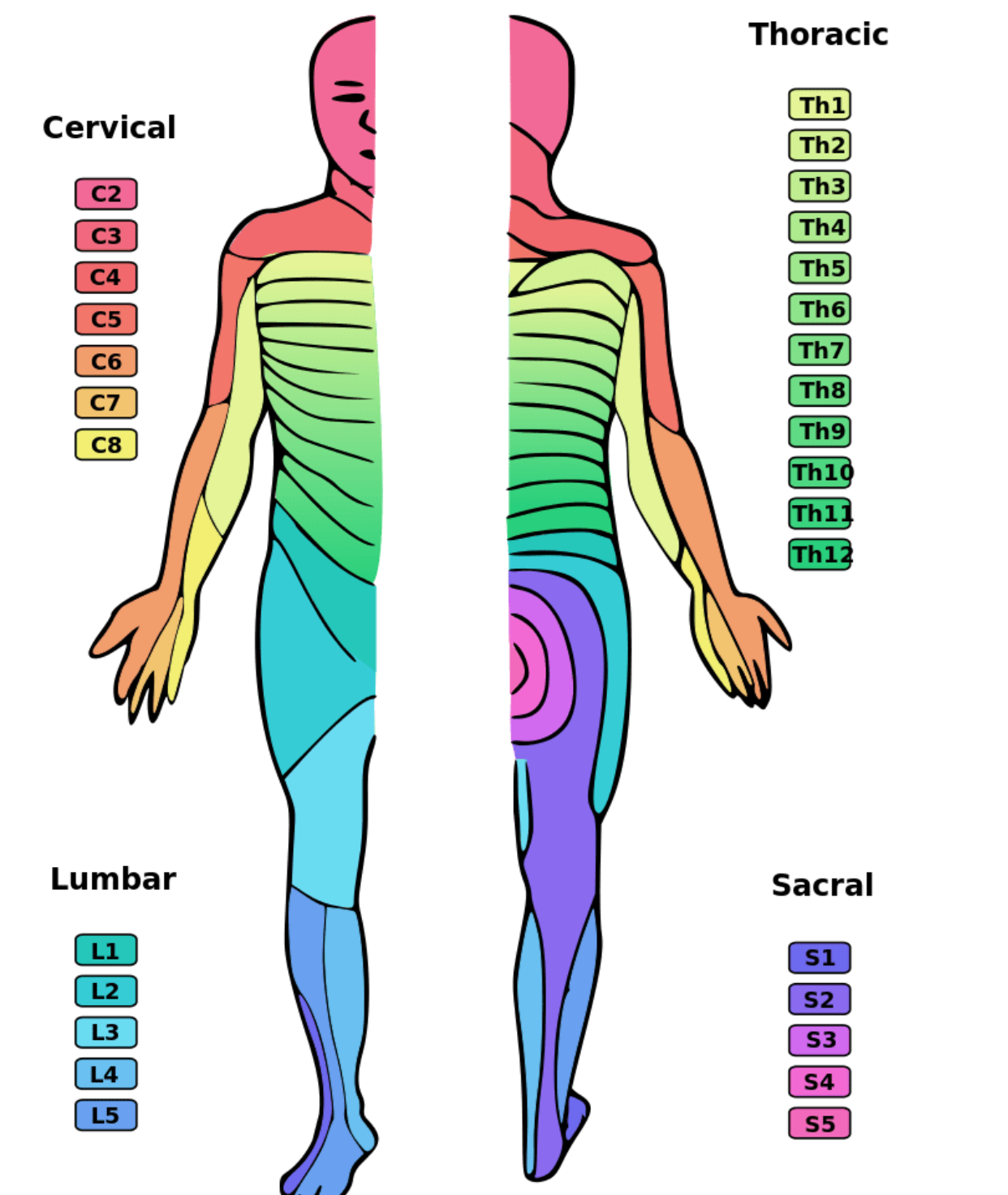
dermatomes
The body can be divided into sections which represents a specific area of the body innervated by a spinal nerve.
important in helping to localize peripheral nervous system injuries.
ANS
can control respiratory, cardiovascular, urinary, digestive and reproductive functions.
does this by sending motor impulses to viscera, cardiac and smooth muscle.
ANS
what works to maintain balance of fluids, electrolytes, blood pressure, nutrients, and blood gasses?
sympathetic
what is the fight or flight system?
sympathetic division
located in the thoracic and lumbar spines and sends fibers to the organs.
parasympathetic divison
located in the cervical and lower lumbar spines and sends fibers to the same organs as the sympathetic.
opposite
what effect does the sympathetic and parasympathetic divisions typically have on organs?
sympathetic increase heart rate; parasympathetic system decreases it.
what is an example of the sympathetic and parasympathetic divisions having opposite effects?
sympathetic nervous system
works to
dilate air passages,
increase activity of sweat glands,
increase glucose levels in the blood,
dilate the pupils,
increase heart rate,
decrease digestive activity.
increase the amount of blood moving to the cardiac and skeletal systems while decreasing blood flow to the skin.
decreases urinary activity.
parasympathetic division
originates in the brain and sacral region of the spinal cord.
sometimes referred to as the craniosacral division of the ANS.
sometimes called the rest and digest division
parasympathetic division
works to
pupil constriction,
decreasing the heart rate and breathing and
increasing digestion.
mixed nerve
nerve that can carry both sensory and motor information
nerves
bundles of fascicles(sections), which are further composed of individual nerve fibers (axons).
contain numerous fibers
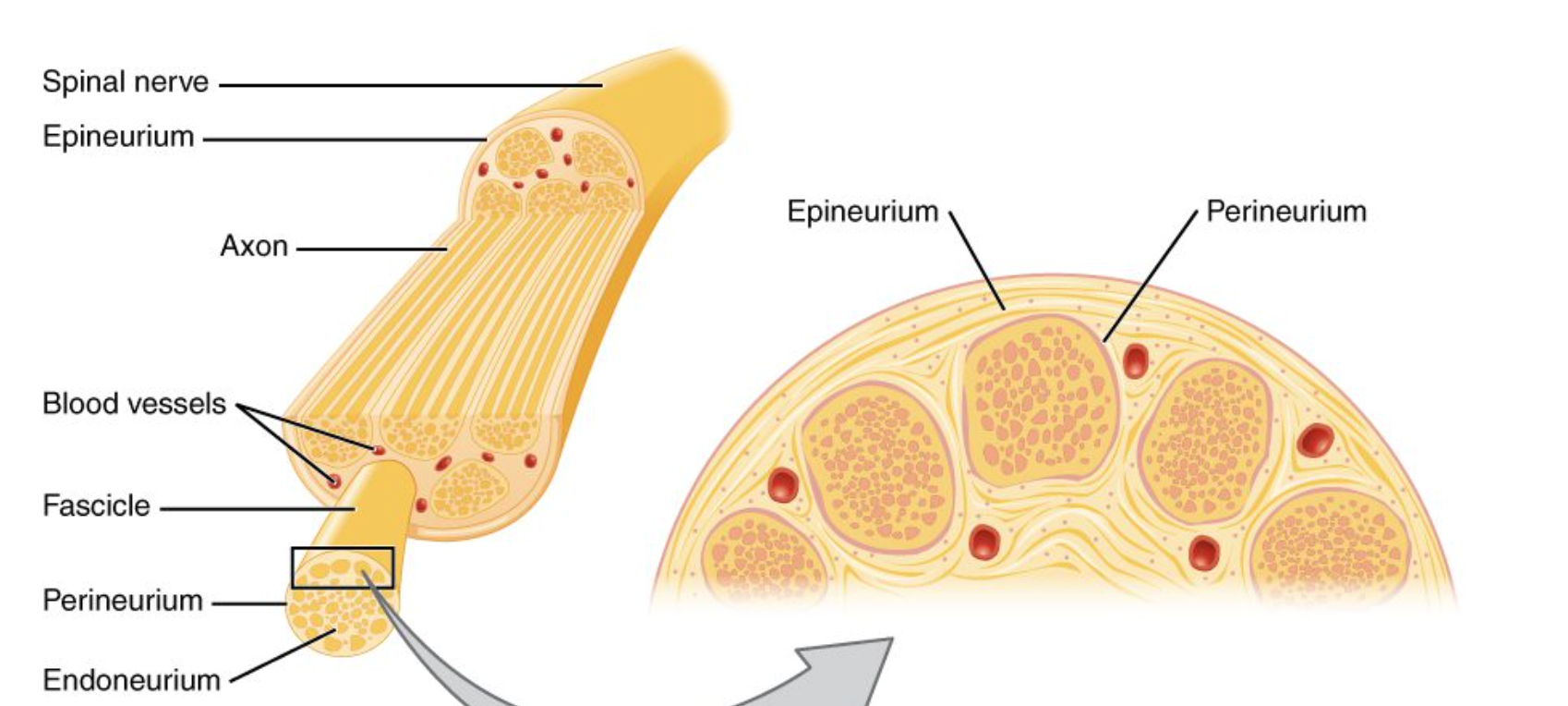
epineurium
outer layer of a nerve
consists of dense connective tissue that surrounds and protects the nerve
perineurium
Inside the nerve the fibers are bundled in fascicles with each fascicle surrounded by a sheath called?
neurons
what is within a fascicle?
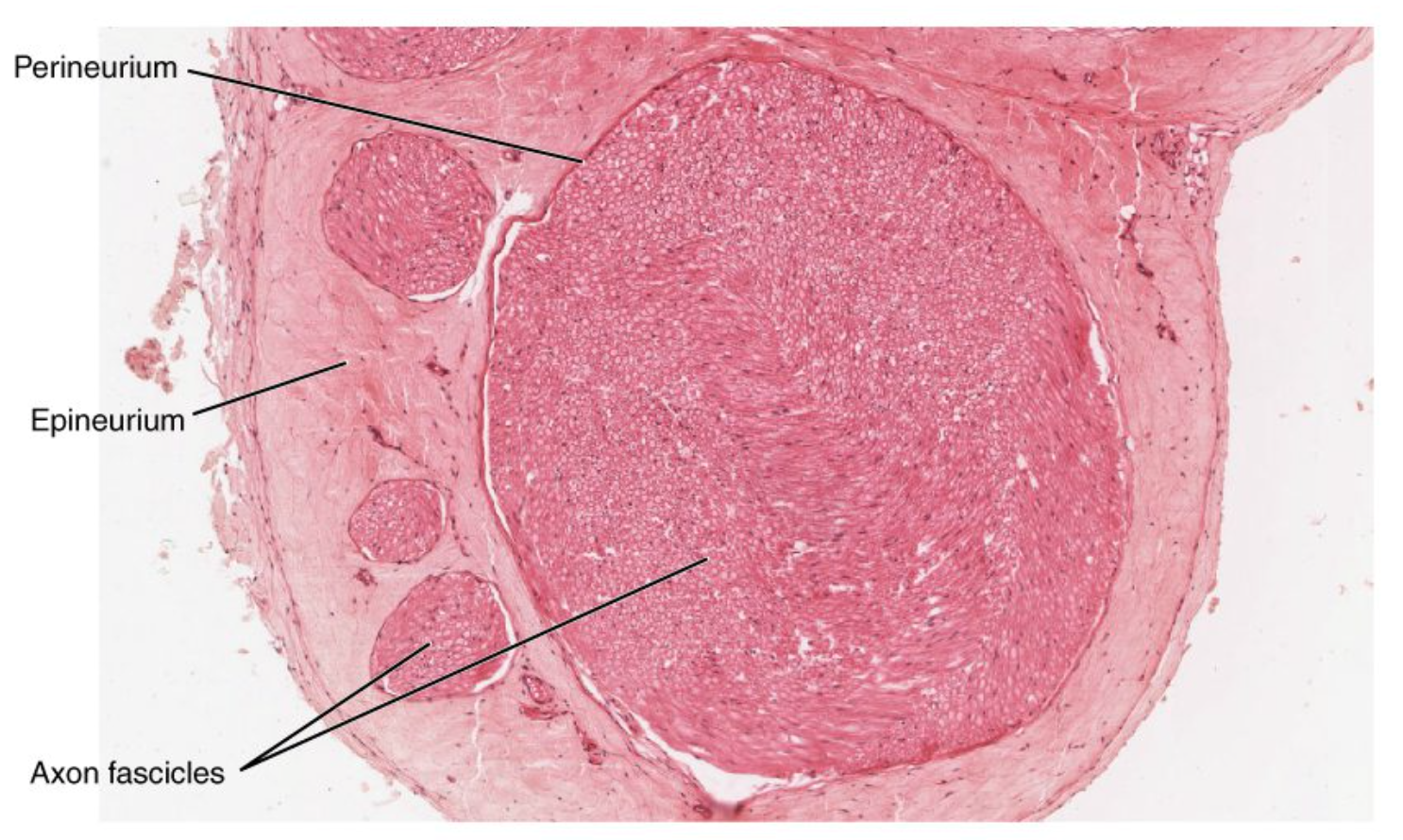
endoneurium
what surrounds the neurons within a fascicle?
plexi
Spinal nerves can combine to form structures called
cervical plexus, phrenic plexus, lumbar plexus, sacral plexus
what are the 4 major plexi in the human body?
cervical plexus
(C1-C4)
innervates the posterior head and skin of the neck.
brachial plexus
spinal nerves (C5-T1)
form the axillary, radial, musculocutaneous, ulnar and median nerves.
lumbar plexus
consists of spinal nerves L1-L4
sacral plexus
consists of the ventral rami from spinal nerves L4-S4
lumbosacral plexus
lumbar and sacral plexus referred to
major nerves exiting the include the obturator, femoral, and sciatic.
neurons and neuroglia
what are the two types of cells in the nervous system?
neurons
the cells that transmit and store information in the nervous system
can connect and communicate with other neurons
neuroglia
support cells in the nervous system
star-shaped astrocytes, oligodendrocytes, ependymal cells, microglia
what are some examples of neuroglia?
star-shaped astrocytes
cells that help to regulate electrolytes
oligodendrocytes
cells that produce myelin
ependymal cells
cells that produce cerebrospinal fluid
microglia
cells that clean up debris
dendrites, cell body, axon hillock, axon, and axon terminal.
what are the parts of neurons?
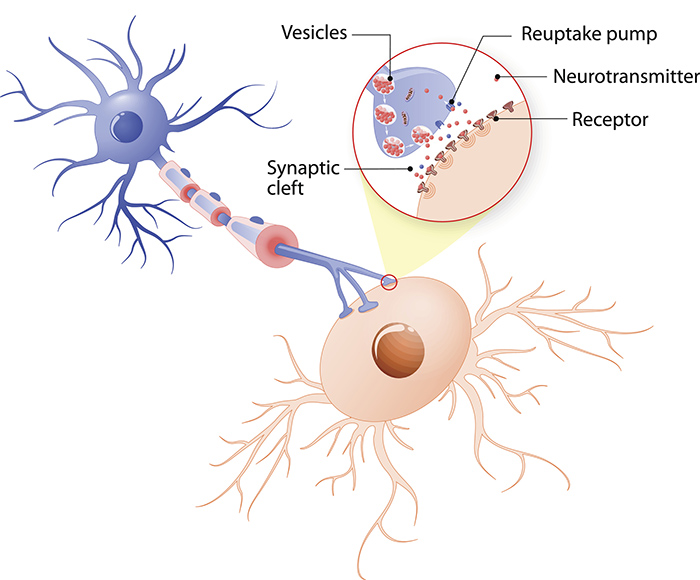
synapse
what is the connection between neurons called?
synaptic cleft
the space between neurons
neurotransmitters
Neurons communicate with each other by sending chemical packets called …. across the synaptic cleft
presynaptic neuron
what is the neuron called that sends a neurotransmitter across the synaptic cleft?
post-synaptic neuron
what is the neuron called that receives the neurotransmitter?
excitatory message and inhibitory message
what are the essential messages that neurons send?
excitatory neurotransmitter
stimulates the post-synaptic neuron to send a message
inhibitory neurotransmitter
keeps the post-synaptic neuron from sending additional messages
interneuron
a type of nerve cell (neuron) found only in the central nervous system
acts as a link or bridge between other neurons (sensory neurons and motor neurons)
allow the nervous system to process information, make decisions, and coordinate responses.
neurons
do not exist at equilibrium with their surroundings
net negative charge on the inside compared to the outside charge.
membrane permeability
This negative charge within neurons exists mostly because of differences in ………. to different electrolytes.
sodium and potassium
what elements are neurons slightly permeable to?
negatively charged ions
There are also a number of …… inside of the neuron’s cell membrane
phosphates, sulfates, ATP, RNA, and proteins
what are the negatively charged ions inside of the neuron’s cell membrane that can NOT leave?
sodium and potassium
what are the ONLY positively charged elements within a neuron?
ionic gradient
difference in concentration and electrical charge of ions across a cell membrane, driving movement to store free energy.
These gradients are maintained by active transport and are essential for nerve impulses, muscle contraction, and ATP production
ionic gradient
potassium diffuses out of the neuron at the same rate that it moves into the cell via a steady
sodium-potassium pump
work to maintain both sodium and potassium gradients by moving sodium out of the cell and potassium into the cell.
potassium
what element are neurons more permeable to?
energy in the form of ATP
what causes the sodium-potassium pump to function?
70%
how much energy used by the nervous system is used by the sodium-potassium pumps?
-70mV
what are neurons typical resting membrane potential?
resting membrane potential
is the stable, negative electrical charge difference (typically (-40) to (-90) mV) across a cell membrane, with the inside more negative than the outside, when a cell is at rest.
opening of sodium gates
what causes a post-synaptic neuron to receive neurotransmitters?
depolarization:
positively charged sodium enters into the post-synaptic neuron decreasing its potential (less negative)
what happens when sodium gates open to receive neurotransmitters?
depolarization
the rapid reduction of the membrane potential in excitable cells (neurons, muscle cells) where the internal charge becomes less negative or positive, triggered by the influx of +sodium ions.
threshold
if the stimulus is strong enough to cause enough of a change in potential to reach a certain level, the neuron will react by opening more sodium gates and depolarizing at a rapid rate.
-55mV to +30mV
what level would a stimulus have to get a neuron to in order to reach threshold?
+30mV to +40mV
what is the max depolarization?
action potential
The rapid change in resting membrane potential from -55 mV to +30mV is called?
all or none principle
once the threshold is reached, the neuron continues through the cycle of depolarization and repolarization to resting membrane potential.
axon hillock
where are action potentials genereated?
voltage-gated sodium channels
sodium gates that react/ open to changes in membrane potential
Voltage-gated potassium channels to open at the same time as the sodium channels
When a stimulus causes depolarization to the threshold, the voltage-gated sodium channels open, causing …
slower
potassium channels work …. than the sodium channels once at the threshold
Na closes, K stays open til resting membrane potential reached
After the maximum depolarization is reached at about +30mV to +40mV what happens to Na and K gates?
neurotransmitters
All of the activity in the brain is governed by
Excitatory neurotransmitters
include epinephrine and norepinephrine (adrenaline and noradrenaline).
Both are secreted by sympathetic neurons, so they cause the effects of the sympathetic nervous system on the body.
Epinephrine and norepinephrine
what hormones connect to adrenergic receptors on other neurons?
Dopamine
plays a role in pleasure and motivation
considered excitatory, but it can be inhibitory depending on the neurons
Acetylcholine
excitatory neurotransmitter that is secreted by parasympathetic neurons and motor neurons attaching to muscles to stimulate muscle contraction.
considered cholinergic, so it will connect to cholinergic receptors on neurons