perception 17 - synaesthesia
 Call Kai
 Learn
Learn Practice Test
 Spaced Repetition
 Match
Match Flashcards
 Knowt Play
1/16

There's no tags or description
Looks like no tags are added yet.
Name | Mastery | Learn | Test | Matching | Spaced | Call with Kai | Chat |
|---|
No analytics yet
Send a link to your students to track their progress
17 Terms
synaesthetes experience
Experience blending of the senses
-when stimulate one sense see response of multiple areas in brain
-one sensory input yields secondary sensory response
-still rounded in reality its an overlay
synaesthesia prevalance
1000 who have sound and colour
500 sound and taste
1 sound, colour and taste - person in vid
Synaesthesia is
-Within or Across modalities (eg grapheme trigger colour is within vision)
-Experience is real not hallucination (is it perceptual or cognitive linkages)
-Automatic (can't stop it)
-Can feel 'normal' to the synaesthete
interactio in synaesthesia
Interaction between 2 things inducer (mainly linguistic) concurrent (mainly visual)
One direction e.g. letter -> colour not colour -> letter
Within head- visual image- ('associator') or out there ('projector')
-grapheme colour is majority of cases but are some more "bizarre" ones realise words taste
history
(very brief) History
Early/mid 1800s
-tended to be colour ones
-Hyperchromaticity (additional new types of cones!) - that was there proposed explanaiton
Late 1800s
-more and more types discovered
-Explosion of types, inc. cross-modal
1900s
-Interest declined - rise of behaviourism = learnt association
-therfore less interested in perception
dd percept vs cog
-study used as a measure of whether people have it
Test / Re-test reliability - Baron-Cohen et al (1993)
117 word list read to participants: (animals, places, objects, occupations, days-of-week, first names, alphabet letters, abstract terms, pronouns/prepositions, nonsense)
Asked for an associated colour after each word
- Controls tested 1 week later (told they could use any mnemonic technique, knew a memory experiment)
age- , IQ- memory- matched controls
- Synaesthetes tested 1 year later ! (not warned)
Baron-Cohen et al (1993) - results
Consistency of colour-word associations
Control - 37.6%
spoken word - colour synaesthetes - 92.3%
(maybe some people werent synesthaates, maybe mood affects who knows)
evidence of atypical perceptual experience or just super-memory?
-if have this automatic trigger don't need amazing memory
People with synesthesia generally have consistent pairings
(consider association question?)
Stroop study
Stroop' - Dixon et al (2000)
"C" - a digit-colour synaesthete vs control
(photism just means perceptual experience)
Baseline - name colours
Congruent colour naming - real colour of numbers is the same as C's photism
Incongruent colour naming - real colour of numbers is different from C'ss photism
-C's choice RT is slowed in incongruent condition
-for non-syensthate doesn't really make a difference
-this feels more of a perceptual thing but could be cognitive too
Stroop mirror
Banissy & Ward (2007)
mirror-touch synaesthetes
-if look at someone being touched feel that touch in that part of their body
Look at a video of someone being touched on face and are also touched on the face by the research
Congruent and incongruent trials (touch by reacher on same or different side as video)
need to say if they felt two or left, right or none
Banissy & Ward (2007) results
Mirror touch error rate much higher in the incongruent condition
-control and congruent have w error rates
RT also increases
Some evidence of perpcpetual but is it? What level is stroop affect at - dont understand
More than learnt association
Grouping - Ramachandran & Hubbard (2001)
Apparent motion - Kim, Blake & Palmeri (2006)
Brain scan -Nunn et al (2002)
Grouping
Ramachandran & Hubbard (2001)
-using Gestalt principles
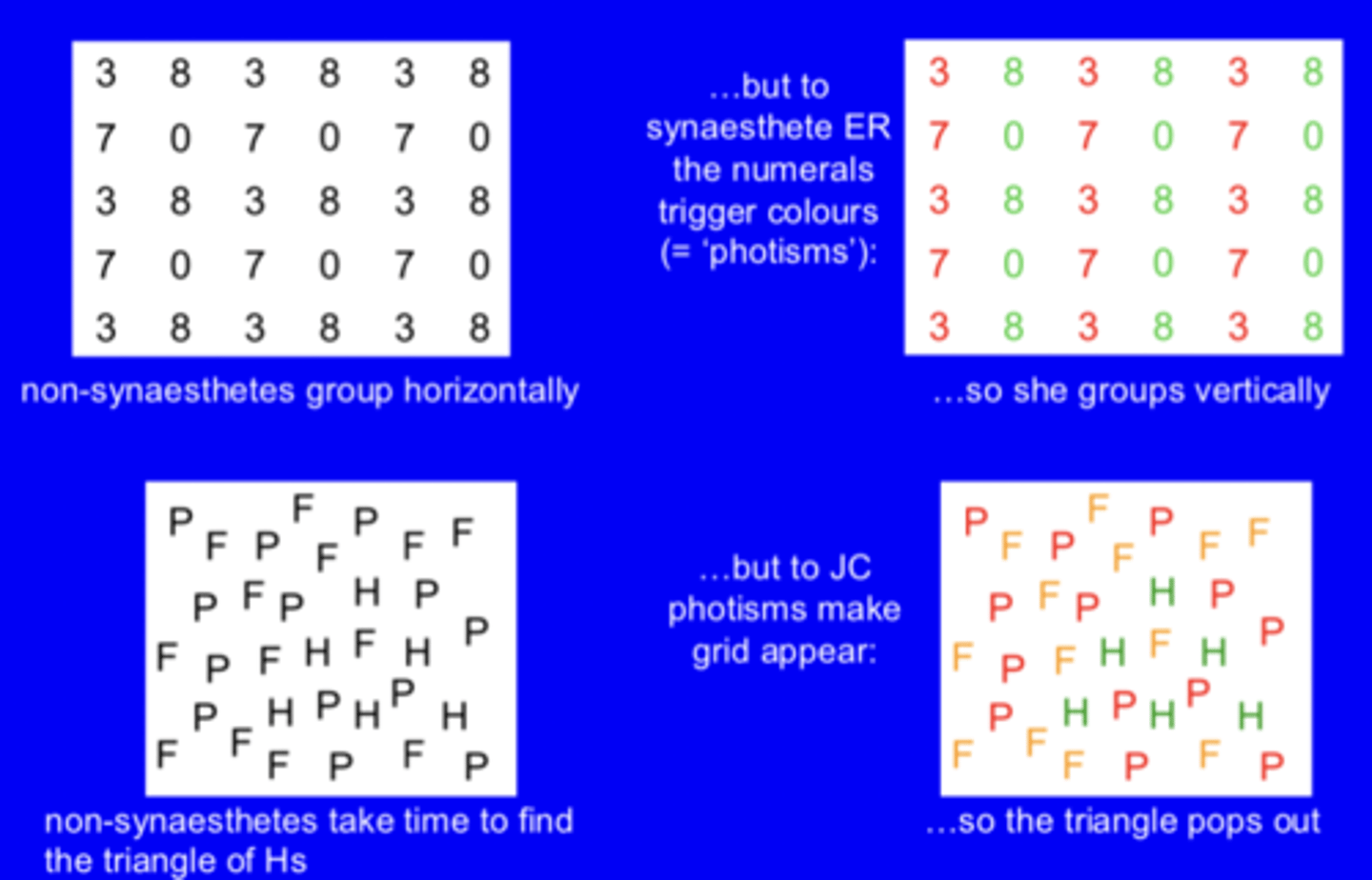
Rows of 3 +8 and 7 +0
-non-syneasthates group horizontally
...but to synaesthete ER the numerals trigger colours (= 'photisms') that allign in colums so she groups vertically (3,7 +8,0)
Black Fs,Ps, Hs - there is a triangle of H's
--non-synaesthetes take time to find the triangle of Hs
...but to JC photisms make grid appear...so the triangle pops out
Much more perceptual!
Apparent motion
Kim, Blake & Palmeri (2006)
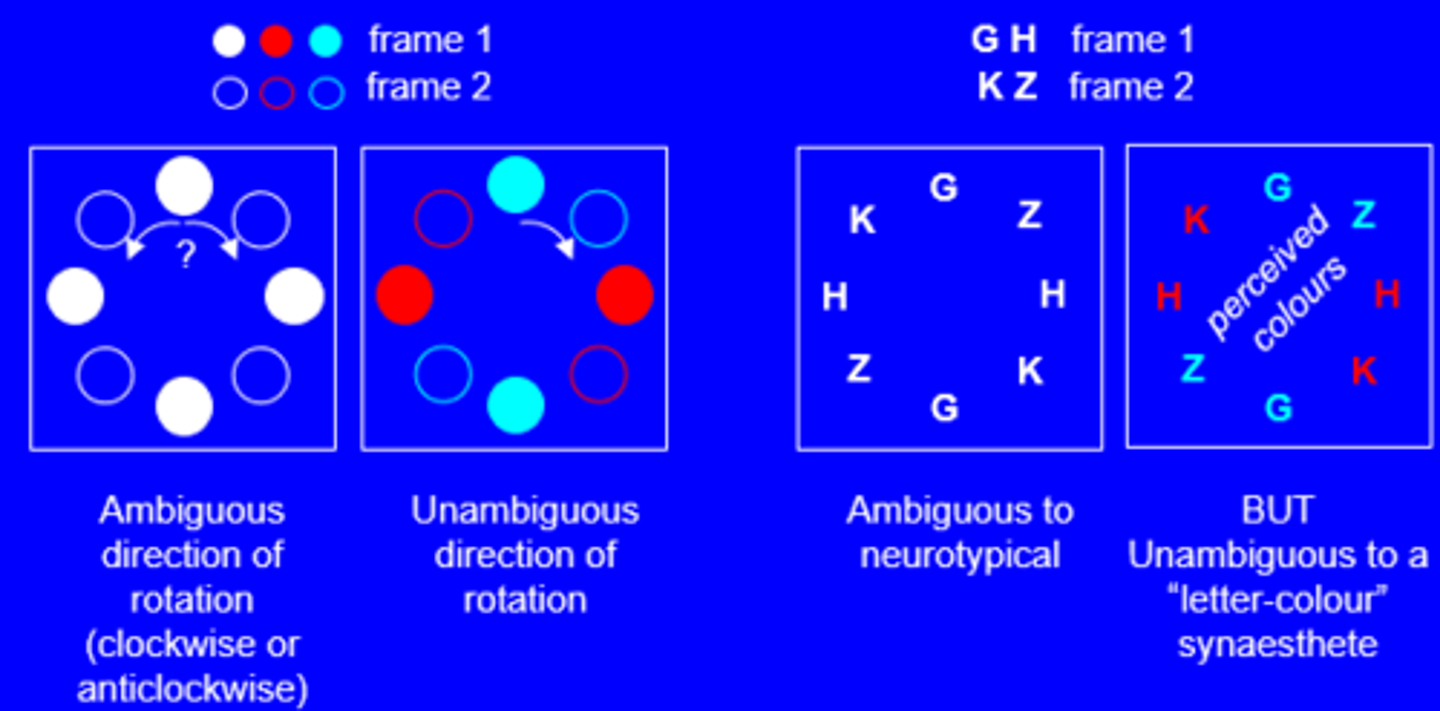
-the direction of apparent motion in a circle can be ambigous, but if the circles are different colours becomes unambiguous as you can track the movement of spec coloured circles
Therefore circles of letters doing apparent motion can be ambiguous to nt but unambgous to a "lettercolour syneasthet"
50/50 versus ceertainty
Synaesthesia cause
nappropriate activation/connectivity between perceptual areas
-stimulus causes activity in correct/nrmal area but also another one
brain scanning
Nunn et al (2002)
-synaesthete with word/colour association
Overlap shows that when you activate word specific area also elicits activity in colour
ADD
Expt 3: no activity in V4 when non- synaesthetes trained on synaethetes' word-colour associations found in Expt 1
Train controls till reasonably high association but colour still doesn't light up, only syneasthesia
-shows not assoiciation is perceptual
why this extra activation?
Incomplete pruning? (see Ward 2013)
- everyone born 'synaesthetic' - massive interconnectivity in neonatal brain
-throgh early experience learn what goes together and what doesn't
- major task of brain during development is functional differentiation between areas ... synaesthetes may not complete this successfully
-functional differetiantion allows different areas to do different things