BSCI331 - Exam 1 (Topics I forget)
 Call Kai
 Learn
Learn Practice Test
 Spaced Repetition
 Match
Match Flashcards
 Knowt Play
1/45

Earn XP
Description and Tags
Includes very similar def and very specific exam content questions
Name | Mastery | Learn | Test | Matching | Spaced | Call with Kai | Chat |
|---|
No analytics yet
Send a link to your students to track their progress
46 Terms
Nucleus
Contains Eukaryotic cells genetic material.
Connected to the ER
Has double membrane
Nuclear Pores
Controls what passes through the nucleus and cytoplasm
Small molecules pass easily, large molecules need active transport
What diffuses through?
Small ions and molecules <5 kDa can diffuse freely.
Proteins <60 kDa can passively diffuse, but more slowly.
Nuclear Lamina
Protein network lining the inside of the nuclear envelope.
Supports shape and structure of the nucleus
Anchors chromatin
Organizes Nuclear pores
Important site for chromosome attachment during interphase
Nucleolus
Dense region inside the nucleus that assembles ribosomes.
Nuclear Envelope
Double membrane that surrounds the nucleus
Outer membrane continuous with ER lumen
Inner membrane is associated with the nuclear lamina
Space between membranes = perinuclear space (associated with ER lumen)
Function: Separates transcription (nucleus) from translation (cytoplasm)

Nuclear Subdomains
Specialized regions within the nucleus that are not surrounded by membranes
How do large macromolecules cross nuclear pores?
Large macromolecules and protein complexes, such as ribosomes, cross through active transport.
Chromatin, and what are its functions?
Chromatin = DNA + proteins + RNA that package and organize DNA
Condenses DNA 📦
DNA is extremely long, so chromatin packages it tightly enough to fit inside the nucleus.
Regulates gene expression 🧬
Chromatin can become more open or closed, controlling which genes can be accessed and expressed.
Helps with DNA replication and cell division 🔄
Heterochromatin
Euchromatin
Heterochromatin: tightly packed chromatin; DNA not accessible —> resistant to gene expression (transcription can not access)
Includes silenced genes
Telomeres, centromeres
Euchromatin: loosely packed chromatin; DNA easily accessible —> gene expression can occur (transcription can access)
Transcriptionally active and accessible genes
What is linker DNA?
Linker DNA is the short stretch of DNA between nucleosomes.
Connects nucleosomes together
Lysine Acetylation
Lysine Acetylation: Reduces its positive charge, which makes the histone bind DNA less tightly.
(+ —> Neutral), Loosens Chromatin, increases gene expression
Lysine Methylation
Lysine Methylation: Replacing all hydrogen groups on nitrogen with methyl groups
(+—>+), activates or represses gene expression
Serine Phosphorylation
Serine Phosphorylation: Phosphate group added on serine leading to - charge.
(Neutral—>-), activates or represses gene expression
ORI
Site where DNA duplication is initiated.
Acetylation
Methylation
What do they do to the charges of amino acids?
Acetylation = removes + charge
Methylation = keeps + charge
Phosphatidyl-Ethanolamine
What face is it found on?
A) Phosphatidyl-Ethanolamine: Net Neutral
Cytosol Face
Phosphatidyl-Serine
What face is it found on?
B) Phosphatidyl-Serine: Net -1 (Negative)
Cytosol
Phosphatidyl-Choline
What face is it found on?
C) Phosphatidyl-Choline: Net Neutral
Extracellular Space
Sphingomyelin
What face is it found on?
Sphingomyelin: Net Neutral
Extracellular Side
Sphingosine
Charge only
Sphingosine: Net Positive
Ganglioside
What face is it found on?
Found on extracellular side
Plasma Membrane Leaflet
Outer leaflet faces =
Inner leaflet faces =
Outer leaflet faces = Extracellular space
Inner leaflet faces = Cytosol
Blurt all amino acids on ipad
check work on ipad idiot
What are the 4 main components of the plant cell wall?
Cellulose: tensile strength (pulling/stretching)
Pectin: resistance to compression (pressing down)
Cross-linking polysaccharides: strengthen the wall
Lignin: waterproofing
ROYGBIV
Rank the wavelength
Shorter Wavelength = Better/Worse resolution
Longer Wavelength = Better/Worse resolution
ROYGBIV
Longest to Shortest
Shorter wavelength = better resolution
Longer wavelength = worse resolution
Sterols
Helps stiffen the plasma membrane
Interact with tails —> regulate membrane fluidity
Get a paper and get ready:
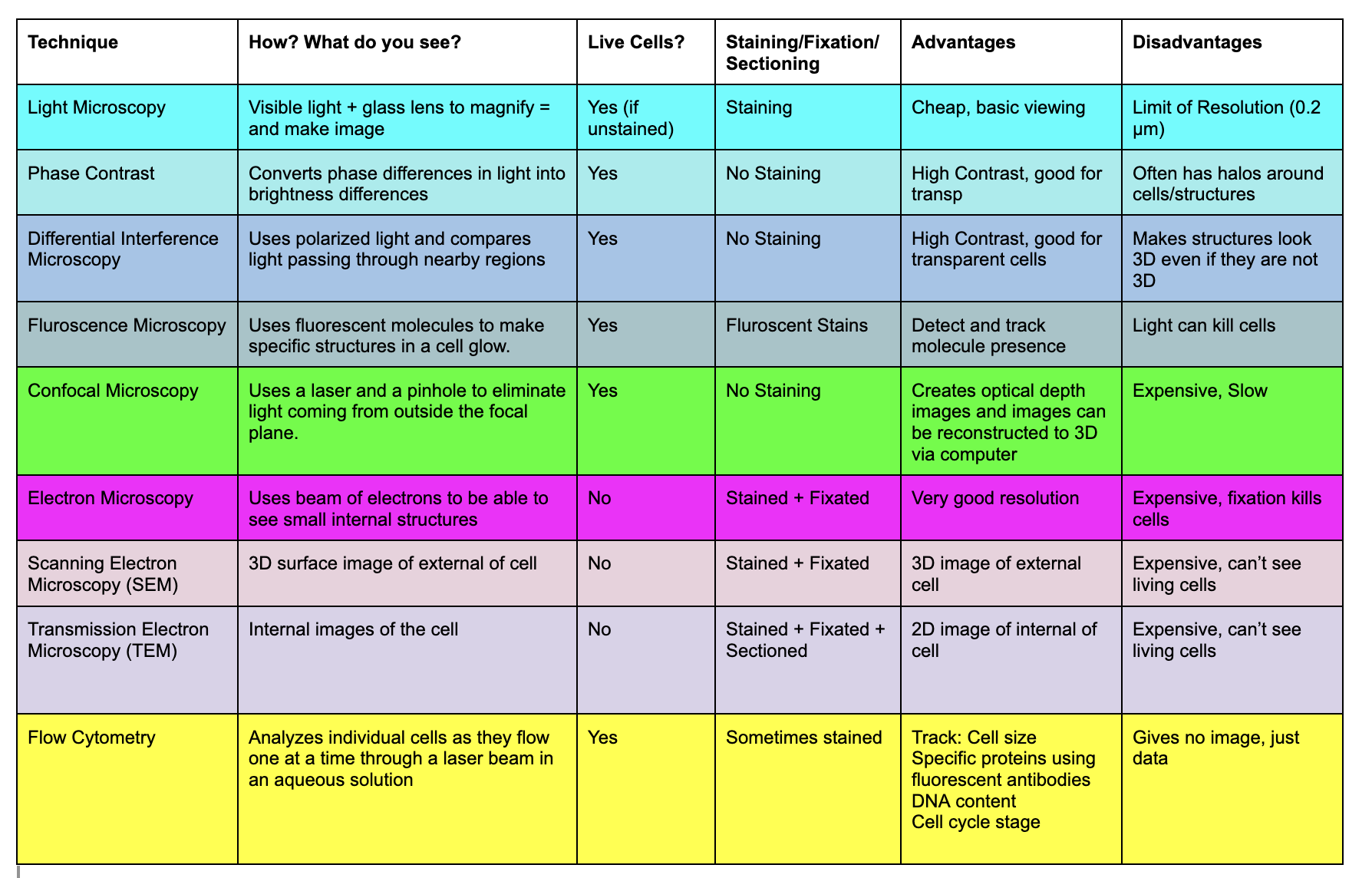
For each microscopy learned about BLURT IT ALL
Light Microscopy
Resolution, light source, staining (yes or no), sectioning (yes or no), fixation (yes or no) for each.
Advantages and Disadvantages of each.
Do not skip—> at least 15% of exam grade.
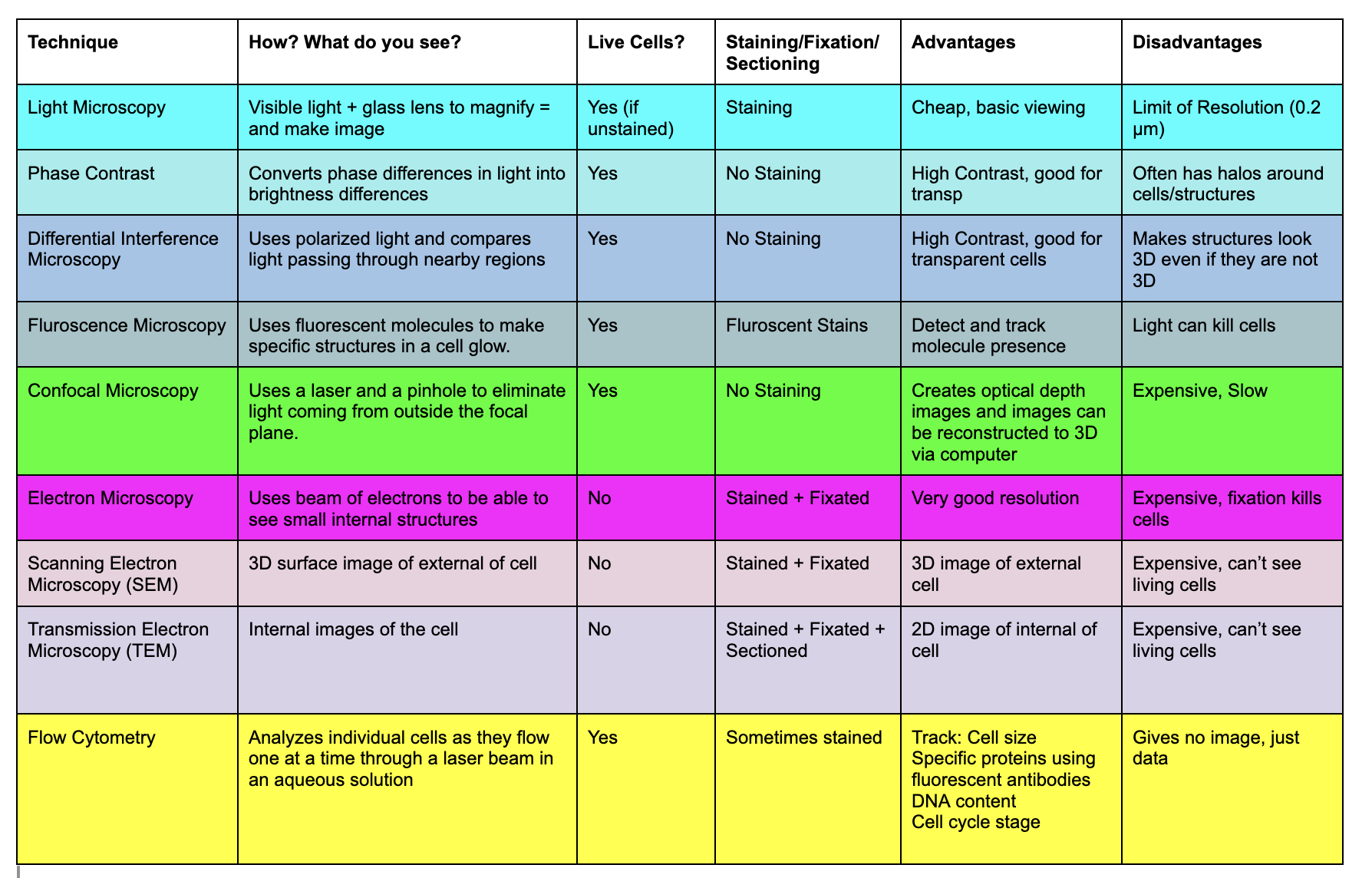
Phase Contrast Microscopy
Resolution, light source, staining (yes or no), sectioning (yes or no), fixation (yes or no) for each.
Advantages and Disadvantages of each.
Do not skip—> at least 15% of exam grade.
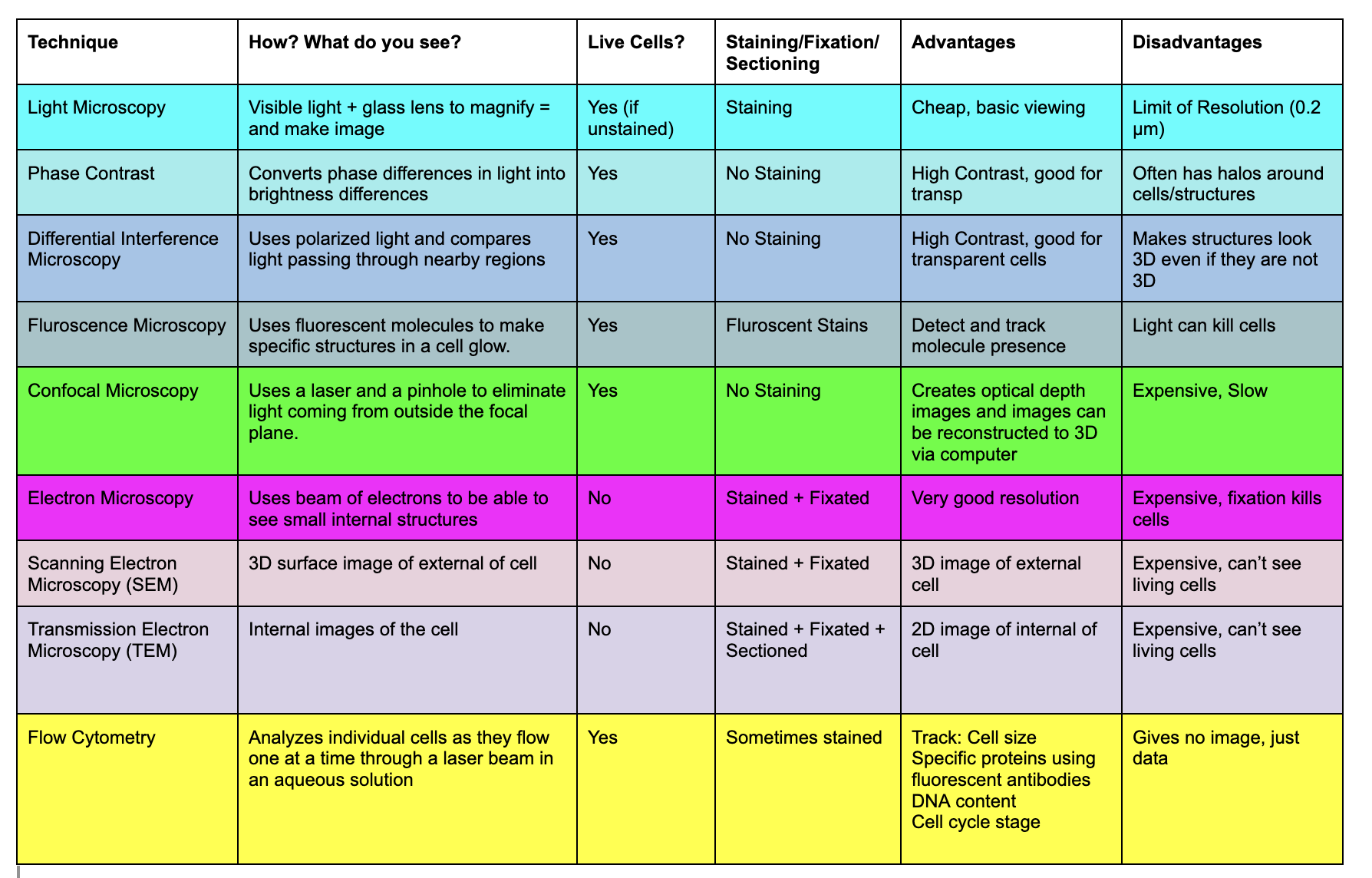
Differential Interference Contrast Microscopy
Resolution, light source, staining (yes or no), sectioning (yes or no), fixation (yes or no) for each.
Advantages and Disadvantages of each.
Do not skip—> at least 15% of exam grade.
can see embryonic dev
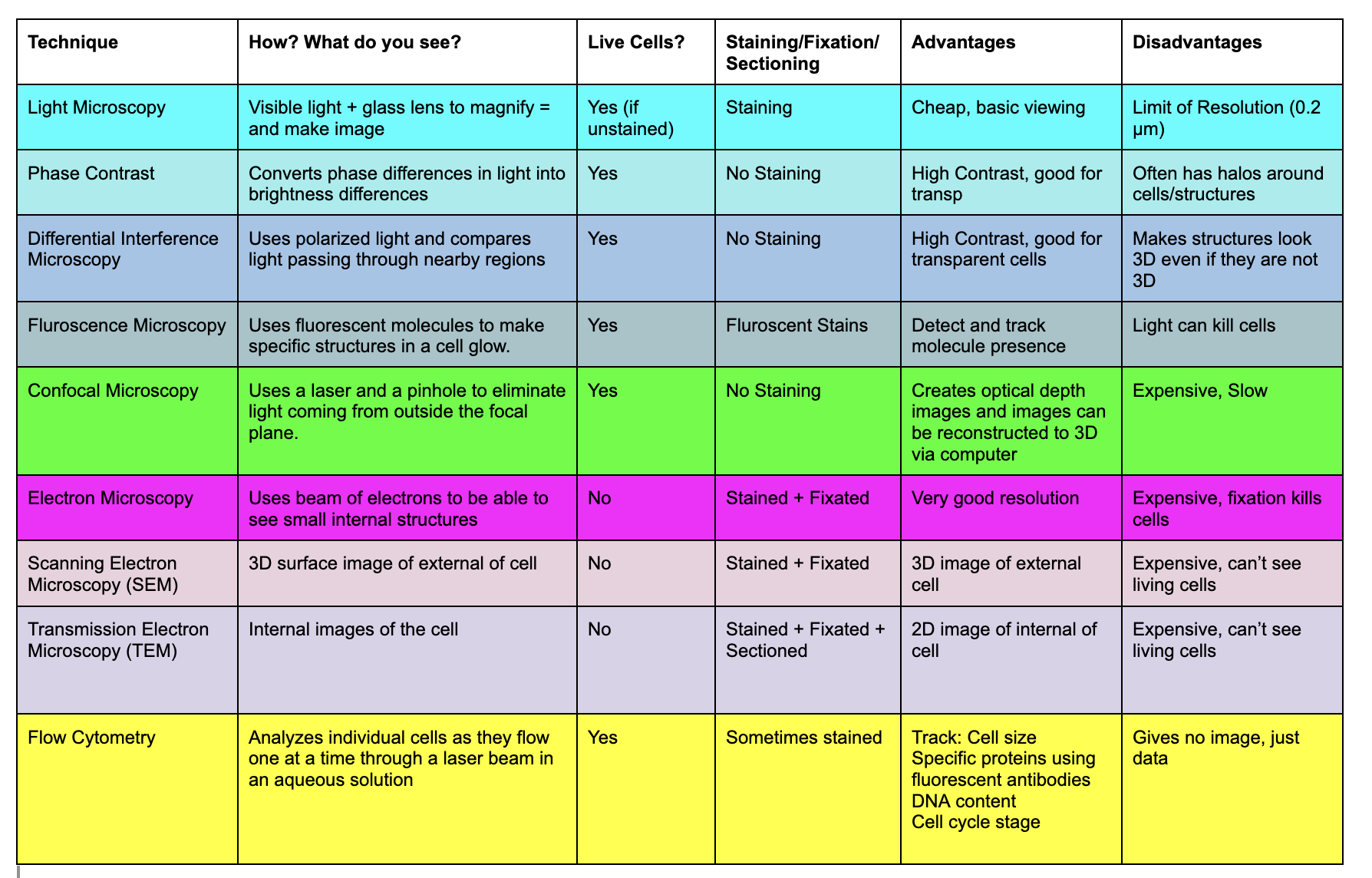
Fluorescence Microscopy
Resolution, light source, staining (yes or no), sectioning (yes or no), fixation (yes or no) for each.
Advantages and Disadvantages of each.
Do not skip—> at least 15% of exam grade.

Confocal Microscopy
Resolution, light source, staining (yes or no), sectioning (yes or no), fixation (yes or no) for each.
Advantages and Disadvantages of each.
Do not skip—> at least 15% of exam grade.
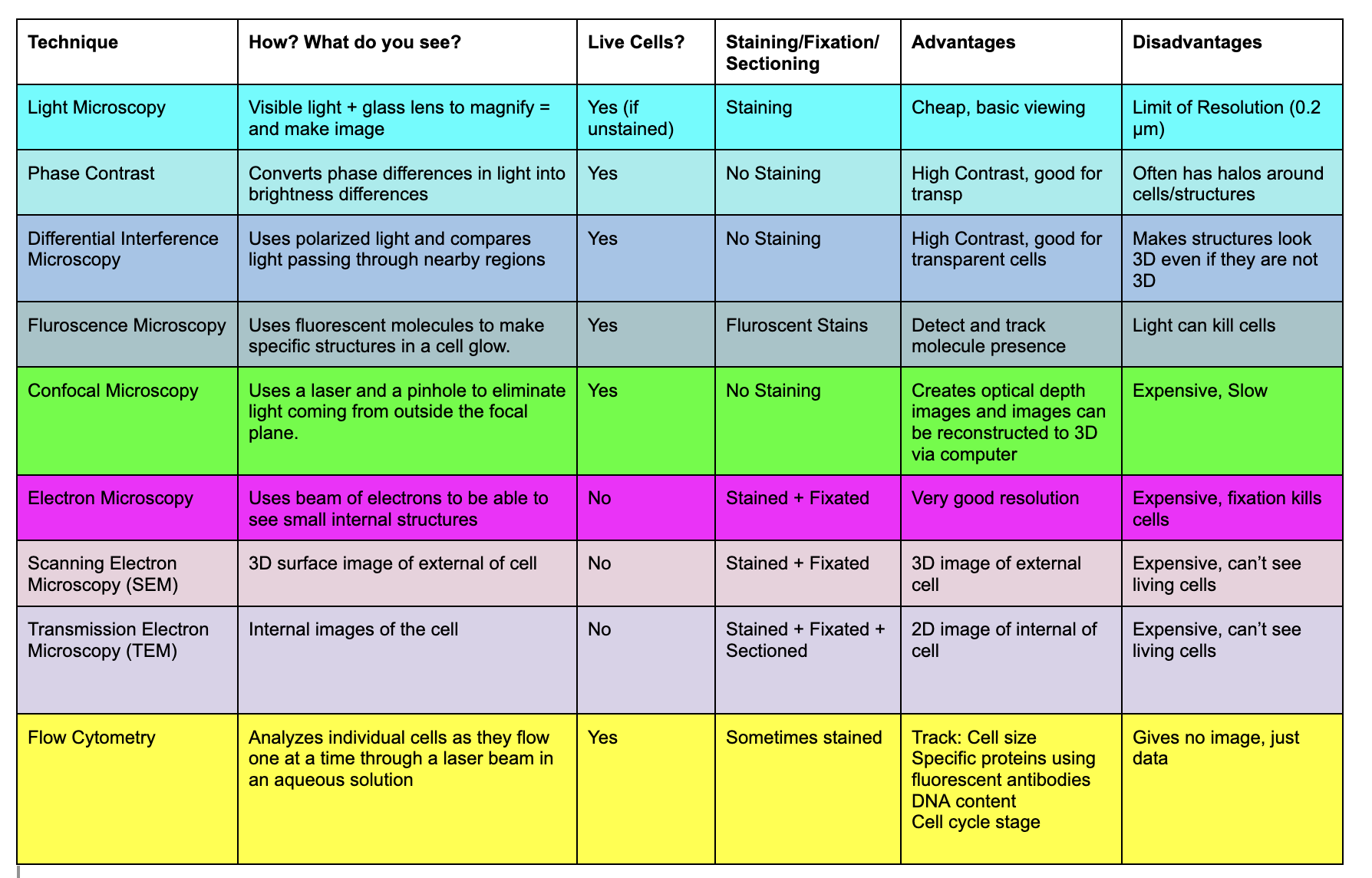
Electron Microscopy (SEM & TEM)
Resolution, light source, staining (yes or no), sectioning (yes or no), fixation (yes or no) for each.
Advantages and Disadvantages of each.
Do not skip—> at least 15% of exam grade.

Flow Cytometry
Resolution, light source, staining (yes or no), sectioning (yes or no), fixation (yes or no) for each.
Advantages and Disadvantages of each.
Do not skip—> at least 15% of exam grade.
The technique of immunofluorescence microscopy uses fluorescently labeled. What must be done to cells in order to allow the visualization of INTERNAL cellular structures using this technique? (4 pts)

Essay: The plasma membrane structure is described by the Fluid Mosaic Model. Briefly explain what is meant by “fluid mosaic,” and explain how the plasma membrane fits this structure. Include the roles that lipid rafts play in this model.

Hydrophobic Force
Tendency for nonpolar molecules to avoid water and clump together
Briefly, how is the hydrophobic force an effect of entropy?
The hydrophobic effect is driven largely by entropy because:
When hydrophobic molecules are separated, water molecules have to organize themselves around them.
This makes the water molecules more ordered → lower entropy.
When hydrophobic molecules cluster together, less surface is exposed to water.
Water becomes less organized → higher entropy.
What chemical property of phospholipids leads to a bilayer structure? How does the concept of entropy lead to the spontaneous assembly of the bilayer? (Be sure to define entropy in your answer).
Phospholipids spontaneously form a bilayer because they are amphipathic molecules, meaning they contain both a hydrophilic (polar) head and hydrophobic (nonpolar) tails. The hydrophilic heads interact favorably with water, while the hydrophobic tails avoid contact with water. As a result, phospholipids arrange themselves with their hydrophilic heads facing the water on the inside and outside of the cell and their hydrophobic tails facing inward toward each other.
Entropy, which is a measure of the disorder or dispersal of matter and energy in a system, helps explain why this process occurs spontaneously. When hydrophobic tails are exposed to water, the surrounding water molecules become more ordered because they cannot interact favorably with the nonpolar tails. When phospholipids come together and form a bilayer, fewer hydrophobic tails are exposed to water, allowing the previously ordered water molecules to become more disordered. This increases the entropy of the surrounding water. Therefore, the increase in entropy makes the formation of the phospholipid bilayer energetically favorable, allowing the bilayer to assemble spontaneously in water.
Cells are considered among the most unusual components of the universe in that they constantly violate the 2nd law of thermodynamics. Is this statement true or false? Fully explain your answer and include: a) an explanation to the 2nd law of Thermodynamics. b) an explanation of why the statement is true or false (how cells violate the law, or why cells do NOT violate the law). Please include physical/chemical mechanisms in your explanation.
The 2nd Law of Thermodynamics states that the total entropy of the universe tends to increase during spontaneous processes. Entropy can be thought of as a measure of disorder/randomness or the dispersal of energy.
Cells are highly organized systems, so they can create and maintain order within themselves. For example, cells use energy to synthesize proteins, maintain membranes, and organize molecules. This may seem to violate the 2nd Law because these processes can decrease entropy within the cell. However, cells are not isolated systems. They exchange both matter and energy with their surroundings.
Cells obtain usable energy from their environment, such as through the breakdown of nutrients. During these processes, some energy is released as heat into the surroundings. The release and dispersal of this heat increases the entropy of the surroundings. The increase in entropy of the surroundings is greater than the decrease in entropy associated with creating order inside the cell. Therefore, the total entropy of the cell + surroundings (the universe) increases, so the 2nd Law is not violated.
Physical/chemical mechanism: Energy transformations in cells are not 100% efficient. During chemical reactions and metabolic processes, some energy becomes dispersed as heat. This increases the number of possible energy distributions in the surroundings, increasing their entropy. Thus, cells can maintain internal organization while still contributing to an overall increase in entropy.
In class we discussed 4 classes of biological molecules, 3 of which are polymers. Please list the 3 classes of biolomecules that are polymers. For each, indicate what class of molecule constitutes the monomer (subunit), and describe TWO functions that each class can perform in cells.

Proteins
2 Functions
Monomer:
Speed up or catalyze chemical reactions
Enzyme = proteins can be used to speed up the rate of a reaction
Proteins can be used in transport
Membrane proteins like the Na/K pump can regulate transport
Monomer: Amino Acids
Carbohydrate
2 Function
Monomer:
Energy source
Glucose can be broken down during cellular respiration to produce ATP for cellular activities.
Energy Storage
Store energy in the form of polysaccharides.
Monomer: Monosaccharide
Nucleic Acids
2 Functions
Monomer
Store genetic information
DNA stores the instructions needed to build and maintain an organism.
Transmit/use genetic information
RNA helps carry and use the information from DNA to make proteins.
Monomer: Nucleotide
Where do new phospholipids attach?
Cytosolic leaflet of the ER
The flippase enzyme:
Generate asymmetry between the leaflets of the plasma membrane
The scrambalase enzyme:
Restores symmetry between the leaflets of the ER membrane
“Scramblase catalyzes mixing of newly synthesized and previously existing phospholipids between the 2 leaflets of the ER membrane.”