Pharmaceutical Powders
 Call Kai
 Learn
 Practice Test
 Spaced Repetition
 Match
 Flashcards
 Knowt Play
1/49

There's no tags or description
Looks like no tags are added yet.
50 Terms
What is a powder?
Pool of solid particles where the solid particles have
The same chemical composition e.g. lactose powder
Multiple chemical compositions = powder blend e.g. ibuprofen, lactose, starch powder blend
An individual diameter, 1000 micrometers beyond this we will refer to granules (2-4,000 micrometers)
Powders are complex heterogeneous systems:
They can flow
Can resits deformation to a point
Can be compressed
Powders as dosage forms: oral administration
Effervescent powders:
Release CO2 when dispersed in water
Source of acid - citric acid and/or tartaric acid
Source of CO2 - sodium bicarbonate or calcium carbonate
Protect from moisture - packed in individual dose units, airtight
Powder for reconstitution

Powders as dosage forms: other RoA
Dusting powders
Applied on the skin
Well-controlled particle size
Good/excellent properties needed
Packaged in bottle with sifter top
Quality assessment:
Fineness
Uniformity of dosage units
Sterility
Label - to mention if powder is sterile
Nasal/pulmonary
Powders for inhalation - DPIs
Nasal powders - fine powders

What is particle size and what does it affect?
Particle size describes the characteristic dimensions of individual powder particles
It is important because particle size affects:
Powder flow
Surface area
Dissolution rate
Mixing and segregation
Packing and bulk density
Content uniformity
Dose uniformity
Why is particle size important in pharmaceutical powders?
Particle size can affect the physical and pharmaceutical properties of a powder
Smaller particles generally have:
Greater surface area
Greater surface energy
Potentially poorer flow
Faster dissolution
Greater tendency to agglomerate
Particle size analysis
Pharmaceutical powders tend to be:
Irregular and heterogeneous
Equivalent sphere:
Concept devised to simplify particle size analysis for powders
Particle size obtained will depend on the method used
Approximation - the actual size may be different
Particle size analysis - microscopy-based methods
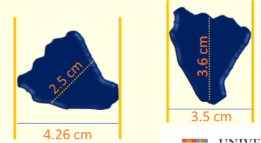
Projected perimeter and area diameters
Independent of particle orientation and shape
Martin’s diameter - length of a line that bisects the particle
Feret’s diameter - distance between drawn tangents
Particle size analysis - sieving-based methods
Dry sieving and air-jet sieve
Sieving diameter undersize vs oversize

Particle size analysis - sieving-based classes table

Particle size analysis - alternative classification table

What is particle size distribution?
Describes the range and proportion of different particle sizes present in a powder sample
What is a monodisperse powder?
A monodisperse powder contains particles that are approximately the same size - has a narrow particle size distribution
What is a polydisperse powder?
A polydisperse powder contains particles with a range of different sizes
Most pharmaceutical powders are polydisperse
Why is particle size distribution important?
PSD affects:
Powder flow
Packing efficiency
Bulk density
Mixing
Segregation
Dissolution
Dose uniformity
What generally happens when particle size decreases?
Surface area ↑ → surface energy ↑ → interparticle forces ↑
This can cause:
Increased cohesion
Increased agglomeration
Poorer flow
However, the increased surface area can also increase the dissolution rate
What happens when light hits a particle?
Scattering
Absorption
Refraction
Diffraction
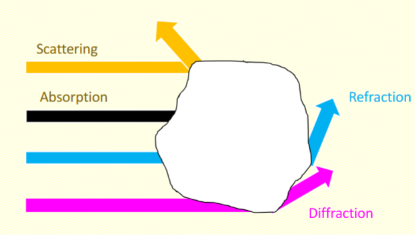
Light scattering - laser diffraction
Laser diffraction:
Size range: 1-1000 micrometers
Measurement performed on dry suspended solids
Particle size>> wavelength of light
Light scattered (forward) with a small change in angle
The angle of diffraction varied with particle size
Fraunhofer diffraction
Light scattering - dynamic light scattering
Hydrodynamic diameter
Measurement performed on suspended solids
The intensity of scattered light is measured as a function of time
Size range: 2nm-2 micrometers
Particle subjected to Brownian motion

Particle size distribution
Different types of size distribution
Number distribution e.g. microscopy - from counting particles in each range
Weight distribution - from determining the weight of particles in each range
Length, area, volume distributions

Normal size distribution graph

Skewed size distribution graph
You can determine only the mode directly from a skewed frequency curve or histrogram

Log-normal distribution graph
Frequency is plotted v particle diameter on a log scale

Multimodal distribution graph

Cumulative distributions graph
From a cumulative frequency graph:
You can get the median NOT the mean - unless the distribution is normal

What are the forces that balance powder flow?
Forces that drive flow (flow-promoting)
Gravity
Particle mass (related to true density)
Inclination
Mechanical force
Forces that resist flow (drag forces)
Adhesion - changes with particle size and moisture content
Cohesion - changes with particle size and moisture content
Electrostatic interactions
Surface forces
A powder will flow if flow-promoting forced > drag forces
Impact of particle size on powder flow diagram

Impact of particle shape on powder flow table

Packing and flow
Study of packing geometry
How solid particles are arranged in a powder blend
How particles are packed in a powder bed will also affect the volume the powder bed occupies

Packing, porosity, density and powder flow
Consider a single solid particle - it occupies a volume which can be used to calculate density
That volume is the true volume and that density is the true density
A given particle can have only 1 true volume and density
Packing, density and flow - powder bed
Consider a powder bed - it occupies a volume which can be used to calculate its density
That volume is the bulk volume and that density is the bulk density
A powder bed can have multiple bulk volumes and densities

Packing, density and flow - porosity
Can be calculated knowing the bulk and true volumes:
Bulk Volume (Vbulk) = true particle volume + volume of void spaces
True volume (V) = volume of occupied by a solid particle - measured by displacement methods e.g. helium
Porosity is the ratio of the void volume vs bulk volume

Packing, density and flow - bulk density
Bulk volume considers intra and inter particular voids - measured using a graduated cylinder
Bulk density can be calculated knowing the weight
Packing, density and flow - light and heavy powders
For the same material i.e. same true density
‘Light’ powders:
Large bulk volume
Low bulk density
Loose packing
‘Heavy’ powders
Small bulk volume
High bulk density
Tight packing
Change in bulk density/porosity may not be enough to counteract the influence of particle size
Factor affecting flow through an opening
Size of the opening
Flow is independent of the size of the powder bed
Allow filling of powders at a constant rate
Wall angle
Design of the hopper
Hopper width
Height activated in the hopper

Troubleshooting
Look at particle size and size distribution
Remove small particles through sieving (size separation) or adsorption
Granulate the powder
Change the shape, control roughness
Spray-drying to produce more regular-shaped particles
Dry the powder
Cohesiveness increased by moisture
Include magnesium oxide to absorb excess moisture
Use silicon treated powder if hygroscopic
Add a flow-promoting excipient
Glidants, lubricants, antiadherents
Use mechanical assistance
Measuring adhesive/cohesive forces
Shear strength/shear cell
Measures resistance to flow depends on flow preventing forces
Tensile strength
Powder on a plate change the angle detect angle that induces flow
Change the angle
Good correlation with AOR
Powder flow analysis table and equation

What is the angle of repose?
The angle of repose is the maximum angle formed between a pile of powder and the horizontal surface
It is used as an indicator of powder flowability
Lower angle → generally better flow
What does a high angle of repose suggest?
A high angle of repose indicates greater resistance to particle movement
Therefore, the powder generally has poorer flowability
A low angle indicates easier flow
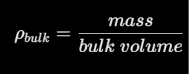
What is bulk density?
Bulk density is the mass of powder divided by its bulk volume, including the spaces between particles
What is tapped density?
Density of a powder after mechanically tapping the container until the volume reaches a relatively stable minimum
Tapping causes particles to rearrange and pack more closely

What does Carr's compressibility index measure?
Carr's index estimates powder flowability from bulk and tapped density
A lower value generally indicates better flow

Why does Carr's index relate to powder flow?
A powder that undergoes a large reduction in volume during tapping is likely to have:
Poor packing initially
Greater interparticle interactions
Greater cohesiveness
Therefore, a large difference between bulk and tapped density generally indicates poorer flow
Additional methods - critical orifice and hopper flow rate
Critical orifice method
Based on finding out the smallest hole through which powder will flow
Hopper flow rate
Direct measurement of flow properties
Directly relevant to the set-up used in production of solid dosage forms
Allow troubleshooting of manufacture issues
Advantages and disadvantages of powders as dosage forms
Advantages:
Higher stability - shelf-life, powder reconstitution
Convenience - high doses
Faster dissolution - soluble drugs
Disadvantages:
Inconvenient to carry - bulk formats vs sachets
Organoleptic properties
Limited to non-potent drugs
Drug degredation

Granules as dosage forms

Powders as dosage forms

Special cases - hygroscopic, deliquescent and efflorescent powders
Hygroscopic powders - these powders can absorb moisture from air
Deliquescent powders - these hydroscopic powders can liquefy following moisture absorption
Efflorescent powders - powders which contain hydration or crystallisation water, can release water when exposed to low-humidity environments or during handling e.g. trituration
How to handle these powders:
Package in an air-tight container
Store in dry place in tightly closed container +/- desiccant (hygroscopic/deliquescent)
Use excipients that can preferentially absorb humidity (hygroscopic/deliquescent)
Use the anhydrous from (efflorescent)
Special cases - eutectic mixtures
Specific combination of 2 ingredients
Starts as solids but can liquefy during processing at room temperature
How to handle these powders:
Force the mixture, then, adsorb on inert solid
Magnesium carbonate, calcium phosphate, starch, light/heavy magnesium oxide
Mix each ingredient separately with an inert powder
Use a spatula and glass tile rather than mortar and pestle
Quality assessment of powder dosage forms
Uniformity of dosage form
Uniformity of mass or uniformity of content
Uniformity of delivered dose
Multidose container
Disintegration and dissolution
Effervescent powders/granules
Coated, modified released or gastro-resistant granules
Sterility
Depending on use