3.1.1 Atomic Structure
 Call Kai
 Learn
 Practice Test
 Spaced Repetition
 Match
 Flashcards
 Knowt Play
1/59

There's no tags or description
Looks like no tags are added yet.
60 Terms
Position, relative charge and mass of proton, neutron, electron

Changing understanding of atomic structure over time
Dalton
→ atoms are solid spheres with no internal structureJJ Thomson
→ discovered electrons
→ plum pudding model: ball of positive charge with negative electrons embedded in itRutherford gold foil experiment
→ alpha particles fired at a thin sheet of gold foil
→ most went straight through: atom is mostly empty space
→ some were deflected and some went straight back: mass concentrated at centre, centre is positively chargedNuclear model
→ positively charged nucleus
→ mass concentrated at nucleusBohr Model
→ electrons orbit nucleus at specific distances: energy levels
Define and give the letter which represents atomic number
number of protons
(Z)
Define and give the letter which represents mass number
number of neutrons + number of protons
(A)
What are nucleons?
protons and neutrons
How are positive and negative ions formed?
positive: atom loses electron(s)
negative: atom gains electron(s)
Define isotope
atoms of the same element with the same number of protons but different number of neutrons
Define relative atomic mass
the average mass of an atom of an element compared to 1/12th the mass of an atom of carbon-12
or
weighted average mass of all isotopes of an element compared to 1/12th the mass of an atom of carbon-12
Elemental Mass spectrum
Horizontal position of a peak gives its mass-to-charge ratio (m/z)
Peak height shows the relative abundance of that ion
For an isotope ion carrying a 1+ charge, the numerical m/z value gives its…
relative isotopic mass
Mass spectrum for Mg+

How do we identify the mass of ions
using a simple time of flight (TOF) mass spectrometer
Function of TOF Mass Spectrometry
to identify elements by determining all of the isotopes present in a sample
What are the 5 stages of TOF mass spectrometry?
ionisation
→ sample particles are changed into positive ionsacceleration
→ an electric field gives the ions equal kinetic energyion drift
→ the ions cross the flight tube and become separated by different flight timesion detection
→ arriving ions create signals that are measured electronicallydata analysis
→ computer records flight times to construct mass spectrum
What condition must be maintained through the TOF instrument and why?
a high vacuum so that collisions with air molecules do not interfere with the motion of the ions
TOF Step 1: What are the two methods of ionising particles from the sample?
electron impact
electrospray ionisation
How do we carry out (ionisation by) electron impact?
High energy electrons
From hot cathode/electron gun
Are fired at sample
This knocks off an outer electron from each particle
Forming a 1+ ion
X(g) → X+(g) + e-
What is the equation for electron impact?
Electron impact is suitable for which types of samples?
elemental samples and compounds of lower formula mass
Why is electron impact less/not suitable for elemental samples and compounds of larger formula mass?
the energetic ionisation process can break larger molecules into smaller fragment ions which can negatively impact the spectra analysis
What type of ionisation is used for larger molecules?
electrospray ionisation
Steps of electrospray ionisation
Sample is dissolved in a volatile, polar solvent
It is then injected through a fine hypodermic needle giving a fine mist
The tip of the needle has a high voltage
This causes the sample molecule to gain a proton as it leaves the needle
Equation for electrospray ionisation
X(g) + H+ → XH+(g)
TOF Step 2: Acceleration
The electric field pulls and accelerates the positive ions towards a negatively charged plate
The particles are accelerated so that every ion enters the drift region at the same kinetic energy
Acceleration Stage: At constant kinetic energy, what factor causes the differing velocities of the ions?
Mass
→ lighter ions travel faster
because v depends on mass
TOF Step 3: Ion Drift
After passing through an opening in the plate, the ions enter the flight tube
They drift towards the ion detector
The interval between entering the flight tube and reaching the detector is the ion’s time of flight
Why do different ions have different flight times?
equal kinetic energy
different mass = different velocity
= different flight times

TOF Step 3 Continued: Ion Detection
at the end of the flight path, each positive ion reaches the detector (a negatively charged plate)
the positive ions gain an electron
the electron transfer from detector to ion produces a small current
the magnitude of the current increases with the number of ions of that type arriving at the detector
→ this provides a measure of species abundance/ relative abundance
TOF Step 4: Data Analysis
two pieces of information are analysed in combination
→ current which is produced
→ time of flightthis produces a mass spectra with the relative abundance produced by ions with varying m/z ratios
Which two equations are used for TOF calculations?
v=d/t
KE = 0.5mv2
How do we calculate the value of m (mass of one ion) for TOF calculations?
Divide the mass number by the avogadro constant, 6.022×10²³
This gives the mass in grams, we need it in kilograms so divide by 1000
The arrangements of electrons in an atom is called…
the electron configuration
Electrons are arranged around the nucleus in…
energy levels
Each energy level is split into…
sub-shells
Names of the sub-shells
s, p and d (and f)
The energy of the electrons in the sub-shells increases in the order < <
s < p < d
How many electrons does each sub shell hold?
s: 2
p: 6
d: 10
f: 14
Each sub energy level/ sub shell is split into…
orbitals
What does each orbital hold?
2 electrons of opposite spin
The number of orbitals in each sub-shell is as follows:
s : one orbital (1 x 2 = total of 2 electrons)
p : three orbitals ( 3 x 2 = total of 6 electrons)
d : five orbitals (5 x 2 = total of 10 electrons)
f : seven orbitals (7 x 2 = total of 14 electrons)
Shape of s orbital vs shape of p orbital
s: spherical
p: dumbbell shape
Electron arrangement summary

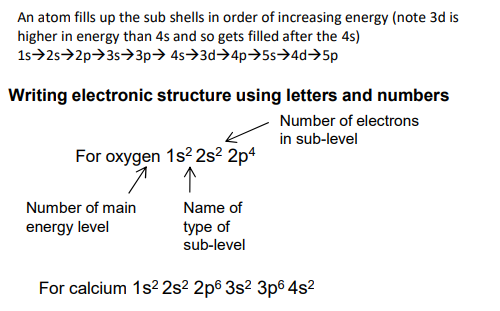
Writing electronic structure using letters and numbers
Using spin diagrams

Blocks of the periodic table

Electronic structure for ions
(electrons are lost from the 4s electrons before the 3d electrons even though the 3d are filled first)

Exceptions to normal electronic structure
Copper and chromium have a single electron in 4s1 before 3d instead of a 4s2 as this gives a more stable structure
Define ionisation energy
the amount of energy required to remove one mole of electrons from one mole of gaseous atoms of an element to form one mole of gaseous ions
Define 1st ionisation energy
energy required to remove one mole of electrons from one mole of gaseous atoms to form one mole of gaseous 1+ ions
1st ionisation energy equation
X(g) → X+(g) + e-
2nd ionisation energy equation
X+(g) → X2+(g) + e-
Which trends are there for ionisation energy?
across a period
down a group
successive ionisation
Factors that affect ionisation energy
atomic radius (distance)
→ the further the distance from the nucleus, the easier to remove an electron due to a weaker attractionshielding
→ the more shells between nucleus and outer electron, the easier to remove an electron so the lower the ionisation energynuclear charge
→ the more protons there are in a nucleus, the greater the nuclear charge
→ the greater the nuclear charge, the stronger the attraction of the outer electron to the nucleus
→ a stronger nuclear charge also pulls the outer shell closer to the nucleus
→ this results in a smaller distance
so more difficult to remove an electron so greater ionisation energy
I.E down a group
I.E decreases down a group
Why does I.E decrease down a group?
atoms get bigger
increase atomic radius so greater distance between nucleus and outer electron
more shells so more shielding
therefore weaker attraction between outer electron and nucleus
so lower ionisation energy
I.E trend across a period (left to right)
I.E increases across a period
Why does I.E increase across a period?
more protons so greater nuclear charge
same shielding across the period
smaller atomic radius so shorter distance between outer electron and nucleus
so stronger attraction between nucleus and outer shell
Deviations in first ionisation energy trend across a period
I.E drops between group 2-3 and group 5-6

Why does first I.E drop from group 2 to 3?
in group 2 the outer electron is in an s sub shell whereas in group 3 the outer electron is in a p sub shell
p sub shells are more shielded, so there is a weaker attraction between nucleus and outer electron, so ionisation energy drops
Why does first I.E drop from group 5 to 6?
the outermost electron in group 6 is paired in a p orbital
paired electrons repel
so less energy is needed to remove the outer electron