ERM Final 2.2
 Call Kai
 Learn
Learn Practice Test
 Spaced Repetition
 Match
Match Flashcards
 Knowt Play
1/53

There's no tags or description
Looks like no tags are added yet.
Name | Mastery | Learn | Test | Matching | Spaced | Call with Kai | Chat |
|---|
No analytics yet
Send a link to your students to track their progress
54 Terms
timing of pregnancy loss? types of pregnancy related mortality?
full term = 40 wks (most 1st trimester loss = chromosomal abnormalities)
miscarriage/spon. abortion = loss b4 20 wks
fetal demise = loss after 20 wks
maternal (related to preg. during-post 42 days, most deaths), preg. related (during-post 1yr), preg. ass. (any/unrelated during-post 1yr)
preg. related mortality most common cause = CVD, medi-cal, 40+, black
types of pregnancy loss?
threatened → bleeding <20 wks, live embryo/fetus, closed cervical os (subset = potential loss)
inevitable → bleeding, cramping, cervical dilation varies = loss
complete → expulsion of entire pregnancy (gestational sac, villi, decidua)
incomplete → bleeding, abdominal pain, cervical dilation, partially extrude/pass conception products
missed → retain deceased/nonviable products of conception, closed cervical os (no heartbeat + anembryonic)
treatment/prevention of preterm labor? drugs of labor initiation/post partum hemorrhage? drugs of pregnancy disorders?
tocolytics or uterine relaxants → hydroxyprogesterone, terbutaline (B-agonist), nifedipine (Ca channel blocker), indomethacin (NSAID), Mg (seizure + preeclampsia), atosiban
oxytocin (Gq → inc. Ca SM contraction), dinoprostone (intravaginal) + carboprost (oxytocic activity), misoprostol
methotrexate (term. ectopic preg.; cause limb/craniofacial abnormalities, NTD, abortion), doxylamine (nausea + vomit), brexanolone (PPD)
trophoblastic differentiation?
cytotrophoblast → germinal cells; chorionic villi BM
syncytiotrophoblast → invasive, multinucleated, secretes hCG (detected in maternal serum + urine); line outer chorionic villi
into → villous (chorionic villi for nutrient/gas XC; floats), extravillous (invades decidua + vasculature for anchor + vasc. interface), intervillous (maternal blood, surround villi for XC)
maternal spiral a. feed intervillous space (no maternal + fetal blood mix)
placental membrane thins over time (efficient XC)
placental site trophoblastic tumor → int. trophoblasts
ectopic pregnancy? risk factors? symptoms? diagnosis? treatment?
blastocyst implantation outside uterine cavity → usually ampulla of fallopian tube
risk factors= chronic salpingitis, PID, endometriosis, prior surgery, IUCD use
symptoms (6-12 wks gestation) = acute abdominal pain + swelling, vaginal bleed, may rupture (hemoperitoneum, hemorrhagic shock)
Dx w/ +hCG, absent IU gestational sac on US, laparoscopy for direct visual, histo confirm (chronic villi in resected tissue)
Tx w/ salpingectomy or salpingostomy
hydatidiform molar pregnancy? complete vs partial? diagnosis? treatment?
abnormal edematous chorionic villi + noninvasive trophoblastic proliferation
invasive = villi into myometrium or vessel; inc. hCG even w/ removal
complete (no fetal tissue)= diffuse hydropic villi w/ trophoblastic hyperplasia (46XX)
partial (abnormal tissue) = focal hydropic villi + smaller nonhydropic (chorionic vasc.) w/ limited hyperplasia (69XXY)
Dx w/ high B-hCG, enlarged IU mass = snowstorm (complete), microscopic
Tx w/ evacuation (e.g curettage) w/ hCG monitor
intrauterine infection? transcervical vs transplacental?
cloudy amniotic fluid; malodorous; purulent exudate involving chorion-amnion grossly; fetal surface w/ green opaque membrane
causes preterm labor via inflammation + PG → rupture + induce labor
transcervical (asc.) → via vaginal microorganism asc. to utero/amniotic fluid or infection @ canal
transplacental (hematogenous) → viral, parasitic, few bacterial (heme access via chorionic villi ANY time during gestation)
rubella, CMV, VZV, malaria, toxoplasma gondii, treponoma pallidum, listeria mono, HIV, HepB
in- utero sepsis cause? symptoms? TORCH infections?
via strep. agalactia → fever, chills, uterine tenderness, foul discharge, lower abdominal pain, ± tissue retention + typically polymicrobial
TORCH = toxoplasmosis, others (syphilis, TB, listeriosis, parvovirus, CP), rubella, CMV, HSV → restricted fetal growth
= dev. delay, chorioretinitis, encephalitis, fever, HSM, pneumonitis, myocarditis, hemolytic anemia, skin lesion
preeclampsia? symptoms? eclampsia? treatment?
endothelial cytotrophoblast fail to properly migrate → maternal spiral arteries remain narrow → HTN
headaches, visual disturbances, hypercoagulable, abnormal liver fxn test → edema + proteinuria
eclampsia → CNS involvement (convulsion, seizure, coma)
Tx both w/ hydralazine, methyldopa, labetalol, Mg, aspirin, indomethacin
hypertensive moms love nifedipine
gestational diabetes? symptoms?
diabetes developing during preg. due to genetic or environmental factors → hyperglycemia (can complicate preg.)
cause CNS malformation, neural tube defect, congenital heart defect, renal abnormalities, craniofacial, MSK issues (diabetic embryopathy)
HELLP syndrome? symptoms?
hemolysis, elevated liver enzyme, low platelets → severe cases may require termination
subcapsular hematoma may result from expansile accumulation/coalescence of blood under pressure
dissection → glisson capsule → hepatic rupture (catastrophic)
placental interruption types?
creta → abnormal placental adherence to myometrium = partial or complete absence of decidua
previa → placental implantation in lower uterine seg. or cervix = close to/covers int. cervical os
abruption → early separation of placenta = retroplacental bleeding (can be via trauma)
multiple gestation effects?
inc. risk of asymmetric growth, intra gestational loss, twin-reversed arterial perfusion (TRAP)
monochorionic gestation (monozygotic twins) = inc. risk congenital anomalies, TRAP, twin-twin transfusion syndrome = vasc. anastomoses w/ shunting (recipient + donor)
TRAP = large vasc. connection (umbilical cord, chorionic plate) w/o parenchymal anastomoses = backward flow → abortive somatic dev. related to hypoxia → dual demise or coexist
follicular development? HPG axis hormonal regulation?
primordial → primary → secondary → graafian → ovulation → corpus luteum → corpus albicans
GnRH → FSH + LH
theca cell (LH) → androgens
granulosa cells (FSH) → androgens to estrogen (via aromatase)
post ovulation = luteinization → prog. prod.

general ovarian cysts symptoms? types?
regress spontaneously; some rupture → acute abdominal pain, nausea, bleeding, dizziness; reproductive age
follicular (unruptured/ruptured sealed graafian follicle) = common, multiple
luteal (corpus luteum cyst) = mimic preg., single
theca-lutein (bilateral, hCG driven) = ass. w/ twins, molar preg., choriocarcinoma; predispose to torsion + hemorrhage; multiple + bilateral
endometrioma (ectopic endometrial tissue in ovary) = pain, infertility, chocolate cyst
causes of anovulation?
pregnancy
hypothalamic (35%) → FHA + kallman syndrome (GnRH def. + anosmia)
pituitary (50%) → prolactinoma, cushing, acromegaly, empty sella syndrome, sheehan syndrome
ovarian → PCOS, POI, turner syndrome

PCOS? pathogenesis? symptoms? diagnosis? treatment?
most common cause of anovulatory infertility; reproductive age
insulin resistance (= inc. androgens @ AC), altered GnRH pulsatility (= inc. LH>FSH = inc. androgen from theca cells/hyperplastic), follicular arrest (= anovulation)
usually inhibited via prog.
irregular menses, infertility, hirsutism, acne, insulin resistance + dyslipidemia (= CVD), inc. risk endometrial hyperplasia (possible endometrial cancer); ass. = obesity, acanthosis nigricans
Dx w/ rotterdam criteria → hyperandrogenism, oligo/anovulation, polycystic ovaries (fibrotic tunica albuginea w/ subcortical cyst) on US (12+ follicles of >10cm3)
Tx w/ clomiphene (GnRH agonist = inc. FSH/LH)
primary ovarian insufficiency (POI)? pathophysiology? symptoms? diagnosis?
premature menopause/ovarian failure most often idiopathic BUT also ass. w/ BRCA1, fragile X, turner, autoimmune, chemo/radiation
follicular atresia → dec. estrogen/prog. + inc. FSH/LH (stop responding to FSH/LH) = hypergonadotropic hypogonadism
amenorrhea, infertility, menopausal symptoms (hot flashes/night sweat/vaginal dry, bone loss/osteoporosis, CV morbidity)
Dx via dec. estrogen, inc. FSH/LH (possible hypothyroidism)
rule out preg., turner, thyroid problems, prolactin disorder
functional hypothalamic amenorrhea (FHA)? cause? pathogenesis? symptoms? diagnosis?
2ndary ovarian failure via hypothalamic hypogonadism/suppression; functional (correction = restore)
via low energy availability (ED, athletes) or stress @ reproductive age
dec. leptin (dec. fat), inc. cortisol → dec. GnRH pulsatility → dec. FSH/LH → dec. estrogen
amenorrhea 3+ mths (check hCG 1st) , low bone density, disordered eating
Dx w/ low gonadotropin + estradiol
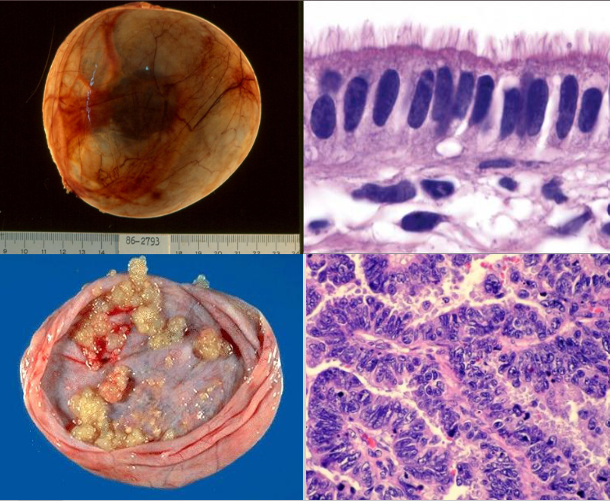
surface epithelium serous ovarian tumors?
surface cuboidal epi. @ fallopian tube (simple columnar ciliated); liquid/thin ascites
serous cystadenoma → benign, most common ovarian neoplasm; lined w/ fallopian tube-like epithelium; single cavity
serous carcinoma → most common malignant ovarian neoplasm; psammoma bodies (calcification); multilayer + atypia
70%, inc. risk w/ nulliparity, late menopause, infertility + age (50-80); more malignant + bilateral than mucinous
can be borderline (low malignancy, nuc. atypia, multilayer + no invasion)

surface epithelium mucinous ovarian tumor?
surface cuboidal epi. @ endocervix (mucous prod. simple columnar); septa + glossy
mucinous cystadenoma → benign, multiloculated, large; lined w/ mucus (2nd common)
mucinous carcinoma → malignant, rate, may be metastatic from appendiceal or other GI tumors; can = pseudomyxoma peritonei (intraepithelial accumulation of mucinous material/ascites → omental caking + fullness)
70%, inc. risk w/ nulliparity, late menopause, infertility + age (50-80); can be borderline (low malignancy, nuc. atypia, multilayer + no invasion)

endometrioid adenocarcinoma?
surface cuboidal epi. @ ovary (simple columnar); similar features as serous tumor; usually malignant
coexist w/ endometriosis (both PTEN mut.)
clear cell adenocarcinoma (coexist/variant) → solid-cystic mass replaces ovary, clear cytoplasm; mostly malignant
brenner tumor (coexist) → benign; nest of urothelial-like (bladderlike) epithelium + fibroblast abundant w/ coffee bean nuclei
surface epithelial tumor pathogenesis?
type 1 = cystadenomas or endometriosis (KRAS mut.) → low grade serous CA, mucinous CA, endometrioid CA
type 2 = ovarian inclusion cyst or serous tubal intraepithelial carcinomas/STIC (TP53, BRCA, NF1, RB mut.) → high grade serous CA
STIC originates from distal FT
any malignant can invade remains of ovary stroma + own capsule + cause coelomic/cavitary/peritoneal metastasis

primitive germ cell tumor? totipotential germ cell tumor of embryonic or somatic differentiation?
dysgerminoma → most common malignant GCT, common in adolescents; sheets of fried egg cells, radiosensitive, primitive/undiff. w/ lymphocytes, inc. LDH + hCG
teratoma (most common GCT, multiple embryonic layers) →
mature (benign, cystic, common) → dermoid cyst; incidental or rupture/torsion w/ necrosis/hemorrhage
immature (malignant, solid) → aggressive, contain fetal tissue + neuroectoderm/more = worse; fleshy w/ necrosis
monodermal (struma ovarii rare) → colloid nodules, >40, 1 tissue type, hyperthyroidism
20%, mostly in <30 y/o; more malignant in younger (location = mediastinum, retroperitoneum, sacrococcygeal area)

totipotential germ cell tumor of extraembryonic structure?
yolk sac/vitelline (endodermal sinus tumor) → malignant + aggressive, mainly in children + YA; yellow, friable (hemorrhagic mass), contain schiller duval bodies (resemble glomeruli) + inc. AFP
choriocarcinoma/trophoblast → hemorrhagic w/ extraembryoinc diff.; heme metastasis; hCG
usually mixed, from placenta or ovary; inc. risk w/ complete hydatiform mole
20%, mostly in <30 y/o.; more malignant in younger (location = mediastinum, retroperitoneum, sacrococcygeal area)

sex cord-stromal tumors?
granulosa cell → most common sex cord tumor; females in 50s; estrogen + inhibin producing, contain carl-exner bodies
hyper estrogen = post menopausal → bleeding, endometrial hyperplasia, breast tender
thecoma → benign, hyper estrogen (endometrial hyperplasia, adenocarcinoma)
fibroma → benign, bundle of spindle shaped fibroblasts; meigs syndrome (benign ovary tumor, ascites, pleural effusion)
sertoli-ledyig → benign, gray-yellow mass, androgen-producing = virilization
10%, females >50/adult
gonadotropic drugs MOA? indications? AE?
follitropin alpha → FSH agonist (ovarian stim, infertility via MHH); AE= multiparity, gynecomastia
hCG → LH agonist (initiate oocyte mat. + ovulation, MHH); AE= depression
leuprolide → GnRH agonist = inc. LH/FSH w/ intermittent OR dec. LH/FSH w/ cont. (ovarian suppress/stim., CPP, prostate cancer, endometriosis, breast cancer); AE= headache, nausea
ganirelix → GnRH antagonist = dec. LH/FSH (prevent premature LH surge during ovarian stim.); AE= headache, nausea
clomiphene → ER agonist @ pit = prevent (-)FB inhibition of estrogen @ hypothalamus = LH/FSH release = ovulation (infertility); AE= blurred vision
risk factors for testicular and prostate cancer?
FMHx → 8-10x if brother affected; 4x if father affected
prior testicular cancer → 2-3x risk of CL tumor
physical, chest radiograph, markers + abd. CT every 3 mths for 2 yrs
cryptorchidism (undescended testes) → 10-15x inc. risk + infertility
HIV infection (esp. seminoma)
genetic → klinefelter, DS (testicular); BRCA, HOXB13, lynch syn. (prostate)
race → CA> AA (testicular), AA > CA (prostate)
age → 50-70 (prostate)
testicular descent?
embryo of testicular guided via gubernaculum
int. descent: post abdominal wall → deep inguinal ring (12th wk)
ext. descent: deep inguinal ring → scrotum (7th mth)

germ cell seminoma tumor? treatment?
most common; remain primitive (may not diff.), related to cryptorchidism = painless testicular mass (US next)
fried egg cells, hCG+, LDH (nonspecific → correlates w/ tumor burden)
after orchiectomy → Tx w/ surveillance, RT, or single-agent carboplatin (SI), BEP chemo or RT (SII), BEP chemo ± surgery (SIII)

germ cell nonseminoma tumor?
more aggressive → diff.; painless testicular mass (US next)
embryonal carcinoma → high-grade, necrosis, nuc. atypia; AFP, hCG, LDH
yolk sac → schiller-duval bodies <edematous/myxoid stroma; AFP
mediastinal GCT
teratoma (CXT res. = resection) → mature/imm. + metastasize, mult. germ layers (hair, neuroectoderm); LDH sometimes
choriocarcinoma → cyto. (polygonal) + syncytio.(multi. nucl. + eosinophilic); hCG
mixed granuloma cell tumor → combination of above
germ cell nonseminoma tumor treatment?
after orchiectomy
stage I → surveillance, RPLND, or BEP chemo
stage II → BEP chemo or RPLND
stage III → BEP chemo ± surgery for residual disease
BEP = bleomycin, etopside, cisplatin
sex chord stromal tumors (SCST) Dx? types? treatment?
scrotal US, markers to rule out GCT (AFP, B-hCG, LDH), hormonal markers (test., LH/FSH, estradiol, prog., cortisol), radical inguinal orchiectomy, CT rule out metastatic
ledyig (common SCST) → androgen-prod. (hirsutism/virilization or feminization); reinke crystal
sertoli → ghost-like cell; hormonally silent, endocrine manifestation (possible feminization)
Tx w/ observation (SI) or RPLND (SII)
chemo or radiation therapy for unresectable metastasis @ retroperitoneal LN (SCST = low response)
primary testicular lymphoma (PTL)? Dx? types? risk factors? treatment?
firm + painless mass; uncommon + aggressive EN NHL
66-68 (common testicular malignancy 60+/elderly men)
most common bilateral testicular neoplasm
scrotal US ± MRI, inguinal orchiectomy
DLBCL → pt. w/ HIV = more aggressive
can travel to CNS/brain
Tx w/ bilateral orchiectomy or radiation, systemic CXT (R-CHOP), CNS prophylaxis w/ MTX
diagnosing testicular staging? clinical stages?
scrotal US (if mass) + radical inguinal orchiectomy; markers (1) AFP, BhCG, LDH drawn b4 surgery
surgical resection for histopathology/biopsy required for Dx, Tx primary tumor, predicts metastasis risk
staging (2) → T (extent of 1 tumor), N (regional LN), M (distant met.)
CT w/ contrast (3)
clinical stages → I (limited to testis), II (retroperitoneal/pelvic LN), III (distant metastases lung, liver, brain)

prostate zones? PSA levels? prostate cancer?
transitional (site of BPH), peripheral (prostate cancers, asymptomatic, 2nd leading cancer death in males + most common male visceral cancer), central (aggressive cancer)
PSA → normal <4, detect prostate cancer vs DRE alone, inc. w/ ejaculation, BPH, prostatitis (@40, 45, 50)
Dx w/ DRE + PSA (free), MRI b4 US guided biopsy → staging w/ PSA, gleason, TNM
asymptomatic or dec. force of stream, urgency, frequency (early) or sig. voiding/metastatic bone pain, lesions, weight loss anemia, hydronephrosis, LE edema, pelvic LN enlarged (late)
surgery + radiation w/ high risk
prostatitis causes? benign prostatic hyperplasia (BPH) cause?
acute bacterial (pain, fever, dysuria, tender prostate, urine culture), chronic bacterial (recurrent UTIs, + culture, leukocytes) = Tx w/ antibiotics
chronic nonbacterial (pelvic pain >3 mths, dx of exclusion) → Tx w/ multimodal therapy, a-blocker
DHT driven hyperplasia of prostate (non-neoplastic), common 50+ yrs → urinary obstruction, retention, painless hematuria
alpha blockers MOA? type? examples? AE?
relax prostatic smooth muscle → improve urinary outflow
nonselective (blocks prostate + BV a subtype; Tx BPH + HTN) → terazosin, doxazosin, alfuzosin (-zosin)
selective → tamsulosin, silodosin (-osin)
hypotension, dizziness (esp. nonselective)
5a-reductase inhibitors MOA? type? examples? AE?
block conversion to DHT → shrink prostate
Type 1+2 (100% reduction) → dutasteride
Type 2 → finasteride
gynecomastia, sexual dysfxn
CI: pregnancy
hypospadias characteristics? treatment?
urethral opening on ventral penis via urethral groove maldevelopment (dev. issue)
ass. w/ undescended testes (cryptorchidism)
inc. risk of urinary obstruction, asc. infection, impaired ejaculation
surgery
phimosis characteristics? treatment?
inability to retract foreskin over glans → congenital or post inflammatory /infections scarring (balanitis via dev. issues)
complications → pain, hygiene issues, infection
stretching, circumcision
cryptorchidism characteristics? treatment?
failure of testicular descent (dev. delay) → untreated = testicular torsion
location → abdominal (15%), inguinal canal (25%), high scrotal (60%)
inc. risk of infertility, testicular atrophy, torsion= torsion via inguinal trauma, hernia, germ cell tumors
orchiopexy in infancy
benign scrotal lesions?
hydrocele → fluid accumulates in tunica vaginalis (= painless swelling, transilluminates + US) via idiopathic, trauma, infection, tumor
aspiration, hydrocelectomy
varicocele → dilated pampiniform plexus (L) = soft, bag of worms; worse w/ standing; inc. risk of infertility (via heat + oxidative stress)
surgery in symptomatic or infertile men
inflammatory disorders of penis?
balanoposthitis (balanitis) → inflammation of glans + foreskin via poor hygiene, smegma, infections (STI) = red erosion, pain, discharge; complications = phimosis, meatal stricture
hygiene, topical antibiotics/antifungals
peyronie’s disease → fibrotic plaques in tunica albuginea = penile curvature, painful erection, deformity, ED via microtrauma, dysregulated wound healing
collagenase injections, surgery
penile squamous cell carcinoma (SCC) cause? types? treatment?
via HR HPV or lack of circumcision; ass. w/ PeIN3
bowen disease (HSIL) → in shaft = leukoplakia, but can be erythematous
erythroplasia of queyrat (HSIL) → in glans mucosa = erythroplasia
Tx N/A
testicular inflammation types? characteristics? treatment?
epididymitis → epididymis inflammation via STIs (chlamydia, gonorrhea), E. coli, TB = scrotal pain, swelling, dysuria, fever, abscess, infertility
antibiotics (azithromycin, cefixime), NSAIDs
orchitis → testicular inflammation via epididymitis, STIs, mumps, ischemia post-surgery = hematuria, hematospermia, pain, swelling
antibiotics, anti-inflammatories
testicular torsion cause? symptoms? complications? treatment?
spermatic cord twisting → ischemia
risk factor = cryptorchidism
Dx w/ doppler US
sudden severe unilateral pain, high-riding testis, absent creamsteric reflex
infarction, necrosis, impaired sperm fxn
Tx w/ emergency detorsion (surgical), orchiopexy in infancy (cryptorchidism)
erectile dysfunction cause? treatment?
vascular disease, diabetes, medication, low testosterone, mental issues
erection = NO + PGE1/2 → VD → venous occlusion (a-adrenergic VC = erection fails)
Tx w/ PDE5 inhibitors (stop cGMP degradation = inc. NO; -fil → headache, dyspepsia, flushing), PGE1 analog (SM relax; alprostadil)
non-pharm → anti-depressant (dec. NO), anti-psychotic (block D2 → inc. prolactin → dec. test.)
androgen replacement therapy indications? administration? side effects?
hypogonadism, delayed puberty, cachexia, short stature
admin via injectable (fluctuating levels) or transdermal (stable serum testosterone)
SE = testicular atrophy, infertility, gynecomastia, polycythemia, prostate disease exacerbation, inc. CVD risk, edema, acne, hepatotoxicity, virilization
leuprolide MOA? uses? AE? ganirelix, degarelix?
both androgen synthesis inhibitors
GnRH agonist; for adv. prostate cancer (cont. w/ bicalutamide)
osteoporosis (radiolucent lesions on xray)
GnRH antagonist → dec. LH/FSH; for medical castration before brachytherapy
headache, nausea, hypersensitivity rxn
flutamide/bicalutamide MOA? uses? AE? aminoglutethimide? prednisone?
androgen synthesis inhibitors
androgen receptor antagonist; prevents initial test. flare/surge when using leuprolide
gynecomastia
inhibits conversion of cholesterol to pregnenolone → dec. testosterone; for sensitive + resistant prostate cancer
rash, ataxia
lowers PSA; along w/ abiraterone + docetaxel
osteoporosis, immunosuppression, hyperglycemia
abiraterone MOA? uses? AE? ketaconazole?
androgen synthesis inhibitors
irreversible inhibition of 17-a hydroxylase/ 17,20 lyase → dec. testosterone; for metastatic castration resistant + adv. prostate cancer (replace cortisol w/ prednisone + manage bony metastasis w/ denosumab/RANKL I)
HTN, hypokalemia, hypernatremia, fatigue
inhibition of 17-a-hydroxylase/17,20 lyase → dec. testosterone; for adv. prostate cancer, fungal infection
gynecomastia, CYP450 inhibition, hepatotoxic, adrenal insufficiency

bleomycin MOA? uses? AE? etoposide? cisplatin, carboplatin?
binds DNA + Fe, DNA bleomycin Fe complexes → DNA strand breaks; BEP regimen in testicular cancer
pulm. fibrosis, rash, hyperpigmentation
inhibits topoisomerase; BEP regimen in testicular cancer
2ndary malignancies, AML
alkylation + formation of intra strand cross-link between guanine residues; BEP for testicular cancer or lung, breast, ovary, bladder, NHL
neuropathy, nephrotoxicity, ototoxicity, electrolyte depletion, nausea, vomit

pembrolizumab MOA? uses? AE? docetaxel, paclitaxel?
PD-1 inhibitor → antitumor effect; for cancer w/ MMR def. or high microsatellite instability
fatigue, cough, nausea, pruritis, rash, arthralgia
binds to tubulin, hyper stabilize polymerized microtubules in M phase so mitotic spindle can’t break down; for NSCLC, ovarian + breast carcinoma
myelosuppression, neuropathy, hypersensitivity