Week 3: Flap Surgery
 Call Kai
 Learn
 Practice Test
 Spaced Repetition
 Match
 Flashcards
 Knowt Play
1/49

There's no tags or description
Looks like no tags are added yet.
50 Terms
Periodontal flap:
Section of gingiva and/or alveolar mucosa separated from underlying tissues to access bone and root surfaces
How is blood supply maintained in a periodontal flap?
thru the base of the flap
Objectives of periodontal flap surgery:
Increase access for debridement, reduce pocket depth, access for regeneration
4 types of flap incisions:
Internal bevel, crevicular/sulcular, interdental, vertical releasing
What is the first incision in flap surgery?
Internal bevel incision
Incision starting away from gingival margin and directed toward crestal bone

What does an internal bevel incision remove?
Sulcular epithelium
What does an internal bevel incision preserve?
Outer surface of gingiva
What tissue is required for an internal bevel incision?
Adequate keratinized gingiva apical to incision
What is the second incision in flap surgery?
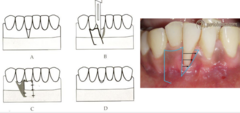
Crevicular/sulcular incision
Incision into gingival crevice for flap elevation and removal of inflamed sulcular tissue

When is a crevicular incision used?
Keratinized gingiva preservation (shown in image), GTR, connective tissue grafting

What is the third incision in flap surgery?
Interdental incision
Separates the collar of the gingiva left around the tooth facially, lingually, and interproximally

What does an interdental incision remove?
Collar of gingiva remaining around the tooth after flap elevation
*OPTIONAL incision
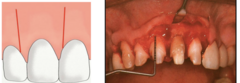
What is the purpose of a vertical releasing incision?
Increase surgical access and facilitate flap positioning
How far must a vertical releasing incision extend for maximum flap mobility?
Beyond the mucogingival junction
Where should a vertical releasing incision be placed?
Over line angle, including papilla
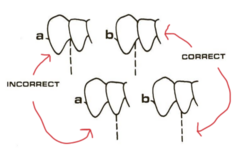
Why avoid the center of the papilla for a vertical incision?
risk of papilla tip necrosis
Why avoid the mid-radicular surface for a vertical incision?
risk of gingival recession
What is an envelope flap?
Flap reflected using horizontal incisions only

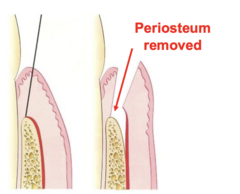
What is a full-thickness flap?
Mucoperiosteal flap with periosteum elevated from bone
What is a partial-thickness flap?
Mucosal flap that leaves periosteum and connective tissue on bone
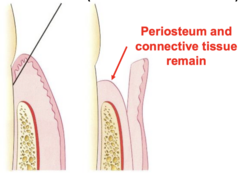
Where does a partial-thickness flap incision begin?
Supracrestal, above the crest of bone
What are the indications for a full-thickness flap?
Pocket reduction, direct bone access, mucogingival osseous procedures
What are the indications for a partial-thickness flap?
Free gingival grafts, connective tissue grafts, laterally positioned grafts, gingival augmentation
What are contraindications for a partial-thickness flap?
Thin tissue, osseous problems such as exostoses
What is the purpose of a Modified Widman Flap?
Root access, pocket reduction, removal of pocket lining
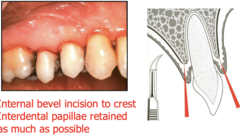
What incision is used for a Modified Widman Flap?
Internal bevel incision to crest
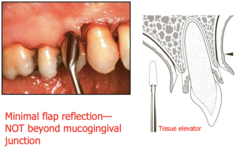
How far is a Modified Widman Flap reflected?
Minimal reflection, not beyond mucogingival junction
What tissue is removed during the Modified Widman procedure?
Granulomatous, diseased tissue

How are flaps replaced after a Modified Widman procedure?
To attain maximum interproximal bone coverage
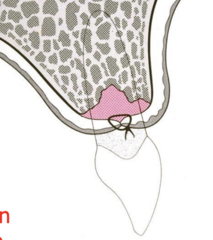
ENAP =
Excisional New Attachment Procedure
What type of incision is used for ENAP?
Inverse bevel, supracrestal incision below pocket depth
When is ENAP indicated?
When esthetic considerations are important
What is removed during ENAP?
Pocket lining/sulcular tissue
How is pocket depth marked for ENAP?
Bleeding points corresponding to probing depths

What is a limitation of ENAP?
Limited access to root surface and alveolar crest
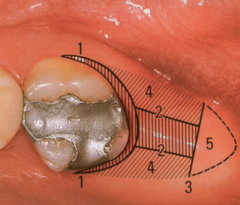
What is the purpose of a distal wedge procedure?
Reduce periodontal pockets distal to terminal tooth
What distal wedge design is used in the mandible?
Wedge or pie-shaped
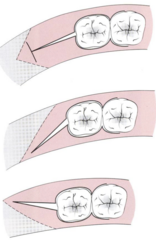
What distal wedge design is used in the maxilla?
T-flap or trolley design

What is a positioned flap?
Flap moved apically, coronally, or laterally from original position
Why must positioned flaps extend beyond the mucogingival junction?
tension release for flap repositioning
Why can't a positioned flap be done on the palate?
theres no alveolar mucosa or elastic fibers
What are the indications for an apically positioned flap?
Pocket reduction, augmentation of attached gingiva
What thickness can an apically positioned flap be?
Full OR partial thickness
What are the indications for a coronally positioned (advanced) flap?
Root coverage, gingival augmentation
What tissue is required for a coronally positioned (advanced) flap?
Adequate attached gingiva coronally
What is AlloDerm derived from?
Donated cadaveric human skin
What is another name for a laterally positioned flap?
Pedicle graft
What are the indications for a laterally positioned flap?
Root coverage, gingival augmentation
What tissue is needed for a laterally positioned flap?
Adequate attached gingiva adjacent to recipient site
Why can't palatal flaps be displaced apically?
Palatal attached keratinized tissue lacks elastic fibers