L5 - Cell specialisation + enzymes
 Call Kai
 Learn
Learn Practice Test
 Spaced Repetition
 Match
Match Flashcards
 Knowt Play
1/124

There's no tags or description
Looks like no tags are added yet.
Name | Mastery | Learn | Test | Matching | Spaced | Call with Kai | Chat |
|---|
No analytics yet
Send a link to your students to track their progress
125 Terms
What is the difference between catabolism and anabolism?
Catabolism = fuel → energy + smaller molecules; anabolism = biosynthesis of macromolecules → requires energy
What is the overall equation for controlled oxidation of glucose?
Glucose + O₂ → 6 CO₂ + 6? H₂O + heat
What is ATP and why is it important in the cell?
ATP = cellular energy store; energy available for cellular work and chemical synthesis
Why is ATP an effective cellular energy store?
Small and transportable; terminal phosphoryl groups are high-energy; hydrolysis energy can couple to other reactions
What happens when ATP is hydrolysed?
ATP + H₂O → ADP + Pi + energy; overall energy change ≈ −7.3 kcal/mol
What are the main stages of aerobic energy generation from glucose?
Glycolysis → pyruvate → acetyl-CoA → TCA cycle → NADH/FADH₂ → electron transport → ATP
What are the main pathways involved in glucose metabolism?
Glycolysis, glycogenesis, glycogenolysis and gluconeogenesis
What hormones regulate glycogen/glucose metabolism?
Glucagon, adrenaline and insulin
Where does glycolysis occur and what does it produce?
Cytosol; glucose → 2 pyruvate + 2 ATP + 2 NADH
What happens during the energy investment stage of glycolysis?
ATP is used to phosphorylate glucose → glucose-6-phosphate → fructose-6-phosphate → fructose-1,6-bisphosphate
What happens during the splitting stage of glycolysis?
Fructose-1,6-bisphosphate → dihydroxyacetone phosphate + glyceraldehyde-3-phosphate; triose phosphate isomerase converts DHAP → glyceraldehyde-3-phosphate
What happens during the energy generation stage of glycolysis?
Glyceraldehyde-3-phosphate → pyruvate; NADH and ATP are generated
What are the key enzymes of glycolysis taught in the lecture?
Hexokinase; phosphoglucose isomerase; 6-phosphofructokinase; aldolase; triose phosphate isomerase; glyceraldehyde-3-phosphate dehydrogenase; phosphoglycerate kinase; phosphoglycerate mutase; enolase; pyruvate kinase
What is the overall yield of glycolysis per glucose molecule?
2 pyruvate + 2 ATP + 2 NADH
How is pyruvate converted to acetyl-CoA?
Pyruvate + CoA-SH + NAD⁺ → acetyl-CoA + CO₂ + NADH; catalysed by pyruvate dehydrogenase complex
Why is acetyl-CoA important in energy metabolism?
It is the metabolic input to the TCA cycle; carbohydrate, lipid and protein breakdown can produce acetyl-CoA
What is Coenzyme A and what does it carry?
Activated carrier of 2-carbon fragments; contains a reactive thiol forming a thioester bond with acetyl groups
What happens to excess dietary carbohydrate according to the lecture?
It can be converted into fat
What are the outputs of one turn of the TCA cycle per acetyl-CoA?
2 CO₂ + 3 NADH + 1 FADH₂ + 1 GTP

What are the main intermediates of the TCA cycle in order?
Citrate → isocitrate → α-ketoglutarate → succinyl-CoA → succinate → fumarate → malate → oxaloacetate
What are the key enzymes of the TCA cycle?
Citrate synthase; aconitase; isocitrate dehydrogenase; α-ketoglutarate dehydrogenase; succinyl-CoA synthetase; succinate dehydrogenase; fumarase; malate dehydrogenase
Does the TCA cycle directly require O₂?
No; O₂ is required later for regeneration of NAD⁺ and FAD
What is substrate-level phosphorylation?
Transfer of phosphate from a substrate to ADP/ATP or GDP/GTP
What is oxidative phosphorylation?
ATP formation coupled to oxidation of NADH or FADH₂
What are NADH and FADH₂?
Electron carriers that carry reducing equivalents/electrons to the electron transport chain
What happens when NAD⁺ is reduced to NADH?
NAD⁺ accepts a hydride (H⁻) containing H⁺ + 2e⁻ → NADH
How does the electron transport chain generate a proton gradient?
Electrons from NADH/FADH₂ pass through complexes → energy pumps H⁺ from mitochondrial matrix → intermembrane space
What are the mitochondrial electron transport chain complexes shown?
Complex I, II, III and IV

How does the proton gradient drive ATP synthesis?
Electron transport pumps H⁺ out of the matrix → electrochemical gradient → H⁺ flow through ATP synthase → ATP
What is chemiosmotic coupling?
Use of the proton electrochemical gradient to drive ATP synthesis through ATP synthase
What is the lecture's stated net aerobic ATP yield per glucose?
36 ATP per glucose
What are the main products generated during glucose oxidation?
ATP, CO₂ and H₂O; NADH and FADH₂ are also generated as electron carriers
How is cellular energy generation regulated?
Regulation occurs at early steps, ATP-requiring steps and multiple steps; feedback mechanisms involve substrates/products
What are the three broad principles of metabolic enzyme regulation taught?
Regulate early steps; regulate ATP-requiring steps; regulate multiple steps/feedback mechanisms
What are the four levels of protein structure?
Primary, secondary, tertiary and quaternary structure
What is primary protein structure?
The amino acid sequence of the polypeptide chain
What is secondary protein structure?
Initial folding of the polypeptide chain; includes α-helices and β-sheets
How are α-helices stabilised?
Internal hydrogen bonds; R groups face outwards
What specialised role can membrane-spanning α-helices have?
They can span membranes as components of ion channels and membrane-bound receptors
How are β-pleated sheets stabilised?
Hydrogen bonds; can be parallel or antiparallel
What are the N- and C-termini of a protein?
N terminus = beginning of protein; C terminus = end of protein
What stabilising covalent bond can link cysteine residues?
Disulfide bond
What is tertiary protein structure?
Overall 3D shape of a protein; determined by interactions between amino acids/protein regions
Why is tertiary structure important?
Overall protein shape determines function
What is a protein domain?
A structurally distinct part of a protein, often with a different function
What determines protein structure?
Amino acid sequence; interactions between amino acids; protein-protein interactions; environment; chaperones
What determines the properties of individual amino acids?
Their R groups
What is quaternary structure?
Association of multiple protein subunits into a functional protein complex
What is a homodimer?
A protein complex containing two identical proteins
What is a heterodimer?
A protein complex containing two different proteins
What is an example of a multi-protein complex from the lecture?
Pyruvate dehydrogenase complex
What is the relationship between protein structure and function?
Interactions between R groups determine structure → structure determines function
What are the major roles of proteins in cells taught in the lecture?
Enzymatic/metabolic; structural; regulatory; cell-type-specific functions
How do different proteins contribute to different cell functions?
Different proteins are associated with different functions, creating distinct functional roles
What are protein families?
Proteins with related structures and functions
How can protein structure explain different enzyme substrate specificities?
Different active-site structures/R-group interactions allow different substrates to bind
How does elastase differ from chymotrypsin in substrate specificity?
Elastase cleaves C-terminal to Gly/Ala/Val; chymotrypsin cleaves C-terminal to Trp/Tyr/Phe/Leu/Met
What is an enzyme?
A biological catalyst
How do enzymes catalyse reactions?
Provide an alternative reaction pathway with lower activation energy

What happens when substrate binds an enzyme?
Substrate interacts with active-site R groups; binding facilitates the reaction/transition state
What is the lock-and-key model of enzyme action?
Substrate fits a complementary active site; helps explain substrate specificity
What is the induced-fit model of enzyme action?
Substrate binding causes an allosteric/conformational change in the active site that facilitates catalysis
How can enzymes facilitate reactions besides binding substrates?
Increase local substrate concentration and facilitate the transition state through conformational change
How does substrate concentration affect enzyme activity?
Increasing substrate concentration generally increases activity until the enzyme becomes saturated
What is Vmax?
Maximum reaction rate an enzyme can support at saturating substrate concentration
What is Km?
Substrate concentration at which reaction velocity is half Vmax
What does V represent in enzyme kinetics?
Rate of substrate consumption per unit time, e.g. μM/min
How do competitive inhibitors work?
Bind directly to the enzyme active site and compete with substrate
How does high substrate concentration affect competitive inhibition?
High substrate can minimise the inhibitor's effect
What happens to Vmax and Km with competitive inhibition?
Vmax unchanged; Km changes/increases

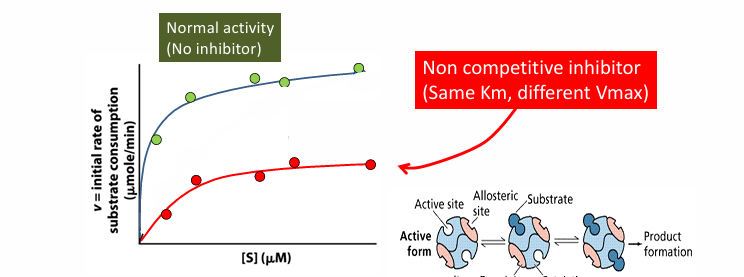
How do non-competitive inhibitors work?
Bind somewhere other than the enzyme active site
How does substrate concentration affect non-competitive inhibition?
Increasing substrate does not overcome the inhibition
What happens to Vmax and Km with non-competitive inhibition?
Km unchanged; Vmax decreases/changes
Why is enzyme inhibition important pharmacologically?
Enzymes are common drug targets; inhibiting enzymes can alter biological pathways
How does aspirin act through enzyme inhibition?
Inhibits COX → inhibits prostaglandin production
How does penicillin act through enzyme inhibition?
Inhibits β-lactamase according to the lecture → inhibits bacterial cell-wall assembly
How does methotrexate act through enzyme inhibition?
Inhibits dihydrofolate reductase → blocks cell division