exam 5 marketing
 Call Kai
 Learn
 Practice Test
 Spaced Repetition
 Match
 Flashcards
 Knowt Play
1/52

There's no tags or description
Looks like no tags are added yet.
53 Terms
pricing
Affects demand
-allows the company to obtain feedback from customers
Sends a signal about positioning and image
Can be used as a segmentation tool
Is easier to change than the other marketing mix variables
The 3 C’s of pricing
1. customers demand
2. company’s cost
3. competitors prices
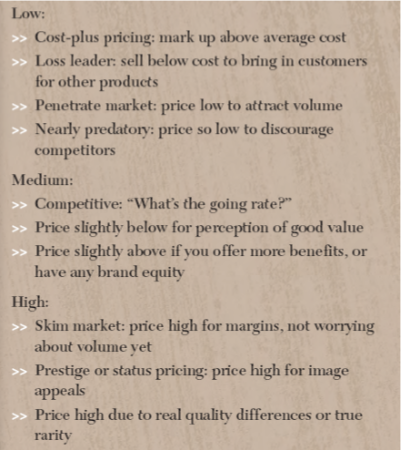
Pricing strategies
Customer → High-end:
-Price=customer willingness to pay - markdown
Competitor → Middle:
-Price= competitor +- fudge factor
Cost Based:
price= cost+ markup
Demand
Profit increases when price increases; however, demand tends to decrease as price increases
Need to find happy medium
Demand increases
With increased customer desire
With favorable perceptions of the products benefits or brand image
If competitors brands aren’t favorable
If there are few good substitutes
If substitutes or competitors are priced even higher
Demand elasticity
elasticity: the proportion change in quantity compared the proportion change in price
-how much does demand (units sold) increase (or decrease) with price change?
E>1, demand is elastic-changes with price change
if 0 <= E < 1, demand is inelastic- barely changes with price change
If E= 1, demand is unitary
Goal is optimize revenue
Demand- Elastic
If charge $7, sell 10 units= $70 revenue
If charge $4, sell 40 units= $160 revenue
Decreased margin ($3) was made up with increased unit sales
Demand- inelastic
if charge $7, sell 35 units= $245 revenue
if charge $4, sell 40units= $160 revenue
Decreased margin ($3) was not made up with adequate increased unit sales
Demand- Segment Elasticity
Elasticity can vary by customer segment
Deal prone vs brand loyalty
Demand is more elastic
When
• Customers don’t care about the purchase
• Customers don’t have strong preferences
• Item is a luxury rather than a necessity
• Many substitutes are available
• Purchase is large compared to income
• When household incomes are lower
• It is easier to compare prices
Price sensitivity
Companies develop a price sensitivity estimate based on
elasticity to determine how much would sales drop off in the
face of a price increase.
Good brands are able to charge premium prices
- Generic spandex sells for $8/lb DuPont sells “Lycra” for $15/lb
-Some define “good” on whether the customer is price insensitive
Companies would
• Use existing PS estimate (always ask your company) OR
• Develop a PS estimate using
1. Scanner Data
2. Survey Data
3. Conjoint Analysis
Costs
• Costs set the minimum floor on pricing
• If fixed costs are relatively high compared to variable costs, maximize
volume (to spread the fixed costs): movie theaters
• If variable costs are relatively high compared to fixed, maximize per unit
margins (grocery stores)
• Cost-plus pricing: P = (unit cost) / (1-X%)
• Where X% is the intended return
• Cost = $5; intended return = 40%
• $5/(1-.4) = $8.33
Breakeven
Number of units needed to sell to cover costs
BE= (fixed costs)/[(price-variable costs)]
competitors
• Customers often compare products and prices between
companies
• Marketers must price relative to competitors’ offerings
• Review customer value analysis and consider the value
customers are getting from you and competitors:
Value = Benefits/Costs
systematic biases in pricing
• No pricing model is perfect
• Marketers will never know or be able to assess all of the
factors that go into the decision to purchase
• Humans are not always rational and utility maximizing –
some behave sub optimally.
• Price Quality
Price serves as a quality cue; higher price may be more appealing
However, studies demonstrate that there is no correlation
between price and quality for most product categories
Absolute vs. relative numbers
• Absolute: $15 off of a $199 item and $15 off of a $49 item is the same in
absolute terms
• Relative: $15 of $199 is 8% while $15 of $49 is 31%
framing
• A $499 trip is the same as a $599 trip with a $100 discount at booking
• However, the $599 trip seems like a better deal because of the
higher starting price
Pricing discount and mood
• Temporary price discounts make customers think they are smart
• They experience happiness, pride, optimism, confidence, etc.
Prices ending 99
• $4.99 or $49.99 tend to be more attractive than $5 or $50
• People read right to left; thus, the 4 is processed first and leaves an
impression
mental accounting
• People categorize & budget purchases
• People pay less attention to future
• e.g., Vacation money is “different than” food money
Compromise effect
• The inner/middle choice between two extremes is attractive
• People assume if a company charges more, it must be providing more
Reference pricing
• People compare price to some referent, either an externally
available price or an internally stored price
• External
• “MSRP is $49.99, now available for $35.99!”
• “Our price $34.99, compare at $45.00!”
• Internal
• Relevant memory
• Inferences about store, etc.
Legal stuff related to pricing
NO:
price fixing-
veticle price fixing
predatory pricing
price discrimination
Deceptive pricing
Quantity pricing & yield mgt
• Quantity Discounts
The more purchased, the more saved
• Yield Management
- Using price and scheduling to manage demand
Go to the movies during the day for less $
Book a flight last minute for less $
• Need to manage perceptions of fairness
Two-part pricing
two-part tariff
-charged a fixed fee and variable usage fee
product life cycle pricing
• Introduction stage
• Penetration: seek market share
Price low to stimulate sales, encourage trial, and trigger word of
mouth
• Skimming: seek profit
Price high initially, then lower to make product more accessible
• Adjust price in various stages; usually end with lower prices in
decline stage
Temporary price cuts
- Competitors can imitate; thus, impact may be negative while
also squeezing margins
Price drops attract disloyal customers
Customers may “stock up”
May negatively affect brand image
-Coupons
Only relevant to coupon clippers
Price is more important to them than brand
350 billion coupons are available in U.S.
Redemption rate is only about 1%
Effective at encouraging new/old customers to try old/new
products
Dynamic pricing
• Price is negotiated by buyer and seller
• Auctions have been gaining in popularity
Sealed or open bid
Bidders compete to buy item
• Reservation price
• Point of indifference: estimate of customers willingness to pay
If the price is higher than reservation, don’t buy. If it is lower, then
buy
Value
• Value is an assessment of what the customer gets compared
with what the customer gives up: Benefits/Costs
• Thus, value is not only based upon price!
distribution
• Sellers prefer to produce large quantities of a limited number
of goods
• Buyers prefer smaller quantities of a wider variety of goods
• Distribution deals with realigning the discrepancies between
quantities and selections
• Breaking bulk: making goods available in smaller batches
distribution channels
A network of inter-connected firms that provide sellers a means
of infusing the marketplace with their goods, and buyers a means
of purchasing those goods, as efficiently and profitably as
possible
distribution channel activities
• Customer oriented: ordering, handling, shipping, etc.
• Product-oriented: storage & display, etc.
• Marketing-centric: promotion, etc.
• Financial-oriented: financing, etc.
• Logistics
distribution channel tension
• All channel functions must be done by someone, the question
is…
What is the most effective and efficient way to distribute the
product?
• Tension in channels can be created by the contribution of each
channel member
Do they provide more benefit than they cost?
Should we do this activity ourselves or have a channel member
do it for us?
channel and supply chains
-suppliers: upstream actors
Supply chain management
-Channel members: downstream actors that help a company reach consumers
Designing channels: intensity
Determine distribution intensity
How many intermediaries will be used?
-intensive distribution usually goes with heavy promotion, lower prices and average or lower quality products
-Exclusive distribution usually goes with exclusive promotional efforts, higher prices and higher quality products
Intensive: widely distributed
• Drugstores, supermarkets, convenience stores, etc.
• Usually for convenience goods; simple, inexpensive, easily transported
products: snack food, shampoo, newspapers, etc.
• Pull strategy: promote to end consumers to pull through channel
Selective: less widely distributed
• Usually for complex or expensive products that require assistance;
• Usually for shopping goods: cars, computers, appliances, etc.
• Push strategy: promote to distributors to push on consumer
• Manufacturer has more control due to fewer relationships to manage
Exclusive: extreme case of selectivity
• Usually for specialty goods: Rolex, Ferrari, etc.
• Manufacturers have the most control; may become monopolistic
Designing channels: push/pull
Push: advertise to partner, distribute more selectively, employ sales force, usually selling more complicated, more expensive stuff, price discounts, quantity discounts, financing, incentives for sales force, allowances for marketing activities
Pull: Advertise to consumers, distribute widely, no sales force, sell small, simple stuff, price discount, quantity discount, larger package, inexpensive trial, free sample, bundled product sample, upgrades, coupons, rebates, financing, loyalty points
Designing channels: conflict
• Conflict can arise when channel partners differ in their opinions
on how to please customers and maximize profit
• Conflict may motivate parties to find alternative solutions
• Power is usually defined by size and effectiveness
• Types of Power
• Coercive power: Ability to take away benefits or inflict punishment
on other party
• Information power: Having information other party seeks
• Legitimate power: Using size or expertise to encourage other party
• Referent power: One party seeks an affiliation with other
• Reward power: Ability to provide good outcomes for other party
Dealing with conflict
How to deal with conflict
• Develop effective communication to enhance trust and satisfaction
• Exchange personnel
• Sponsor joint research projects
• Communicate
• Exchange personnel
• Sponsor joint research projects
If conflict cannot be resolved, two other possible actions:
• Mediation
• Negotiate with 3rd party that determines two parties’ utility functions
Arbitration
• The 3rd party makes a binding decision for the two
Transaction cost analysis (TCA)
• A model that considers channel members’ production costs and
governance costs, both of which are ideally minimized
• Production Costs
• Costs of producing/bringing product to market
• Governance Costs
• Costs involved with relational issues incurred coordinating the
enterprise and controlling one’s partners
Revenue sharing
• Channel conflict often comes down to revenue sharing
• Double Marginalization
• The manufacturer wants a mark-up when it sells to a retailer
• The retailer wants a second markup when it sells to the consumer
Channel integration
All functions within a channel need to be completed.
Revisit make-or-buy decision.
• Make: complete a function yourself
• Buy: outsource a function
• If a company is currently using a partner to do something, it
might wish to bring that function back in-house
Forward Integration
• e.g., manufacturer controls its retail stores
Backward integration
• e.g., manufacturer controls raw material
• Private label: Type of backward integration
• Gives retailer negotiating power with manufacturers
• Offers significant margins
• Helps differentiate retailer from other retailers
• e.g., Great Value oatmeal is only at Walmart
Types of retailing 1/2
Retailers have been gaining power and momentum over the
past 10-20 years
Powerful retailers can make or break a new product
Categorize retailers according to extent of manager’s
ownership
• Independent retailers - Local florist
• Branded store chains - Old Navy
• Franchises - Jiffy Lube
Types of retailing 2/2
• Categorize retailers according to their level of service which
tends to be positively related to their price points
Full service: Nordstrom’s
Limited service: K-mart
• Categorize retailers according to product assortment
Specialty: carry depth not much breadth - Toy stores
General merchandise: carry breadth but not much depth -
Department stores
Importance of location
• Consider factors needed to be successful
• Environmental data
• Population densities
• Income and social class distributions
• Median ages
• Household composition, etc.
Retailer growth strategies
• Provide additional services
• Reach out to attract additional segments
• Open additional stores
• Expand internationally
• Exporting, joint ventures, direct foreign investment, license
agreements, etc.
• Depends upon: talent, costs, labor pool, infrastructure,
government’s stance on foreign investment, real estate costs,
travel costs, local ethics, etc.
Franchising
Company can retain some control without complete
ownership or capital expenditure
• Franchisor: the company
• Franchisee: local owner
• Pays fee and royalties
Product franchising
• Ford dealer, Coca-Cola bottlers
Business format franchising
• McDonalds, Holiday Inn
E-commerce
• Many businesses drive customers online to reduce labor costs
• Online retail sales are about $180 billion (about 11% of total
sales).
• Customers are younger and more affluent.
• Customer characteristics are changing to match customers in
general markets.
Catalog Sales
• Top 10 catalogers are B2B companies
• e.g., Dell, Staples, etc.
• 80 of the top 100 catalogers continue to see sales growth
• Internet is well-suited for a search while catalogs still
dominate browsing
• Catalogs often complement not compete with Internet
• Catalogs trigger web visits
• Customer databases are utilized for customized catalogs,
promotions, etc.
Sales Force
Utilized extensively by companies utilizing a push strategy
Compensation: Sales compensation is usually salary plus
bonuses
• Bonuses can be cash, trips, etc.
• The question is how much is fixed and how much is variable
Evaluation factors:
• Sales
• by segment, product, improvement, etc.
• Time spent with clients
• Expertise
• Knowledge
• Attitudes
• Days worked
• Selling expenses, etc.
Integrated Marketing Channels
When designing marketing channels understand your
customers’ behavior
Ask these questions
• What are your target market segments?
• What benefits do they seek?
• How can we match customer needs to our corporate growth
strategies?
• What mix of channels will facilitate our meeting these goals?