Photosynthesis Biology
 Call Kai
 Learn
Learn Practice Test
 Spaced Repetition
 Match
Match Flashcards
 Knowt Play
 Podcast
1/39

Earn XP
Description and Tags
WE Want to Be able to 1) Describe structures and substates required for photosynthesis, 2) Understand the nature of light and how it is absorbed, 3) Understand how light energy is converted to chemical energy, 4) Describe the Calvin Cycle and Carbon Fixation. Textbook Connections: Chapter 8 Photosynthesis
Name | Mastery | Learn | Test | Matching | Spaced | Call with Kai | Chat |
|---|
No analytics yet
Send a link to your students to track their progress
40 Terms
Heterotrophs examples and function
Obtain energy from the organic molecules they eat (Ie animals, fungi, and most bacteria) They could do then do cellular respiration to create ATP
QUIZ: Heterotrophs use organic molecules produced by other organisms (T/F)
True
If it takes energy to create sugars, where to heterotrophs get these sugars from?
Autotrophs (Primary producers). Make organic -C, do photosynthesis and respiration
Photoautotrophs use what to make food
Use sunlight to make food (EX. plants, algae, cyanobacteria)
Photosynthesis equation
6Co2 + 6H2o ——> C6H12O6 + 6O2
Photosynthesis uses ______ ______ to produce sugar from carbon dioxide and water. O2 is a waste product
Solar Energy
Plants: Photosynthetic Reactions
How do plants source the reactants needed
1) ___ is absorbed by the roots from the soil
2) ___ is aquired from the air as a result of gas exchange through the stomata(small pores on the leaf underside)
3) Likewise, the ___ waste products exits through the stomata
4) _____
H2o, Co2, O2, Sunlight
Light Energy
Electromagnetic energy, composed of photon particles that travel as waves
Longer wavelengths (crests farther apart) carry ____ energy,
Shorter wavelengths carry _____ energy
less, more

What is light energy measured in and how is the color spectrum described interns of wavelengths and energy
Wavelength measured in nm (nanometer; 10^9 m; 1 billionth)
In the visible range (700-400nm), the violets have the shortest wavelengths (and most energy) and the reds have the longest
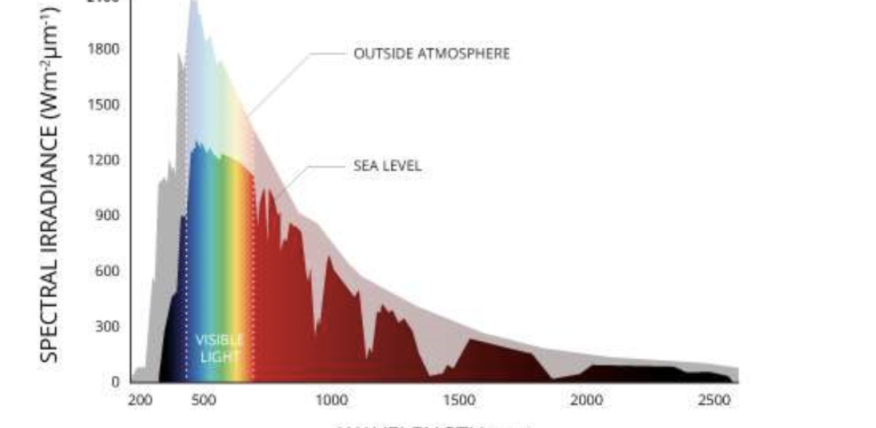
Solar light spectrum from the sun
Most intense wavelengths from the sun are visible, also the range photosynthesis takes advantage of
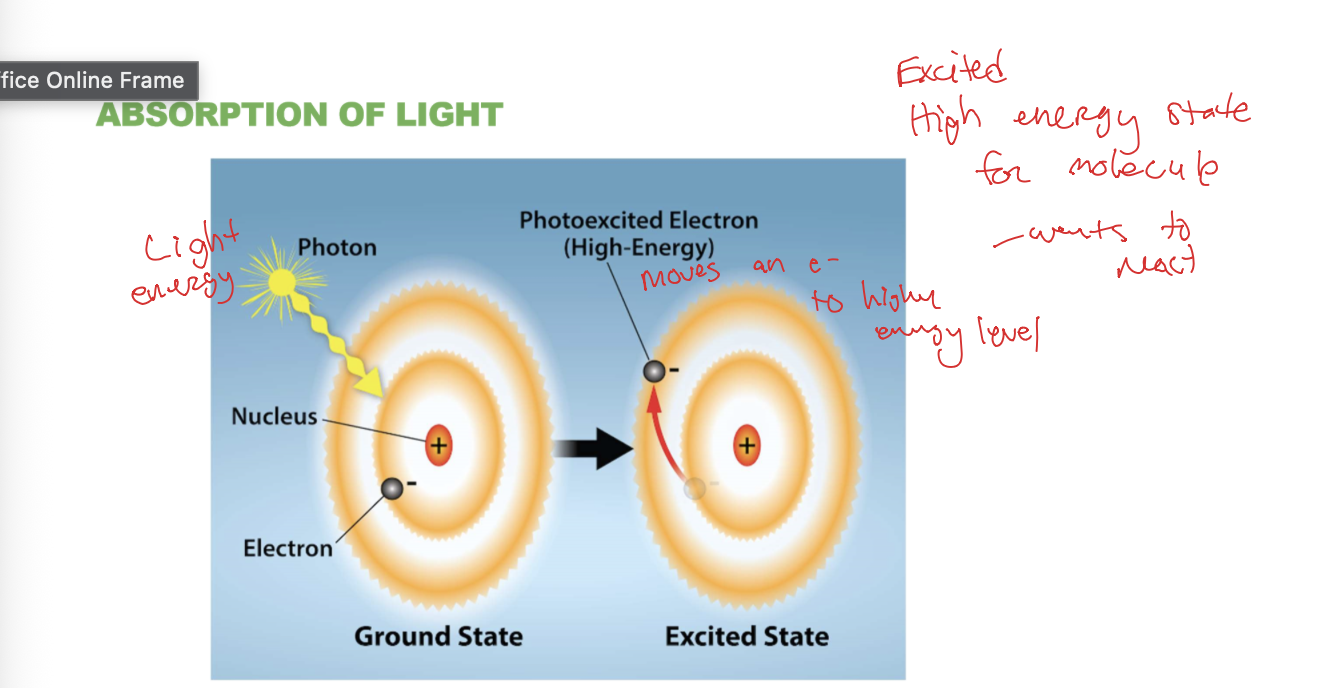
Absorption of Light
When a substance takes in light energy, usually causing its electrons to gain energy. Objects appear the color of what is NOT absorbed (reflected)
Photosynthetic pigments each absorb (gain energy) specific wavelengths of light; observed by its _____
absorbance spectrum
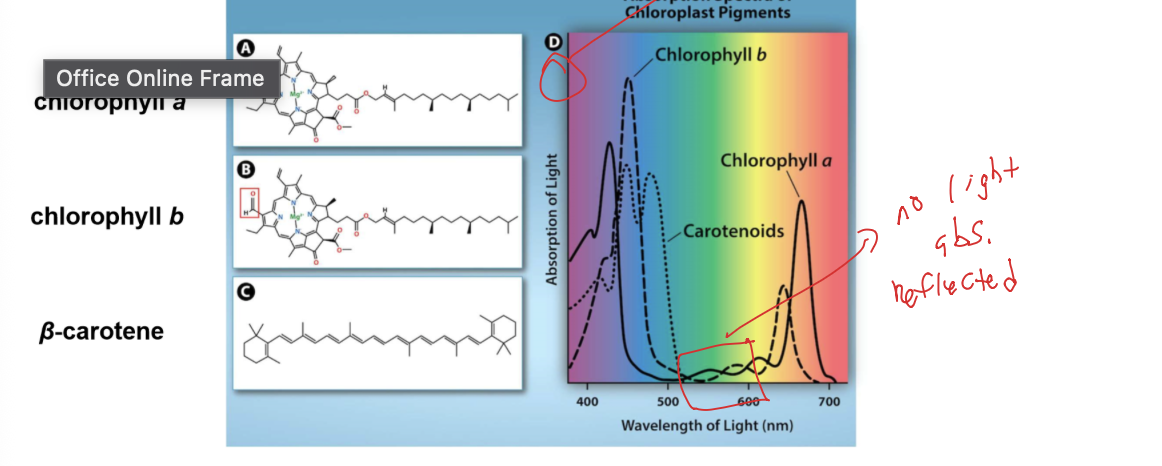
The main pigments of thylakoid membranes are:
chlorophyll a, chlorophyll b, B-carotene
Chlorpphyll
Chlorophyll a and b capture light for photosynthesis, the reason leaves are green (green wavelengths are reflected)
Caretenoids
B-carotene helps to protect photosystems by dissipating excess energy, also found in cells of carrots and oranges
QUIZ: Which colors of visible light can plants utilize
White
Red
Blue
Green
White, red, blue
Photosynthesis equation
Carbon Dioxide + Water —→ Sugar + oxygen
Just like cellular respiration, photosynthesis invovles complex metabolic pathways with _________
e- transfer steps
The two metabolic pathways of photosynthesis are
The light reactions, The Calvin cycle
The light Reactions
Convert light energy to chemical energy, energy capture/gain by the cell, high energy ATP and NADPH (e- carrier) formed, occurs in the thylakoid membranes of cholorplasts
What do light reactions do in general
cover light energy to chemical energy
Where do light reactions occur
thylakoid membranes of chloroplasts
The Calvin Cycle
Uses ATP and NADPH to make sugar, light-independent, energy required (from light), sugars created, occurs in the stroma of chloroplasts
What does the Calvin Cycle do in general
uses ATP and NADPH to make sugar
Calvin Cycle characteristics
light-independent, energy required (from light), sugars created, occurs in the stroma of chloroplasts
Where does the Calvin Cycle Occur
Stroma of chloroplasts

Chloroplasts structure
Double membrane (outer and inner)
Stroma - Inner fluid space
Grana - Stacks of thylakoids
Thylakoids - membrane bound structures with pigments where light reactions occur

Photosynthesis Part 1 - Light Reactions
Chorlophylls absorb light energy, turn light into chemical energy as ATP and NADH (will support sugar formation later), Occurring in thylakoid membrane in chloroplasts

The light reactions consist of Photosystem II and I (occur as II then I)
Light energy in needed for PS Ii and PS I
PS II
Photon absorbed by chlorophyll, splits water into waster O2, PSII releases e- to ETC
H+ is pumped into thylakoid space via ETC (PS II)
Proton gradient Established
PS I
E- finally transferred to NADP+ to create NADPH
— Highly reduced NADPH Formed
PS II
Photon absorbed by chlorophyll, splits water into waster O2, PSII releases e- to ETC
H+ is pumped into thylakoid space via ETC (PS II)
Proton gradient Established
PS I
E- finally transferred to NADP+ to create NADPH
— Highly reduced NADPH Formed

Photosynthesis Part 1 - Light reactions
Just like the ETC of Cellular respiration,
__ gradient is created as e- fall down the chain
Building PE
ATP synthase uses to gradient to generate ATP (chemioosmosis)
H+

Photosynthesis part 2 — Calvin Cyle
The ATP and NADPH from the light dependent reactions are made in the stroma for use in the Calvin cycle (sugar formation)
QUIZ:
Choose the correct order that the complexes would be used during the light reactions of photosynthesis.
(PS = photosystem)
PSII, ETC, PSI, ATP synthase
ETC, PSII, PSI, ATP synthase
PSI, ETC, PSII, ATP synthase
PSI, PSII, ETC, ATP synthase
PSII, ETC, PSI, ATP synthase
QUIZ: PSI (photosystem 1) can do all of the following EXCEPT
split water to generate an e- to ETC
transfer electron to NADP+ to create NADPH
capture light energy to excite a central electron
receive electrons from the ETC
split water to generate an e- to ETC
QUIZ: Photisystems (select ALL that apply)
Concentrate light energy into a single excited electron
Are large complexes of pigments
Can absorb energy from photons
Are food in the stroma of the chloroplast
Concentrate light energy into a single excited electron
Are large complexes of pigments
Can absorb energy from photons
QUIZ: Which of the following is the main output of the Calvin cycle:
Oxygen
g3P (glycerahyde 3 phosphate)
RuBP
Glucose
g3P (glycerahyde 3 phosphate)
QUIZ: Match the following components of the ETC (electron transport chain).
(e = electron)
e-donor in photosynthesis
H2O
QUIZ: Match the following components of the ETC (electron transport chain).
(e = electron)
e-acceptor in photosynthesis
NADP+ (to form NADH)