Introduction to business law reflect questions
 Call Kai
 Learn
Learn Practice Test
 Spaced Repetition
 Match
Match Flashcards
 Knowt Play
1/4

There's no tags or description
Looks like no tags are added yet.
Name | Mastery | Learn | Test | Matching | Spaced | Call with Kai | Chat |
|---|
No analytics yet
Send a link to your students to track their progress
5 Terms
What are the main differences between civil law and criminal law.
Civil law deals with private disputes between individuals or organisations. Whereas criminal law is an offence against society that is punished by the state.
Additionally, civil law must be proven against a balance of probabilities whilst criminal law must be proven beyond all reasonable doubt.
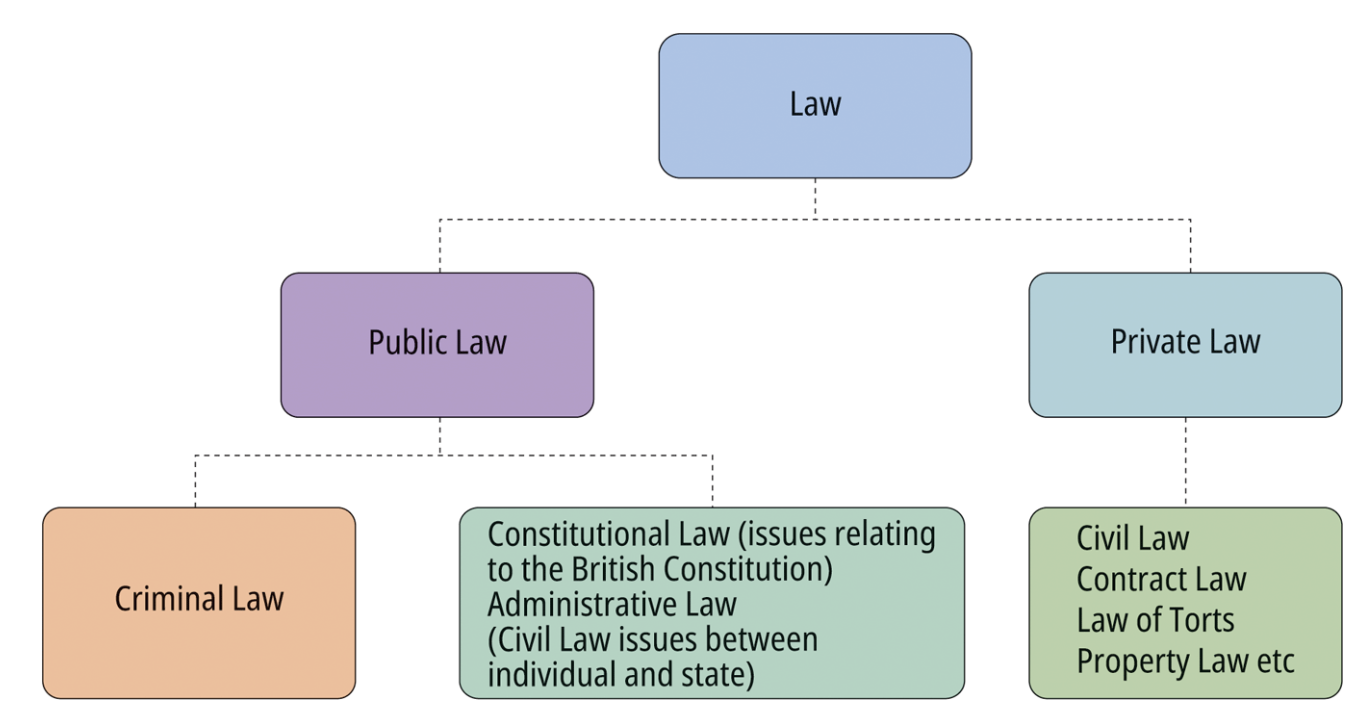
How would you define private law and public law.
Public law encompasses many different aspects of law such as constitutional, administrative and criminal law. Public law can apply to legal person’s such as a company and natural persons such as individual people. Public Law involves the relationship between individuals and the state and is concerned with the decisions by, and control of, government bodies.
How would you define private law and public law.
Private Law is concerned with the rights and duties between individuals and covers areas of law such as contract, tort, property, company, and family law. The individuals may be private persons, companies, or even a state body such as a local authority if, for example, a citizen has a contract with that local authority.
How would you define private law and public law.
Different meanings of the term common law
t is usually used to mean the law that is not the result of legislation but is the law created by the decisions of the judges. When common law is given this meaning it encompasses cases that have used both, or either, equity and common law.
An alternative meaning of the term common law is when it is used to distinguish common law from equity, and refers to case law that has been developed through the old Common Law Courts as opposed to the old Chancery Courts.
An archaic meaning of the term common law is law that is common to the whole of England as opposed to local law. However, this is no longer the usual meaning of the term.
Finally, the term may mean the law that is not foreign law; in other words, the law of England, or of other countries (such as America) that have adopted English law as a starting point.