Glycogen and Glycolysis and energy cycles
 Call Kai
 Learn
 Practice Test
 Spaced Repetition
 Match
 Flashcards
 Knowt Play
1/40

There's no tags or description
Looks like no tags are added yet.
41 Terms
carbohydrates are composed of?
carbon hydrogen and oxygen
2 types of carbohydrates
Monosaccharides - simple sugars that are basic units of carbohydrates eg: glucose, fructose
disaccharides - formed by linkage of two monosaccharides
eg: lactose, sucrose

in animals what is their storage form of energy
what is the structure of it?
Glycogen - highly branched polysaccharide composed of glucose
alpha 1,4 glycosidic links form main chains #
alpha 1,6 links form branches

glycogen storage sites in animals
liver - maintaining blood glucose levels
skeletal muscles - stores glycogen as energy reverse for muscle activity
also can be stored in cytoplasm as visible granules
breakdown of glycogen (glycogenolysis)
glycogen phosphorylase - enzyme that catalyses phosphorolysis of alpha 1,4 glycosidic bonds (breaks 1,4 alpha bonds) releasing glucose 1 phosphate from non reducing end of glycogen
Debranching enzyme - cuts off branches, glucanotransferase which transfers 3 glucose from the branches to main chain,
alpha 1,6 glucosidase - hydrolyses (breaks off) remaining single glucose from branch and releases the glucose
products of glycogen breakdown
glucose 1 phosphate - turned into glucose 6 phosphate
glucose 6 phosphate - can enter glycolysis
free glucose at the end - used in glycolysis or released in bloodstream
glycogen synthesis (glycogenesis)
Glucose activation - Glucose is converted into glucose 6 phosphate by hexokinase, then isomerised to glucose 1 phosphate by Phosphoglucomutase
UDP Glucose formation - Glucose 1 phosphate reacts with uridine triphosphate (UTP) to form UDP glucose (activated glucose donor)
Glucose synthase - enzyme transfers glucose residue from UDP glucose to non reducing end of glycogen chain to form alpha 1,4 glycosidic bond
2 key regulatory enzymes in breakdown and synthesis
glycogen phosphorylase - key enzyme in glycogen breakdown
glycogen synthase - key enzyme for glycogen synthase
hormonal effects in body
insulin - promotes glycogen synthesis in liver and muscle. When blood sugar is high
Glucagon - promotes glycogen breakdown in liver signalling low blood glucose levels
Adrenaline - promotes glycogen breakdown and prepares body for fight or flight
regulation of glucagon
in low blood sugar conditions glucagon binds to receptor leading to:
increased cyclic AMP (cAMP)
Activation of protein kinase A (PKA) which activates glycogen phosphorylase stimulating glycogen breakdown
PKA also inhibits glycogen synthesis
Regulation by Exercise
Increased calcium Ca2+ levels
release of adrenaline
Production of AMP
calcium - activates glycogen phosphorylase kinase
Adrenaline - stimulates cAMP leading to PKA activation and further phosphorylation of glycogen phosphorylase kinase
AMP - activates glycogen phosphorylase b to more active state
Fed state Regulation
when blood glucose is high:
insulin levels rise, promoting glucose uptake and synthesis
glucagon levels fall
Glucose can inhibit glycogen phosphorylase thus inhibiting glycogen breakdown
insulin signalling pathways promote activation of glycogen synthase
glycolysis process
glucose is phosphorylated
2 ATP used
Glucose is split into two - 3 carbon atoms ]
NADH is produced
ATP is produced
The molecules are converted into pyruvate
More ATP is produced
Regulation of Glycolysis - Hexokinase
Hexokinase I,II,III - High affinity for glucose, inhibited by glucose 6 phosphate
Hexokinase IV - low affinity for glucose, not inhibited by glucose 6 phosphate
Regulation of Glycolysis - Phosphofructokinase
controls main rate liming step of glycolysis
Inhibitors
ATP - high energy levels means less glucose broken down
Citrate - indicates enough energy is available
H+ - high levels indicate acidic conditions so glycolysis slows down
Activators -
AMP - signals low energy so glycolysis speeds up
Fructose 2,6 biphosphate - strongly activates PFK and increases glycolysis #
Regulation of Glycolysis - Pyruvate Kinase
controls final step of glycolysis where pyruvate is produced
Activated by:
Fructose 1,6 biphosphate speeds up final steps of glycolysis
Inhibited by: ATP - High energy means less glycolysis is needed
what happens after glycolysis
pyruvate is converted into acetyl coenzyme a and produces NADH and CO2
evidence for endosymbiotic theory for mitochondria
similar size to bacteria
possession of their own circular DNA #
Double membrane structure
Presence of their own Ribosomes and tRNAs
Roles of mitochondria
Energy production
Regulation of calcium concentrations
Detoxification of ammonia through the urea cycle
production of heat
regulation of programmed cell death (apoptosis)
structure of mitochondria
outer membrane - highly permeable membrane
Inner membrane - highly specialised and impermeable to ions, forms folds called cristae that increase surface area. This membranes has electron transport chain and ATP synthase complexes
Intermembrane space - the region between outer and inner membrane
Matrix - innermost compartment containing enzymes for pyruvate and fatty acid metabolism, as well as enzymes of citric acid cycle. Also has mitochondrial DNA, ribosomes and granules

overview of krebs cycle
takes place in mitochondrial matrix
produces co2 as a waste product
generates NADH and FADH2 that are essential for ATP synthesis
what happens in citric acid cycle / krebs cycle
2 molecules of CO2 are produced.
1 molecule of GTP(which is readily converted to ATP) is produced.
3 molecules of NADH are produced.
1 molecule of FADH2 is produced.
A total of 8 electrons are released.

NAD AND FAD
NAD+ is an oxidising agent and accepts electrons to become reduced NADH
FAD is an oxidising agent and accepts 2electrons and 2 protons (H+) to become reduced FADH2
what is oxidative phosphorylation
process by which ATP is generated in aerobic respiration and involves electron transport chain and chemiosmosis
where is electron transport chain located and what is the process
location - inner mitochondrial membrane
process = electrons are passed from one complex to the next releasing energy at several steps. This energy is used to pump protons H+ from mitochondrial matrix into intermembrane space creating electrochemical gradient
Final electron acceptor - Oxygen accepts electrons and combines with protons to form water
what are the complexes associated with etc
complex I - accepts electrons from NADH. Pumps protons
Complex II - accepts elctrons from FADH2, but does NOT pump protons, it is not transmembrane
Complex III - Accepts electrons from ubiquinone, pumps protons
Complex IV - accepts electrons from cytochrome C and transfers them to oxygen, Pumps protons
Proton Gradient and ATP synthesis
Proton Gradient - pumping of protons by ETC creates electrochemical gradient across inner mitochondrial membrane with high concentration of H+ in intermembrane space than the matrix. This represents stored potential energy
ATP synthase - This enzyme uses energy stored in proton gradient to synthesise ATP. Protons flow back into matrix through ATP synthase allowing phosphorylation of ADP to ATP
The electrochemical gradient of protons is the driving force for ATP synthesis
catabolism vs anabolism
catabolism - the breakdown of complex molecules into simpler ones releasing energy
eg: glycolysis, oxidative phosphorylation TCA cycle
Anabolism - The synthesis of complex molecules from simpler ones and requires energy
eg: Gluconeogenesis, fatty acid synthesis
functions of pentose phosphate Pathway
produces NADPH a critical reducing power for biosynthetic reactions
Generates ribose 5 phosphate
interconverts various sugar molecules
pentose phosphate overall reaction
glucose-6-phosphate+2NADP+ + H2O→ribose-5-phosphate+2NADPH+2H+ + CO2
Branches of Pentose phosphate pathway
oxidative branch
converts glucose - 6 phosphate into ribulose 5 phosphate producing NADPH and CO2
Non oxidative branch - produces ribulose 5 phosphate and various sugars
where does pentose phosphate pathway occur
cytosol
how is pentose phosphate pathway utilised
high demand for ribulose 5 phosphate
equal demand for ribulose 5 phosphate and NADPH
High demand for NADPH
what is gluconeogenesis
metabolic process that synthesises glucose from non carbohydrate precursors (eg: lactate, amino acids and glycerol)
where does it take place
liver
key enzymes in gluconeogenesis
glucose 6 phosphatase
frcutose 1,6 biphosphatase
pyruvate carboxylase
phosphoenolpyruvate carboxykinase
3 main sources of glucose
lactate
amino acids
glycerol
hormone regulation of gluconeogenesis (insulin and glucagon)
insulin - promotes glycogen synthesis and glucose uptake
inhibits gluconeogenesis
Glucagon - promotes gluconeogenesis by increasing cAMP levels and stimulating enzymes
regulation of gluconeogenesis (Activation and Inhibition)
activated by: ATP, citrate, Glucagon
inhibited by; AMP, Fructose 2,6 biphosphate, Insulin
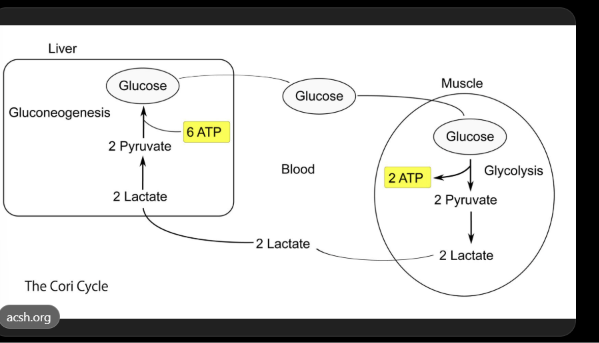
cori cycle
muscles produce lactate in anaerobic conditions
lactate goes to liver
liver converts lactate to glucose
glucose travels to the muscles