lecture 5: Agonist
 Call Kai
 Learn
 Practice Test
 Spaced Repetition
 Match
 Flashcards
 Knowt Play
1/19

There's no tags or description
Looks like no tags are added yet.
20 Terms
background info: what is law of mass action
bacground info: dose response curve
what is agonist, partial agonist and full agonist
Agonist: drug which interact with the receptor form drug-receptor complex, which generate a response
partial agonist: cannot produce full maximum response
full agonist: can produce maximum response
what are the 2 factors affect the size of reponse produced by agonist?
affinity (occupacy)
efficacy (links with the concentration of agonist and tissue response)
what is occupancy
proportion of the receptor that is occupied by the agonist compared with the total amount of receptors on the tissue

how does the graph looks like for the occupancy
explain each section of occupancy and related concentration of the drug
C:- Initiation of the occupation
B: rate of occupancy is increased quickly with the concentration of the drug
a small increase in the agonist concentration can cause a large increase in occupancy
A:
most of the receptor is being occupied with agonist
the rate of occupantion is slow down

what is the equation of occupancy

How to derive the Xa/(Xa+Ka) use law of mass action

what is Ka
explained by the law of mass equation
explained by the word definition
law of mass equation
backward reaction rate/forward reaction rate
word definition
concentration of the drug needed to occupied half of the receptor
it indicate the agonist’s tendency to form complex with the receptor, link with the affinity of the drug
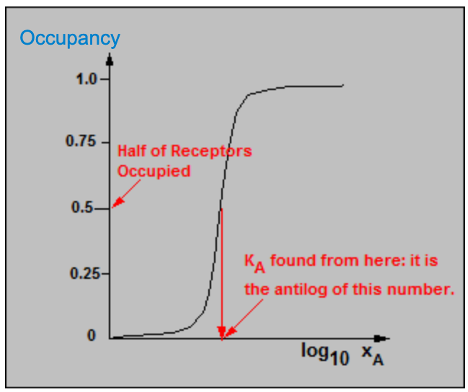
How to find Ka on the graph?
use the occupancy and log concentration graph
find 50% occupation
find the related drug concentration on the x-axis

what does high and low Ka value indicate
High Ka
there is higher rate of backward reaction compared with the forward reaction
therefore, there is more dissociation of the drug from the receptor, compared with the drug bind, less affinity
more free drug is needed to achieve the 50% occupation.
Low Ka
lower rate of the backward reaction, less dissociation of the drug with the receptor, the drug has higher affinity of the drug
less drug is need to achieve 50% occupation
overall
Ka indicate the drug concentration, higher Ka indicate the affinity of drug is lower with receptor
what is maximum reponse
full agonist
partial agonist
Maximum response:
the largest response that can be produced by the biological organism
Full agonist:
it can produce maximum response upon binding
Partial agonist:
it cannot produce maximum response even if all the receptor is binded
what is efficacy
measure the drug ability to evoke a reponse in the tissue
what are the 3 factors affect the efficacy
from tissue level
from the agonist and receptor itself
characteristics of the receptor on tissue
- number of receptors presents on the tissue
- type of reaction between tissue and receptor bindingintrinsic efficacy
how does the number of receptors on the tissue affect the efficacy
if each complex generate same amount of signal, tissue with more receptor will form more agonist-receptor complex, which produce a larger response.
However, for partial agonist, it generates less stimulus per receptor
therefore, even there is100% receptor occupancy, maximum response cannot be reached
what are the 2 types of receptor and response coupling
direct coupling of the receptor
- single receptor complex leads to a single responseindirect coupling of the receptor
trigger an amplification of the reponse in the cell
what is intrinsic efficacy
it is the ability of the agonist to generate the degree of response from the receptor complex
even they have same affinity to the same receptor, different type of agonist is produce will produce different level of response
-full agonist: produce larger response
-partial agonist: produce weaker response

how does change in affinity effect the response curve
how does change efficacy effect the response curve
what is spare receptor hypothesis
There are more receptors presents on the cell than needed to generate a full response.
only a fraction of receptor is needed rather than occupation of all the receptors.
Therefore, the maximum response can be achieved without full occupation of the receptor.