Chapter 9 - Rehabilitation and Restorative Care
 Call Kai
 Learn
 Practice Test
 Spaced Repetition
 Match
 Flashcards
 Knowt Play
1/26

There's no tags or description
Looks like no tags are added yet.
27 Terms
Rehabilitation
Care by professionals that restores a person to their highest possible level of functioning. Includes physiological and psychosocial needs so they can be as independent as possible.
Restorative care
Keeps residents at a level achieved by rehabilitative services (ex. Being able to sit and get up on their own)
Ambulation
“Moving or walking, with or without an assistive device” (p. 237)
Ambulatory
Someone who is able to move or walk by themselves
NOTE: Most residents are ambulatory, but need help moving safely (tools like transfer belts, canes, walkers, and crutches help with ambulation)

Canes
Help with balance, placed 6 in distance on stronger side of leg -> bringing weaker leg even with the cane -> then brings stronger leg
Most people should be able to bear weight on BOTH legs
If one leg is weaker, cane is held in the hand on the stronger side

Walker
Resident places walker 6 in (or comfortable distance) in front of themselves
All four feet on the ground
Walker shouldn’t be moved again until person has moved BOTH feet forward and is steady (feet never ahead of walker)
Crutches
Fitted to resident & taught how to use them correctly by physical therapist or nurse
Resident can use crutches in different ways (varying on weakness)
Weight should always be under hands & arms
Weight should NOT be on underarm area
Assistive Devices
Helping residents perform activities of daily living (aka ADLs)
Each device made to support a particular disability (ex. Raised seating makes it easy for a resident with weak legs to stand)
Supportive devices
Assists in ambulation (canes, walkers, and crutches); helps residents move from Point A to Point B

Safety devices
Purpose is to prevent accidents
ex. Shower chairs, transfer belts
ex. Safety bars/grab bars often installed in and near tubs & toilet for residents to hold onto while changing position
Amputation
“Surgical removal of some or all of a body part, usually an arm, hand, leg, or foot” (p. 241)
Cause: Injury or disease
Phantom sensation
When a person feels a body part that’s not there; “feels” like the limb is still there when it’s not
Phantom limb pain
Feeling pain “in a limb (or extremity) that has been amputated. It may last for a short time or for years” (p. 241)
This pain is real & shouldn’t be ignored!
Medication or physical therapy (PT) can treat these conditions
Prosthesis
Device replacing a body part missing or deformed due to an accident, injury, illness, or birth defect
Purpose: Improve person’s ability to function and/or improve appearance
ex. Artificial limbs (hands, arms, feet, eyes, etc.)
ex. Dentures, hearing aids
Range of Motion (ROM)
"Exercises put a joining through its full arc of motion” (p. 242)
Decreases/prevents contractures
Improves strength
Increases circulation
Types
Active Range of Motion (AROM)
Active Assisted Range of Motion (AAROM)
Passive Range of Motion (PROM)
Active Range of Motion (AROM)
Exercises done by residents themselves, without help. NA’s role is encouraging the resident
Active Assisted Range of Motion (AAROM)
Passive Range of Motion (PROM)
“Exercises used when residents are not able to move on their own… Exercises done by a staff member, without the resident’s help” (p. 243)
Should begin from resident’s shoulders and work down the body
Done once/twice per day, 3-5 reps on both sides
If any pain, stop immediately and report to nurse ASAP
Abduction
Moving a body part AWAY from the midline of the body
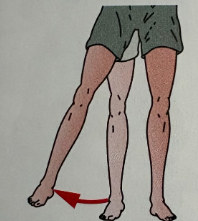
Adduction
Moving a body part TOWARD the midline of the body

Extension
Straightening a body part
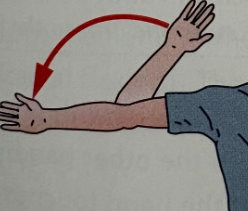
Flexion
Bending a body part

Dorsiflexion
Bending backward

Rotation
Turning a joint

Pronation
Turning DOWNWARD

Supination
Turning UPWARD

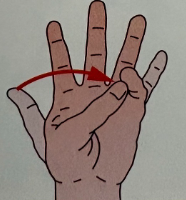
Opposition
Touching the thumb to any other finger