MODULE 5: HEREDITY
 Call Kai
 Learn
 Practice Test
 Spaced Repetition
 Match
 Flashcards
 Knowt Play
1/104

There's no tags or description
Looks like no tags are added yet.
105 Terms
what is external fertilization?
Gametes fuse outside the female’s body.
Common in aquatic animals such as fish, frogs and sea urchins.
Large numbers of eggs and sperm are usually released.
Water allows sperm to swim towards the egg.
what is internal fertilization?
Fertilisation occurs inside the female reproductive tract.
Common in mammals, birds and reptiles.
Fewer gametes are usually produced.
Sperm and egg are brought into close proximity.
Gametes are protected from the external environment.
what are advantages of internal fertilisation?
Higher chance of fertilization because sperm is delivered close to the egg.
Protects sperm and eggs from drying out & prevents environmental hazards.
Fewer eggs are needed, reducing wasted reproductive cells.
Allows reproduction on land without needing external water for fertilization.
What are disadvantages of internal fertilisation?
Requires finding a mate and usually mating, which takes time and energy.
Requires specialised reproductive organs and often complex behaviours.
Usually produces fewer offspring than external fertilization.
Can require substantial maternal energy, especially when embryos develop inside the mother.
what advantages do external fertilisation have?
Many offspring can be produced due to the large numbers of eggs released.
No pregnancy is required, reducing the burden of carrying developing offspring.
Offspring can spread over a wide area, reducing competition.
Direct mating is often unnecessary.
what disadvantages do external fertilization?
lower chance of fertilization because sperm may not reach the eggs.
Many eggs and sperm are wasted or eaten by predators.
Usually requires water so sperm can swim and eggs do not dry out.
Release of eggs and sperm must be coordinated for fertilization to succeed.
how does external fertilization ensure continuity?
large number of gametes are produced; higher chance of successful fertilisation & producing genetically varied offspring.
Despite many lost; the amount produced increases the likelihood that some will live
Genetic variation will result in some offspring being better suited to the environment.
Which as a result are more likely to grow to reproductive maturity and reproduce.
how does intenral fertilization ensure continuity?
ametes are within the female productive system; higher chance of fertilisation & reduced loss of gametes to environmental conditions.
Combines genetic material from both parents, always resulting in genetically varied offspring.
Developing embryos are protected from predators and environmental conditions.
Due to genetic variation they are more likely to be better suited to the environment.
Therefore more likely to survive to reproductive maturity.
What is asexual reproduction in plants?
Asexual reproduction produces plants that are genetically identical to the parent plant because no mixing of male and female gametes takes place
What is sexual reproduction in plants?
Sexual reproduction produces plants that are not genetically identical to the parent plant because mixing of male and female gametes takes place
What is plant fertilisation?
pollen containing the male gametes must be transferred from the anther to the stigma. This process is called pollination.
What is plant pollination?
Pollination is which pollen lands on the stigma, a pollen tube grows down the style and carries the male gamete to an ovule in the ovary, where fertilisation occurs.
What is seed production?
When the zygote develops a embryo inside a seed.
how do plants grow?
grows through vegetative propagation, where new plants grow through parts of parent plants.
what types of methods is used in plants growth?
runners
tubers
rhizomes
cuttings
what are runners?
Produce horizontal stems that form new plants, such as strawberries.
what are tubers?
Produce underground storage organs that can grow into new plants, such as potatoes
what are rhizomes?
Ginger produces underground stems that frow into new shoots, such as ginger.
what are cuttings?
Piece of stem, leaf or root is removed from parent plant and grows into a new plant.
What is budding?
Small outgrowth that forms on the parent organism; known as a bud.
what is the process of budding?
The parent replicates the DNA, the nucleus divides, then one copy goes into the bud and grows until it detaches.
The offspring is genetically identical.
what are examples of budding?
Yeast
Tokophyra (Protist)
how does budding ensure continuity?
Can occur rapidly without needing a mate when condition are favourable
No energy wasted on pulling any shawtys
what are spores?
Fungi can produce large numbers of microscopic spores in a structure called sporangia.
The spores themselves are light enough to be dispersed by wind over long distance.
what is the process of spores?
The structure called sporangia sends out spores
They travel long distances
Once they reach optimal conditions they germinate.
what are examples of spores?
Moulds
Mushrooms
how does it ensure continuity?
The sporangia sends out millions to billions of spore, increasing the chances of survival and the chance to germinate.
Survival, dispersal, and colonisation
what is binary fission?
Main method of reproduction in bacteria.
Asexual method of reproduction.
what is the process of binary fission?
The bacteria cell grows;
replicates DNA;
then the two identical copy moves to opposite ends.
Resulting in TWO genetically identical daughter cells
how does it ensure continuity?
It is highly efficient method, with one division taking 20 minutes at 37^c (for e.coli)
Due to its high division rate it can easily reproduce at a expotiental rate
what is sexual reproduction
Sexual reproduction involves fertilisation, fusion of male and female gametes to form a zygote.
what is a zygote?
The zygote has combination of genetic material from both parents.
what does the zygote result in?
Genetic variation therefore leads to stronger chances of survival in environmental conditions.
what are the severeal mechanisms that maximise reproduction?
Internal fertilisation
Implantation
Pregnancy
Timing
what is internal fertilisation?
Fertilisation occurs inside the female reproductive tract.
Common in mammals, birds and reptiles.
Fewer gametes are usually produced.
Sperm and egg are brought into close proximity.
Gametes are protected from the external environment.
what are the menstrual cycle hormones?
fsh
lh
oestrogen
progesterone
hCG
what is fsh?
released by the anterior pituitary
stimulates the growth and maturation of an ovarian follicle containing an egg.
whta is lh?
luteinising
released by anterior pituitary
sharp lh surge triggers ovulation and promotes formation of corpus luteum.
what is oestrogen
produced by developing follicle
helps rebuild thicken the endometrium and contributes to lh surge
what is progesterone?
produced by corpus leuteum after ovulation
maintains endometrium ready for implantation.
what is hCG?
egg has impacted on the uterine
hCG helps thicken oyur uterine lining to support a foetus
tells the body to stop menstruating
what is the fertilisation in mammals?
Fertilisation is the fusion of nuclei of a haploid sperm and haploid egg, forming a diploid zygote.
Usually occurs in the oviduct (fallopian tube)
Sperm and egg each contribute half of the chromosome number (23)
Fusion restores the diploid chromosome number.
Sperm (n) + egg (n) = zygote (2n)
how is fertilisation seen within mammals?
the egg has a protective layer
When a sperms binds to that layer, a series reactions takes place.
The nuclear membranes of egg and sperm breakdown and the two haploids genomes condense to form a diploid genome.
what is implantation in mammals?
Fertilized (at conception) the egg becomes known as zygote (you should know this by now)
Zygote goes through fallopian tube into the uterus.
Developing embryo must implant into the wall of the uterus within 7 days or it will deteriorate & die.
Fertilised ovum implants in the uterus, pregnancy results and uterine wall is maintained through progesterone and oestrogen
Produced by corpus luteum at first and later by placenta.
what is pregnancy in mammals?
HCG is the key hormone during pregnancy
Tells the body that fertilisation and implantation in her uterus has occurred.
HCG tells ovaries to shut off production of maturing eggs each month.
Hormone stimulates the corpus letuem to produce progesterone and oestrogen
what hormones are responsible for pregnacy?
Progesterone | Oestrogen |
|
|
what is the hormonal aspect of birth?
The uterine muscles must contract to expel the baby
Cervix softens and dilates to allow the baby to pass.
the hormonals responsible is;
oestrogen
prostaglandins
oxytocin
relaxin
prolactin
what is oestrogen?
makes uterus more sensitive to oxytocin.
Promotes prostaglandin production, helps prepare for labour
what is prostaglandins?
soften and idlate cervix
stimulate uterine contractions
what is oxytocin?
stimulates strong, coordinated contractions of the uterus.
what is relaxin?
soften the cervix
Relaxes pelvic ligaments to assist passage of the baby.
what is prolactin?
Produces breast milk
what is the positive feedback loop?
positive is to push something away; in this case its spitting out a baby

what is the hierarchical structure of the DNA through the chromosomes?
DNA (genes and other nucleotides) reside in 46 chromosomes.
Genes are nucleotides that get expressed in the real world
Nucleotides are multiple segments of DNA base pairs.
DNA combination of 4 possible amino acids, bound in pair, in a double helix structure.
what is the DNA structure?
each nucleotide contains
deoxyribose sugar
phopshate group
one nitrogenous base
Adenine (A)
Thymine (T)
Guanine (G)
Cytosine (C)
A-T:
Two hydrogen bonds
G-C:
Three hydrogen bonds.
what is mitosis?
Leads to the formation of 2 new identical cells that contribute to the growth of the organism

what is the stages of mitosis?
interphase
prophase
prometaphase
metaphase
anaphase
telophase
cytokinesis
what is interphase? (not needed but here it is, the hscs will never ask for this exactly, according to miss; confirm it if you wish so)
Cell prepares for division
what is prophase? (not needed but here it is)
chromosomes condense
nuclear envelope breaks downs. Spindle forms.
what is pro metaphase? (not needed but here it is)
Nucleus dissolves mitotic spindle (microtubules) attaches to centromeres
what is metaphase? ( not needed)
Chromosome align at the cell equator
what is anaphase? (not needed)
Sister chromatids separate and move to opposite pole
what is telophase? (not needed)
Beginning of separation
what is cytokinesis? (not needed)
End of separation
what is the significance of mitosis?
Growth of multicellular organisms
From fertilised egg to embryo from infant to adult, growth relies on mitotic division
Repair
Repair of damaged tissue and replacement of worn-out cells.
Asexual reproduction
Growth of plants from cutting, eg.
Genetic stability
Mitosis ensures the precise and equal distribution of chromosomes to each genetic information
Genetic information as each and the original parent cell
what is a chromosome?
Structure composed of DNA and proteins that has genetic info.
what is a chromatid?
One of the two copies of a replicated chromosome.
what is a sister chromatid?
Two initially identical copies of a chromosome joined at the centromere following DNA replication.
what is a non-sister chromatid?
Chromatids belonging to different chromosomes of a homologous pair.
what is centromere?
Region of chromosome that holds sister chromatids together, and is involved in spindle attachment.
what is homologous chromosomes?
Pair of chromosomes, one maternal and one paternal, containing the same genes at corresponding locations but potentially different alleles.
what is diploid?
2n
cell containing two sets of chromosomes, one from each parent.
what is haploid?
A cell containing one set of chromosome.
n
what is allele?
Alterative version of gene.
what is dna replication?
Process of copying DNA before meiosis 1, producing sister chromatids.
what is synapsis?
Pairing of homologous chromosomes during prophase 1.
what is bivalent?
A pair of homologous chromosomes joined during prophase I, containing four chromatids in total.

what is tetrad?
Four chromatids within a paired set of homologous chromosomes.
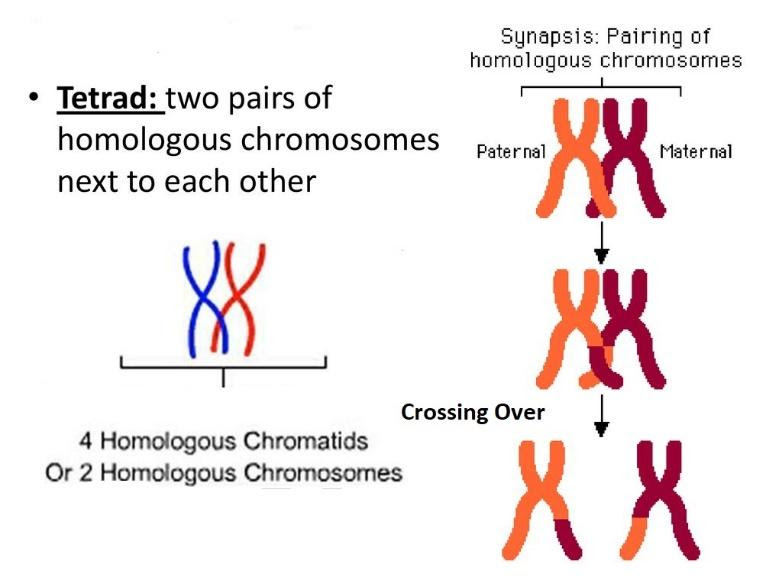
what is genetic recombination?
Formation of new combinations of alleles through the exchange or rearrangement of genetic material.
what is spindle fibres?
icrotubule structure that help move chromosomes during cell division.
what is disjunction?
Normal separation of homologous chromosomes or sister chromatids during cell division.
what is nondisjunction?
Failure of homologous chromosomes or sister chromatids to separate correctly, potentially producing cells with abnormal chromosome number.
what is meiosis?
Leads to the formation of 4 genetically different gametes (sperm and egg) that transmit genetic material from one generation to the next during sexual reproduction,
When a cell divides by meiosis, DNA replicates before division such as mitosis the undergoes successive divisions
Meiosis I: where the diploid cell divides into two haploid cells and the chromosomes number is halved
Meiosis II: where two cells each divide again, resulting in four haploid daughter
what is the end result of meiosis?
Each daughter has half (haploid) the original number of chromosomes that the parent cell had.
Results in daughter cells, or gametes in plants and animals are;
Egg cells (in ovaries) and the sperm cells (in testes) in animals
Pollen grains (in anthers) and egg cells (in ovules) in seed producing plants
Meiosis is also the process which genetic variation is introduced.
what is crossing over?
Chromosome line up in homologues pairs (one maternal and one paternal chromosome in each pair)
Arms of homologous chromosomes exchange genetic material.
Exchange of genetic material of homologous chromosomes during crossing over causes the mixing of paternal and maternal genes and the result is an increased number of combinations of genes which can be transmitted.

what is independent assortment?
Different pairs of alleles segregate independently of each other.
Example;
For parent with genotype Aa Bb, the allele inherited for Gene A is independent of the Allele inherited for gene B.
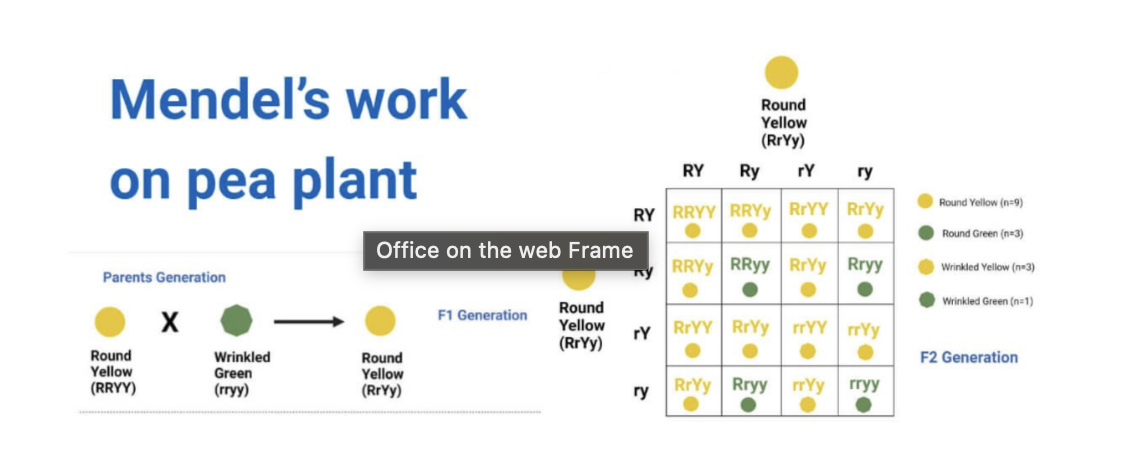
what is random segratation?
During meiosis, homologous chromosomes separate independently into different daughter cells, so different combinations of maternal and paternal chromosomes can end up in the gametes.

what are the two phases of meiosis responsible for in chromosomes behaviour?
meiosis 1
separation of homologous chromosoems
known as the reduction division
meiosis 2
separation of sister chromatids (equational divisions)
what is prophase 1 responsible for in chromosomal behaviour?
Homologous chromosomes pair up (called synapsis) forming bivalents.
Crossing over occurs between non-sister chromatids, exchanging genetic material and producing new allele combinations.
what is metaphase 1 responsible for in chromosomal behavior?
Homologous chromosomes pair align randomly along the equator of the cell.
Allows for independent assortment of maternal and paternal chromosomes.
what is anaphase 1 responsible for in chromosomal behavior?
Homologous chromosomes separate and move towards opposite poles, while sister chromatids remain attached at their centromeres.
what is telophase 1 responsible for in chromosomal behaviour?
Two haploid daughter cells form, each contain half the original chromosome number.
Chromosomes still consisting of two sister chromatids.
what is prophase 2 reponsible for in chromosomal behaviour?
Chromosomes condense and spindle fibres form in each haploid cell.
what is metaphase 2 reponsible for in chromosomal behaviour?
Individual chromosomes align along the equator of each cell.
what is anaphase 2 responsible for in chromosomal behaviour?
Sister chromatids separate at the centromere and move towards opposite poles, becoming individual chromosomes.
what is telophase 2 responsible for in chromosomal behaviour?
Nuclear membranes reform
what is the difference between meiosis 1 and 2?
Meiosis 1
Generation of genetic variation + reduction of chromosome number.
Separates homologues chromosomes.
Meiosis 2
Separation of sister chromatid to produce haploid cells.
What are nucleotides?
They are groups of;
Pentose Sugar
Phosphate Group
Nitrogenous Base
Adenine
Thymine
Guanine
Cytosine

what is DNA replication?
DNA replication is a process of copying a strand of DNA.
DNA can replicate itself exactly so identical copies of genes are made.
Possible by the double helix nature.
what are the steps of DNA replication?
DNA Double Helix unwinds
DNA is unzipped
Nucleotides are added to each strand.
New identical DNA molecule