Art Final
 Call Kai
 Learn
 Practice Test
 Spaced Repetition
 Match
 Flashcards
 Knowt Play
1/30

Earn XP
31 Terms
SPACE
The emptiness of area between, around, above, below, or within objects
Negative Space
The empty spaces between the shapes or form
Positive Space
The area your shape or form takes up
SHAPE
A 2 dimensional flat area that is defined someway
Geometric
Precise shapes that can be described using mathematical formulas
Freeform
Irregular and uneven shapes. Their outlines may be curved, angular, or a combination of both. Another way to describe free-form shapes is organic
Organic
Organic is used when we talk about shapes that are silhouettes of living things
FORM
3 Dimensional objects with L+W+H that have depth
Depth
The distance from the top of the surface to the bottom of the form
VALUE
The amount of lightness or darkness is in color
COLOR
An element of art that is derived from reflected light. The sense of color is aroused in the brain by response of the eyes to be different wavelengths
Color Spectrum
When light passes through a wedge shaped glass called a prism, the beam of white light is bent and separated into bands of color.
Primary
Red, Yellow, Blue, I can make all other colors by mixing different amounts of primary color.
Secondary
Orange, Purple, Green, I can mix 2 primary colors to make a secondary color
Tertiary
It is the color in between the primary and secondary colors on the color wheel
Hue
The name of the color on the color spectrum
Intensity
The lightness or dullness of a hue (how bright?)
Value
The amount of lightness or darkness in art.
Warm Colors
Red, Orange, Yellow, Red-orange, orange-yellow, yellow. All colors with red and orange tones are warm.
Cool Colors
Blue, Green, Purple, Violet, and all the colors with blue and green tones are cool.
Color Wheel Order
red, red-violet, violet, blue-violet, blue, blue-green, green, yellow-green, yellow, yellow-orange, orange, red-orange
Complimentary
Opposites on the color wheel. Example: red and green.
yellow and purple.
blue and orange.
red-orange and blue-green.
yellow-orange and blue-violet.
yellow-green and red-violet.
Monochromatic
One color, color scheme is made of one color and its shade and tints.
Achromatic
The lack of hue is considered neutral. (Black, White and Grey colors.)
Dominant Color
The main color in a composition
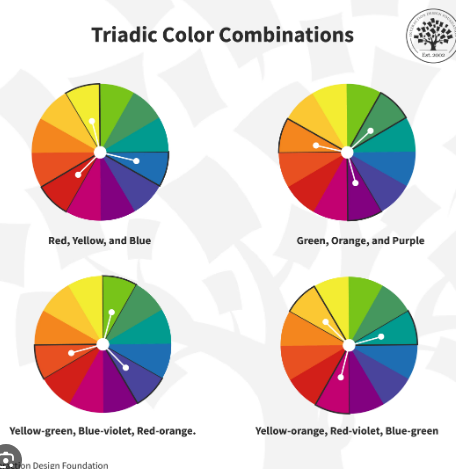
Color Triads
Three colors that are equal distance from each other on the color wheel. Example: Red, Yellow, and Blue. Green, Orange, Purple. Yellow-green, Blue-violet, Red-orange.
Neutrals
Hues that appear to be without color and doesn’t typically appear on color wheel. Used for mixing colors.
TINT
When we add white to a hue, we change it’s tint.
TONE
When we add grey to a hue we change it’s tone.
SHADE
When we add black to a hue, we change it’s shade
HIGHLIGHT
Small areas of white used to show the very brightest spots. Opposites of shadows.