Lecture 8- Anatomy and Physiology of Articulation and Resonation
 Call Kai
 Learn
 Practice Test
 Spaced Repetition
 Match
 Flashcards
 Knowt Play
1/30

There's no tags or description
Looks like no tags are added yet.
31 Terms
Appearance of Lips: What are the four parts of the lip and where are they?
Cupid’s bow, Columella nasi, Philtrum, Philtral column (or ridge)

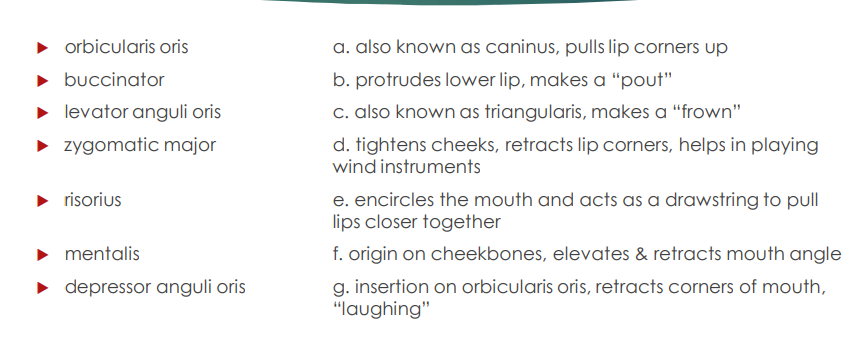
Orbicularis oris → E. Encircles the mouth; acts as a drawstring to pull lips closer together.
Buccinator → D. Tightens cheeks, retracts lip corners, helps with playing wind instruments.
Levator anguli oris → A. Also known as caninus; pulls lip corners up.
Zygomatic major → F. Origin on cheekbones; elevates and retracts mouth angle.
Risorius → G. Retracts corners of mouth ("laughing").
Mentalis → B. Protrudes lower lip; makes a "pout."
Depressor anguli oris → C. Also known as triangularis; makes a "frown."

Tongue: Where is it? What can it be divided into?What is it involved in?
The tongue occupies the floor of the mouth, is divided into dorsum (back, upper surface), apex (tip), and base.
It is involved in speaking, chewing, and swallowing

Tongue: Lingual Frenulum?
joins the inferior tongue and the mandible

Tongue: Sublingual Folds?
transverse bands of tissue on either side of the tongue - for sublingual salivary glands

Tongue Muscles: Intrinsic vs Exrinsic
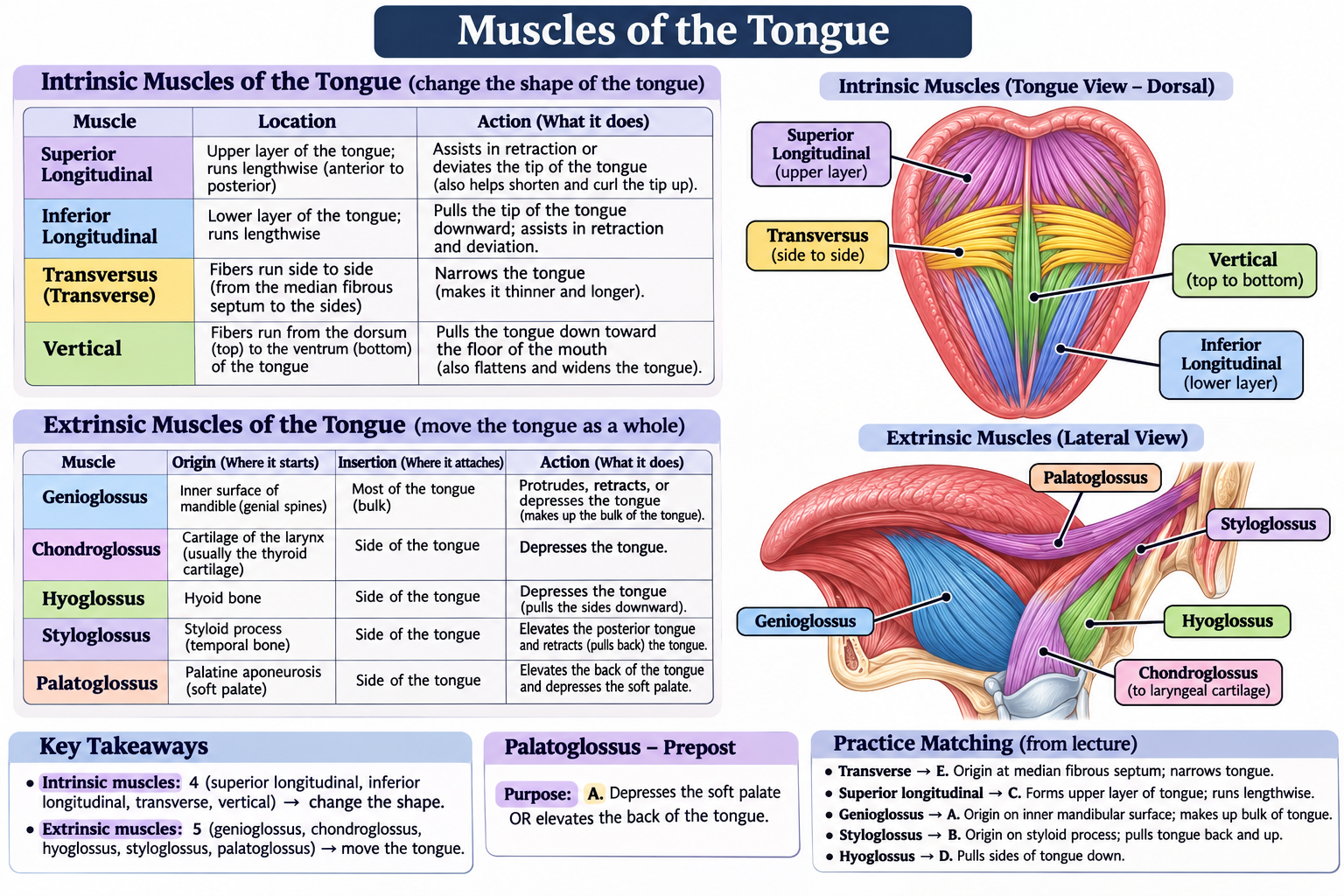
Intrinsic : Provide precise articulatory movements
Extrinsic: Move tongue in general region desired: larger adjustments of tongue movement
Tongue Muscles: Intrinsic muscles? (Four of them)
Superior longitudinal
Inferior longitudinal
Transversus
Vertical

Intrinsic Muscles of the Tongue: Superior Longitudinal Muscle?Where is it and what does it do
assists in retraction or deviates the tip of the tongue

Intrinsic Muscles of the Tongue: Inferior Longitudinal Muscle: Where does it do?
pulls tip of the tongue downward, assists in retraction and deviates the tongue

Intrinsic Muscles of the Tongue: Transversus Muscles: What does it do?
narrows the tongue

Intrinsic Muscles of the Tongue: Vertical Muscles: Where is it, what does it do?
pulls the tongue down into the floor of the mouth

Larger adjustments of lingual movement are completed through the use of ____ muscles.
Larger adjustments of lingual movement are completed through the use of extrinsic muscles.
Name five extrinsic tongue muscles.
genioglossus
chondroglossus
hyoglossus
styloglossus
palatoglossus

Name what the five extrinsic tongue muscles (genioglossus
chondroglossus
hyoglossus
styloglossus
palatoglossus) do
The genioglossus retracts, protrudes, or depresses the tongue
The hyoglossus and chondroglossus depress the tongue
The styloglossus and palatoglossus elevate the posterior tongue

Prepost: What are the purposes of the palatoglossus muscle?
A. Depresses the soft palate OR elevates the back of the tongue.

Pre post
Transverse → E. Origin at median fibrous septum; narrows tongue.
Superior longitudinal → C. Forms upper layer of tongue; runs lengthwise.
Genioglossus → A. Origin on inner mandibular surface; makes up bulk of tongue.
Styloglossus → B. Origin on styloid process; pulls tongue back and up.
Hyoglossus → D. Pulls sides of tongue down.

Muscles of Mastication: What is mastication?
the process of chewing food
Mandibular (mandible) Elevators and Depressors: Mandibular Elevators
Masseter
Temporalis
Pterygoids
Mandibular (mandible) Elevators and Depressors: Mandibular Depressors
Digastricus
Mylohyoid
Geniohyoid
Platysma


pre post 67
Lateral pterygoid → C. Protrudes mandible.
Digastricus → D. Has anterior and posterior bellies that depress the mandible.
Masseter → B. The muscle that bulges when you clench your teeth.
Temporalis → A. Origin over a broad area of temporal and parietal bones.

Muscles of the Velum: During most speaking time and swallowing, the velum (soft palate) is actively ____
During most speaking time and swallowing, the velum (soft palate) is actively elevated(shut)
Muscles of the Velum: Only ___ nasal speech sounds in English require the velum to be depressed (lowered)
Only 3 nasal speech sounds in English require the velum to be depressed (lowered)
Muscles of the Velum: Name them and whether or not they elevate or depress
Levator veli palatini (elevator)
Musculus uvulae (elevator)
Palatoglossus (depressor)
Palatopharyngeus (depressor)
Tensor veli palatini (a Eustachian tube dilator)

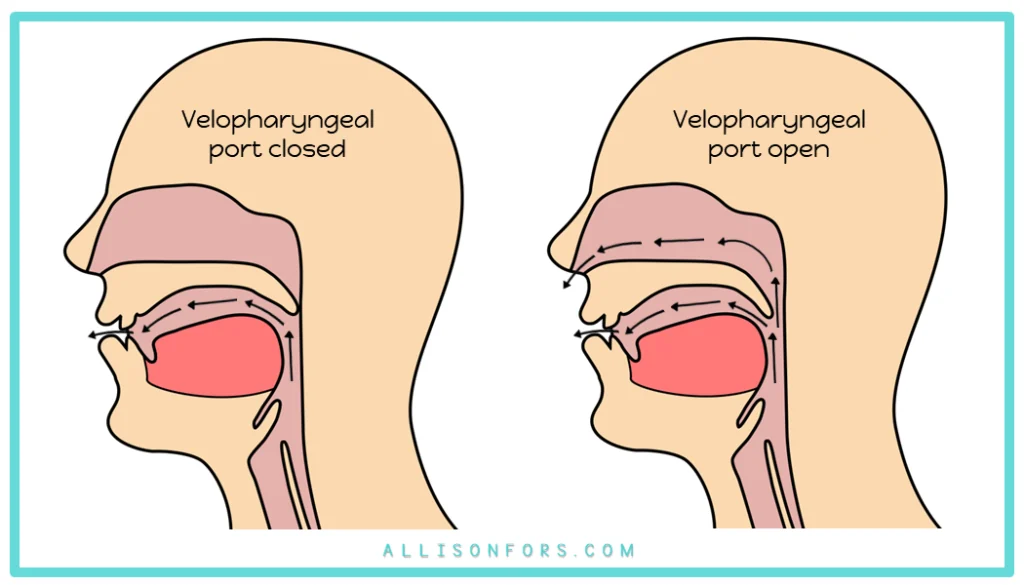
Movement of the Velum: Velopharyngeal port remains ___ most of the time to allow nasal breathing and for nasal consonants
Must ____for production of oral speech sounds Velopharyngeal closure is achieved when the velum raises to the pharyngeal walls
Velopharyngeal port remains open most of the time to allow nasal breathing and for nasal consonants
Must close for production of oral speech sounds Velopharyngeal closure is achieved when the velum raises to the pharyngeal walls

Musculus uvulae → B. Shortens soft palate.
Levator veli palatini → A. Elevates soft palate.
Palatoglossus → C. Forms anterior faucial pillar; actively depresses soft palate.
Palatopharyngeus → D. Forms posterior faucial pillar; narrows pharynx.

Pre-post question: Which muscle is responsible for “popping” the ear open?
Tensor veli palatini


Orbicularis oris → D. Encircles the mouth; acts as a drawstring to pull lips closer together.
Buccinator → G. Tightens cheeks, retracts lip corners, helps in playing wind instruments.
Levator anguli oris → A. Also known as caninus; pulls lip corners up.
Zygomatic major → E. Origin on cheekbones; elevates and retracts mouth angle.
Risorius → F. Retracts corners of mouth ("laughing").
Mentalis → C. Protrudes lower lip; makes a "pout."
Depressor anguli oris → B. Also known as triangularis; makes a "frown."
What are the purposes of the palatoglossus muscle?
B. Depresses the soft palate OR elevates the back of the tongue.
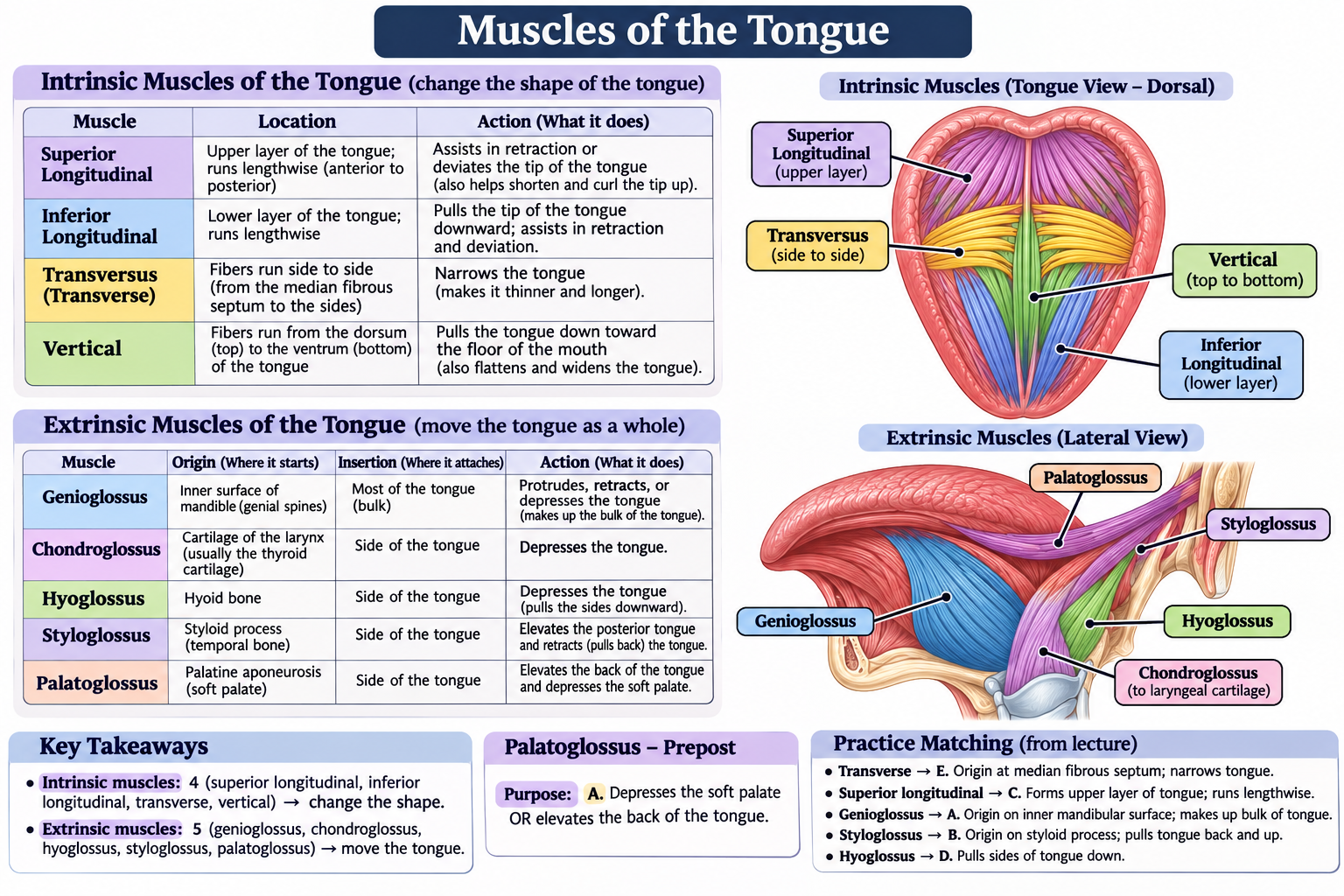

Transverse → A. Origin at median fibrous septum; narrows tongue.
Superior longitudinal → C. Forms upper layer of tongue; runs lengthwise.
Genioglossus → B. Origin on inner mandibular surface; makes up bulk of tongue.
Styloglossus → E. Origin on styloid process; pulls tongue back and up.
Hyoglossus → D. Pulls sides of tongue down.

Lateral pterygoid → A. Protrudes mandible.
Digastricus → D. Has anterior and posterior bellies which depress the mandible.
Masseter → B. The muscle that bulges when you clench your teeth.
Temporalis → C. Origin over a broad area of temporal and parietal bones.